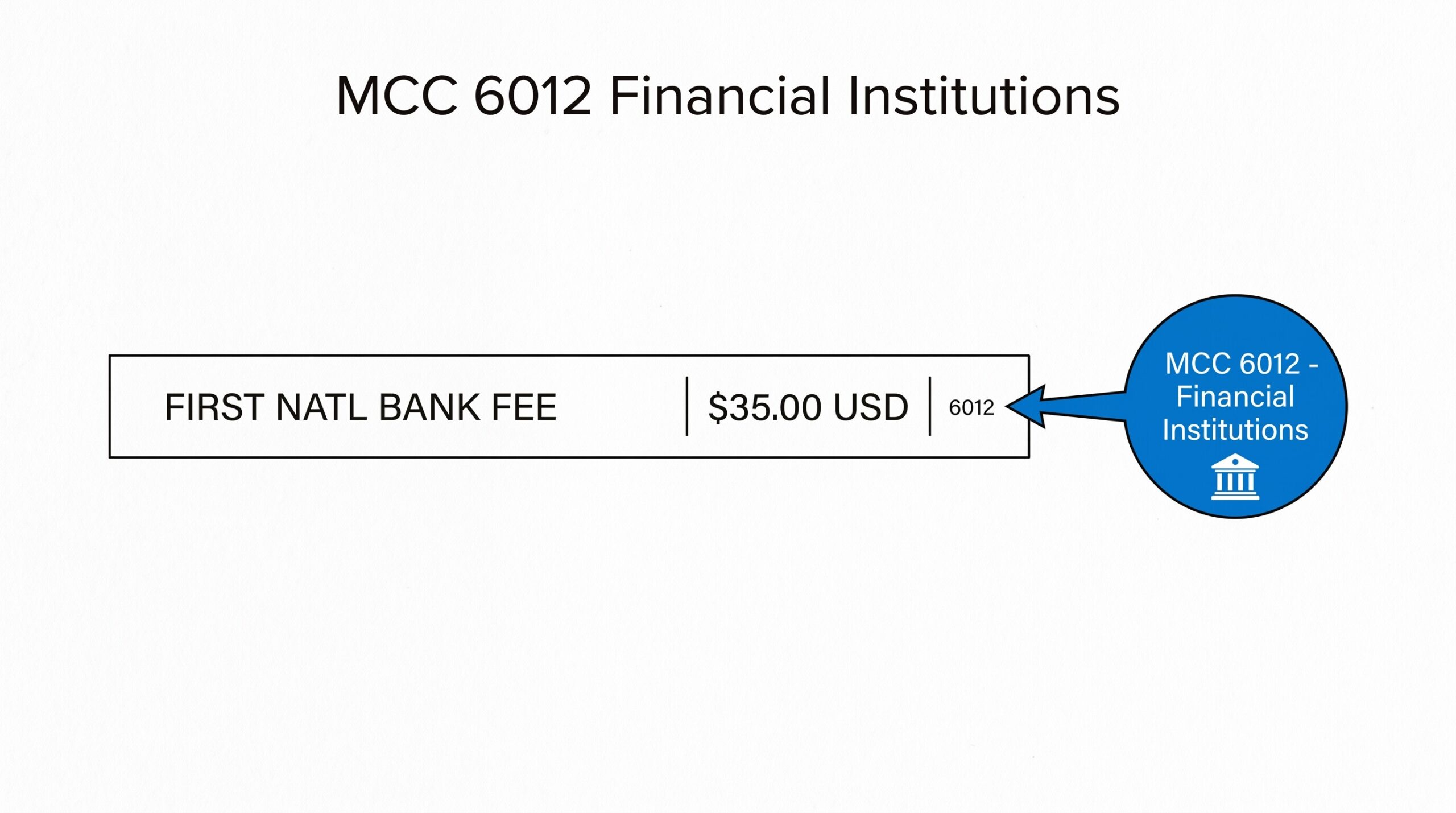

You open your credit card statement and see a $35 charge from “FIRST NATL BANK FEE” with the code 6012 next to it. The same statement has a separate $50 charge from “WIRE TRANSFER FEE” that also shows 6012, and a $12 charge from a cryptocurrency exchange that shows 6051.
You are trying to reconcile these for your business books, and the codes look almost identical but they aren’t the same thing, and the IRS treats them very differently. That little 4-digit number is doing more classification work than you realized.
MCC 6012 is the Merchant Category Code that Visa, Mastercard, American Express, and Discover assign to financial institutions.
Specifically, the official ISO 18245 description is “Financial Institutions: Merchandise, Services, and Debt Repayment.” That wording matters, because 6012 is not just “any bank charge” but a particular subset of charges that fall under the financial services umbrella,
The 6012 code sits within a larger family of financial service codes. For the full landscape of merchant classification, the complete MCC code list provides reference for 50+ commonly searched codes. Other financial service codes worth knowing about include MCC 6011 ATM and the dedicated MCC 4900 utilities reference, both of which often appear alongside 6012 on personal and business statements.
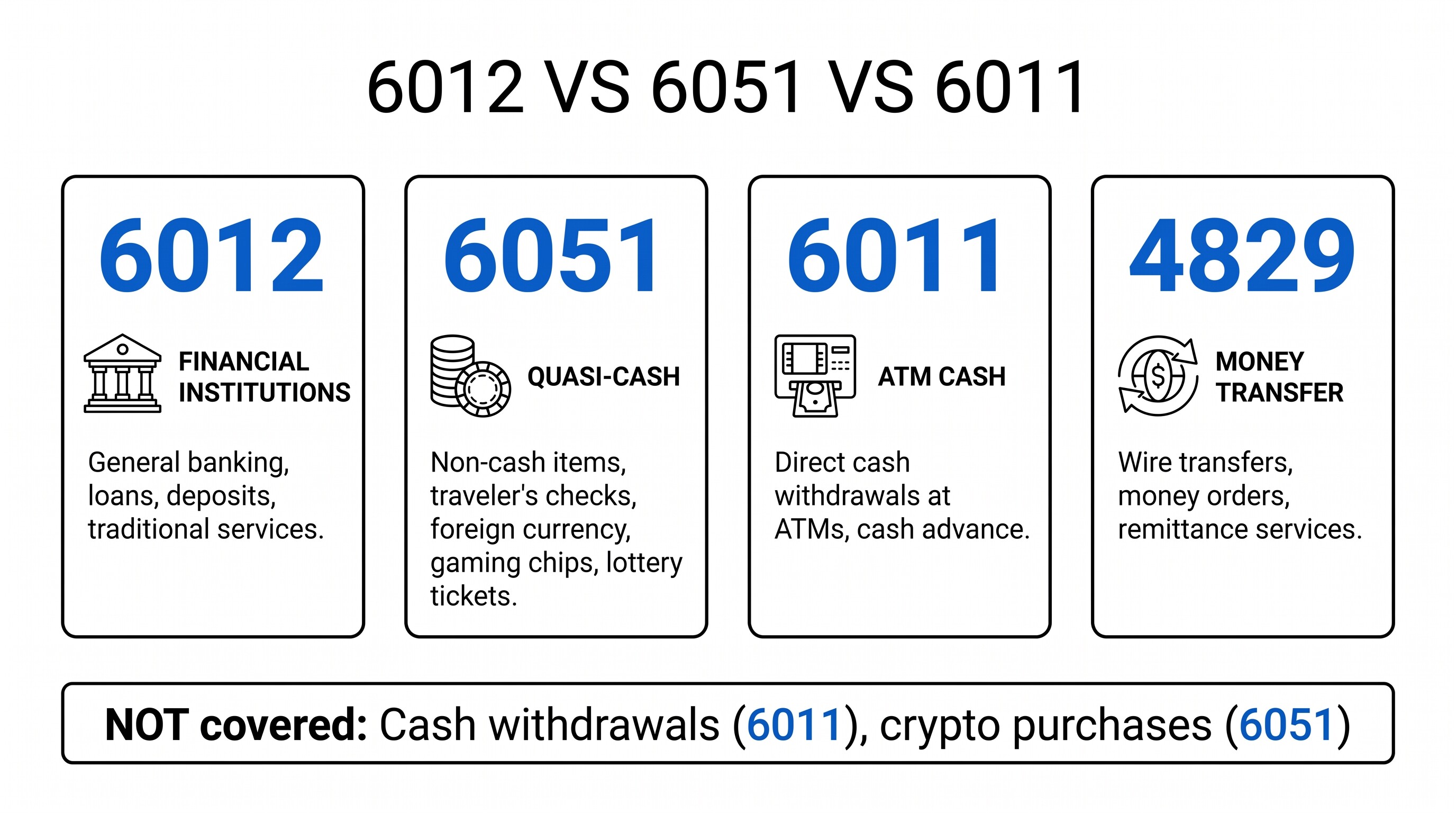
Quick Answers: MCC 6012 is the ISO 18245 code for financial institutions (merchandise, services, and debt repayment). It typically covers bank service fees, wire transfer fees, foreign currency exchange at a bank, and financial product purchases. It does not cover ATM cash withdrawals (6011), cryptocurrency purchases (6051), or money transfer services like Western Union (4829).
What MCC 6012 Covers
The 6012 classification applies to charges that originate from a regulated financial institution, typically a bank, credit union, or licensed finance company, when the charge represents a service fee, a debt repayment, or a financial product purchase rather than a cash withdrawal or money transfer.
The acquirer (the merchant’s payment processor) reports this MCC to the card network, and the network passes it along to your statement.
Common charges that typically appear as 6012 include:
- Monthly bank account maintenance fees charged to a credit card
- Wire transfer initiation fees (both domestic and international)
- Foreign currency conversion fees when purchased through a bank
- Overdraft fees (when charged to a credit card through a cash advance structure)
- Loan origination fees charged to a credit card
- Safe deposit box rental fees paid by credit card
- Stop payment fees
- Cashier’s check fees paid by credit card
- Returned deposit fees
- Investment account maintenance fees
- Brokerage account fees when paid through a bank
- Insurance premiums paid through a financial institution
The classification depends on how the financial institution registered with its acquirer and what kind of product or service the charge represents. A bank that processes a wire transfer will typically code that fee as 6012. The same bank’s ATM cash withdrawal, processed through a different system, will show as 6011 instead.
A cryptocurrency exchange that holds funds at a bank but sells crypto to customers will often code those crypto purchases as 6051, not 6012, because the exchange itself is not a financial institution in the card network’s classification system.
The Difference Between 6012 and 6051
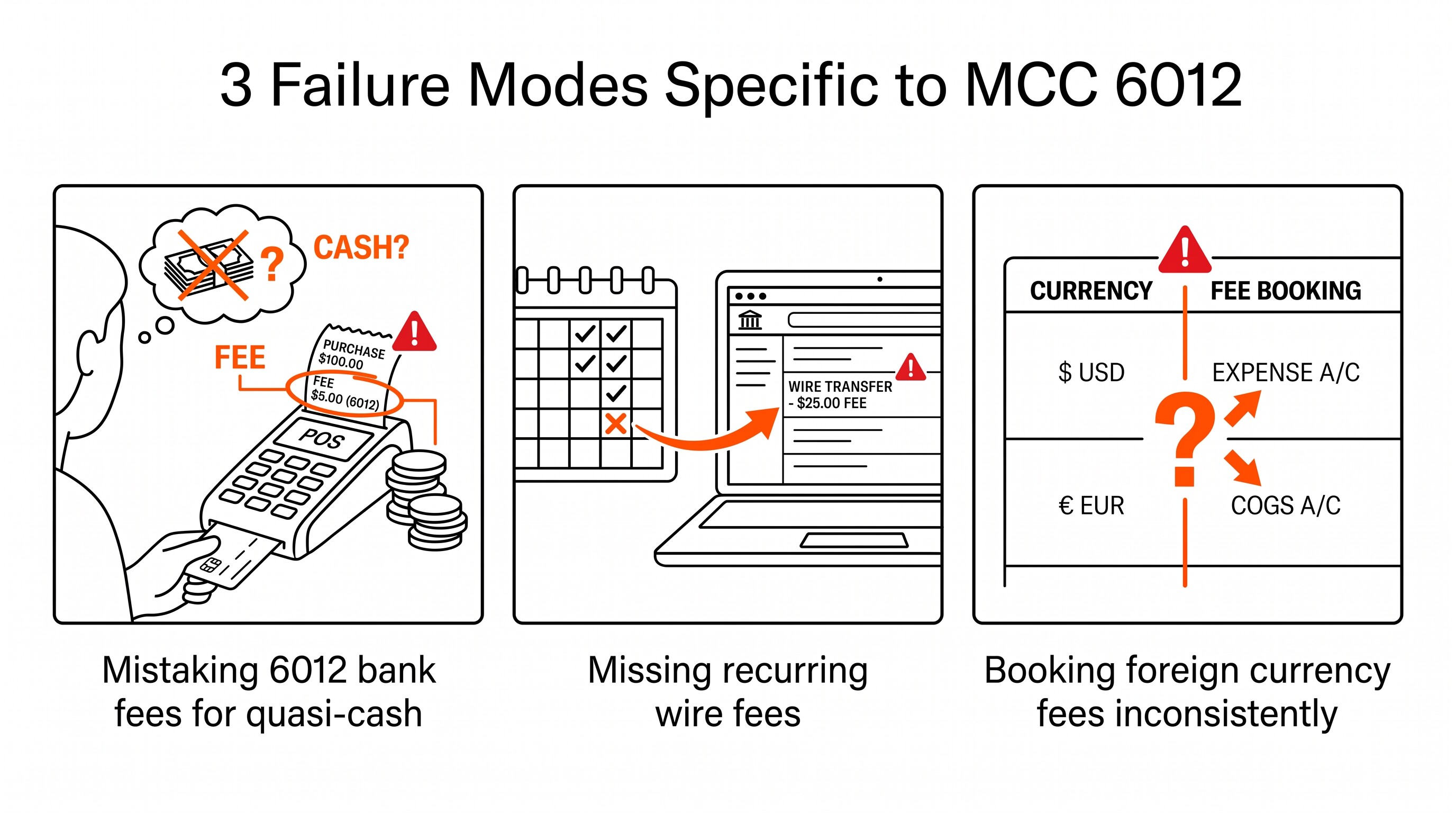
This is the distinction that trips up more people than any other in the financial services MCC family. 6012 is for legitimate financial institution charges. 6051 is for “quasi-cash,” which the card networks define as items that are essentially equivalent to cash, including cryptocurrency, foreign currency, money orders, travelers checks, casino gaming chips, and similar instruments.
The reason the distinction matters is that some card issuers treat quasi-cash purchases differently for credit limits, cash advance fees, and rewards earning.
For example, if you buy $500 of bitcoin on Coinbase with your credit card, that charge will typically appear as 6051 (quasi-cash). The card network classifies it that way because bitcoin, like cash, can be used for transactions that the card network cannot monitor.
The card issuer may charge a cash advance fee on a 6051 transaction, may apply a different (lower) credit limit, and may not earn purchase rewards. The full breakdown of how 6051 is treated by the card networks is in our MCC 6051 quasi-cash guide.
If you wire $2,000 from your bank account to a relative abroad through your bank’s wire service, and the bank charges you a $35 wire fee paid by credit card, that $35 fee will typically appear as 6012 (financial institution) because the bank is the merchant and the charge is a service fee.
The actual $2,000 wire transfer itself is a separate transaction that doesn’t go through the card network at all. Only the fee shows up on your credit card statement, and the fee is 6012.
For a broader view of how MCC codes appear on statements, the MCC overview for credit card statements covers the framework these distinctions sit inside.
Turn any PDF statement into a clean sheet
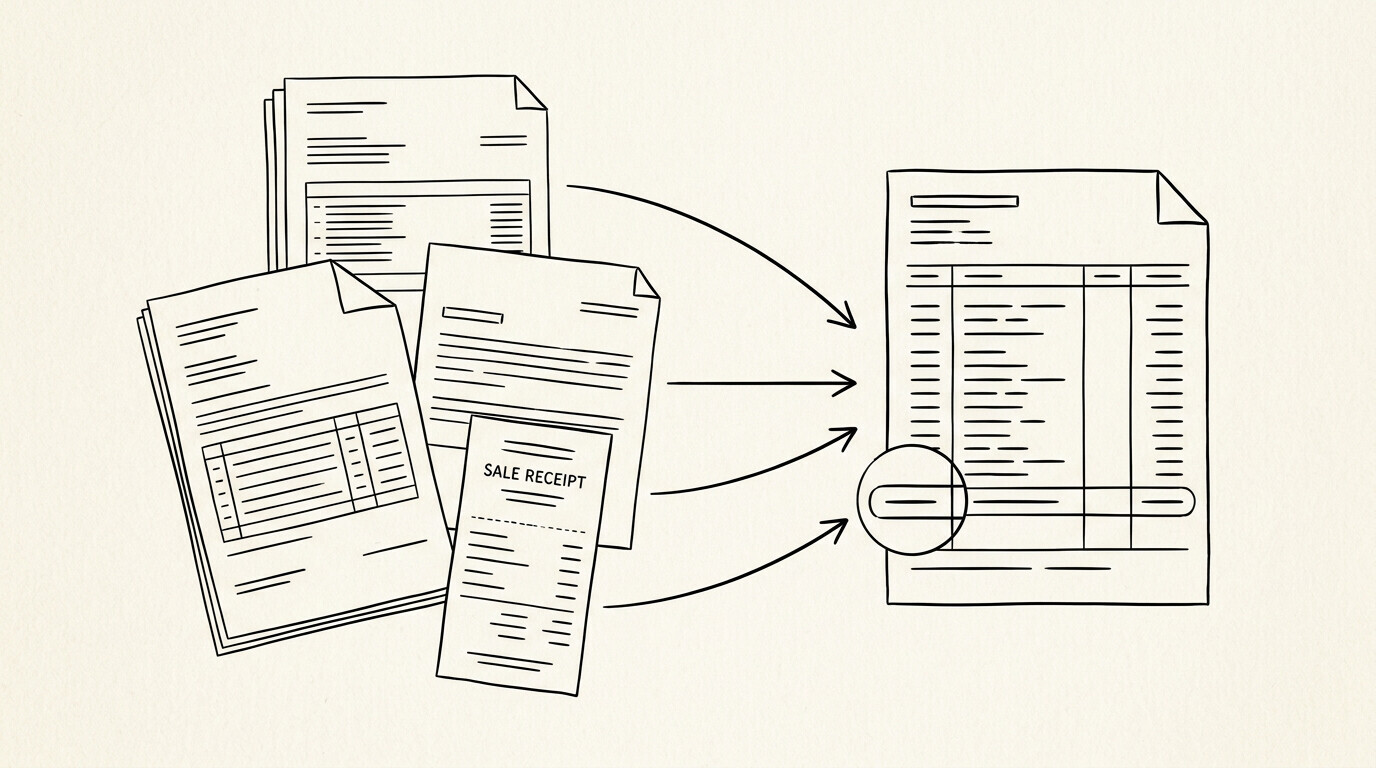
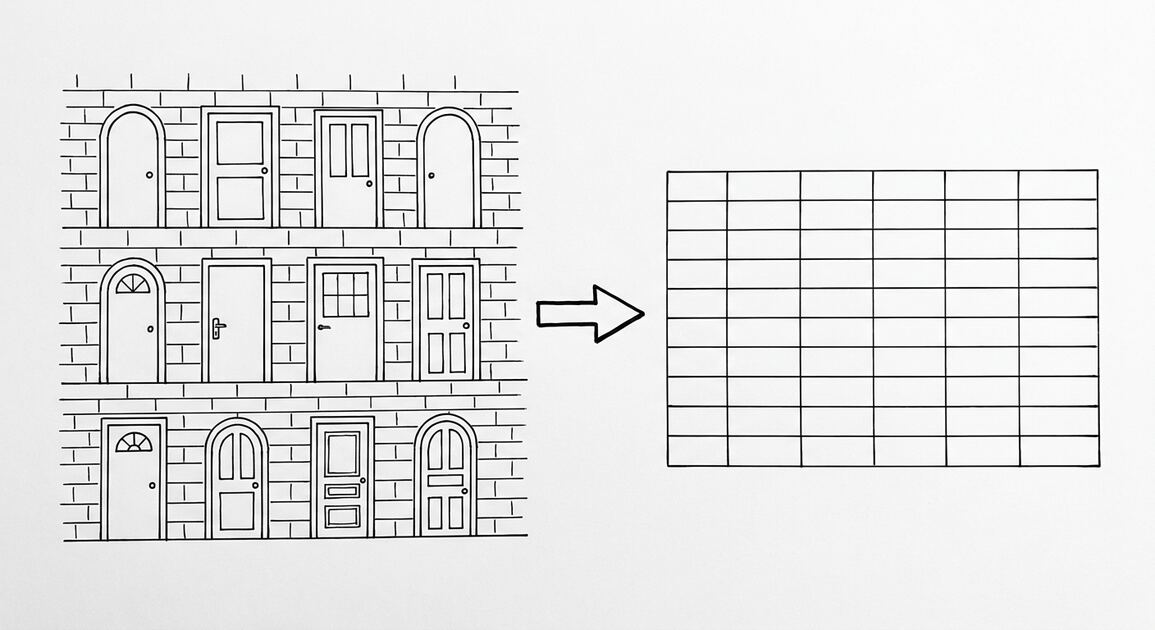
Skip the typos and the hours of copying. Our converter handles any bank statement format and outputs Excel, CSV, or QBO for QuickBooks. No file retention, free to try.
Convert your statementHow MCC 6012 Is Treated for IRS Schedule C
For self-employed individuals filing Schedule C, 6012 charges typically fall into one of three categories. The right category depends on what the charge was for, not what the MCC alone suggests.
Bank service fees (Line 22, Supplies, or Line 27a, Other Expenses) cover monthly account fees, wire fees, stop payment fees, and similar charges that the business incurs in the course of operating its bank account. These are generally 100% deductible as ordinary business expenses.
Interest and finance charges (Schedule B, then Line 17) apply when the 6012 charge represents loan interest, credit card interest, or other financing costs. These are reported separately from operating expenses and have their own Schedule B treatment for businesses.
Foreign currency conversion fees may book to different categories depending on the business’s policy. Some businesses book them to Office Expenses (Line 18), others to Travel (Line 24a), and others to Other Expenses (Line 27a). The IRS does not specify a category, so a consistent internal policy matters more than the technical right answer.
For businesses operating internationally, the business bank statement with categorization workflow covers how to apply consistent categorization across mixed currency charges. The distinction between 6012 financial institution fees and 6051 quasi-cash becomes especially important when reconciling these statements for tax filing.
For broader IRS recordkeeping guidance on bank statement transactions, the IRS Publication 552 recordkeeping guide provides context that applies across multiple MCC codes including 6012.
The IRS does not publish a mapping of MCC codes to Schedule C line items, and banks sometimes classify the same charge under different MCCs depending on how they registered. For businesses with significant 6012 charges (active international vendors, frequent wire transfers), working with a bookkeeper or CPA to apply consistent categorization is often worthwhile.
The 5 Most Common 6012 Transaction Patterns
Across personal and business credit card statements, 6012 charges appear in five common patterns. Recognizing the pattern helps determine how to categorize the charge in your records.
Bank service fees paid by credit card. Some businesses pay their monthly bank fees by credit card for cash flow or rewards reasons. These show up as 6012 with the bank name as merchant. The fee is typically $10-50 per month and posts on a recurring schedule.
Wire transfer initiation fees. Banks charge $15-50 per wire when you initiate a transfer from your bank account but pay the fee by credit card. The $2,000 wire itself doesn’t appear on your credit card statement (it’s a separate bank transaction), but the $35 fee shows as 6012.
Foreign currency conversion fees at a bank. When you exchange currency at a bank branch (rather than at an airport kiosk), the conversion fee typically appears as 6012 if you paid by credit card. The conversion itself is a separate transaction.
Investment account fees. Brokerage accounts sometimes charge asset-based fees or transaction fees that, when paid by credit card, appear as 6012. These fees are typically small but recurring, and they often get overlooked in personal finance tracking.
Loan service charges. When a financial institution charges a loan origination fee, document preparation fee, or annual fee, and you pay by credit card, that charge typically appears as 6012. Personal loans, mortgages, and business lines of credit may all generate these charges.
How MCC 6012 Affects Credit Card Rewards
MCC 6012 typically does not earn bonus rewards on most credit card rewards programs. The charges are usually small dollar amounts and infrequent, so card issuers have not built bonus categories around them.
The exception is some business credit cards that waive foreign transaction fees or include wire transfer fees as covered expenses, but even those typically treat the fees as statement credits rather than rewards points.
For personal cards, 6012 charges typically earn the base 1 point per dollar. If you pay a $35 wire fee by credit card, you earn 35 points, which is essentially negligible. The main reason to pay these fees by credit card is to consolidate the charges in one place for tracking purposes, not for rewards optimization.
Some cards also apply a foreign transaction fee (typically 3%) to charges made in foreign currencies. If your 6012 charge is denominated in a foreign currency (rare but possible), the foreign transaction fee may apply on top of the original charge. The fee appears as a separate charge on the statement rather than being embedded in the original 6012 amount.
What Most MCC References Miss About 6012
Most MCC reference pages treat 6012 as a catch-all “bank fees” code without explaining the regulatory structure behind it. The classification is tied to the bank’s status as a regulated financial institution under the Bank Secrecy Act and other federal regulations, which is why banks get a specific code rather than being lumped under a generic services category.
A 6012 charge carries more regulatory weight behind it than a typical merchant charge, even though the dollar amount is often smaller.
The other thing most references miss is that 6012 applies to debt repayment charges, not just service fees. When you pay a loan by credit card and the lender charges a convenience fee, that fee typically appears as 6012 because the lender is a regulated financial institution.
The fee itself is a service charge, but the underlying transaction is debt repayment, which is what the ISO 18245 description calls out specifically.
For developers building tools that parse these fields, the bank statement API for developers covers how 6012 appears in different parsing libraries and the typical field naming conventions used by major banks.
When 6012 Differs from Related Codes
Three codes get confused with 6012 often enough that the distinction matters for both expense categorization and IRS treatment.
MCC 6011 (Automated Cash Disbursement) covers ATM cash withdrawals and the fees charged for them. When you withdraw $200 from an ATM, the $200 cash and the $3 ATM fee both typically appear as 6011, not 6012.
The full treatment of ATM charges on credit card statements is in our MCC 6011 ATM cash guide , which covers the distinction between 6011 and 6051 in detail.
MCC 4829 (Money Transfer Services) covers non-bank money transfer businesses like Western Union, MoneyGram, and some peer-to-peer payment apps. If you send $500 to a family member through Western Union and pay the $15 fee by credit card, the fee typically appears as 4829, not 6012.
The distinction matters because money transfer services are not classified as financial institutions by the card networks even though they perform similar functions.
MCC 6051 (Quasi-Cash) covers cryptocurrency purchases, foreign currency purchases at non-bank locations, money orders, and similar instruments. If you buy $1,000 of bitcoin through Coinbase by credit card, that charge will appear as 6051, not 6012, because Coinbase is classified as a quasi-cash merchant rather than a financial institution.
This distinction determines whether the card network treats the charge as a purchase or a cash advance.
For tracking these charges on monthly statements, the bank transaction categorization workflow covers how to apply the 6012 vs 6051 vs 6011 distinction consistently across all financial service charges in a given month.
If you see recurring service charges from your bank that you have not been tracking, recognizing them as 6012 is the first step toward accurate expense categorization.
The MCC is doing more work than the merchant name alone would suggest, and that 4-digit code is often the difference between a charge that books to Supplies on Schedule C and one that the IRS treats as a separate financial category.
For developers building tools that read these fields from statement PDFs, the bank statement API for developers covers how 6012 appears in different parsing libraries and which fields typically carry the MCC code through the parsing pipeline.
See also
For the broader financial service MCC family, see the common MCC codes reference. For tracking all financial service charges across a month, the bank transaction categorization workflow covers how to apply consistent categorization rules.
See also: MCC 6012 in context
This explainer is one of the merchant category code guides on the site. The consolidated overview of the entire MCC system, including every US card-network overlay, lives in the complete MCC guide. The full code-by-code reference is the complete MCC code reference.
For the broader reading on what every column on a US bank statement means, including the merchant description column where MCC appears, see the expanded bank statement anatomy.
Output format: which one matches the destination?
Picking the right output format is a separate decision from picking the right converter.
XLSX for human spreadsheet review. CSV for downstream scripts and tools. Google Sheets-compatible for shared cloud review. QBO for QuickBooks.
The four canonical columns are preserved across every format. What differs is how the downstream consumer expects the rows.
For a side-by-side rule of thumb that maps destination to format, see the decision framework on the output format pillar.
Read the full output format decision framework
From Bank Statement to QuickBooks-Ready File
That manual cleanup you just read about? This tool skips it. Turn your PDF into QBO for QuickBooks without storing your data anywhere.
Start Converting