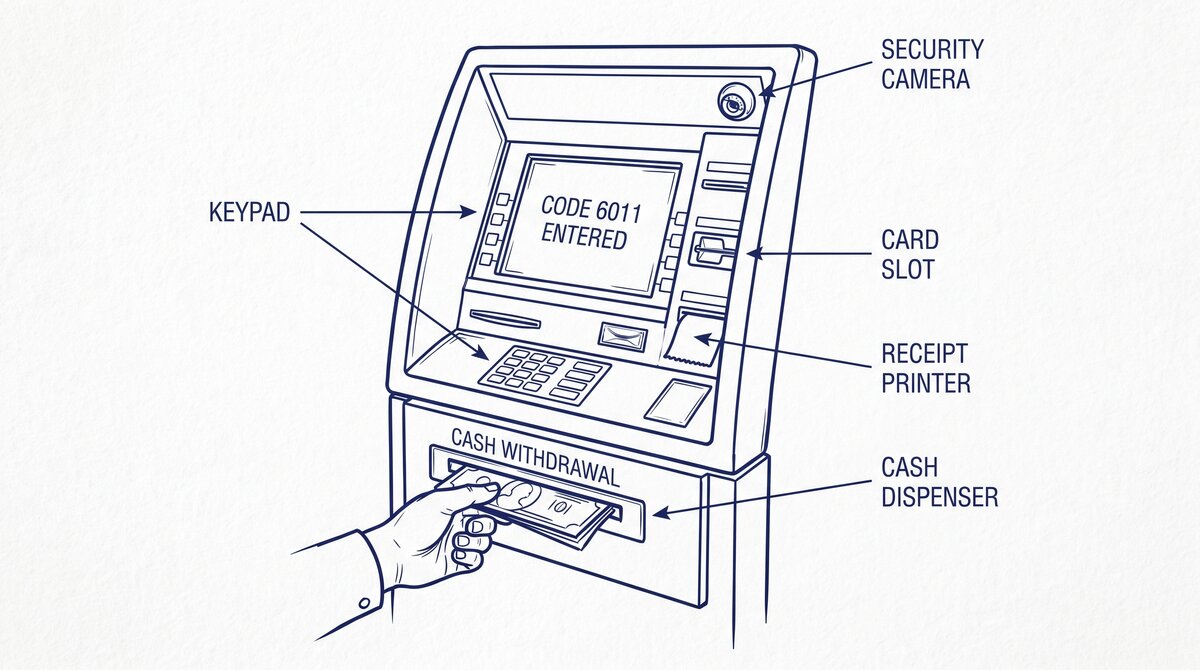

MCC 6011 is the Merchant Category Code for financial institution automated cash disbursements, primarily ATM cash withdrawals. The code is assigned to ATM operators and to banks when they dispense cash through a card transaction. The code is distinct from 6051 (quasi-cash) and has a specific IRS treatment: ATM cash withdrawals are not deductible business expenses by themselves; the underlying expense is what counts.
What MCC 6011 Covers
MCC 6011 is the financial institution automated cash disbursement code. It covers transactions where cash is dispensed through a card-based system, typically at an ATM.
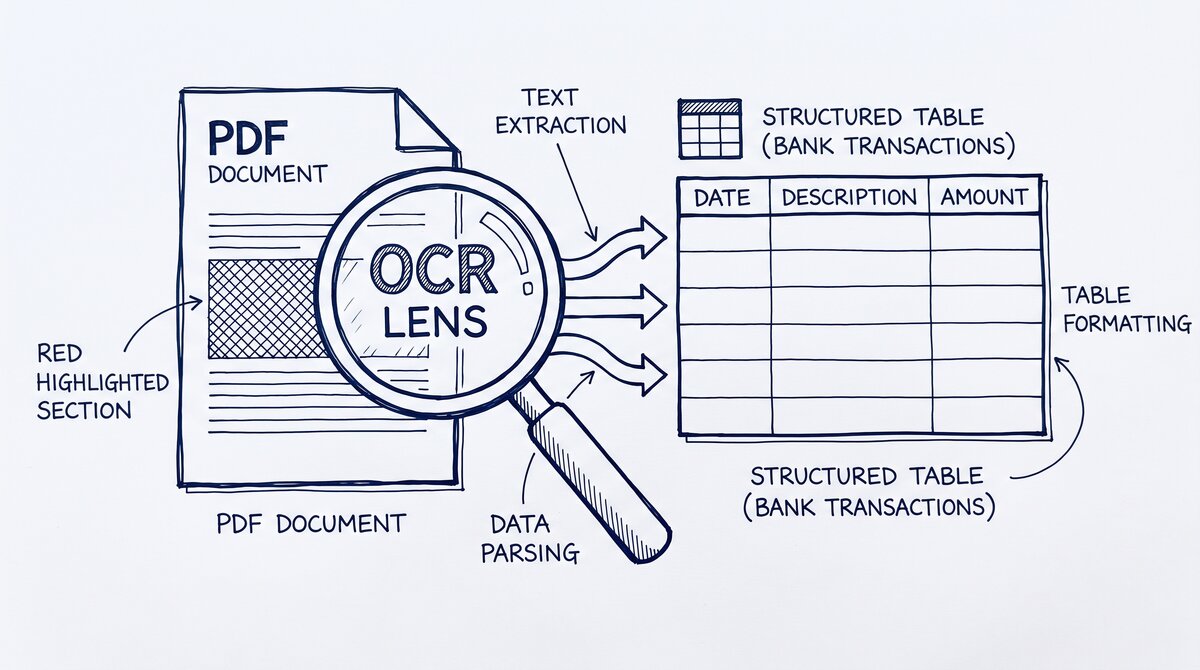
What most guides miss about credit card statements is that the quality depends on the mechanism, not on the tool. Two tools that look different on the surface often run the same 4-step process underneath: read, find, parse, verify. The difference is in how well each step handles edge cases (merged cells, missing balances, non-standard date formats, scanned vs digital input).
Choosing between tools based on UI alone misses the actual quality lever.
Included Transactions
- Bank ATM withdrawals: withdrawals from the cardholder’s bank ATM network
- Non-bank ATM withdrawals: withdrawals from third-party ATMs (convenience store, gas station, mall)
- Bank teller cash disbursements: some bank teller transactions coded as cash disbursement rather than a generic withdrawal
- Cash back at point of sale: some point-of-sale cash back transactions are coded 6011
- International ATM withdrawals: ATM withdrawals in a foreign country, often with currency conversion
Excluded Transactions
- Purchases with a debit card: standard merchant purchases, coded by the merchant’s MCC
- Quasi-cash transactions: separate code (6051) for money orders, crypto, travelers checks
- Bank fees: bank fees (monthly maintenance, overdraft) may be coded 6011 or 4829 (government services) depending on the bank
- Wire transfers and ACH: separate codes, not 6011
The merchant (ATM operator or bank) determines the MCC. Most bank ATMs are coded 6011 by the issuing bank. Some non-bank ATM operators are coded 6011, others may be coded differently.
The Difference Between 6011 and 6051
The 6011 and 6051 codes are both financial transaction codes, but they cover different types of transactions. The distinction matters for tax treatment and for fraud monitoring.
6011: Financial Institution Automated Cash Disbursements
Real cash dispensed through an ATM or bank teller. The cardholder receives physical cash that can be used for any purpose.
6051: Quasi-Cash
Cash-equivalent instruments: money orders, travelers checks, casino chips, cryptocurrency purchases. The cardholder does not receive physical cash; the cardholder receives an instrument that can be converted to cash or used like cash.
The Practical Test
If the cardholder walks away from the transaction with physical cash, the MCC is 6011. If the cardholder walks away with a money order, casino chips, or crypto, the MCC is 6051.
For example, a $500 ATM withdrawal is 6011. A $500 money order purchase is 6051. A $500 Bitcoin purchase at a Bitcoin ATM is 6051 (quasi-cash, even though it is a physical ATM transaction). A $500 cash advance from a credit card at a bank teller is 6011.
From PDF to Excel in one click
Forget retyping line by line. Upload any bank statement, get a spreadsheet you can actually use. Your files are never stored, and you can test the converter with 3 free conversions.
Try it freeHow MCC 6011 Is Treated for IRS Schedule C
For self-employed individuals and small business owners, 6011 charges have a specific IRS treatment that is different from a regular purchase.
The General Rule
ATM cash withdrawals are not deductible business expenses by themselves. The IRS requires the cardholder to document the business use of the cash. The cash withdrawal is a method of obtaining cash, not an expense.
The 4 Documentation Requirements
To claim a 6011 charge as a business expense, the cardholder must document:
The amount of the cash withdrawal: the 6011 charge shows the amount, date, and ATM location.
The business purpose of the cash: what the cash was used for (e.g., business meal, client gift, office supply purchase from a cash-only vendor).
The receipts for the underlying expense: the actual receipt from the merchant where the cash was spent.
The reconciliation of the cash: the difference between the cash withdrawn and the documented business expenses is treated as personal use (not deductible).
For example, a self-employed consultant withdraws $200 from an ATM on Monday. The cash is used for: $80 client lunch (with receipt), $50 office supplies from a cash-only vendor (with receipt), $70 personal use (groceries, no business connection). The deductible amount is $130 ($80 + $50). The remaining $70 is treated as personal.
Why the IRS Treats ATM Withdrawals This Way
The IRS requires the underlying expense to be documented, not the cash withdrawal, to prevent abuse. Without the documentation requirement, a cardholder could withdraw cash for personal use and claim it as a business expense. The receipt requirement provides the evidence.
The Practical Approach
Most small business owners do not document ATM withdrawals in detail. They either:
- Use a business debit card or business credit card for all business expenses, avoiding ATM withdrawals for business use
- Use accounting software to tag 6011 charges and reconcile them with receipts monthly
- Accept that ATM-based business expenses may not be fully deductible and minimize ATM use for business
The approach depends on the volume and discipline of the business owner. A high-volume business with strict expense tracking may use 6011 charges extensively; a low-volume business owner typically avoids them.
The 4 ATM Transaction Patterns
The most common 6011 charges on a credit card statement:
1. Bank ATM Withdrawal (Same Bank)
A withdrawal from the cardholder’s own bank’s ATM. Typically no fee. The MCC is 6011. The amount is the cash withdrawal.
2. Non-Bank ATM Withdrawal (Out of Network)
A withdrawal from a non-bank ATM (convenience store, gas station, mall). Typically $2-$5 fee plus a percentage fee from the cardholder’s bank. The MCC is 6011. The amount may be the net amount (after fee) or the gross amount (before fee), depending on the ATM operator.
3. International ATM Withdrawal
A withdrawal from a foreign ATM. The MCC is 6011. The amount is in the foreign currency, with the USD equivalent shown on the statement. Foreign transaction fees (1-3%) and ATM fees ($2-$5) are common.
4. Cash Advance from Credit Card
A cash advance from a credit card at a bank teller or ATM. The MCC is 6011. The amount is the cash advance. Cash advances typically have higher interest rates than purchases, no grace period, and a cash advance fee (3-5% of the amount). Cash advances are generally not deductible as business expenses.
A common failure mode bookkeepers report is treating this as a single operation rather than a chain of dependent steps. The temptation is to find a tool that ‘just works’ and stop investigating the mechanism.
The result is a wrong-fix cycle: the tool gives partial output, the bookkeeper spends 30+ minutes troubleshooting, the fix is for the wrong step, and the same error recurs on the next statement. The fix: identify which step failed and apply the right intervention to that step.
When 6011 Differs from a Bank Fee
Bank fees (monthly maintenance, overdraft, wire transfer) are sometimes coded 6011, sometimes coded differently. The inconsistency matters for the cardholder who is trying to categorize the charge.
When 6011 Covers Bank Fees
Some banks code monthly maintenance fees and overdraft fees as 6011 (financial institution transaction). In this case, the charge is the fee, not a cash withdrawal.
When 6011 Does Not Cover Bank Fees
Most banks code monthly maintenance fees as 4829 (government services, not elsewhere classified) or 6011 (financial institution). Overdraft fees are typically 6011. Wire transfer fees are typically 6051 (quasi-cash) or 4829.
The Practical Test
If the charge is a flat fee (not a withdrawal), the code is more likely 4829 or a non-6011 code. If the charge is a withdrawal (cash out), the code is 6011. The merchant descriptor is the best indicator: a $30 “ATM WITHDRAWAL” is 6011; a $30 “MONTHLY MAINT FEE” is 4829 or similar.
For tax purposes, bank fees on a business account are deductible as a business expense (line 27a, other expenses). The code inconsistency is less important than the underlying fee.
The common MCC codes pillar covers the 30 most common codes. The MCC 4814 (telecommunication) sub-pillar covers phone, internet, and streaming codes. The MCC 5968 (direct marketing subscription) sub-pillar covers subscription merchant codes. The MCC glossary entry covers the definition in isolation. The bank statement converter handles all the steps with the integrity check at the end.
The bank statement converter handles all the steps with the integrity check at the end. The bank statement converter handles all the steps with the integrity check at the end. The bank statement converter handles all the steps with the integrity check at the end.
See also: MCC 6011 in context
This explainer is one of the merchant category code guides on the site. The consolidated overview of the entire MCC system, including every US card-network overlay, lives in the complete MCC guide. The full code-by-code reference is the complete MCC code reference.
For the broader reading on what every column on a US bank statement means, including the merchant description column where MCC appears, see the expanded bank statement anatomy.
More on MCC 6011 in practice
ATM cash advances are MCC 6011 on most US card statements. They are flagged by lenders because they often signal financial distress when multiple charges appear within a short window. Underwriters will typically ask about every cash advance on a statement from the last 60-90 days.
On a personal credit-card statement, an MCC 6011 charge usually shows up as a distinct transaction with both the bank-network identifier and the ATM operator. The two-line pattern on a typical statement breaks down to the issuer fee plus the ATM fee, and the total reveals exactly what was dispensed.
For small-business books, MCC 6011 charges are uncommon but should be tracked because they are sometimes consumed by employees as out-of-band cash needs. The complete MCC guide covers how the codes show up on small-business vs consumer card statements.
When reconciling, MCC 6011 charges often go into a separate category called Cash Advances rather than the general utilities or services bucket. Easy Statement Sheet preserves the MCC label through the conversion so the categorization rolls through to QuickBooks Online or Xero with no manual override.
ATM cash withdrawals on a statement
Cash advances on a personal credit-card statement are the same MCC 6011 code as cash-equivalent ATM withdrawals on a small-business card. They typically carry a fee plus interest from the day they post. Lenders penalize balances that include these on a snapshot date.
For the self-employed borrower preparing a mortgage packet, any ATM cash withdrawal over a few hundred dollars is a question that will come up. The simplest way to handle this is to keep cash uses to the debit card on the bank-account statement rather than the credit card.
If the ATM cash advance is unavoidable (an out-of-band payment, a vendor that does not take cards), the lender will want documentation. Easy Statement Sheet preserves the MCC label so the audit trail is intact for any follow-up explanation.
Turn any PDF statement into a clean sheet
Skip the typos and the hours of copying. Our converter handles any bank statement format and outputs Excel, CSV, or QBO for QuickBooks. No file retention, free to try.
Convert your statement