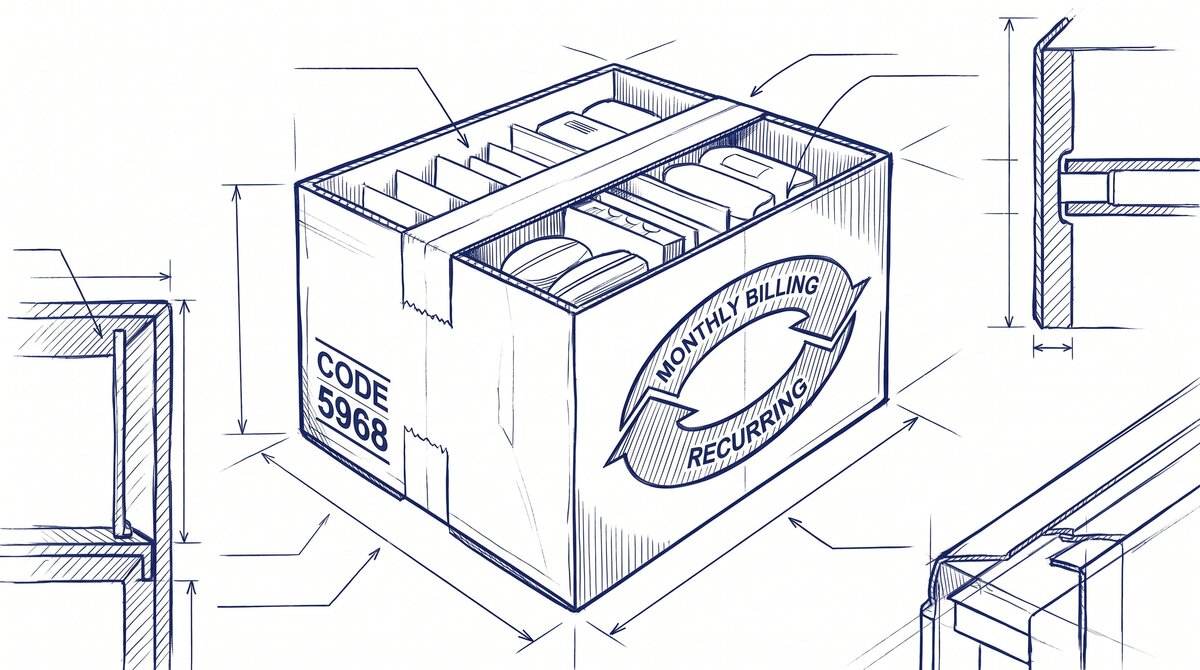

MCC 5968 is the Merchant Category Code for direct marketing continuity/subscription merchants, including monthly boxes and recurring subscriptions. The code is distinct from 5969 (other direct marketing) and is assigned by the card network to merchants that bill customers on a recurring basis for goods delivered over time.
For tax purposes, 5968 charges typically map to IRS Schedule C line 8 (advertising) or line 27a (other expenses) depending on the business context.
What MCC 5968 Covers
MCC 5968 is the direct marketing continuity/subscription merchant code. It covers merchants that sell products or services through a recurring billing relationship with the customer. The defining characteristic is the recurring nature of the billing: the customer signs up once and is billed automatically at regular intervals (monthly, quarterly, annually) until cancellation.
What most guides miss about credit card statements is that the quality depends on the mechanism, not on the tool. Two tools that look different on the surface often run the same 4-step process underneath: read, find, parse, verify. The difference is in how well each step handles edge cases (merged cells, missing balances, non-standard date formats, scanned vs digital input).
Choosing between tools based on UI alone misses the actual quality lever.
Included Merchants
- Subscription boxes: Birchbox, Stitch Fix, Loot Crate, similar monthly boxes
- Recurring product subscriptions: wine clubs, book clubs, coffee subscriptions
- Continuity programs: products that ship automatically and bill the customer until they cancel (e.g., razor blade refills, supplement auto-ship)
- Paid newsletters and memberships: Substack, paid Medium publications, professional membership sites
- Recurring SaaS with physical goods: software that ships hardware as part of the subscription (rare)
- Continuity shipping programs: Amazon Subscribe & Save merchants, similar recurring ship programs
Excluded Merchants
- One-time direct marketing purchases: separate code (5969)
- Standard e-commerce purchases: depends on the merchant’s primary business, often 5499 (misc food) or 5943 (office supplies) or 5734 (computer software)
- Streaming services: separate code (4899 or 5817)
- Subscription services without physical goods: SaaS, streaming, memberships (different codes)
The merchant’s primary business and the recurring nature of the billing determine the MCC. A merchant that primarily sells through subscription boxes is 5968. A merchant that primarily sells one-time products but also offers a subscription option may still be 5968 if the subscription is the dominant revenue model.
The Difference Between 5968 and 5969
The 5968 and 5969 codes are both direct marketing codes, but they cover different billing models. The distinction matters for rewards rate calculations and tax categorization.
5968: Direct Marketing Continuity/Subscription
Recurring billing relationship. Customer signs up once and is billed automatically until cancellation. The customer does not initiate each purchase.
5969: Direct Marketing – Other
One-time or non-subscription direct marketing. The customer initiates each purchase, or the merchant uses direct marketing techniques but does not have a recurring billing relationship. Includes catalog merchants, direct response TV/radio, infomercials.
The Practical Test
If the customer is billed automatically at regular intervals without initiating each purchase, the merchant is 5968. If the customer initiates each purchase, even if the merchant uses direct marketing techniques, the merchant is 5969.
For example, a subscription wine club (monthly auto-ship) is 5968. A wine merchant that advertises on TV and takes orders by phone (each order is customer-initiated) is 5969. Same product, different code.

Turn any PDF statement into a clean sheet
Skip the typos and the hours of copying. Our converter handles any bank statement format and outputs Excel, CSV, or QBO for QuickBooks. No file retention, free to try.
Convert your statementThe 5 Most Common Subscription Merchants Coded 5968
The most common 5968 charges on a credit card statement:
1. Monthly Subscription Box
A monthly box service (Birchbox, Loot Crate, BarkBox) charges a monthly fee. The MCC is 5968. The charge is typically $10-$50 per month. The customer is billed automatically.
2. Recurring Product Subscription
A recurring product subscription (wine club, book club, coffee subscription) charges a monthly or quarterly fee. The MCC is 5968. The charge is typically $20-$200 per month.
3. Continuity Program
A continuity program (razor blade refills, supplement auto-ship) charges a monthly fee. The MCC is 5968. The customer signs up once and receives products until cancellation.
4. Paid Newsletter or Membership
A paid newsletter (Substack, paid Medium) or membership site (professional association) charges a monthly or annual fee. The MCC is 5968. The charge is typically $5-$50 per month.
5. Recurring Membership with Physical Goods
A membership that includes recurring physical shipments (e.g., a curated product club) charges a monthly fee. The MCC is 5968. Less common than digital-only memberships.
How MCC 5968 Maps to IRS Schedule C
For self-employed individuals and small business owners, 5968 charges map to specific IRS Schedule C lines based on the nature of the expense.
Line 8: Advertising
If the 5968 charge is for marketing the business (e.g., a subscription to a service that promotes the business, or a customer acquisition cost through a subscription platform), the charge maps to line 8.
Line 18: Office Expense
If the 5968 charge is for office supplies delivered through a subscription (e.g., a recurring office supply shipment), the charge maps to line 18.
Line 22: Supplies
If the 5968 charge is for materials or supplies used in the business (not for resale), the charge maps to line 22.
Line 27a: Other Expenses
If the 5968 charge does not fit the above categories, it maps to line 27a. Common examples: subscription to a research service, professional development subscription, recurring software with a physical component.
The Practical Rule
For a self-employed individual or small business, the categorization depends on the purpose of the subscription, not the type of merchant. A subscription to a research database is line 27a (other expenses) or line 18 (office expense) if used in the business. A subscription box for personal use is not deductible.
A subscription box for client gifts is line 22 (supplies) or line 25 (utilities) if a utility, or line 27a (other expenses) for miscellaneous.
A common failure mode bookkeepers report is treating this as a single operation rather than a chain of dependent steps. The temptation is to find a tool that ‘just works’ and stop investigating the mechanism.
The result is a wrong-fix cycle: the tool gives partial output, the bookkeeper spends 30+ minutes troubleshooting, the fix is for the wrong step, and the same error recurs on the next statement. The fix: identify which step failed and apply the right intervention to that step.
When a Subscription Should Be a Different Code
The 5968 code applies to subscription merchants, but some subscriptions are coded differently. The inconsistency matters for the cardholder who is trying to match the MCC to a tax category.
SaaS Without Physical Goods
A SaaS subscription (Microsoft 365, Adobe Creative Cloud, Salesforce) is typically coded 5734 (computer software) or 5817 (digital goods), not 5968. The code reflects the digital nature of the product, not the recurring billing.
Streaming Services
A streaming subscription (Netflix, Hulu, Spotify) is typically coded 4899 (cable/pay TV) or 5817 (digital goods), not 5968. The code reflects the streaming media nature, not the recurring billing.
Membership Without Physical Goods
A membership subscription (professional association, online community) without recurring physical shipments is typically coded 8699 (membership organizations), not 5968. The code reflects the membership nature.
One-Time Direct Marketing
A one-time purchase from a direct marketing merchant (catalog order, infomercial purchase) is coded 5969, not 5968. The code reflects the one-time nature.
For the cardholder, the inconsistency means the merchant descriptor is more useful for expense categorization than the MCC. A “Stitch Fix” charge is identifiable from the descriptor; the MCC may or may not be 5968.
The common MCC codes pillar covers the 30 most common codes. The MCC 4814 (telecommunication) sub-pillar covers phone, internet, and streaming codes. The MCC 6011 (ATM cash) sub-pillar covers ATM withdrawal codes. The MCC glossary entry covers the definition in isolation. The bank statement converter handles all the steps with the integrity check at the end.
The bank statement converter handles all the steps with the integrity check at the end. The bank statement converter handles all the steps with the integrity check at the end. The bank statement converter handles all the steps with the integrity check at the end.
See also: MCC 5968 in context
This explainer is one of the merchant category code guides on the site. The consolidated overview of the entire MCC system, including every US card-network overlay, lives in the complete MCC guide. The full code-by-code reference is the complete MCC code reference.
For the broader reading on what every column on a US bank statement means, including the merchant description column where MCC appears, see the expanded bank statement anatomy.
More on MCC 5968 in practice
Direct-marketing MCC 5968 covers most online subscription services, recurring subscription models that bill via a parent platform, and high-volume customer-acquisition funnels. It is one of the more common codes on personal credit-card statements because of streaming, SaaS, and paid membership ecosystems.
Lenders and bookkeepers pay attention to MCC 5968 charges because recurring direct-marketing charges can drag down a borrower’s free-cash-flow calculation when they are underwriting a small-business or self-employed applicant. Multiple MCC 5968 charges across different merchants for similar amounts often signal unused subscriptions that the borrower can cancel pre-closing.
For consumer credit-card holders, MCC 5968 is rarely the subject of a dispute because direct-marketing subscriptions are consent-based. When a dispute does happen, it is usually about whether the merchant provided the cancellation option clearly. The full code-by-code reference is the MCC code reference.
Easy Statement Sheet reads MCC 5968 as part of the four-column output, so the subscriber companies show up alongside Date, Description, and Amount on a clean converted statement.
Direct-marketing subscription patterns
Common direct-marketing subscription clusters include streaming services, productivity SaaS, membership sites, and subscription-box services. Each will appear as a separate MCC 5968 charge. Lenders may ask about any subscription that exceeds $50/month because that level of recurring expense affects debt-to-income.
For bookkeepers, MCC 5968 is one of the codes that benefits most from explicit category assignment. Many accounting systems default to Misc Expense for unknown MCC labels. Set the rule to Software/Subscription or Marketing so the charge is correctly attributed.
On a converted credit-card statement, MCC 5968 charges line up in column 4 alongside Date, Description, and Amount. The pattern is easy to read top-to-bottom: most cardholders with high MCC 5968 counts also have high discretionary-spend ratios.
Where MCC 5968 charges cluster
The MCC 5968 direct-marketing label spans several merchant ecosystems. Subscription-based businesses (SaaS, streaming, news, music) typically flow over this code. Cash-equivalent purchases and recurring memberships also fall under MCC 5968.
On a personal credit-card statement, an MCC 5968 charge usually appears with a description that reflects the merchant’s registered business name. For high-frequency recurring subscriptions, the merchant description is consistent across months, which makes pattern detection easy.
On a small-business statement, MCC 5968 charges often come from SaaS providers and corporate subscriptions. These flow into the Software/Subscription category if the chart of accounts is correctly configured at the rule layer.
Easy Statement Sheet reads MCC 5968 as one of the four columns in every converted statement, ready for downstream categorization.
From Bank Statement to QuickBooks-Ready File
That manual cleanup you just read about? This tool skips it. Turn your PDF into QBO for QuickBooks without storing your data anywhere.
Start Converting