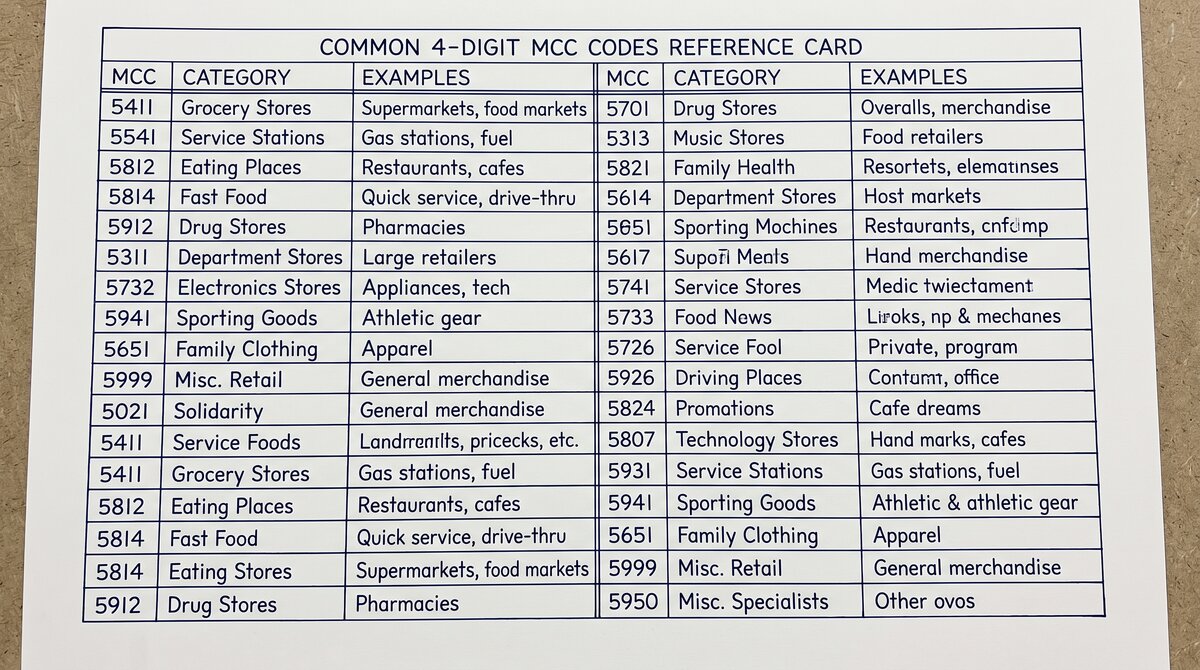

Merchant Category Codes (MCCs) are 4-digit numbers that classify every business that accepts a card payment. The wrong MCC raises your processing fees, breaks your rewards, and can trigger a tax audit. There are approximately 600 MCCs organized into 15 categories, and the same merchant can have different MCCs at different banks.
Approximately 0.5-3% of every transaction is determined by the MCC. For a business processing $1M per year, that is $5,000-$30,000 per year. The MCC matters.
TL;DR. Merchant Category Codes (MCCs) are 4-digit codes assigned by the merchant’s bank to classify the business. They affect 4 things: interchange fees, rewards categories, tax classification, and bank statement categorization. There are approximately 600 MCCs in 15 categories. The most common on bank statements: 5411 (grocery), 5541 (gas), 5812 (restaurants), 5311 (department stores), 7995 (gambling). MCCs are not chosen by the merchant. They are assigned. And they are not always right.
A bookkeeper is reconciling a client’s credit card statement. The statement shows transactions categorized as 5411, 5541, 5812, and 7995. The bookkeeper needs to verify the categorization is correct, because miscategorized transactions can affect the client’s tax reporting and the business’s expense categorization. The 7995 transaction (gambling) is particularly important because it triggers IRS reporting for winnings.
All MCC Codes: Quick Reference (50+ Most-Searched)
Every MCC code users search for, with the category and example merchants. The MCC is a 4-digit ISO 18245 code that identifies the merchant’s business type on every card transaction.
| MCC | Category | Example Merchants |
|---|---|---|
| 1099 | Financial Services (Misc) | Currency exchanges, money orders |
| 1799 | Contractors (Misc) | Special trade contractors |
| 4121 | Taxicabs and Rideshares | Uber, Lyft, local taxi |
| 4722 | Travel Agencies | Online travel agencies, tour operators |
| 4814 | Telecommunications | Phone, internet, cable |
| 4816 | Computer Network/Info Services | Cloud services, hosting |
| 4829 | Money Orders | Wire transfers via money order |
| 4900 | Utilities | Electric, gas, water, trash |
| 5039 | Building Materials | Lumber yards, hardware stores |
| 5046 | Commercial Equipment | Office machines, fixtures |
| 5200 | Home Supply Stores | Hardware, paint, lumber (larger) |
| 5251 | Hardware Stores | Home Depot, Lowe’s, Ace |
| 5262 | Marketplaces | Online marketplaces (non-classified) |
| 5310 | Discount Stores | General discount retailers |
| 5399 | General Merchandise | Variety stores, general goods |
| 5411 | Grocery Stores | Supermarkets, food stores |
| 5422 | Frozen Food | Frozen meat, seafood, dairy |
| 5499 | Food Stores (Misc) | Specialty food markets |
| 5533 | Automotive Parts | AutoZone, O’Reilly, NAPA |
| 5541 | Service Stations | Gas stations (with/without services) |
| 5542 | Automated Fuel Dispenser | Self-service gas pumps |
| 5691 | Men’s/Women’s Clothing | Apparel stores |
| 5699 | Apparel (Misc) | Clothing accessories, specialty |
| 5734 | Computer Software | Software purchases (boxed/download) |
| 5812 | Eating Places/Restaurants | Sit-down restaurants, cafes |
| 5813 | Drinking Places | Bars, nightclubs, lounges |
| 5814 | Fast Food Restaurants | McDonald’s, Wendy’s, etc. |
| 5815 | Digital Goods | App stores, streaming media |
| 5816 | Digital Goods (Games) | Video games, in-game purchases |
| 5817 | Digital Goods (Misc) | Software as a service (some) |
| 5944 | Jewelry Stores | Fine jewelry, watches |
| 5967 | Direct Marketing (Inbound) | Telesales, inbound telemarketing |
| 5968 | Direct Marketing (Outbound) | Outbound telemarketing, subscriptions |
| 5969 | Direct Marketing (Other) | Other DM services |
| 5999 | Misc Retail | Tobacco, florists, gift shops |
| 6011 | Automated Cash Disbursement | ATM withdrawals |
| 6012 | Financial Institutions | Banks, credit unions (in-person) |
| 6051 | Quasi-Cash | Crypto, foreign currency, money orders |
| 6300 | Insurance Sales/Underwriting | Insurance premiums |
| 6513 | Real Estate Agents | Rental payments to agents |
| 6540 | Financial Institutions (Stored Value) | Gift cards, prepaid cards |
| 7011 | Lodging (Hotels/Motels/Resorts) | Hotels, Airbnb (some) |
| 7299 | Personal Services (Misc) | Photographers, event planners |
| 7399 | Business Services (Misc) | Consulting, advertising |
| 7512 | Car Rental | Hertz, Enterprise, Turo |
| 7922 | Theatrical Producers | Concert venues, theatrical events |
| 7994 | Video Game Arcades | Arcade facilities |
| 7995 | Betting/Track/Casino | Online gambling, sports betting |
| 7997 | Membership Clubs | Country clubs, gym memberships |
| 8011 | Doctors | Medical doctors (not dentists) |
| 8099 | Medical Services (Misc) | Labs, clinics, health services |
| 8299 | Educational Services | Schools, colleges, tutoring |
| 8999 | Professional Services (Misc) | Lawyers, accountants, consultants |
What Are Merchant Category Codes
Merchant Category Codes are 4-digit numerical codes assigned to businesses that accept card payments. The codes are defined by ISO 18245, an international standard managed by the International Organization for Standardization. The card networks (Visa, Mastercard, American Express, Discover) maintain the actual code list and assign them to merchants through their acquiring banks.
What most guides miss about credit card statements is that the quality depends on the mechanism, not on the tool. Two tools that look different on the surface often run the same 4-step process underneath: read, find, parse, verify. The difference is in how well each step handles edge cases (merged cells, missing balances, non-standard date formats, scanned vs digital input). Choosing between tools based on UI alone misses the actual quality lever.
Every card transaction includes the MCC of the merchant. The MCC determines 4 things for the transaction: the interchange fee (the processing fee paid by the merchant’s bank to the cardholder’s bank), the rewards category (which card benefits apply), the tax classification (how the IRS views the expense), and the bank statement categorization (how the expense appears on the customer’s statement).
There are approximately 600 active MCCs, organized into 15 broad categories: Agriculture, Contracted Services, Travel and Entertainment, Business Services, Clothing and Retail, Transportation, Financial Services, Government Services, Healthcare, Home and Office, Personal Services, Professional Services, Repair Services, Retail, and Utilities.
Turn any PDF statement into a clean sheet
Skip the typos and the hours of copying. Our converter handles any bank statement format and outputs Excel, CSV, or QBO for QuickBooks. No file retention, free to try.
Convert your statementHow MCCs Are Assigned
MCCs are assigned by the merchant’s acquiring bank, not by the merchant. The merchant applies for a merchant account at a bank. The bank reviews the merchant’s primary business activity and assigns the MCC that best matches. The merchant does not pick the MCC.
This is important because the same merchant can have different MCCs at different banks. A coffee shop might be 5814 (fast food) at one bank and 5812 (restaurant) at another. The acquiring bank makes the determination based on the merchant’s stated business activity.
MCCs can change if the merchant’s business changes. A bookstore that adds a coffee shop may keep 5942 (bookstore) or be reclassified as 5812 (restaurant), depending on how the acquiring bank interprets the new business activity. The merchant must notify the bank of significant business changes to ensure the MCC is updated.
MCCs are not always correct. A restaurant misclassified as 5814 (fast food) instead of 5812 (restaurant) is a 0.5-1% difference in interchange fees. The categorization is also wrong for the customer’s tax records. Errors happen, and the merchant can dispute the MCC with their acquiring bank.
How MCCs Affect Interchange Fees
Interchange fees are the largest component of card processing costs. The card network sets the interchange fee for each MCC. The fee is a percentage of the transaction amount plus a fixed per-transaction amount.
Lower interchange MCCs: 5411 (grocery), 5541 (gas), 9311 (government). These typically have 0.5-1.5% interchange because the cardholder’s bank has higher confidence in the transaction type and the merchant is typically a low-risk business.
Medium interchange MCCs: 5812 (restaurants), 5311 (department stores), 4121 (taxicabs). These typically have 1.5-2.5% interchange because the transaction types are standard but the merchants may have higher chargeback risk.
Higher interchange MCCs: 7995 (gambling), 6051 (cryptocurrency), 4829 (wire transfers). These typically have 2.5-3.5% interchange because the cardholder’s bank has lower confidence in the transaction type and the merchants have higher chargeback risk.
For a merchant, the difference between a low and high interchange MCC is significant. A $50 transaction at 5411 (grocery) has approximately $0.50 interchange. The same $50 transaction at 7995 (gambling) has approximately $1.50 interchange. Multiply by 10,000 transactions per year, and the difference is $10,000 per year.
How MCCs Affect Rewards
Credit card rewards are organized by MCC. A card that offers 3% cash back on dining will pay 3% only on transactions at MCC 5812 (restaurants), 5813 (bars), and 5814 (fast food). A transaction at MCC 5411 (grocery) on the same card will earn 1% (the default rate), not 3%.

This is why rewards cards have specific categories: dining, gas, groceries, travel, streaming. Each category corresponds to specific MCCs. The card issuer sets the MCC eligibility for each category, and the cardholder earns the bonus only on transactions at eligible MCCs.
The rewards calculation is done by the card network, not the merchant. The merchant does not need to do anything. The card network checks the MCC of the transaction, looks up the rewards rate for that MCC on the cardholder’s card, and applies the rate.
For cardholders, knowing the MCCs of their frequent merchants can help them choose the right card. A person who spends $500/month on dining should use a card that offers 3-4% on MCC 5812, 5813, 5814. The same person spending $300/month on gas should use a card that offers 3-4% on MCC 5541. The right card depends on the spending pattern.
The Most Common MCCs on Bank Statements
Approximately 50 MCCs account for 90% of card transactions. The most common on bank statements:
5411 – Grocery Stores: Supermarkets, grocery stores, food stores. Interchange 1-1.5%. Often eligible for grocery rewards category on cards.
5541 – Gas Stations: Service stations, gas stations, automated fuel dispensers. Interchange 1-1.5%. Often eligible for gas rewards category on cards.
5812 – Eating Places and Restaurants: Restaurants, sit-down dining, table service. Interchange 1.5-3%. Often eligible for dining rewards category on cards.
5813 – Drinking Places (Bars, Taverns, Nightclubs): Bars, pubs, nightclubs, cocktail lounges. Interchange 1.5-3%. Often eligible for dining rewards.
5814 – Fast Food Restaurants: Quick-service restaurants, fast food, takeout. Interchange 1.5-2.5%. Often eligible for dining rewards.
5311 – Department Stores: Department stores, general merchandise. Interchange 1.5-2.5%. Usually not eligible for specific rewards categories (default rate).
4121 – Taxicabs and Limousines: Taxi, rideshare (Uber, Lyft typically use 4121). Interchange 1.5-2.5%. May be eligible for travel rewards.
7995 – Gambling Transactions: Casinos, racetracks, lottery, online gambling. Interchange 2.5-3.5%. Triggers IRS reporting for winnings.
4900 – Utilities: Electric, gas, water, sanitary services. Interchange 0.5-1%. Often eligible for utility rewards or special financing.
5942 – Bookstores: Bookstores, newsstands. Interchange 1.5-2.5%. Usually not eligible for specific rewards.
How MCCs Affect Tax Classification
The IRS uses MCCs to identify certain transaction types. Most MCCs do not trigger any special tax treatment. A few do.
MCC 7995 (gambling) triggers IRS Form W-2G reporting for winnings above certain thresholds. Casinos and gambling merchants must issue W-2G to customers who win above the threshold. The customer’s bank statement will show the 7995 MCC, which the customer uses to identify the gambling income.
MCC 6051 (cryptocurrency) is a recent addition. Crypto exchanges and brokers are assigned this MCC. The IRS treats cryptocurrency as property, and transactions at this MCC may trigger capital gains reporting.
MCC 4829 (wire transfers) is used for money transfer services like Western Union and MoneyGram. The IRS requires these merchants to report transactions above certain thresholds. The customer’s bank statement will show the 4829 MCC, which the customer uses to identify the transfer.
For most other MCCs, the categorization is informational only. The customer or bookkeeper uses the MCC to understand the expense type (groceries, dining, gas) but the IRS does not have specific reporting requirements based on the MCC alone.
How to Look Up an MCC
The official MCC list is maintained by Visa and published in their merchant documentation. Mastercard publishes a similar list. The lists are largely identical because the card networks coordinate on MCC definitions.
To look up a specific MCC, the steps are: identify the 4-digit code on the bank statement, search for the code in the Visa or Mastercard documentation, find the merchant category that matches.
For bookkeepers, the MCC reference page provides a quick lookup of the most common codes. The lookup is organized by category so you can find the code by the type of expense, not just by the number.
For merchants, the MCC is available from the acquiring bank. The merchant’s monthly processing statement lists the MCC for the merchant account. If the MCC is wrong, the merchant can dispute it with the acquiring bank and request a reclassification based on the actual business activity.
Common MCC Errors and Fixes
Error 1: A restaurant is classified as 5814 (fast food) instead of 5812 (restaurant). The fix is for the merchant to contact the acquiring bank and request a reclassification. The bank will review the business activity (sit-down dining vs. counter service) and update the MCC.
Error 2: A bookstore with a coffee shop is classified as 5942 (bookstore) instead of 5812 (restaurant). The fix depends on which business activity is primary. If 80% of revenue is from books and 20% from coffee, the MCC should be 5942. If the ratio is reversed, the MCC should be 5812.
Error 3: A rideshare driver is classified as 4121 (taxi) but the customer expects 5812 (restaurant) rewards. The fix is not possible at the MCC level. Rideshare is 4121, and dining rewards cards do not earn bonus at 4121. The customer needs to use a travel rewards card for rideshare transactions.
Error 4: A gambling transaction at 7995 triggers IRS reporting but the customer did not know. The fix is for the customer to keep better records of gambling activity. The MCC on the statement is the customer’s signal that the transaction is reportable.
What to Do Right Now
A common failure mode bookkeepers report when working with credit card statements is treating it as a single operation rather than a chain. The temptation is to find a tool that “just works” and stop investigating the mechanism. The result is a wrong-fix cycle: the tool gives partial output, the bookkeeper spends 30+ minutes troubleshooting, the fix is for the wrong step, and the same error recurs on the next statement. The fix: identify which step failed (read, find, parse, verify) and apply the right intervention to that step.
If you are looking at MCCs on a bank statement right now, do these three things in this order.
First, identify the most common MCCs in the statement. Most statements show 3-5 distinct MCCs. Note the 4-digit code for each. These are the categories the cardholder spent in.
Second, verify the MCCs match the expected merchant types. A grocery store should be 5411. A gas station should be 5541. A restaurant should be 5812. If any MCC does not match, the merchant or the acquiring bank may have made an error.
Third, check the rewards rate for each MCC on the cardholder’s card. A 3% dining rewards card earns 3% at 5812, 5813, 5814. A 3% gas rewards card earns 3% at 5541. If the cardholder is not earning the expected rewards, they may be using the wrong card or the MCC may be wrong.
For a complete MCC reference, the MCC lookup table provides the codes, descriptions, and common merchants for each category. The reference is updated as the card networks add or modify codes. For credit card statement specifics including sign convention and statement balance, the statement balance guide covers the related reading. The bank statement to Excel converter extracts MCC data from the statement for tax and bookkeeping purposes.. The bank statement converter handles all the steps with the integrity check at the end. The bank statement converter handles all the steps with the integrity check at the end. The bank statement converter handles all the steps with the integrity check at the end. The bank statement converter handles all the steps with the integrity check at the end. For more, see the merchant category code guide.
Turn PDF Bank Statements Into Workable Spreadsheets
Your bank statement is a mess of numbers, but your books shouldn't be. Use our converter to get Excel, CSV, or QBO files — ready for QuickBooks.
Try It Free Now