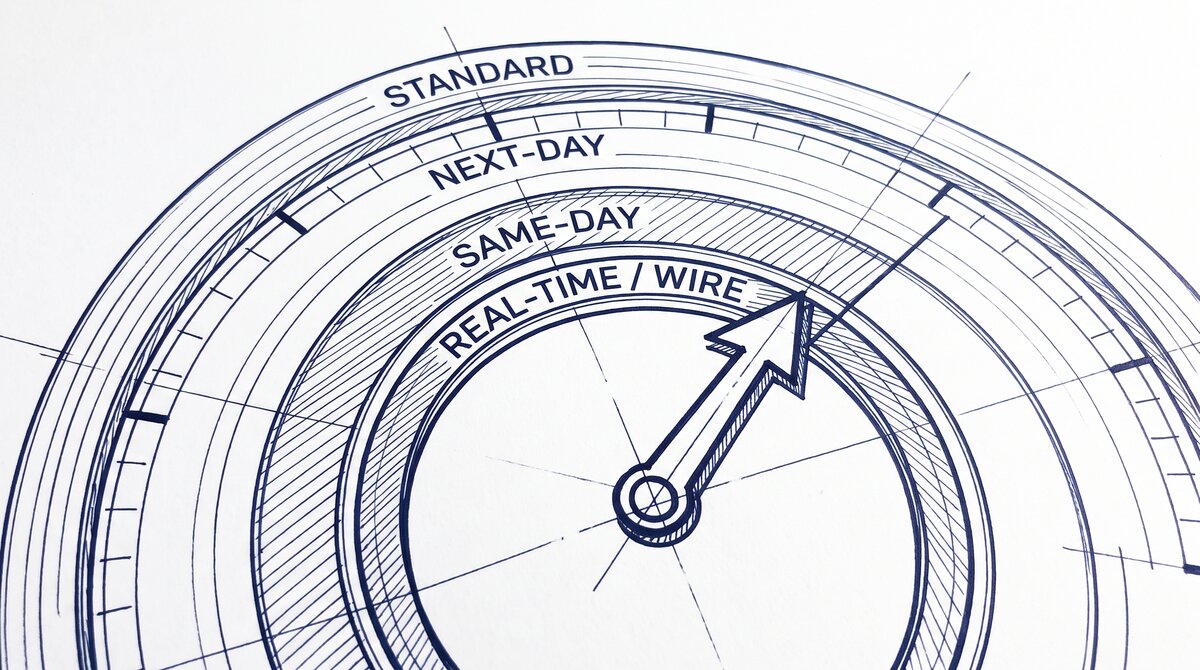

ACH has 4 speeds: standard 3-day, next-day, same-day, and real-time via RTP/FedNow. Wire has 1 speed: same-day, with cut-off at 4-5pm local. The constraint is the cut-off time, not the rail type. After the cut-off, even same-day ACH and wire wait until the next business day.
The 4 ACH Speeds (and the 1 Wire Speed)
ACH is not a single-speed rail. There are now 4 distinct ACH speeds, each with its own cut-off time and use case.
What most guides miss about this workflow is that the quality depends on the mechanism, not on the tool. Two tools that look different on the surface often run the same 4-step process underneath: read, find, parse, verify. The difference is in how well each step handles edge cases (merged cells, missing balances, non-standard date formats, scanned vs digital input).
Choosing between tools based on UI alone misses the actual quality lever.
Standard ACH (1-3 Business Days)
The original ACH speed. The transfer is submitted to Nacha, batched with other transactions, and processed at the next settlement window. The recipient’s bank credits the account 1-3 business days later, depending on the originating bank’s submission time. This is the cheapest ACH option (often free for consumer accounts).
Next-Day ACH
A faster ACH tier. The transfer is submitted before the bank’s next-day cut-off (typically 10am-2pm local) and settles the next business day. The fee is slightly higher than standard ACH, typically $0.50-$1.00.
Same-Day ACH
The fastest traditional ACH speed. The transfer is submitted before the bank’s same-day cut-off (typically 2-4pm local) and settles the same business day. The per-transaction limit is $1M (raised from $25K in recent Nacha rule changes). The fee is $0.50-$1.50 per transaction.
Real-Time Payments (RTP) and FedNow
Not technically ACH, but often grouped with it because they are lower-cost alternatives to wire. RTP (operated by The Clearing House) settles in real time, 24/7/365, with a $1M per-transaction limit. FedNow (operated by the Federal Reserve) does the same with a $500K initial limit (rising over time). Both have no cut-off time. Fees are $0.25-$1.00 per transaction.
Wire (Same-Day)
Wire has one speed: same-day. The transfer is submitted before the bank’s wire cut-off (typically 4-5pm local) and settles the same business day, often within minutes. After the cut-off, the wire waits until the next business day. Wire has no transaction limit (other than the sender’s available balance). Fee: $15-$50 domestic.
The Cut-off Time Matrix: When Each Rail Stops Working
Cut-off times are the real constraint. A same-day ACH submitted at 3pm settles today; submitted at 5pm settles tomorrow. The matrix:
| Rail | Cut-off (typical) | Settlement | Limit |
|---|---|---|---|
| Standard ACH | End of business | 1-3 business days | $25K (consumer) / $1M (business) |
| Next-day ACH | 10am-2pm local | Next business day | $25K / $1M |
| Same-day ACH | 2-4pm local | Same business day | $1M |
| RTP | None | Real-time | $1M |
| FedNow | None | Real-time | $500K (initial) |
| Wire (domestic) | 4-5pm local | Same business day | No standard max |
| Wire (international) | 2-4pm local | Same business day (often next day for time zones) | No standard max |
After the cut-off, the transfer waits. The user has to either accept the delay (use ACH or wait for next business day) or use a faster rail (RTP/FedNow, if available) or wire (if cut-off has not passed).
Turn any PDF statement into a clean sheet
Skip the typos and the hours of copying. Our converter handles any bank statement format and outputs Excel, CSV, or QBO for QuickBooks. No file retention, free to try.
Convert your statementReal-Time Payments: When RTP and FedNow Beat Wire
RTP and FedNow are not always the right choice, but for specific scenarios they beat wire.
When RTP/FedNow Wins
The transfer is under $1M (RTP) or $500K (FedNow). The recipient is at a participating bank. Real-time certainty is required (not just same-day). Cost matters (RTP/FedNow fees are 50-75% lower than wire).
When Wire Still Wins
The transfer is over $1M. The recipient is at a non-participating bank (smaller banks and credit unions may not support RTP/FedNow yet). International. The sender’s bank does not support RTP/FedNow yet.
The adoption of RTP and FedNow is growing but not universal. As of 2025, RTP is supported by most major US banks; FedNow is supported by a smaller subset. Users should check with their bank before relying on real-time rails for time-critical transfers.
Weekends and Holidays: The Hidden 3-Day Gap
ACH does not settle on weekends or US federal holidays. A transfer submitted on Friday at 5pm waits until Monday (or Tuesday if Monday is a holiday). The total delay: 3-4 calendar days.
Wire and RTP/FedNow do not have this problem for most scenarios. Wire settles on the next business day after submission. RTP and FedNow settle in real time, including weekends and holidays.
The practical impact: a payment submitted Friday at 3pm via same-day ACH settles Friday. Submitted at 6pm, it settles Tuesday. The user has to plan around the cut-off and the weekend/holiday calendar.
For businesses with weekly payment cycles, the weekend gap is a real constraint. The pattern: submit ACH payments by Wednesday to ensure same-week settlement.
A common failure mode bookkeepers report is treating this as a single operation rather than a chain of dependent steps. The temptation is to find a tool that ‘just works’ and stop investigating the mechanism.
The result is a wrong-fix cycle: the tool gives partial output, the bookkeeper spends 30+ minutes troubleshooting, the fix is for the wrong step, and the same error recurs on the next statement. The fix: identify which step failed and apply the right intervention to that step.
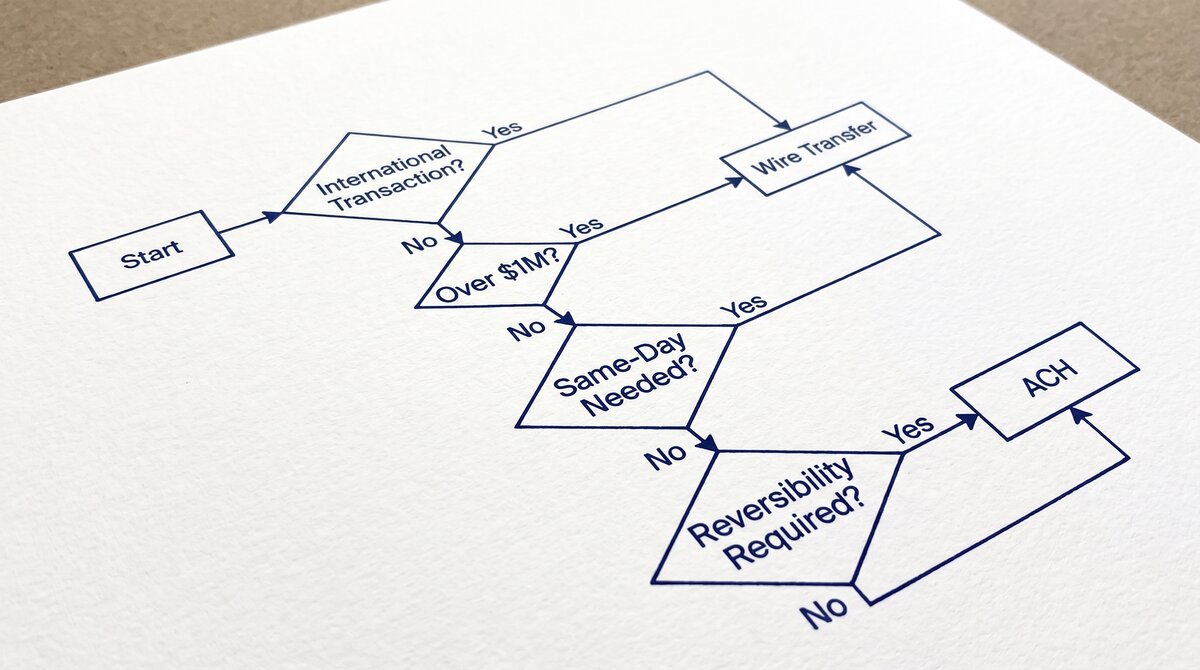
The Decision Tree: Speed-Critical vs Cost-Critical
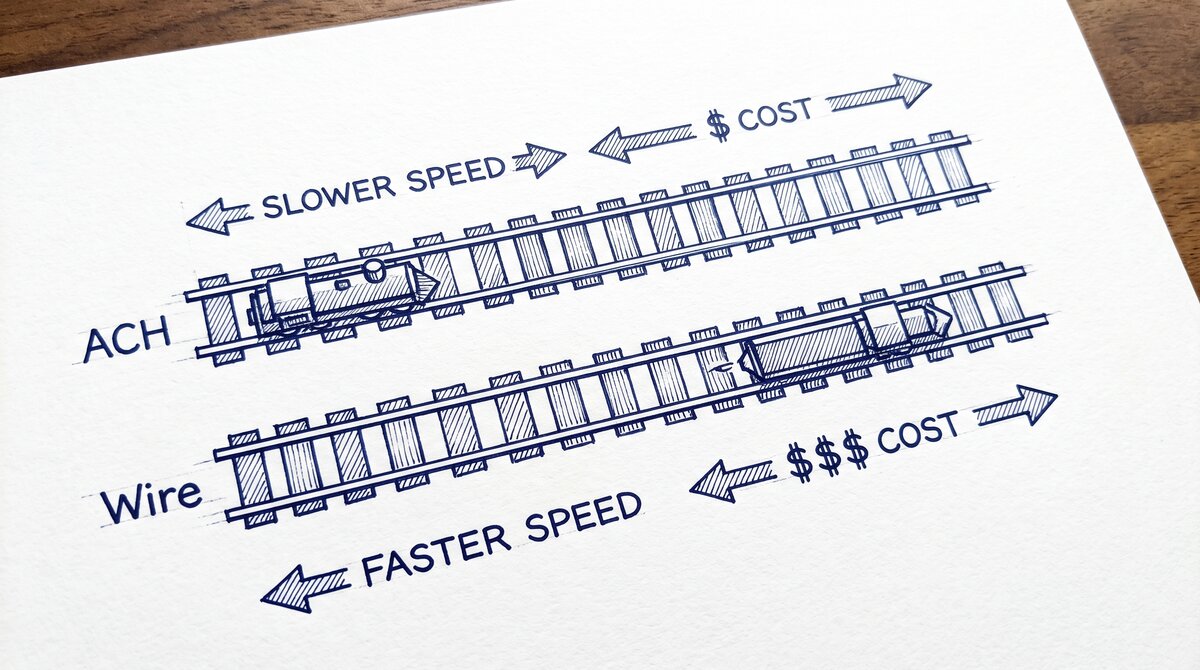
For any transfer, the speed-vs-cost decision is a tradeoff.
Choose Speed (Wire, RTP, FedNow) When
The transfer is time-critical (today, not tomorrow). The cost of delay exceeds the fee. The recipient needs same-day certainty. The amount is within the rail’s limit.
Choose Cost (ACH) When
The transfer is not time-critical (1-3 day window is acceptable). The cost matters more than the speed. The amount is within the ACH limit. The recipient expects ACH settlement.
The Default
For most business and consumer transfers, ACH is the default. The exceptions (wire or RTP/FedNow) are specific scenarios: international, large, time-critical, or real-time-required.
The ACH vs wire transfer pillar covers the 5-criteria decision matrix. The when to use wire vs ACH sub-pillar covers the decision tree. The cost comparison covers the time-value-of-money math. The statement appearance covers how to identify each on a bank statement.
For a deeper understanding, see: payment rails pillar . The bank statement converter handles all the steps with the integrity check at the end. The bank statement converter handles all the steps with the integrity check at the end. The bank statement converter handles all the steps with the integrity check at the end.
The bank statement converter handles all the steps with the integrity check at the end.
See also: ACH vs wire speed in context
This explainer is part of the payment rails coverage on this site. The consolidated overview of ACH, wire, Zelle, RTP, and FedNow for US banks now lives in the complete US bank payment rails guide, which is the modern hub for the topic.
For parallel reading on the merchant category codes that flow over the card-network rails, see the complete MCC guide. For what every column on a US bank statement means and where the rail labels appear, see the expanded bank statement anatomy.
Speed comparison in practice
Same-day ACH is the fastest batch rail in the United States. Three windows daily at 10:30 AM, 2:45 PM, and 4:45 PM ET. Funds post the same day. For same-day to work, the originator’s bank must opt in and there is a per-entry fee on top of the regular ACH fee.
Wire is faster than same-day ACH but only for completed transactions during business hours. Wire transfers initiated before 5:00 PM ET usually settle same day. After hours, wires wait until the next business day.
FedNow and RTP both settle in under 10 seconds, all day, every day. Banks charging no fee for inbound real-time payments are increasingly common, but the originating bank usually pays a per-transaction fee that they may or may not pass through.
For a payroll payment at 11:00 AM on Friday, the right rail depends on employee geography and the company’s existing banking arrangement. Same-day ACH reaches most US banks by Friday close. Real-time rails reach any bank with FedNow or RTP coverage within seconds.
When the timing window matters
If a payment needs to land by 4:30 PM ET today, the choice is between same-day ACH, wire, or a real-time rail. Same-day ACH has three windows daily and is the cheapest option. Wire works for higher dollar amounts but with a wire fee. Real-time rails are 24/7 but may have bank coverage gaps.
For payroll run at noon Eastern on a Friday, same-day ACH from the noon window usually reaches most US banks by 4:30 PM. Real-time rails reach any bank with FedNow or RTP coverage within seconds. Wires before 5 PM settle same day.
A small business that pays vendors weekly with consistent timing should default to standard ACH and only escalate to same-day ACH or wire for late-period adjustments. The complete US bank payment rails guide covers the cost-vs-speed trade-off for all four rails.
Speed benchmarks by scenario
An outbound payroll run before 10:30 AM Eastern reaches most US banks by end of day over standard ACH, or by 4:30 PM ET over same-day ACH. Wire before the 5 PM cut hits the recipient’s account within hours.
A late-period invoice payment from a vendor to a small business should default to ACH. Real-time rails are useful when the recipient has confirmed the rail is supported and the cost is acceptable.
For banking integrations, a small business that routinely sends payments to vendors across multiple states should benchmark each rail quarterly. The complete US bank payment rails guide covers the operational benchmarks for all four rails.
Easy Statement Sheet handles conversion of any bank or credit-card statement into a four-column spreadsheet for free (up to three conversions per month, no card required). The conversion preserves the rail label in the description column.
Practical speed benchmarks
A small business that runs weekly payroll through ACH experiences the rail at scale. Standard ACH hits most US banks within 1-2 business days. Same-day ACH hits within 8 hours if submitted before the noon or 2:45 PM ET window.
A small business that occasionally wires to overseas vendors experiences international wire: Fedwire for domestic last-leg, SWIFT for the international hop, CHIPS for high-volume US settlement. International wires typically settle in 0-2 business days and cost $35-$75 per transfer.
Real-time rails (RTP, FedNow) are 24/7/365 and settle in under 10 seconds for any bank that has integrated. The complete US bank payment rails guide walks through both rails and their adoption rates by US bank tier.
Output format: which one matches the destination?
Picking the right output format is a separate decision from picking the right converter.
XLSX for human spreadsheet review. CSV for downstream scripts and tools. Google Sheets-compatible for shared cloud review. QBO for QuickBooks.
The four canonical columns are preserved across every format. What differs is how the downstream consumer expects the rows.
For a side-by-side rule of thumb that maps destination to format, see the decision framework on the output format pillar.
Read the full output format decision framework
Turn PDF Bank Statements Into Workable Spreadsheets
Your bank statement is a mess of numbers, but your books shouldn't be. Use our converter to get Excel, CSV, or QBO files — ready for QuickBooks.
Try It Free Now