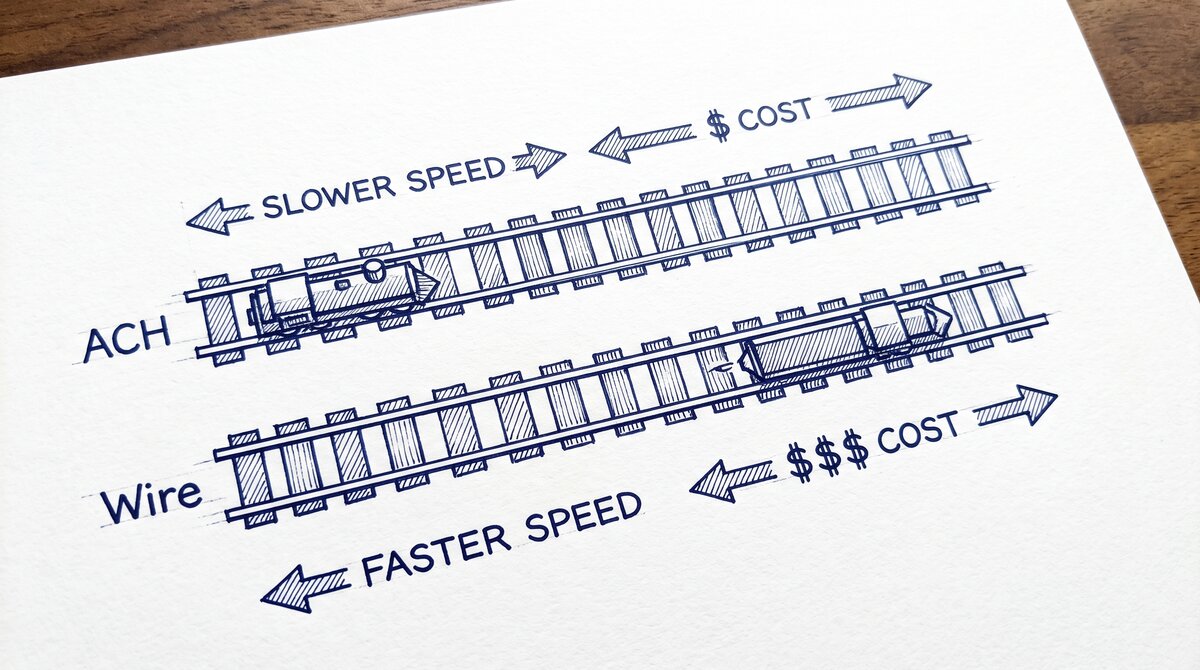

ACH and wire are the two US payment rails, and the right one depends on cost, speed, and whether the transfer can be reversed. ACH is cheaper (typically $0.20-$1.50) and reversible within 24-60 hours, but takes 1-3 business days. Wire is expensive ($15-$50 domestic, $40-$75 international) and irreversible, but settles the same day with certainty. Most transfers should use ACH; some have no choice but wire.
TL;DR. ACH and wire differ on 5 criteria: cost, speed, cut-off time, reversibility, and international support. ACH wins on cost and reversibility. Wire wins on speed, certainty, and international reach. Use ACH for routine payments under $1M with 1-3 day tolerance. Use wire for same-day settlement, international transfers, real estate closings, court-ordered payments, and amounts over $1M. Same-day ACH and FedNow/RTP have narrowed the speed gap but not eliminated it.
What Is ACH vs Wire Transfer: The Two US Payment Rails
A payment rail is the underlying system that moves money from one bank to another. The United States has two main domestic rails: ACH (Automated Clearing House), operated by Nacha, and Wire (FedWire, operated by the Federal Reserve, and CHIPS, operated by The Clearing House). International transfers use SWIFT as a messaging network on top of correspondent banking relationships.
What most guides miss about this workflow is that the quality depends on the mechanism, not on the tool. Two tools that look different on the surface often run the same 4-step process underneath: read, find, parse, verify. The difference is in how well each step handles edge cases (merged cells, missing balances, non-standard date formats, scanned vs digital input). Choosing between tools based on UI alone misses the actual quality lever.
What ACH Is
ACH is a batch-processed, store-and-forward system. Transactions are submitted by the originating bank, batched together, and processed at scheduled intervals (multiple times per day for same-day ACH). The receiving bank credits the account on the next business day or later, depending on the ACH speed tier. ACH is governed by Nacha rules, which include reversal rights, transaction limits, and standard entry class codes (SEC codes) for different transaction types.
What Wire Is
Wire is a real-time gross settlement system. Each transaction is settled individually in real time, with funds moved from the originating bank’s reserve account to the receiving bank’s reserve account at the Federal Reserve. The settlement is final and irrevocable. There is no batch processing and no reversal mechanism. The wire is governed by Federal Reserve regulations and clearing house rules, not by Nacha.
Why the Distinction Matters
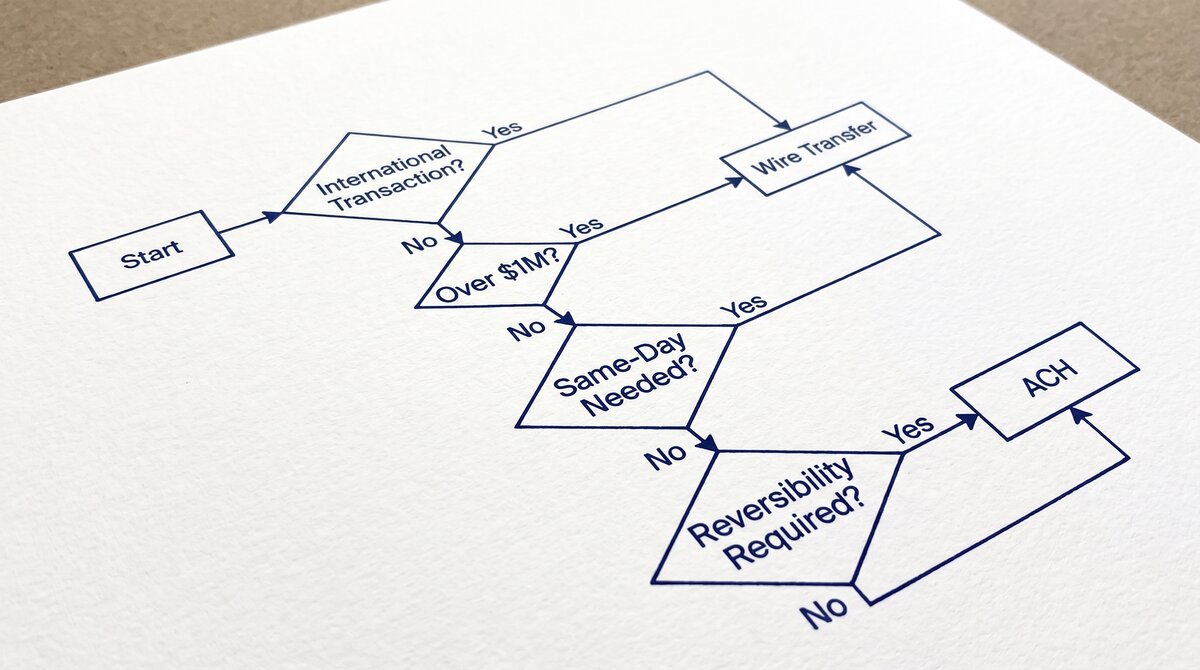
The two rails are not interchangeable. Choosing the wrong one has consequences: a wire sent to the wrong account cannot be recalled; an ACH transfer that needs to settle today will not; a $2M payment that goes via ACH will hit the per-transaction limit and be rejected. The article gives the decision matrix, then the specific scenarios where the choice is constrained.
The 5 Criteria Where ACH and Wire Differ
ACH and wire differ on five measurable criteria. The decision tree uses these in order.
Cost
ACH: $0.20 to $1.50 per transaction, charged to the originating bank (often free to consumers). Wire: $15 to $50 domestic, $40 to $75 international, charged to both sender and sometimes recipient. International wires also include a 1-3% FX margin and possible intermediary bank fees ($15-$30 deducted from the amount).
Speed
ACH: 1-3 business days standard, with same-day ACH available for transactions submitted before the bank’s cut-off (typically 2-4pm local). Wire: same-day, with cut-off typically 4-5pm local. Real-Time Payments (RTP) and FedNow: real-time, 24/7/365, with $1M (RTP) and $500K (FedNow) per-transaction limits.
Cut-off Time
ACH cut-offs vary by bank and by ACH speed. Standard ACH typically has a 5pm local cut-off for next-day settlement. Same-day ACH has a 2-4pm local cut-off. Wire cut-offs are typically 4-5pm local for same-day settlement. After the cut-off, the transfer waits until the next business day.
Reversibility
ACH: reversible within 24-60 hours via Nacha’s reversal process, typically for erroneous or unauthorized transactions. After 60 hours, the transaction is settled. Wire: not reversible. Once the wire is sent, the funds are at the receiving bank. Recovery requires the recipient’s cooperation, which is rare in fraud cases.
International Support
ACH: domestic US only. International ACH exists for some corridors (US-Canada, US-Europe via SEPA) but is not universally available. Wire: international via SWIFT, with correspondent banking relationships. A wire to a foreign bank goes through 1-3 intermediary banks, each potentially charging a fee.
Turn That PDF Into a Spreadsheet in Minutes
You've seen how to do it manually — now let the tool handle the heavy lifting. Upload your bank statement and get Excel, CSV, or QBO in a few clicks.
Try It FreeWhen ACH Is the Right Choice (and When Wire Is the Only Option)
Use ACH When
The transfer is domestic. The amount is under $1M (standard ACH) or under $5M (same-day ACH). The cost matters more than the speed. Reversibility is acceptable or desirable. The recipient expects a 1-3 day settlement. The transfer is a recurring payment (payroll, vendor, mortgage) where batching reduces cost.
Use Wire When
The transfer must settle today. The amount exceeds $1M. The transfer is international. The transfer is for a real estate closing, court-ordered payment, or other high-stakes transaction where reversibility is undesirable. The recipient requires same-day certainty. The cut-off for ACH has already passed.
The 5 Scenarios Where Wire Is the Only Option
- International transfers. ACH does not support most international corridors; wire via SWIFT is the standard.
- Real estate closings. Title companies require wire for closing funds; ACH would not settle in time.
- Court-ordered payments. Many court orders specify wire; ACH is not acceptable.
- Same-day large-amount transfers. Above $1M, same-day ACH does not apply; wire is the only option.
- Time-critical business transactions. M&A closing, emergency vendor payment, regulatory deadline.
The Cost vs Speed Trade-off: A Concrete Example
A freelancer sends a $5,000 client payment. Using ACH: $0.50 fee, settles in 1-3 business days. Using wire: $25 fee, settles same day. The $24.50 cost difference is the price of speed.
The breakeven math: if the freelancer bills hourly and waits 1 extra day for ACH, that delay has an opportunity cost. At $200/hour with 8 billable hours per day, the cost of the day’s delay is $1,600, which exceeds the $24.50 wire fee. The wire is the right choice.
For a non-time-critical payment (rent, vendor invoice, recurring subscription), ACH is the right choice. The $24.50 saved over 12 monthly payments is $294 per year, which compounds over years.
The pattern: ACH for cost, wire for speed, with the breakeven point around $5,000 for time-sensitive payments.
Why This Matters on a Bank Statement
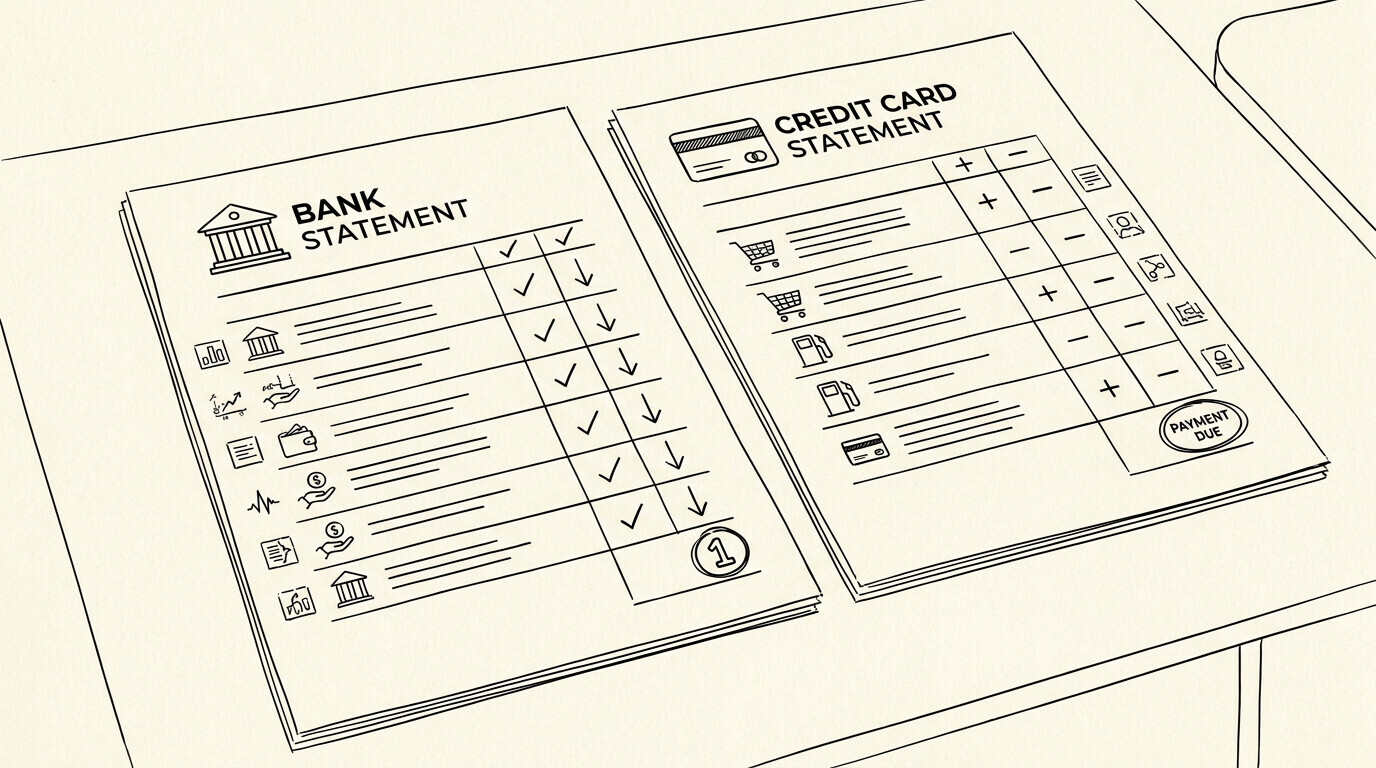
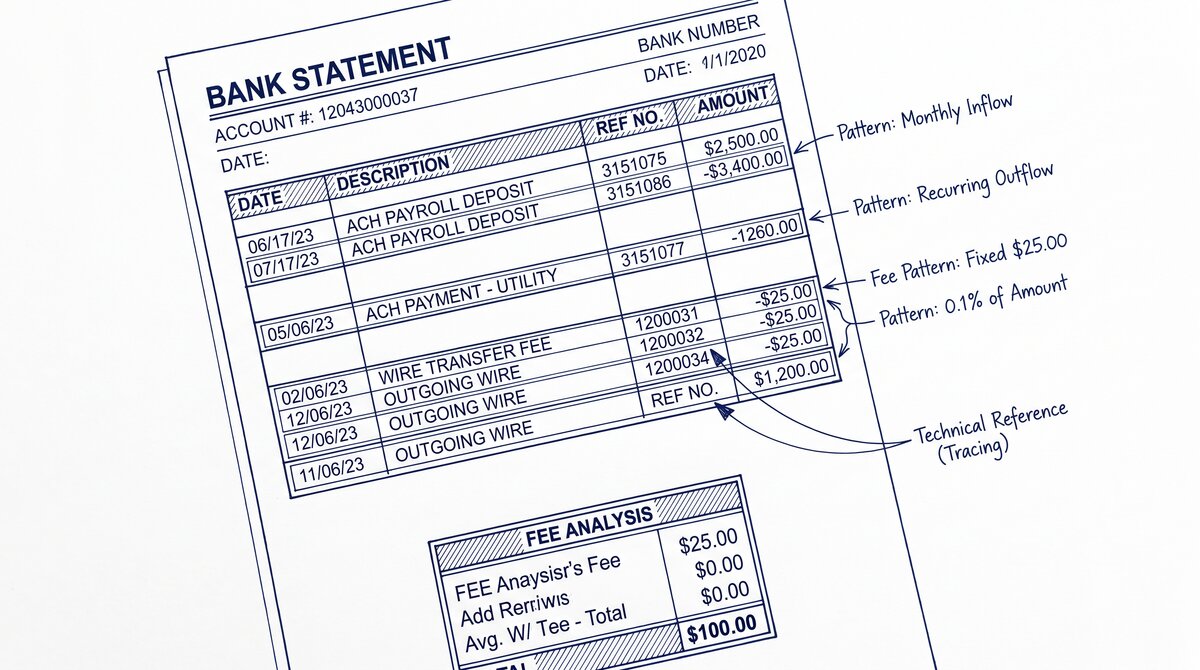
ACH and wire transfers appear differently on a bank statement. The way to identify each is by the transaction code and the description format.
ACH transactions appear as batch debits or credits with a SEC code (Standard Entry Class). Common codes include PPD (Prearranged Payment and Deposit) for consumer payments, CCD (Corporate Credit or Debit) for business payments, WEB (Internet-initiated) for online bill pay, and TEL (Telephone-initiated) for phone banking. The description typically includes the originating company name and the SEC code.
Wire transfers appear as single transactions with a 16-character IMAD (Input Message Accountability Data) or OMAD (Output Message Accountability Data) reference number. The description includes the originating bank, the beneficiary name, and sometimes the purpose. The wire fee appears as a separate line item on the sender’s statement.
Reconciling ACH and wire in accounting software (QuickBooks, Xero) requires matching the bank statement line to the originating transaction. ACH batches may need to be split if they include multiple invoices. Wire transfers typically match 1-to-1.
Limits, Errors, and Reversals
The most common error with ACH is the rejected transaction. ACH transactions can be rejected for insufficient funds (R01), invalid account number (R03), or account closed (R02). The rejection code appears on the bank statement as a reversing entry. The user has to retry the transaction or contact the recipient for a different account.
The most common error with wire is the sent-to-wrong-account. Wire is irreversible, so a wire to the wrong account is recoverable only if the recipient agrees to send it back. Banks will not reverse a wire, even for fraud, without a court order. Bookkeepers report this is the single most expensive mistake in the payment rails.
The most common error in choosing between ACH and wire is using ACH for a time-critical payment. The transfer misses the cut-off, sits in the batch overnight, and the recipient (vendor, landlord, client) flags the payment as late. The user then has to send a wire anyway, paying both the ACH fee (which is often not refunded) and the wire fee.
The pattern across all three: the choice between ACH and wire is irreversible. The cost of getting it wrong exceeds the cost of asking the bank which rail is right. A 2-minute call to the bank before a large transfer prevents a $25-$75 mistake.
The ACH vs wire transfer glossary entry covers the definitions in isolation. The bank statement converter makes both types of transactions usable in spreadsheets. The cost comparison, speed comparison, and statement appearance spokes cover the specific decision points.
For a deeper understanding, see: payment rails pillar. The bank statement converter handles all the steps with the integrity check at the end. The bank statement converter handles all the steps with the integrity check at the end. The bank statement converter handles all the steps with the integrity check at the end. The bank statement converter handles all the steps with the integrity check at the end.
From Bank Statement to QuickBooks-Ready File
That manual cleanup you just read about? This tool skips it. Turn your PDF into QBO for QuickBooks without storing your data anywhere.
Start Converting