
DTI is the percentage of your gross monthly income that goes to monthly debt payments. Lenders use it as the primary qualification
If your monthly debts are $2,000 and your gross income is $6,000, your back-end DTI is 33%, which is borderline for conventional loans but acceptable for FHA and VA programs.
This page covers what DTI is, why lenders care so much about it, how to calculate it, the difference between front-end and back-end DTI, the typical thresholds by loan type, how the bank statement fits in (especially for self-employed borrowers), how to lower DTI before applying, and the 4 common mistakes that lead to denial. For a broader look at the bank statement role in mortgage applications, see the mortgage application bank statement guide. For the full vocabulary, see the bank statement glossary.
TL;DR. DTI (debt-to-income ratio) is your total monthly debt payments divided by gross monthly income, expressed as a percentage. Lenders use 2 versions: front-end (housing only, target below 28%) and back-end (all debts, target below 36% for conventional, below 43% for FHA, below 50-55% for VA). DTI matters because it predicts whether you can afford the new loan. For self-employed borrowers, DTI is calculated from bank statement deposits, not W-2 wages. The 4 common mistakes: using net income instead of gross, excluding small debts, forgetting recent debts, and not counting co-signed loans.
What DTI (Debt-to-Income Ratio) Is
DTI is a percentage that compares what you owe each month to what you earn each month. The formula is simple: sum all monthly debt payments, divide by gross monthly income, multiply by 100 to get a percentage. Gross income means before taxes and deductions, not take-home pay, because lenders want to know what you can actually afford to commit to debt service before other obligations.
Monthly debt payments include the proposed new loan (mortgage principal, interest, taxes, insurance) plus any existing debts: car loans, student loans, credit card minimums, child support, alimony, and any other loans that show on your credit report. Lenders count the minimum payment, not the actual balance, because minimum payment is what hits your bank account each month.
A common failure mode bookkeepers report is applicants who underestimate their DTI by including only the “big” debts and forgetting small recurring obligations like store credit cards, buy-now-pay-later plans, and personal loans from family members. The fix: pull a recent credit report, list every monthly payment, and add them all up. A DTI calculator helps, but the underlying data has to be complete, which matters because understating DTI by 5% is the difference between approval and denial.
Front-End vs Back-End DTI: The 2 Calculations

Lenders use 2 DTI calculations, and the difference matters for qualification. The front-end DTI (also called the housing ratio) is just the proposed housing payment divided by gross income. For a $2,000 PITI payment on $6,000 income, the front-end DTI is 33%. The back-end DTI is all monthly debts including the housing payment, divided by gross income. For the same scenario with $2,000 in other debts, the back-end DTI is 67%, which is too high for any program.
Most lenders focus on the back-end DTI because it captures the full debt picture. Conventional loans (Fannie Mae, Freddie Mac) typically cap back-end DTI at 36%, though some allow up to 45% with compensating factors like high credit score or large reserves. FHA is more flexible, allowing back-end DTI up to 43% (and higher with strong compensating factors up to 56.9%). VA loans are the most flexible, often allowing 50-55% back-end DTI because they back the loan themselves rather than selling it to investors.
For self-employed borrowers who cannot show W-2 wages, the back-end DTI calculation is different. Instead of using a salary, the lender uses the average monthly deposits from the bank statement (typically 12 or 24 months) as the income figure. This is why bank statement loans exist, and it is why the bank statement matters so much for DTI qualification. For the full process, see the self-employed mortgage application guide.
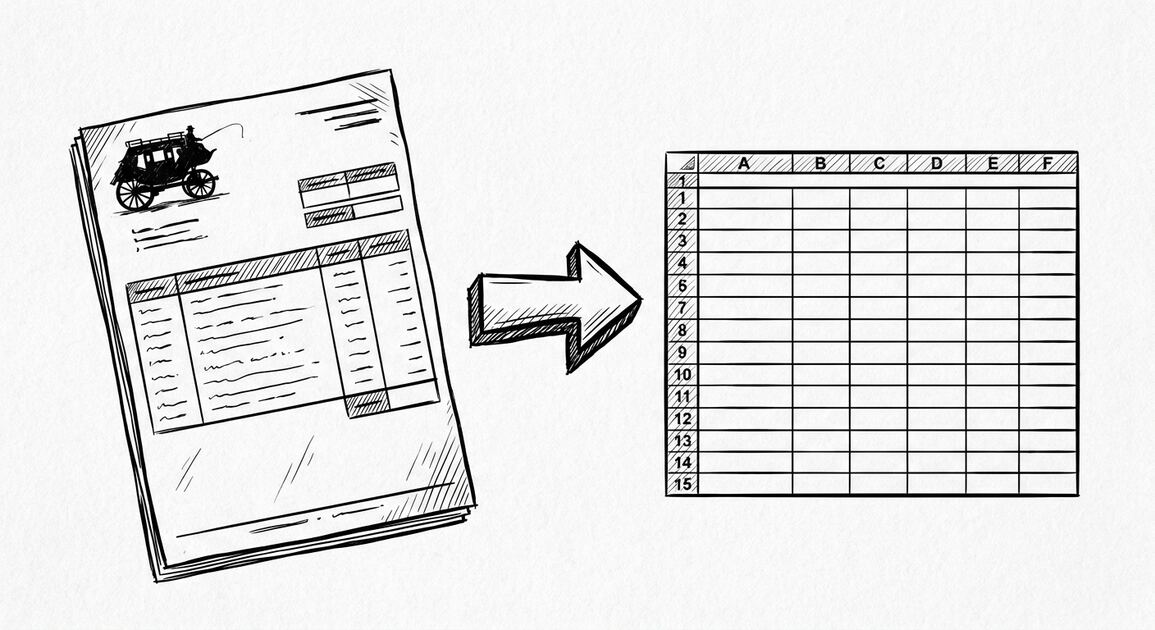
Turn PDF Bank Statements Into Workable Spreadsheets
Your bank statement is a mess of numbers, but your books shouldn't be. Use our converter to get Excel, CSV, or QBO files — ready for QuickBooks.
Try It Free NowHow to Calculate DTI: The Formula and a Worked Example
The formula is: DTI = (sum of all monthly debt payments) / (gross monthly income) x 100. The numerator includes the proposed new loan payment (principal, interest, taxes, insurance, HOA if applicable) plus all existing monthly debt payments. The denominator is gross monthly income, which means before taxes for W-2 borrowers or average monthly business deposits for self-employed borrowers.
Worked example: A borrower with a $300,000 mortgage at 7% interest for 30 years has a principal and interest payment of $1,996/month. Add $400/month for property taxes, $100/month for homeowners insurance, and $0 HOA, and the total PITI is $2,496. The borrower has a $400 car loan, $300 student loan, and $150 credit card minimum. Total monthly debts including the new mortgage: $2,496 + $400 + $300 + $150 = $3,346. Gross monthly income: $8,000. Back-end DTI: $3,346 / $8,000 x 100 = 41.8%, which is within FHA limits but above conventional limits.
Front-end DTI for the same scenario: $2,496 / $8,000 x 100 = 31.2%, which is acceptable for most programs. The back-end DTI is the binding constraint here, so the borrower would either need to pay down some debts, find a
less expensive home, or apply for an FHA or VA program with higher DTI tolerance.
DTI Thresholds by Loan Type
Different loan programs accept different DTI levels. The most common programs and their typical back-end DTI caps:
- Conventional (Fannie Mae, Freddie Mac): 36% target, up to 45% with strong compensating factors (high credit score 740+, large reserves 6+ months PITI, low LTV below 75%).
- FHA: 43% standard ceiling, up to 50% with compensating factors, up to 56.9% with automated underwriting approval and strong residual income.
- VA: 41% guideline, but the residual income test is the primary check. Many VA approvals happen at 50-55% back-end DTI because the residual income covers the affordability gap.
- USDA: 41% standard ceiling, with some flexibility for strong files.
- Jumbo (non-QM): 40-45% typical, varies by lender and investor.
- Bank statement loans (self-employed): Typically 50% max, with 12 or 24 months of bank statement deposits as the income basis.
The thresholds matter because choosing the right loan program affects whether you qualify at your current DTI. A borr
ower with 42% back-end DTI would be denied by a conventional lender but approved by FHA, which matters when comparing loan offers.
How the Bank Statement Fits Into DTI
For W-2 borrowers, the bank statement’s role in DTI is limited. The lender uses the W-2 wages or pay stubs for income, and the credit report for debts. The bank statement is used for asset verification (showing down payment and reserves) and source-of-funds documentation, but not for the DTI calculation itself. For the asset documentation requirements, see the asset verification for mortgage application.
For self-employed borrowers, the bank statement is the primary income documentation. The lender takes the average monthly deposits over 12 or 24 months and uses that figure as the gross income for the DTI denominator. This is why bank statement loans exist, and it is why the cleanliness of the bank statement matters: a statement with mixed personal and business expenses, irregular deposits, or large unexplained transactions can lead the lender to discount the income, which raises the DTI and can push the borrower over the threshold. To get a usable statement, most self-employed borrowers convert the PDF to a clean spreadsheet first, so the lender can see the deposit pattern clearly. For that workflow, see the bank statement converter.
A common failure mode is the borrower who shows 12 months of strong deposits but misses documenting 1-2 large deposits as gift funds, business loans, or asset sales. The lender counts those as income in the average, then excludes them when verifying source of funds, which creates a gap. The fix: annotate every large deposit in the statement with its source before submission, and provide separate documentation for any deposit over 2x the average monthly amount.
How to Lower DTI Before Applying
4 actions that lower DTI before applying for a mortgage:
1. Pay down credit card balances. Credit card minimums are what count for DTI, but high balances hurt credit score and signal risk. Paying balances below 30% of the limit (ideally below 10%) improves both the DTI numerator and the credit profile.
2. Avoid new debt for 6-12 months before applying. A car loan taken out 60 days before a mortgage application counts as a monthly debt and raises DTI. The same loan taken 6 months earlier (and partially paid down) has a smaller impact.
3. Refinance or consolidate student loans. Extending the term lowers the monthly payment, which lowers the DTI numerator. Income-driven repayment plans on federal student loans can also lower the counted payment.
4. Document all income sources, not just the biggest one. A spouse’s income, rental income, investment dividends, and side business deposits all count toward gross income if documented properly. Adding $1,000/month in documented side income on a $6,000 base salary drops DTI from 33% to 28%, which matters because it moves the borrower from “borderline” to “preferred.”
The 4 Common Mistakes That Lead to Denial
4 mistakes that consistently cause DTI-based mortgage denial:
1. Using net income instead of gross. Lenders use gross income, which is before taxes. Calculating DTI on net (take-home) income shows a lower percentage than the lender will calculate, so the borrower overestimates their qualification. The fix: use the gross figure from the W-2, not the take-home from the pay stub.
2. Excluding some debts. Lenders include all monthly obligations reported on the credit report. Forgetting a store card, a personal loan, or a buy-now-pay-later plan means the borrower’s DTI looks better on paper than the lender will see. The fix: pull a tri-merge credit report before applying and list every monthly payment.
3. Forgetting about new debts. A car loan taken out 30 days before the mortgage application counts as a monthly debt. So does opening a new credit card (the minimum payment shows up). The fix: freeze all new debt activity 90 days before applying.
4. Not counting co-signed loans. If the borrower co-signed a loan for a family member, the full payment counts toward the borrower’s DTI, even if the family member is the one making payments. The lender has no way to know who is actually paying, so the full payment is included. The fix: get a co-signer release letter from the lender or remove the co-sign before applying.
DTI vs LTV: The Other Major Underwriting Metric
LTV (loan-to-value) is the other primary underwriting metric. LTV is the loan amount divided by the appraised value of the property, while DTI is the borrower’s debt divided by their income. Both matter, but they measure different risks: LTV measures the lender’s risk if the borrower defaults (how much equity is in the property), while DTI measures the borrower’s ability to repay. A borrower can have a low LTV (lots of equity) but high DTI (overextended), or vice versa. For the full comparison, see the LTV definition and the DTI comparison pages.
Start with the Workflow
The fastest path is to start with the conversion step, which produces the data that every other step needs. The bank statement converter handles the PDF-to-Excel step in 2-5 minutes, with no upload to a server.
For a complete reference of the terms used throughout this article, see the bank statement glossary.
For a deeper understanding, see: rental application pillar.
Turn PDF Bank Statements Into Workable Spreadsheets
Your bank statement is a mess of numbers, but your books shouldn't be. Use our converter to get Excel, CSV, or QBO files — ready for QuickBooks.
Try It Free Now