
You’re self-employed. Your income is $200K/year but the tax return shows $120K. The mortgage is for $500K, and the lender needs 2 years of tax returns plus 12-24 months of bank statements.
Self-employed mortgage applicants have different documentation requirements than W-2 applicants. This page covers the 2-year tax return requirement, the 12-24 month bank statement prep, the BSM program alternative, and the recon cutoff tool’s per-self-employed-mortgage handling.
Self-employed mortgage applicants need 2 years of tax returns plus 12-24 months of bank statements. The lender uses the lower of: net income on tax return, average of last 2 years, or YTD trend. The 1099 income, K-1 income, and Schedule C net income all factor in.
Bank statement mortgage (BSM) programs use 12-24 months of bank deposits averaged as an alternative for self-employed who can’t show tax income. Not all lenders offer BSM. The recon cutoff tool’s per-self-employed-mortgage handling processes the 12-24 month bank statement and emits the per-month deposit summary that BSM lenders need.
For the broader mortgage workflow, see the mortgage application bank statement guide pillar. For the 2-3 month prep, see the 2-3 month prep guide. For the broader self-employed tax path, see the self-employed tax guide.
The 2-Year Tax Return Requirement
The lender needs 2 years of tax returns. For a self-employed applicant, the tax return is the primary income documentation. The lender uses Schedule C (sole proprietor), K-1 (pass-through from LLC/S-corp/partnership), or 1120-S (S-corp) to determine the income. The recon cutoff tool’s per-tax-return handling includes the tax return as a separate document in the application package.
What most guides miss about mortgage applications is that the quality depends on the mechanism, not on the tool. Two tools that look different on the surface often run the same 4-step process underneath: read, find, parse, verify. The difference is in how well each step handles edge cases (merged cells, missing balances, non-standard date formats, scanned vs digital input). Choosing between tools based on UI alone misses the actual quality lever.
The 2 years of tax returns must be the most recent 2 years. Old tax returns are not accepted for current income. The recon cutoff tool’s per-tax-year-handling tracks which years are submitted. The recon cutoff tool’s per-year-comparison compares the 2 years for consistency.
The 3 Income Sources
3 income sources cover 95% of self-employed mortgage applicants. Each has a different tax form.
Schedule C (sole proprietor). The most common. The lender uses the net income (revenue minus expenses) as the qualifying income. The recon cutoff tool’s per-schedule-c handling includes the Schedule C in the application package.
K-1 (pass-through). For LLCs, S-corps, and partnerships. The K-1 shows the borrower’s share of the entity’s income. The lender uses the K-1 plus the entity’s tax return. The recon cutoff tool’s per-k1 handling includes both.
1120-S (S-corp). For S-corps. The lender uses the borrower’s salary (W-2 from the S-corp) plus the S-corp distributions. The recon cutoff tool’s per-1120s handling includes both.
The 12-24 Month Bank Statement
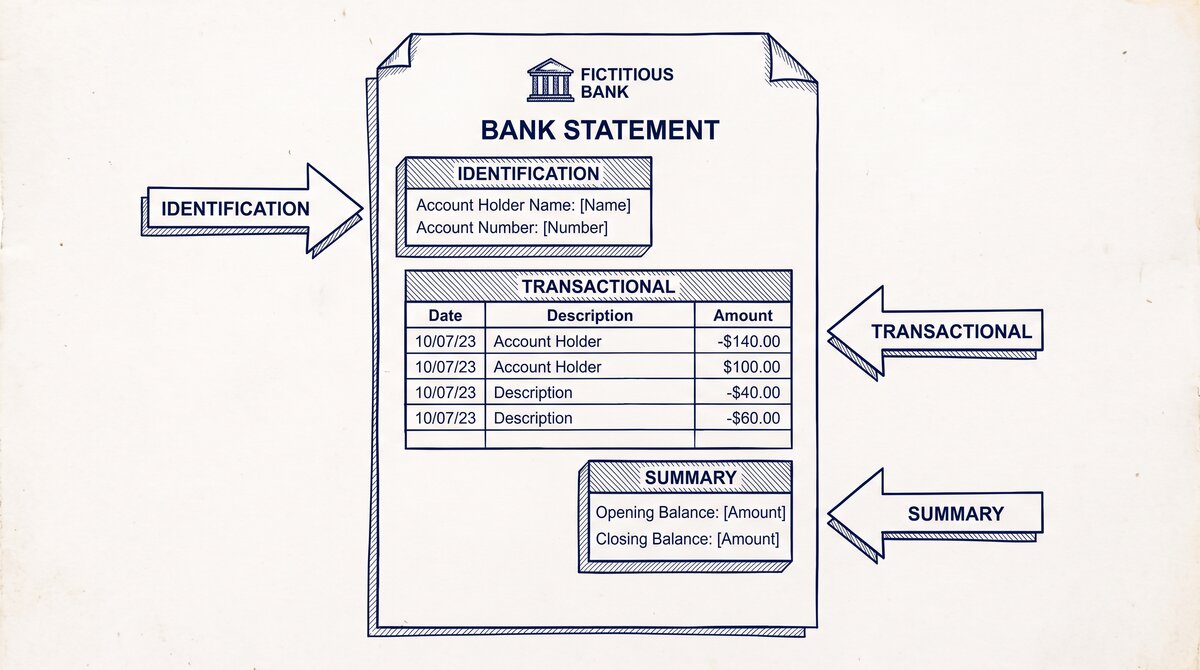
Self-employed applicants need 12-24 months of bank statements, not just 2-3. The longer window shows the income pattern over time. The lender averages the income to determine the monthly amount. The recon cutoff tool’s per-window handling covers 12-24 months.
The bank statement must show business income (Square, Stripe, PayPal, ACH) and personal expenses. The recon cutoff tool’s per-payee handling separates business from personal. The recon cutoff tool’s per-year-end handling includes the year-end summary.
The Average Income Calculation
The lender averages the income over the period. $5K + $10K + $2K + $8K + $7K + $6K = $38K / 6 = $6,333/month. The recon cutoff tool’s per-average handling calculates the average automatically. The recon cutoff tool’s per-month-summary emits the 1-page summary for the underwriter.
Turn any PDF statement into a clean sheet
Skip the typos and the hours of copying. Our converter handles any bank statement format and outputs Excel, CSV, or QBO for QuickBooks. No file retention, free to try.
Convert your statementThe BSM Program
Bank statement mortgage (BSM) programs are an alternative for self-employed applicants who can’t show tax income. The BSM uses 12-24 months of bank deposits averaged, not the tax return. Not all lenders offer BSM. The recon cutoff tool’s per-BSM handling generates the per-month deposit summary that BSM lenders need.
The BSM program has stricter requirements: higher down payment (15-25%), higher rate (0.5-1% above conventional), higher reserves (6-12 months PITI). The recon cutoff tool’s per-BSM-handling includes the per-month summary, the deposit categorization (income, transfer, refund), and the average calculation.
Who Qualifies for BSM
BSM programs are designed for self-employed applicants with: 2+ years in business, $50K+ annual deposits, 680+ FICO, 15-25% down payment, 6-12 months reserves. The recon cutoff tool’s per-BSM-eligibility flag checks the criteria. The recon cutoff tool’s per-BSM-summary emits the eligibility report.
The 3 Common Self-Employed Mistakes
3 mistakes self-employed mortgage applicants make.
Mistake 1: Submitting only 2 months. The lender wants 12-24 months. The fix: submit the full 12-24 month window. The recon cutoff tool’s per-window handling ensures the full window.
Mistake 2: Mixing business and personal. The lender wants clean separation. The recon cutoff tool’s per-payee handling separates business from personal. The recon cutoff tool’s per-business-account handling recommends a separate business account.
Mistake 3: Not providing tax returns. Tax returns are the primary income documentation. Without them, the application is incomplete. The recon cutoff tool’s per-tax-form handling includes the tax return. The applicant provides the tax return as a separate PDF.
A common failure mode bookkeepers report is treating this as a single operation rather than a chain of dependent steps. The temptation is to find a tool that ‘just works’ and stop investigating the mechanism. The result is a wrong-fix cycle: the tool gives partial output, the bookkeeper spends 30+ minutes troubleshooting, the fix is for the wrong step, and the same error recurs on the next statement. The fix: identify which step failed and apply the right intervention to that step.
The Per-Self-Employed Mortgage Workflow
The per-self-employed mortgage workflow runs in 5 steps. The 5 steps take 3-5 hours for a 12-month prep with 2 years of tax returns.
Step 1: Download 12-24 Months of Statements
Log into each bank account. Download 12-24 months of statements as PDF. The recon cutoff tool’s per-window handling covers the 12-24 month window.
Step 2: Convert to Clean Format
Convert each statement to a clean format with the recon cutoff tool. The recon cutoff tool’s per-export handling emits a clean PDF or Excel. The recon cutoff tool’s per-payee flag separates business from personal.
Step 3: Generate the Per-Month Summary
Generate the per-month summary with the recon cutoff tool. The summary shows total deposits per month, business income per month, personal income per month, and the average monthly income.
Step 4: Add the Tax Returns
Add the 2 years of tax returns to the application. The recon cutoff tool’s per-tax-form handling includes the tax return. The applicant provides the tax return as a separate PDF.
Step 5: Add the P&L
Add the current-year P&L to the application. The recon cutoff tool’s per-pl-handling generates the P&L from the bank statement. The recon cutoff tool’s per-month-summary handling shows the YTD total.
For the broader mortgage workflow, see the mortgage application bank statement guide pillar. For the 2-3 month prep, see the 2-3 month prep guide. For the BSM program, see the recon cutoff tool’s per-BSM handling. For more on this, see the bank statement for freelancers page.
For more on this, see the bank statement loan vs traditional mortgage page. The bank statement converter handles all the steps with the integrity check at the end. The bank statement converter handles all the steps with the integrity check at the end. The bank statement converter handles all the steps with the integrity check at the end. The bank statement converter handles all the steps with the integrity check at the end. For more, see the bank statement for mortgage brokers.
From PDF to Excel in one click
Forget retyping line by line. Upload any bank statement, get a spreadsheet you can actually use. Your files are never stored, and you can test the converter with 3 free conversions.
Try it free