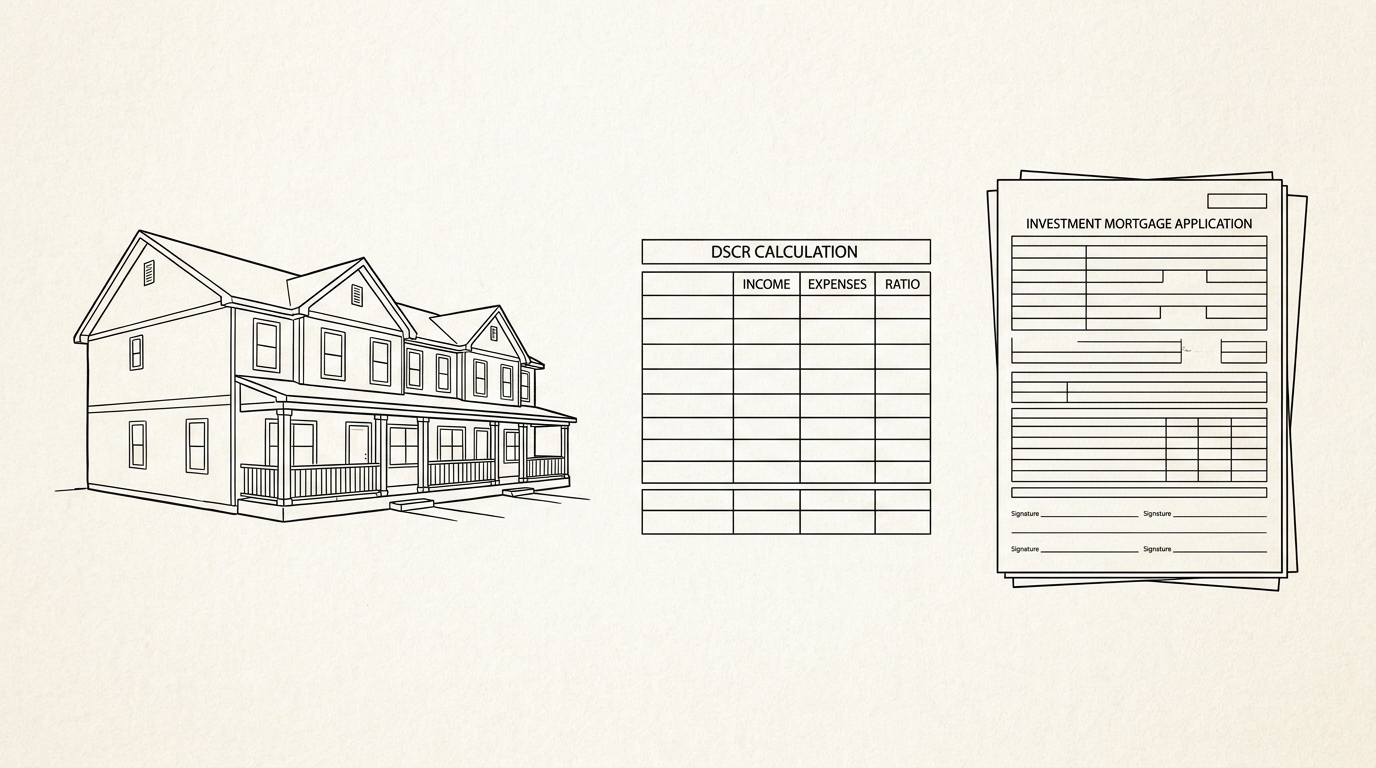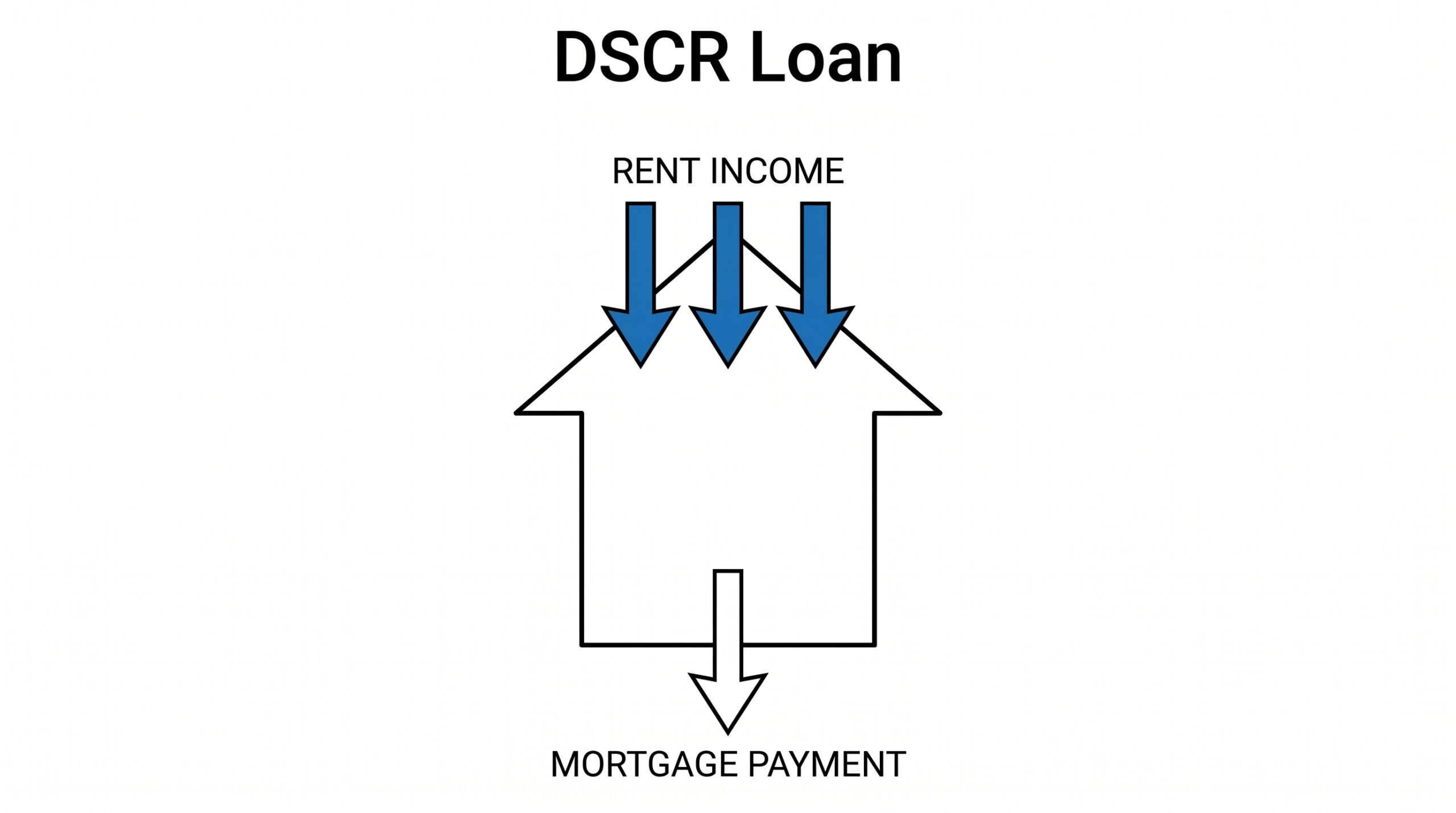

A DSCR loan lets a real estate investor qualify based on the property’s income, not their W-2. The 1.25 number is the threshold.
DSCR stands for Debt Service Coverage Ratio. It is the lender’s test that the property generates enough income to cover the mortgage payment. A DSCR of 1.0 means the property’s net operating income (NOI) exactly equals the annual mortgage payment. A DSCR of 1.25 means the property generates 25% more than the payment.
Most DSCR lenders require a minimum of 1.20-1.25, with better rates at 1.50+. The DSCR loan is the standard for real estate investors who don’t have W-2 income (or have insufficient W-2 to qualify conventionally).
DSCR is a ratio that compares a property’s net operating income to its annual mortgage payment. Lenders require 1.20-1.25 minimum, 1.50+ for best rates. The DSCR loan is the standard for real estate investors without W-2 income.
For the existing DSCR definition, see the DSCR definition guide. For the broader LTV/DTI/PITI context, see the mortgage application bank statement guide and the LTV guide.
What most DSCR guides miss is that the calculation is straightforward but the inputs are not. The property’s net operating income (NOI) depends on actual collected rent, not scheduled rent. The annual mortgage payment depends on the loan amount and interest rate. The lender uses the lower of (scheduled rent minus vacancy) or (actual collected rent) for the income.
For investors using DSCR loans on 1-4 unit rentals, the typical DSCR is 1.10-1.30 because the rental income is usually just barely above the mortgage payment. For investors using DSCR on 5+ unit commercial properties, the DSCR is typically 1.25-1.50 because the income is more diversified. The 1.25 minimum is the industry standard for residential DSCR, not the lender’s preference.
The DSCR Formula: Step by Step
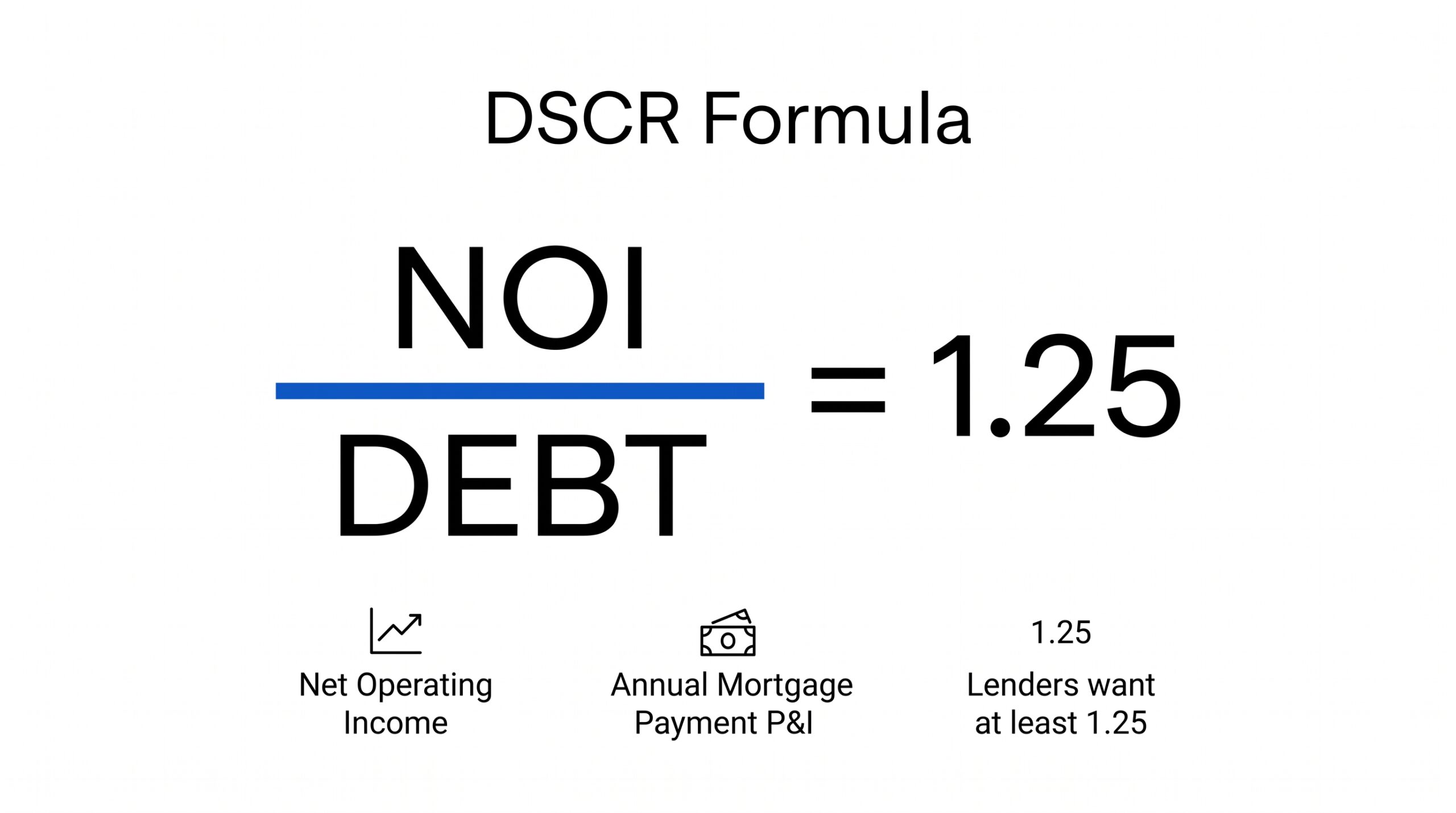
DSCR is calculated as:
DSCR = Net Operating Income / Total Debt Service
Where:
Net Operating Income (NOI). The property’s annual income after operating expenses but before debt service and taxes. NOI is calculated as: Gross Rental Income + Other Income – Vacancy Loss – Operating Expenses. The result is the property’s actual income that can be used to service debt.
Total Debt Service. The annual mortgage payment, including principal and interest. The standard formula for a fixed-rate mortgage is: P&I = Loan Amount × (r × (1+r)^n) / ((1+r)^n – 1), where r is the monthly interest rate and n is the number of months. For a $300,000 loan at 7% over 30 years, the annual P&I is approximately $23,940.
For these numbers, DSCR = $24,000 / $23,940 = 1.003. This is just above 1.0, which is the absolute minimum for most lenders. To get to 1.25 (a typical minimum for DSCR loans), the NOI would need to be $29,925, which means gross rent needs to be about $41,925 (with $12,000 in operating expenses), or operating expenses need to drop by $5,925.
DSCR by Loan Type: The Lender Thresholds
Different loan types have different DSCR requirements. The typical thresholds:
| Loan Type | Minimum DSCR | Typical Rate vs Conventional | Best For |
|---|---|---|---|
| DSCR loan (1-4 unit rental) | 1.00-1.25 | 0.5-1.5% above | Real estate investors without W-2 |
| Conventional rental (5+ units) | 1.20-1.50 | Standard conforming rates | Investors with strong W-2 |
| FHA (1-4 unit) | 1.00-1.20 | FHA rates (with MIP) | Owner-occupied with rental unit |
| Commercial (5+ units, 5+ acres) | 1.20-1.40 | Commercial rates (variable) | Apartment buildings, mixed-use |
| Portfolio lender (bank-specific) | 1.00-1.15 | Negotiated (bank-by-bank) | Local investor relationships |
Lower DSCR requirements (1.00-1.10) come with higher rates because the lender is taking more risk. The typical DSCR loan for a real estate investor has a rate 0.5-1.5% above the conventional 30-year fixed, in exchange for qualifying based on the property income rather than the borrower’s W-2 income.
For the broader loan type comparison, see the mortgage application bank statement guide.
Turn any PDF statement into a clean sheet
Skip the typos and the hours of copying. Our converter handles any bank statement format and outputs Excel, CSV, or QBO for QuickBooks. No file retention, free to try.
Convert your statementWhat Counts as NOI vs Debt Service
3 categories that count as NOI:
Gross rental income. All rent collected from tenants, including late fees and pet fees. The amount is the actual collected rent, not the scheduled rent (vacancy loss is subtracted separately).
Other income. Application fees, parking, storage, laundry, vending, pet rent, and any other property-related income the owner collects.
Effective gross income. Gross rental income + other income, less vacancy loss (typically 5-10% of gross rent) and credit loss (typically 1-2% of gross rent).
4 categories that count as operating expenses (subtracted from NOI):
Fixed expenses. Property taxes, insurance, HOA fees, property management fees. These don’t vary with occupancy.
Variable expenses. Utilities (if owner-paid), repairs and maintenance, landscaping, pest control, cleaning, turnover costs. These vary with occupancy and use.
Reserves. Capital expenditure reserve (typically 5-10% of gross rent) for future repairs, replacement reserves for appliances, HVAC, roof.
What does NOT count. Mortgage principal and interest (that’s debt service), income taxes, depreciation (a non-cash expense), capital expenditures (a balance sheet item).
DSCR by Property Type: The Practical Numbers
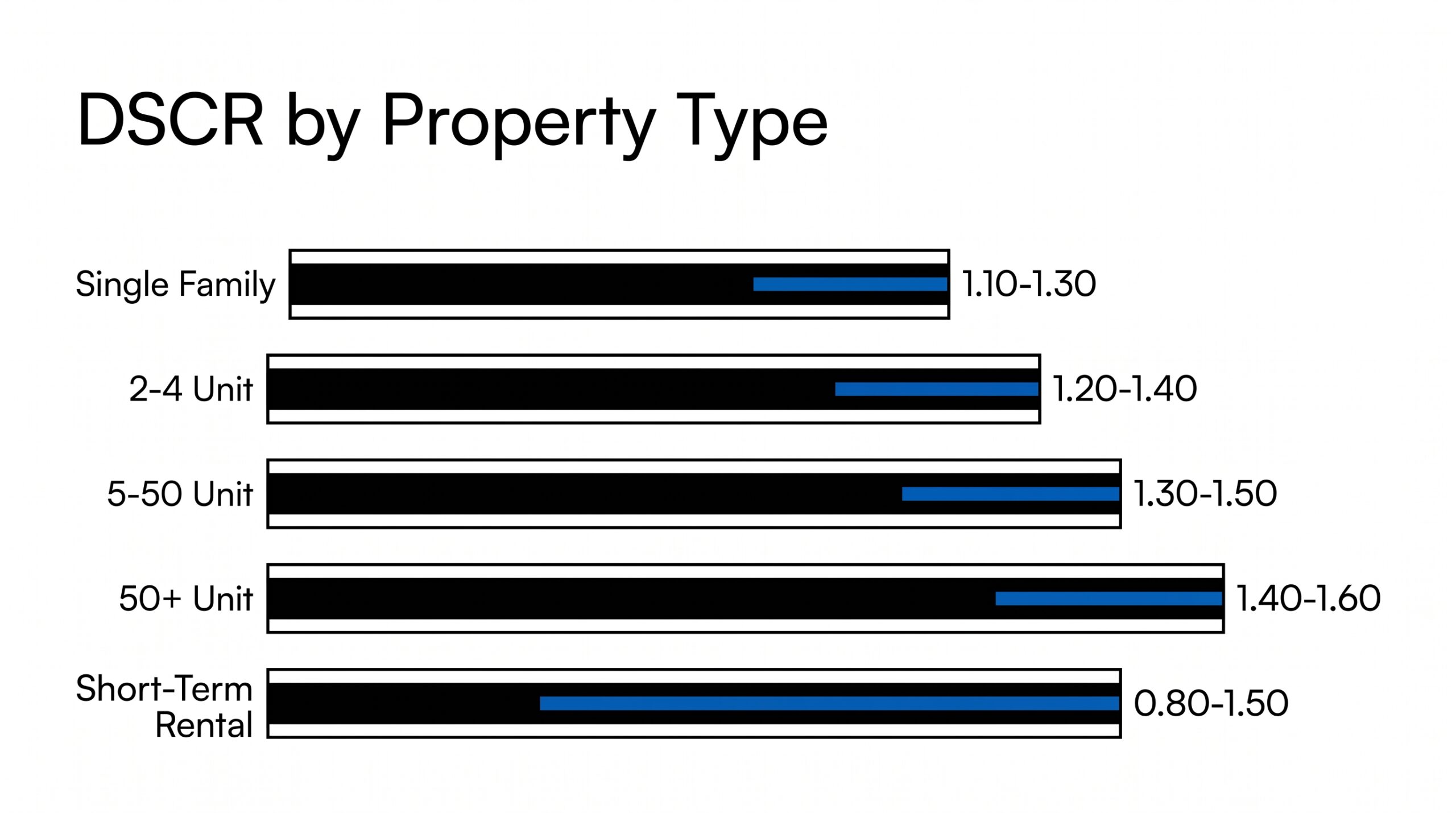
DSCR varies by property type. The typical DSCR ranges:
Single-family rental (SFR). DSCR typically 1.10-1.30. The property has 1 unit, so the income is concentrated. A 1-month vacancy (8.3%) cuts the DSCR by 8%. Most lenders want 1.20+ for SFR.
2-4 unit rental (small multifamily). DSCR typically 1.20-1.40. The property has 2-4 units, so the income is more diversified. A 1-unit vacancy cuts the DSCR by 25-50% depending on the unit count.
5-50 unit apartment building. DSCR typically 1.30-1.50. The property has 5+ units, so the income is well-diversified. A 1-unit vacancy cuts the DSCR by 2-20% depending on the unit count.
50+ unit apartment building. DSCR typically 1.40-1.60. The property is commercial, with professional management and significant operating expenses. The DSCR is calculated differently (with commercial loan terms).
Short-term rental (Airbnb, VRBO). DSCR varies 0.80-1.50. STR income is seasonal and unpredictable, so lenders use the lower of (last 12 months actual) or (forward 12 months projected). Many STR properties have DSCR below 1.0, which is why STR investors use portfolio lenders or DSCR lenders with STR-specific programs.
Commercial (office, retail, industrial). DSCR typically 1.25-1.50. The property is leased to commercial tenants, often with 5-10 year leases. The income is more stable but the property is more sensitive to economic downturns.
For the broader property type comparison, see the mortgage application bank statement guide.
DSCR vs DTI: The Comparison for Real Estate Investors
DSCR and DTI are different tests for different loan types. The key differences:
DSCR (Debt Service Coverage Ratio). Measures the property’s ability to cover the mortgage payment. Used for DSCR loans (1-4 unit rentals) and commercial loans (5+ units). The test is on the property, not the borrower.
DTI (Debt-to-Income Ratio). Measures the borrower’s ability to cover the mortgage payment based on their personal income. Used for conventional, FHA, VA, and USDA loans. The test is on the borrower, not the property.
For a real estate investor with no W-2 income, DTI is undefined (zero income, infinite ratio). DSCR is the only option. For an investor with strong W-2, DTI is typically better because conventional rates are lower than DSCR rates.
The break-even point depends on the property’s rental yield. A property with 8% gross rental yield (rent / value) and 50% expense ratio generates a 4% net yield, which is enough for DSCR 1.20 at 5% interest rate.
A property with 6% gross yield and 50% expense ratio generates 3% net yield, which is not enough for DSCR 1.20 at 5% interest rate (would need 4.5%+ net yield).
For the DTI definition, see the DTI definition guide. For the broader mortgage application context, see the mortgage application bank statement guide.
DSCR and the Bank Statement: What the Lender Needs
For a DSCR loan, the bank statement serves a different purpose than for a conventional loan. The lender is qualifying based on the property income, not the borrower’s W-2 income. The bank statement is needed to verify:
Down payment and reserves. The borrower typically needs 20-25% down plus 6-12 months of mortgage payments in reserves. The bank statement shows the source and seasoning of these funds. The down payment must be “seasoned” (in the account for 60+ days) or documented as a gift.
Rental income deposits. For refinances, the bank statement shows the actual rent collected (which determines the actual DSCR). The lender typically wants 2-3 months of recent statements showing consistent deposits. For purchases, the rent is estimated from a rent schedule or appraisal.
No W-2 or tax returns required. The DSCR loan does not require W-2s, tax returns, or employment verification. The lender is qualifying on the property, not the borrower. This is the main advantage for real estate investors with no W-2 or insufficient W-2.
Personal bank statements (not property bank statements). The lender uses the borrower’s personal bank statements to verify the down payment and reserves, not the property’s bank statements. The property’s bank statements (showing rent deposits) are typically requested as a separate document.
For the broader self-employed bank statement loan workflow, see the mortgage application bank statement guide. For asset verification, see the asset verification guide. For the workflow that produces clean bank statement data, see the bank statement converter.
The 4 Common DSCR Mistakes
4 mistakes that consistently cause problems:
1. Using scheduled rent instead of actual collected rent. Lenders want the lower of (scheduled rent – vacancy) or (actual collected rent). Inflating the rent by ignoring vacancy leads to denial. The fix: track actual collected rent for at least 2-3 months before applying.
2. Not including all operating expenses. Some expenses (utilities, landscaping, turnover) are easy to forget but must be in the NOI calculation. A property that looks profitable on rent alone may be unprofitable after all expenses. The fix: use a property management software that tracks all expenses.
3. Forgetting reserves. Most lenders require a 5-10% capital expenditure reserve. Forgetting this in the operating expense calculation inflates the DSCR. The fix: include the reserve in the operating expense line.
4. Using the wrong debt service amount. The P&I payment is fixed, but the actual debt service for DSCR purposes can include taxes, insurance, and HOA if they’re escrowed. The fully indexed PITI may differ from the P&I alone. The fix: ask the lender for the exact debt service number they use.
A common failure mode bookkeepers report is the investor overestimating NOI by using scheduled rent instead of actual collected rent, and the lender catches it at underwriting. The fix: maintain a separate rent roll that tracks actual collected rent, not scheduled rent, for at least 2-3 months before applying.
The Memorable Line
DSCR is the property’s report card. The 1.25 is the passing grade. Below that, the lender sees a property that barely covers the mortgage. Above that, the lender sees an investment worth financing.
Related Pages
For the DSCR definition, see the DSCR definition guide . For the LTV calculation that goes with DSCR, see the LTV guide and the LTV comparison . For the DTI definition (the borrower-side test), see the DTI definition guide . For the mortgage application workflow, see the mortgage application bank statement guide . For asset verification, see the asset verification guide .
For the bank statement glossary, see the bank statement glossary .
For the workflow that produces clean bank statement data for the DSCR loan application, see the bank statement converter. The output includes a payment type column and a date-sorted transaction list that the lender can verify quickly.
Related: complete mortgage application bank statement guide
This topic is one node in the broader mortgage-application bank-statement cluster on this site. he consolidated hub, with the full decision framework covering FHA, VA, conventional Fannie Mae and Freddie Mac, DSCR, and conventional loans, lives in the complete mortgage application bank statement guide.
For related reading on the broader statement-reading clusters, see the complete MCC guide and the complete US bank payment rails guide. he expanded bank statement anatomy pairs naturally with this hub as a primer.
Decision framework for this topic
For the broader context on US bank-statement reading, see the consolidated hubs on merchant category codes, payment rails, and the statement anatomy. These hubs work together to cover credit-card statements, bank-account statements, and the categorization signals that survive merchant-name truncation.
Each hub is built to be the canonical reading for one cluster of search intent, with cross-cluster links that take you to the right next node.
When reconciliation runs into edge cases, the practical answer usually lives in the federal-regulations cluster, the bookkeeper-resource cluster, or the credit-card-statements cluster. Each offers a domain-specific take on the same underlying signal. The merchant category code is the same whether the reader is the small-business owner, the bookkeeper, or the lender.
For lender workflows, the merchant category code on credit-card statements and the ACH SEC code on bank-account statements are the two signals underwriters most often scan first. Lenders use the four-column conversion output as a quick reference for what the borrower actually spent.
Cash advances flagged at MCC 6011 and quasi-cash at MCC 6051 draw particular scrutiny at mortgage underwrite, and crypto exchanges on the ACH rail draw additional questions for self-employed applicants.
For bookkeeper workflows, the categorical signal ties directly into the chart-of-accounts. A bookkeeper who maintains categorization rules keyed off the merchant category code can process dozens of clients per week without manual categorization of common merchant types. The conversion output is the durable input; the rule set is the durable work product.
Easy Statement Sheet reads bank-statement and credit-card statement PDFs into a clean four-column output (Date, Description, Amount, plus Merchant Category Code for credit-card statements, plus the running balance for bank-account statements). Files are never stored. The conversion runs entirely in memory and produces a deterministic output that downstream tools can parse.
The first three statement conversions are free, no card required. Plans start at $15 per month. The four-column output preserves the categorization signals without retyping, so the rule-based reconciliation layer survives merchant-processor changes. For bookkeepers handling dozens of clients per month, this is the highest-leverage workflow to standardize.
Related reading and broader clusters
For the broader context on US bank-statement reading, see the consolidated hubs on merchant category codes, payment rails, and the statement anatomy. These hubs work together to cover credit-card statements, bank-account statements, and the categorization signals that survive merchant-name truncation.
Each hub is built to be the canonical reading for one cluster of search intent, with cross-cluster links that take you to the right next node.
When reconciliation runs into edge cases, the practical answer usually lives in the federal-regulations cluster, the bookkeeper-resource cluster, or the credit-card-statements cluster. Each offers a domain-specific take on the same underlying signal. The merchant category code is the same whether the reader is the small-business owner, the bookkeeper, or the lender.
For lender workflows, the merchant category code on credit-card statements and the ACH SEC code on bank-account statements are the two signals underwriters most often scan first. Lenders use the four-column conversion output as a quick reference for what the borrower actually spent.
Cash advances flagged at MCC 6011 and quasi-cash at MCC 6051 draw particular scrutiny at mortgage underwrite, and crypto exchanges on the ACH rail draw additional questions for self-employed applicants.
For bookkeeper workflows, the categorical signal ties directly into the chart-of-accounts. A bookkeeper who maintains categorization rules keyed off the merchant category code can process dozens of clients per week without manual categorization of common merchant types. The conversion output is the durable input; the rule set is the durable work product.
Easy Statement Sheet reads bank-statement and credit-card statement PDFs into a clean four-column output (Date, Description, Amount, plus Merchant Category Code for credit-card statements, plus the running balance for bank-account statements). Files are never stored. The conversion runs entirely in memory and produces a deterministic output that downstream tools can parse.
The first three statement conversions are free, no card required. Plans start at $15 per month. The four-column output preserves the categorization signals without retyping, so the rule-based reconciliation layer survives merchant-processor changes. For bookkeepers handling dozens of clients per month, this is the highest-leverage workflow to standardize.
From Bank Statement to QuickBooks-Ready File
That manual cleanup you just read about? This tool skips it. Turn your PDF into QBO for QuickBooks without storing your data anywhere.
Start Converting