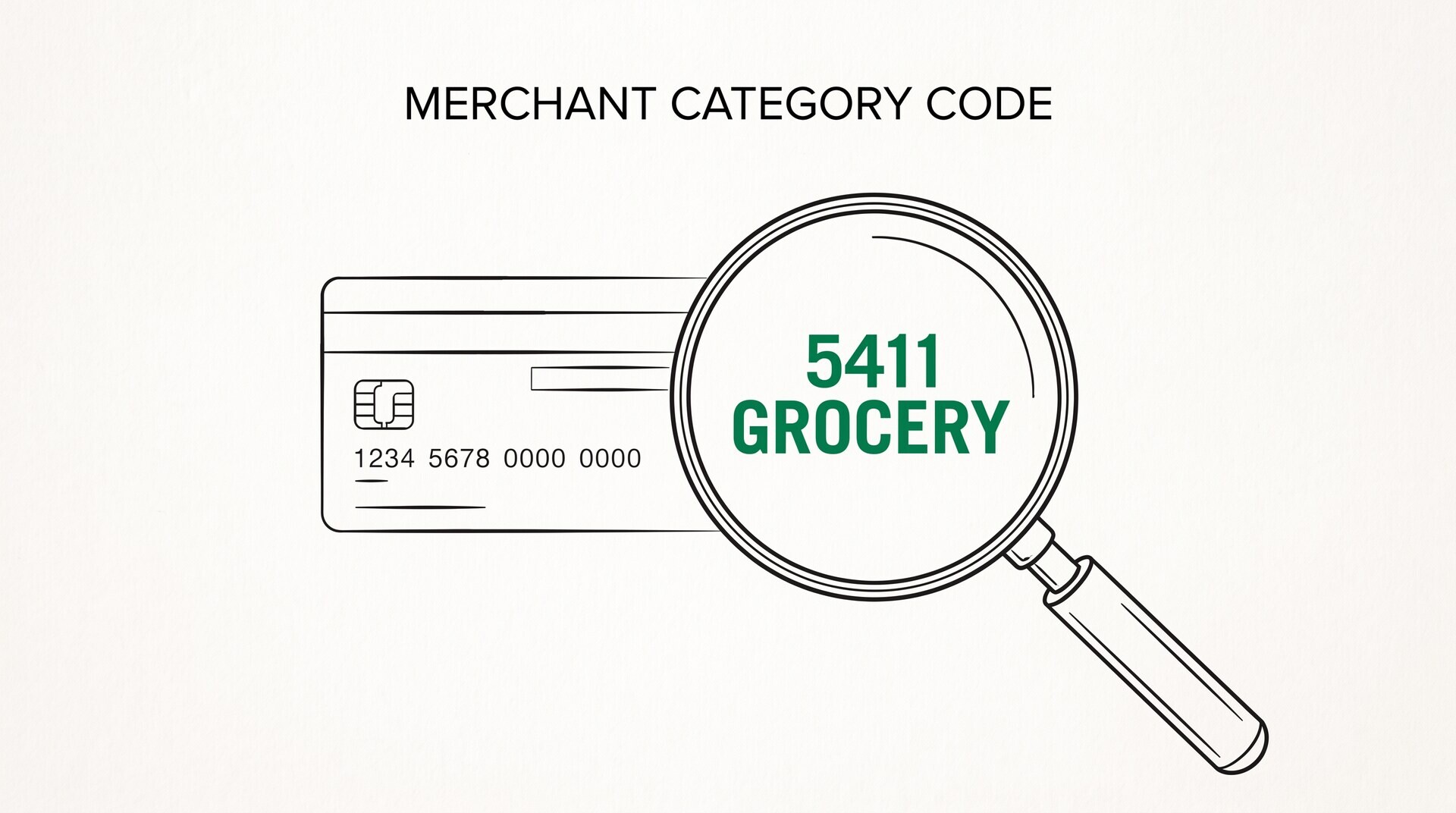

A 4-digit code on every credit card transaction tells the card network what business the merchant is in. The code is the MCC.
A Merchant Category Code (MCC) is a 4-digit number assigned by the card networks (Visa, Mastercard, Amex, Discover) to every merchant that accepts card payments. The MCC determines which credit card rewards apply, which IRS expense category the transaction falls into, and how the merchant’s statement looks. The code is standardized by ISO 18245 and is the same across all 4 networks.
MCCs range from 3000 to 9999, with 5812 (eating places) and 5411 (grocery stores) being the most common.
An MCC is a 4-digit code that classifies every card-accepting merchant into a business category. ISO 18245 standard. Used for rewards, IRS expense categorization, and merchant analytics. 3000-9999 range.
For the existing MCC reference, see the MCC on a credit card statement guide. For the full MCC list, see the complete MCC code reference. For the broader statement balance context, see the statement balance guide.
What most MCC guides miss is that the MCC affects 3 different things simultaneously: (1) credit card rewards rates (3% on dining, 4% on travel, etc.), (2) IRS expense categorization (which Schedule C line the transaction belongs to), and (3) merchant analytics (the card network tracks MCCs to understand consumer spending patterns).
Most guides focus on one of these three uses and miss the other two. The MCC is not just a number on the statement; it is a multi-purpose classification system that affects how the transaction is taxed, rewarded, and analyzed.
What Is an MCC (Merchant Category Code)?
An MCC is a 4-digit code assigned by the card networks to every merchant that accepts card payments. The code is standardized by ISO 18245 and used by all 4 major networks (Visa, Mastercard, American Express, Discover). The MCC range is 3000-9999, with 5812 (eating places, restaurants) and 5411 (grocery stores) being the most common codes by transaction volume.
The MCC is assigned when the merchant opens a card-accepting account with their bank or processor. The merchant self-reports the type of business, and the processor assigns the corresponding MCC.
The merchant cannot choose an arbitrary MCC; the code is determined by the merchant’s actual business type, with some edge cases (e.g., a gas station with a convenience store might be coded as 5541 or 5499 depending on the processor’s classification).
The 4 main uses of the MCC:
1. Credit card rewards. Card issuers use the MCC to determine which transactions get bonus points. Common bonus categories: 3% on dining (5812), 4% on gas (5541), 5% on travel (4111, 7011), 2% on groceries (5411). The merchant’s MCC determines whether the transaction qualifies for the bonus.
2. IRS expense categorization. The IRS uses the MCC to determine which Schedule C line a business expense belongs to. The mapping is not 1-to-1 (multiple MCCs can map to one Schedule C line), but the MCC is the primary signal for tax software like QuickBooks.
3. Merchant analytics. Card networks and merchant acquirers track MCCs to understand consumer spending patterns. The data is aggregated and sold to merchants for benchmarking and to networks for product development.
4. Risk and fraud detection. Card networks and issuers use the MCC to detect unusual spending patterns. A cardholder who typically spends on dining (5812) and groceries (5411) suddenly making purchases at jewelry stores (5944) and electronics stores (5732) may trigger a fraud alert.
The ISO 18245 Standard
The MCC system is defined by ISO 18245, the international standard for “Financial services – Merchant category codes.” The standard was first published in 2003 and updated several times since. The ISO standard defines:


The 4-digit code structure. All MCCs are 4 digits. The first digit is the broad category (3=travel, 4=transportation, 5=retail, 6=healthcare, 7=recreation, 8=services, 9=government). The next 3 digits refine the category.
The category descriptions. Each MCC has a standardized description. For example, MCC 5411 is described as “Grocery Stores, Supermarkets” in the ISO standard. The descriptions are not exactly the same as the card networks’ descriptions (which sometimes use slightly different terminology), but they are close.
The category hierarchy. MCCs are organized into a hierarchy. MCC 5812 (Eating Places, Restaurants) is under MCC 5813 (Bars, Cocktail Lounges, Discotheques, Nightclubs, Beer Parlors) and MCC 5814 (Fast Food Restaurants) in the same family. The hierarchy is not always intuitive, but the codes are.
The ISO standard is maintained by the International Organization for Standardization. The card networks (Visa, Mastercard, etc.) publish their own MCC lists that are based on but not identical to the ISO standard. The differences are usually minor (a few codes added or removed, slight wording changes).
From PDF to Excel in one click
Forget retyping line by line. Upload any bank statement, get a spreadsheet you can actually use. Your files are never stored, and you can test the converter with 3 free conversions.
Try it freeThe 10 Major MCC Categories
The 3000-9999 range is divided into 10 broad categories. The most common categories by transaction volume:
3000-3999: Travel and entertainment. Airlines (4511), hotels (7011), car rental (7512), travel agencies (4722), cruise lines (4411). This is the travel category, where most premium credit cards offer 3-5x points.
4000-4999: Transportation and utilities. Commuter transit (4111), taxis (4121), buses (4131), utilities (4900), telecommunications (4814). The transportation category covers local travel and services.
5000-5999: Retail. Grocery stores (5411), restaurants (5812), department stores (5311), clothing (5651), electronics (5732), drug stores (5912), office supplies (5943). The retail category is the largest by transaction volume.
6000-6999: Healthcare and professional services. Healthcare (8011), dental (8021), legal (8111), accounting (8931), consulting (7392), direct marketing (5968). This category includes both consumer and business services.
7000-7999: Recreation and entertainment. Hotels (7011), restaurants (5812, also in 5000s), recreation (7999), theaters (7832), amusement parks (7996), video rental (7841), sports (7941). The recreation category is split across multiple ranges.
8000-8999: Services. Personal services (7299), business services (7392), professional services (8111), automotive (5511), repair (7531), government (9399), education (8211), religious (8661).
9000-9999: Government and miscellaneous. Government services (9399), postal services (9402), court costs (9211), fines (9222), bail bonds (9223), tax payments (9311). The government category is mostly for tax and fee payments.
For the full list of specific MCCs with descriptions and common confusion points, see the complete MCC code reference and the MCC on a credit card statement guide.
The Most-Used MCCs (Top 30 by Transaction Volume)
The top 30 MCCs by transaction volume cover 80%+ of all card transactions. The list:
| MCC | Description | Common Bonus |
|---|---|---|
| 5411 | Grocery Stores, Supermarkets | 2-6% on most cards |
| 5812 | Eating Places, Restaurants | 3-4% on most cards |
| 5541 | Service Stations (with or without ancillary services) | 3-4% on most cards |
| 5814 | Fast Food Restaurants | 3-4% on most cards |
| 4121 | Taxicabs and Limousines | Varies by card |
| 5311 | Department Stores | 1-2% on most cards |
| 7011 | Lodging – Hotels, Motels, Resorts | 3-5% on travel cards |
| 4111 | Local and Suburban Commuter Transportation | Varies by card |
| 5912 | Drug Stores and Pharmacies | 2-3% on most cards |
| 5499 | Miscellaneous Food Stores | Varies by card |
| 5943 | Stationery, Office Supplies | 1-2% on most cards |
| 5651 | Family Clothing Stores | 1-2% on most cards |
| 5732 | Electronics Stores | 1-2% on most cards |
| 7538 | Automotive Service Shops | Varies by card |
| 6011 | Financial Institutions – Automated Cash Disbursements | 0% (no bonus) |
| 4900 | Utilities – Electric, Gas, Water, Sanitary | 1-2% on most cards |
| 4814 | Telecommunications Services | 1-2% on most cards |
| 4511 | Airlines, Air Carriers | 3-5% on travel cards |
| 4722 | Travel Agencies and Tour Operators | 3-5% on travel cards |
| 5813 | Bars, Cocktail Lounges, Nightclubs | 3-4% on most cards |
| 5999 | Miscellaneous and Specialty Retail Stores | Varies by card |
| 5968 | Direct Marketing – Continuity/Subscription | Varies by card |
| 4214 | Motor Freight Carriers, Trucking | Varies by card |
| 5532 | Automotive Tire Stores | Varies by card |
| 5065 | Electrical Parts and Equipment | Varies by card |
For the full list of 100+ specific MCCs, see the complete MCC code reference.
MCC and Credit Card Rewards: How It Works
Credit card rewards programs use the MCC to determine which transactions get bonus points. The 5 most common bonus MCCs:
For more on this, see common MCC codes.
Dining (MCC 5812, 5813, 5814). Most cards give 3-4x points on dining. 5812 is the main dining MCC, but 5813 (bars) and 5814 (fast food) are also typically included. Some cards exclude 5813 or 5814, so check the terms.
Gas (MCC 5541). Most cards give 3-4x points on gas. 5541 covers service stations (gas stations with repair services). 5983 covers fuel dealers (truck stops, marinas). Some cards include both, some only 5541.
Travel (MCC 3000-3999 for airlines, 7011 for hotels, 4111 for transit). Most travel cards give 3-5x points on travel. The specific MCCs vary by card issuer. Premium travel cards (Chase Sapphire Reserve, Amex Platinum, Capital One Venture X) give 5-10x on specific travel categories.
Groceries (MCC 5411). Most cards give 2-3x on groceries. 5411 is the main grocery MCC, but 5499 (miscellaneous food stores) and 5921 (package stores, beer, wine) may or may not be included.
Streaming (MCC 4899, sometimes 5968). Some cards give 2-3x on streaming subscriptions. 4899 (cable, satellite, other) and 5968 (direct marketing, subscription) may qualify depending on the merchant.
Common mistake: assuming a merchant is in the bonus category based on what it sells, not based on its MCC. A restaurant coded as 5812 gets dining bonus. A restaurant coded as 5499 (misc food stores) does not. The MCC, not the product, determines the category.
For the full credit card rewards and MCC mapping, see the MCC on a credit card statement guide.
MCC and IRS Schedule C: The Mapping for Self-Employed
Self-employed people using business credit cards need to map MCCs to IRS Schedule C categories. The MCC on the statement determines the expense category. The mapping is not 1-to-1 (multiple MCCs can map to one Schedule C line), but here are the most common ones:
Cost of Goods Sold (Schedule C Line 4): MCCs for inventory purchases: 5411 (grocery, for restaurants), 5499 (misc food stores), 5311 (department stores, for resellers), 5943 (office supplies, for resellers).
Advertising (Schedule C Line 8): MCCs: 7311 (advertising services), 5968 (direct marketing, subscription), 5732 (electronics, for advertising equipment).
Car and Truck Expenses (Schedule C Line 9): MCCs: 5541 (gas), 5983 (fuel dealers), 7538 (auto service), 5532 (tire stores), 5511 (car dealers, for vehicle purchase).
Office Expense (Schedule C Line 18): MCCs: 5943 (stationery, office supplies), 5111 (stationery, office supplies), 5021 (office furniture), 5734 (software, for office use).
Travel (Schedule C Line 24a): MCCs: 7011 (hotels), 4511 (airlines), 4121 (taxis), 4111 (transit), 7012 (timeshares), 4722 (travel agencies).
Meals (Schedule C Line 24b, 50% deductible): MCCs: 5812 (restaurants), 5813 (bars), 5814 (fast food), 5811 (caterers). All 581x codes for business meals are 50% deductible.
Utilities (Schedule C Line 25): MCCs: 4814 (telecommunications), 4900 (utilities), 4899 (cable, internet), 4812 (telephone).
Other Expenses (Schedule C Line 27a): MCCs: 7392 (consulting), 8111 (legal), 8931 (accounting), 8011 (healthcare), 8021 (dental).
For the full Schedule C mapping and how to use it in tax preparation, see the complete MCC code reference.
How to Find Your MCC on a Bank Statement
The MCC appears in 3 places on a typical credit card statement:
1. In the transaction description. Some statements show the MCC directly in the transaction line. Most statements do not; the MCC is in the detail view.
2. In the merchant detail. Click any transaction in online banking to see the merchant detail. The MCC is typically listed under “Merchant Information” or “Category Code.”
3. In the merchant category summary. Some statements group transactions by MCC and show the totals per category. The summary is at the end of the statement.
For specific banks:
Chase. The MCC appears in the transaction detail view. Click any transaction → “View Details” → the MCC is listed under “Merchant Information.” Chase uses 4-digit ISO 18245 MCCs.
Bank of America. The MCC appears in the transaction detail. Click any transaction → “More Details” → look for “Merchant Category” or “MCC.”
Capital One. The MCC appears in the transaction detail view. Click any transaction → “Transaction Details” → the MCC is listed under “Merchant Information.”
American Express. The MCC appears in the “Merchant Information” section of the transaction detail. Amex uses 4-digit ISO 18245 MCCs.
Citi. The MCC appears in the transaction detail view. Click any transaction → “View Details” → look for “Merchant Category” or “MCC.”
For the workflow that produces clean bank statement data with the MCC identified, see the bank statement converter. When the source PDF carries the merchant category code label inline, Easy Statement Sheet preserves it as part of the merchant description.
The 4 Common MCC Mistakes
4 mistakes that consistently cause problems:
1. Assuming a merchant is in the bonus category based on what it sells. A restaurant coded as 5812 gets dining bonus. A restaurant coded as 5499 does not. The MCC, not the product, determines the category. The fix: check the MCC in the transaction detail before assuming the bonus applies.
2. Misclassifying expenses on Schedule C. Using the wrong MCC-to-Schedule-C mapping leads to misclassified expenses. The fix: use the MCC on the statement as the primary signal, not the merchant name.
3. Not checking the MCC on refund or chargeback transactions. A refund typically uses the same MCC as the original transaction. A chargeback may use a different MCC (e.g., 5968 for direct marketing). The fix: verify the MCC on the credit to ensure the expense category is correct.
4. Relying on the merchant name to determine the MCC. A “restaurant” can be coded as 5812, 5813, 5814, or 5499 depending on the merchant’s actual category. The merchant name does not determine the MCC; the processor’s classification does. The fix: always check the MCC in the transaction detail, not the merchant name.
A common failure mode bookkeepers report is missing the MCC on a transaction and accidentally categorizing the expense into the wrong Schedule C line. The fix: ensure the bank statement data includes the merchant category code label inline with the merchant description.
If the source PDF does not include the merchant category code label inline with the merchant descriptionC, the bank statement converter may not be able to recover it, but the merchant name + transaction amount can usually identify the MCC via lookup.
The Memorable Line
The MCC is the merchant’s business card, in 4 digits. Same for every network, standardized globally, but each card uses it differently. Master the MCC, master the rewards.
Related Pages
For the MCC on a credit card statement, see the MCC on a credit card statement guide . For the full MCC code list, see the complete MCC code reference . For the statement balance context, see the statement balance guide . For the credit card statement workflow, see the credit card statement guide .
For the bank statement glossary, see the bank statement glossary .
For the workflow that produces clean bank statement data with the MCC identified, see the bank statement converter. When the source PDF carries the merchant category code label inline, Easy Statement Sheet preserves it as part of the merchant description.
For more on this, see convert credit card statements.
How this page relates to the complete MCC hub
This page covers the basics of merchant category codes at the level a beginner needs. The consolidated overview of the entire MCC system now lives in the complete MCC guide, which is the more thorough modern hub covering what an MCC is, where it shows up on statements, why the three US card networks diverge on labels, and the four most common dispute scenarios.
For the full code-by-code reference covering every MCC 0001 through 9999, see the complete MCC code reference. For what every column on a US bank statement means and how to pair MCC reading with the rest of your statement data, see the expanded bank statement anatomy.
From Bank Statement to QuickBooks-Ready File
That manual cleanup you just read about? This tool skips it. Turn your PDF into QBO for QuickBooks without storing your data anywhere.
Start Converting