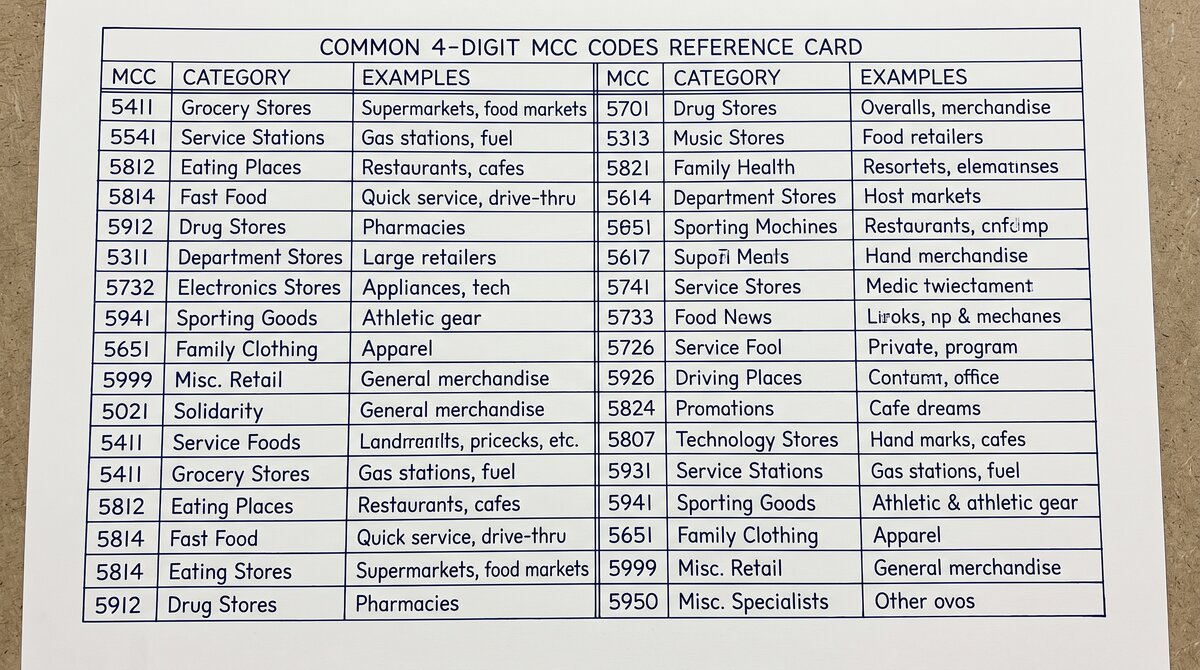

A Merchant Category Code (MCC) is a 4-digit code assigned by the card network (Visa, Mastercard, American Express, Discover) to each merchant that accepts the network’s cards. There are about 600 MCCs total, but only 30 cover 80% of consumer cardholder expenses.
The MCC determines rewards rates, maps to IRS Schedule C lines for business tax categorization, and is invisible on most consumer credit card statements. Note: 8949 is NOT an MCC. It is the IRS Form 8949 for capital gains and losses, frequently confused with MCCs because of the 4-digit number format.
Quick MCC Code Lookup (All 50+ Most-Searched Codes)
Use this table when you need to find a merchant’s MCC. The MCC appears on your credit card statement as a 4-digit code, either next to the merchant name or in the transaction details.
| MCC | Category | Example Merchants |
|---|---|---|
| 1099 | Financial Services (Misc) | Currency exchanges, money orders |
| 1799 | Contractors (Misc) | Special trade contractors |
| 4121 | Taxicabs and Rideshares | Uber, Lyft, local taxi |
| 4722 | Travel Agencies | Online travel agencies, tour operators |
| 4814 | Telecommunications | Phone, internet, cable |
| 4816 | Computer Network/Info Services | Cloud services, hosting |
| 4829 | Money Orders | Wire transfers via money order |
| 4900 | Utilities | Electric, gas, water, trash |
| 5039 | Building Materials | Lumber yards, hardware stores |
| 5046 | Commercial Equipment | Office machines, fixtures |
| 5200 | Home Supply Stores | Hardware, paint, lumber (larger) |
| 5251 | Hardware Stores | Home Depot, Lowe’s, Ace |
| 5262 | Marketplaces | Online marketplaces (non-classified) |
| 5310 | Discount Stores | General discount retailers |
| 5399 | General Merchandise | Variety stores, general goods |
| 5411 | Grocery Stores | Supermarkets, food stores |
| 5422 | Frozen Food | Frozen meat, seafood, dairy |
| 5499 | Food Stores (Misc) | Specialty food markets |
| 5533 | Automotive Parts | AutoZone, O’Reilly, NAPA |
| 5541 | Service Stations | Gas stations (with/without services) |
| 5542 | Automated Fuel Dispenser | Self-service gas pumps |
| 5691 | Men’s/Women’s Clothing | Apparel stores |
| 5699 | Apparel (Misc) | Clothing accessories, specialty |
| 5734 | Computer Software | Software purchases (boxed/download) |
| 5812 | Eating Places/Restaurants | Sit-down restaurants, cafes |
| 5813 | Drinking Places | Bars, nightclubs, lounges |
| 5814 | Fast Food Restaurants | McDonald’s, Wendy’s, etc. |
| 5815 | Digital Goods | App stores, streaming media |
| 5816 | Digital Goods (Games) | Video games, in-game purchases |
| 5817 | Digital Goods (Misc) | Software as a service (some) |
| 5944 | Jewelry Stores | Fine jewelry, watches |
| 5967 | Direct Marketing (Inbound) | Telesales, inbound telemarketing |
| 5968 | Direct Marketing (Outbound) | Outbound telemarketing, subscriptions |
| 5969 | Direct Marketing (Other) | Other DM services |
| 5999 | Misc Retail | Tobacco, florists, gift shops |
| 6011 | Automated Cash Disbursement | ATM withdrawals |
| 6012 | Financial Institutions | Banks, credit unions (in-person) |
| 6051 | Quasi-Cash | Crypto, foreign currency, money orders |
| 6300 | Insurance Sales/Underwriting | Insurance premiums |
| 6513 | Real Estate Agents | Rental payments to agents |
| 6540 | Financial Institutions (Stored Value) | Gift cards, prepaid cards |
| 7011 | Lodging (Hotels/Motels/Resorts) | Hotels, Airbnb (some) |
| 7299 | Personal Services (Misc) | Photographers, event planners |
| 7399 | Business Services (Misc) | Consulting, advertising |
| 7512 | Car Rental | Hertz, Enterprise, Turo |
| 7922 | Theatrical Producers | Concert venues, theatrical events |
| 7994 | Video Game Arcades | Arcade facilities |
| 7995 | Betting/Track/Casino | Online gambling, sports betting |
| 7997 | Membership Clubs | Country clubs, gym memberships |
| 8011 | Doctors | Medical doctors (not dentists) |
| 8099 | Medical Services (Misc) | Labs, clinics, health services |
| 8299 | Educational Services | Schools, colleges, tutoring |
| 8999 | Professional Services (Misc) | Lawyers, accountants, consultants |
What a Merchant Category Code Is
A Merchant Category Code is a 4-digit number assigned by the card network to each merchant. The code classifies the type of business the merchant operates, not the specific transaction. A gas station is 5541 whether the customer buys $20 or $200 of fuel. A grocery store is 5499 whether the customer buys milk or a full cart.
What most guides miss about credit card statements is that the quality depends on the mechanism, not on the tool. Two tools that look different on the surface often run the same 4-step process underneath: read, find, parse, verify. The difference is in how well each step handles edge cases (merged cells, missing balances, non-standard date formats, scanned vs digital input).
Choosing between tools based on UI alone misses the actual quality lever.
Who Assigns the Code
The merchant’s acquiring bank (the bank that processes the card transactions) assigns the MCC based on the merchant’s primary business activity. The acquirer submits the MCC to the card network, and the network includes it in the transaction data sent to the card issuer.
For most consumer credit cards, the MCC is part of the authorization data but is not visible on the statement. The cardholder sees the merchant descriptor (e.g., “SHELL #12345”) but not the MCC (e.g., 5541). For business credit cards, the MCC may be visible in the transaction data and is the basis for expense categorization.
Why It Matters
The MCC affects three things:
- Rewards rates: many credit cards offer higher rewards for specific categories (e.g., 3% on dining, 2% on gas). The MCC determines which category a transaction falls into. A charge at a restaurant coded 5812 earns dining rewards; a charge at a grocery store coded 5499 earns grocery rewards.
- Tax categorization: businesses use the MCC to map credit card transactions to IRS Schedule C lines. A 5943 (office supplies) charge maps to line 18; a 5541 (gas) charge for a delivery vehicle maps to line 9 (car and truck expenses).
- Merchant fees: the MCC determines the interchange fee the merchant pays to the card network. A 5812 (restaurant) charge has a higher interchange fee than a 5499 (grocery) charge, which is why some merchants push customers toward debit cards.
Turn any PDF statement into a clean sheet
Skip the typos and the hours of copying. Our converter handles any bank statement format and outputs Excel, CSV, or QBO for QuickBooks. No file retention, free to try.
Convert your statementThe 30 Most Common MCC Codes
The 30 most common MCCs cover approximately 80% of consumer cardholder expenses. The full list with categories and typical merchants:
| MCC | Category | Typical Merchants |
|---|---|---|
| 5411 | Grocery Stores | Supermarkets, grocery stores |
| 5499 | Misc Food Stores | Specialty food, health food, bakeries |
| 5541 | Service Stations | Gas stations, fuel |
| 5812 | Eating Places/Restaurants | Restaurants, fast food, cafes |
| 5813 | Bars/Cocktail Lounges | Bars, pubs, nightclubs |
| 5814 | Fast Food Restaurants | McDonald’s, Burger King, etc. |
| 5912 | Drug Stores/Pharmacies | CVS, Walgreens |
| 5943 | Stationery/Office Supplies | Office Depot, Staples |
| 5968 | Direct Marketing – Subscription | Monthly boxes, recurring subs |
| 6011 | Financial Inst – ATM Cash | ATM cash withdrawals |
| 6051 | Quasi-Cash | Money orders, crypto, travelers checks |
| 7011 | Lodging | Hotels, motels (not timeshares) |
| 7512 | Automobile Rental | Rental cars, truck rental |
| 7832 | Motion Picture Theaters | Movie theaters |
| 7922 | Theatrical Producers | Live theater, concerts |
| 7995 | Betting/Casino Gambling | Casinos, sports betting |
| 8062 | Hospitals | Hospitals, medical centers |
| 8099 | Health Services | Doctors, dentists, clinics |
| 8111 | Legal Services | Attorneys, legal aid |
| 8211 | Elementary/Secondary Schools | K-12 tuition |
| 8220 | Colleges/Universities | Higher education tuition |
| 8241 | Correspondence Schools | Online schools |
| 8351 | Child Care Services | Daycare, preschools |
| 8641 | Civic/Social Associations | Memberships, fraternal orgs |
| 8661 | Religious Organizations | Churches, religious donations |
| 8699 | Membership Organizations | Trade associations |
| 8999 | Professional Services | Misc professional (not classified) |
| 9222 | Fines | Court fines, government penalties |
| 9311 | Tax Payments | Tax payments to government |
| 9399 | Government Services | Misc government (not classified) |
This table covers the codes a typical cardholder is most likely to encounter. The full MCC list is published by each card network and is available on the card network’s website.

This page is a focused shortlist of the 25-or-so merchant category codes most often seen on US credit-card statements. The codes shown here are common across personal and small-business cards. For the complete code-by-code reference covering every MCC, see the complete merchant category code reference. For broader context on how MCCs flow from merchant to statement, see the MCC codes complete guide.
How MCC Maps to IRS Schedule C
For self-employed individuals and small business owners, the MCC is the basis for mapping credit card transactions to IRS Schedule C lines. The mapping depends on the type of business, but common mappings include:
| MCC | Schedule C Line | When |
|---|---|---|
| 5541 | Line 9 (Car and truck expenses) | For delivery vehicles, business use |
| 5812, 5813, 5814 | Line 24b (Meals) | 50% deductible for business meals |
| 5943 | Line 18 (Office expense) | Office supplies, software |
| 7011 | Line 20 (Travel) | Business travel lodging |
| 7512 | Line 20 (Travel) | Business rental cars |
| 8099, 8062 | Line 14 (Employee benefits) or Line 17 (Legal/professional) | Health services |
| 8211, 8220 | Line 13 (Rent/lease) or Line 18 (Office) | School tuition as business expense |
| 8699 | Line 27a (Other expenses) | Memberships, subscriptions |
| 8999 | Line 27a (Other expenses) | Misc professional services |
| 9222 | Line 27a (Other expenses) | Fines are generally NOT deductible |
| 9311 | Line 27a (Other expenses) | Tax payments – depends on type |
The IRS does not have a formal mapping table. The mapping is based on the business activity and the IRS’s general rules for what is deductible. A bookkeeper or accountant typically does the mapping for the client.
The 3 Codes People Search For That Are Not MCCs
Some 4-digit numbers look like MCCs but are not. The most common confusion is with IRS forms.
8949 (Not an MCC: IRS Form 8949)
Form 8949 is the IRS Sales and Other Dispositions of Capital Assets form. It is used to report capital gains and losses. A user who searches for “8949 MCC” is often looking for the form, not an MCC. The confusion arises because both MCCs and IRS form numbers are 4 digits.
1099 (Not an MCC: IRS Form 1099)
Form 1099 is a series of IRS information returns (1099-INT, 1099-MISC, 1099-B, 1099-DA, etc.). Same confusion as 8949: 4 digits, looks like an MCC.
W-2 (Not an MCC or 4 digits: IRS Form W-2)
W-2 is the IRS wage and tax statement. Not 4 digits, so less likely to be confused.
For users who search for these numbers, the answer is to redirect them to the IRS form, not to a card network.
How to Find the MCC on Your Credit Card Statement
Most consumer credit card statements do not show the MCC. The merchant descriptor is the only visible information. The MCC is in the transaction data, accessible via:
- Online banking: some banks include the MCC in the transaction details (click on the charge to see more)
- Card network apps: Visa, Mastercard, Amex, and Discover have apps that may show the MCC
- Business credit cards: business cards often include the MCC in the transaction data
- Cardholder statements of work: for high-volume transactions, the cardholder can request a data feed that includes the MCC
For the cardholder who needs the MCC for expense categorization, the easiest approach is to use a transaction data export from the bank (CSV, OFX, QFX) and parse the MCC field. The credit card statement to Excel workflow covers the export and parsing.
A common failure mode bookkeepers report is treating this as a single operation rather than a chain of dependent steps. The temptation is to find a tool that ‘just works’ and stop investigating the mechanism.
The result is a wrong-fix cycle: the tool gives partial output, the bookkeeper spends 30+ minutes troubleshooting, the fix is for the wrong step, and the same error recurs on the next statement. The fix: identify which step failed and apply the right intervention to that step.
When the MCC Matters for Rewards and Fees
For most consumer cardholders, the MCC is invisible and irrelevant. The merchant descriptor is what they see and remember. The MCC becomes relevant in three scenarios:
- Category-specific rewards: when the cardholder has a card with category bonuses (3% on dining, 2% on gas), the MCC determines which transactions earn the bonus. A restaurant coded 5812 earns the dining bonus; a restaurant coded 5814 (fast food) may or may not, depending on the card’s terms.
- Business expense categorization: when the cardholder is a business owner, the MCC is the basis for mapping transactions to IRS Schedule C. The merchant descriptor is not sufficient; the MCC is what makes the mapping rule-based.
- Disputed charges: when the cardholder disputes a charge, the MCC may be relevant. A charge coded 5968 (direct marketing subscription) is treated differently from a charge coded 5499 (grocery) for dispute purposes.
The MCC 4814 (telecommunication) sub-pillar covers phone, internet, and streaming codes. The MCC 5968 (direct marketing subscription) sub-pillar covers subscription merchants. The MCC 6011 (ATM cash) sub-pillar covers ATM cash withdrawals. The MCC glossary entry covers the definition in isolation. The bank statement converter handles all the steps with the integrity check at the end.
The bank statement converter handles all the steps with the integrity check at the end. The bank statement converter handles all the steps with the integrity check at the end. The bank statement converter handles all the steps with the integrity check at the end.
How this shortlist relates to the rest of the MCC content
This page lists 25-or-so codes that show up most often on US credit-card statements. It is not a substitute for the full reference table. The complete merchant category code reference covers every MCC 0001 through 9999 across all US card networks, including the issuer-level overlays that diverge on subtle categories (Visa, Mastercard, American Express, Discover).
If you are trying to identify one specific code on your statement, the dedicated explainer pages on this site go deeper per code. The MCC 5816 explainer, the MCC 5541 service stations explainer, and the MCC 6051 quasi-cash explainer are three representative examples. The same naming convention covers every short code explainer.
The consolidated overview is the complete guide to MCC codes on bank statements, which covers what an MCC is, where it lives on your statement, why the three US networks use slightly different reference tables, and the four most common dispute scenarios. Treat the shortlist on this page as a quick lookup; treat the complete reference as the deep dive.
MCC codes in practice for reconciliation
Common MCC codes matter when you reconcile a credit-card statement against your bank-account statement, because each network’s MCC label differs slightly from the merchant name on your statement. The net effect is that two adjacent transactions at the same coffee shop can show up under different MCC labels, depending on whether the merchant uses Chase’s merchant services, Square, Toast, or a regional processor.
Understanding the MCC, not the merchant name, is what lets a credit-card statement survive reconciliation when the acquirer routing changes mid-year.
If you are doing monthly reconciliation, treat the MCC as your primary signal and the merchant description as your secondary. Most small-business accounting software uses the MCC for default category mapping, but the merchant description for ad-hoc vendor recognition. The two together make the reconciliation robust.
When you run a mortgage preapproval, lenders look at the MCC distribution on your bank and credit-card statements as a proxy for income stability. Restaurants and bars (MCC 5812, 5813, 5814) draw more scrutiny than grocery (MCC 5411). Cash advances (MCC 6012) and crypto (MCC 6051) often disqualify a borrower or trigger manual review.
If your statement has a heavy concentration of these codes, prepare explanations before the lender asks.
Most small businesses do not see MCC codes on their checking-account statements, because ACH transfers and debit-card transactions use a different categorization scheme. The codes you see are on credit-card statements or on the merchant card mix dashboard inside your payment processing portal.
For a QuickBooks Online or Xero cleanup that uses MCC, work from the credit-card statement first, then reconcile against the bank-account statement using the date and amount fields.
MCC labels also matter when you dispute a charge. Many disputes hinge on whether the merchant category matches the actual sale (grocery, fuel, restaurant, etc.). The bank’s dispute-resolution process looks at the MCC on the merchant’s side, not the MCC on your statement.
So when you call to dispute a charge, ask what MCC the merchant is on file with, not what MCC your statement shows. The two can disagree.
Easy Statement Sheet reads credit-card statements into the standard four-column output (Date / Description / Amount / Balance); merchant category codes are preserved as part of the merchant description, alongside Date, Description, and Amount. That puts MCC into your spreadsheet or your QuickBooks import, ready for the same rules-based reconciliation as the date column.
The first three statements convert free, and the MCC flows along with the rest.
Turn PDF Bank Statements Into Workable Spreadsheets
Your bank statement is a mess of numbers, but your books shouldn't be. Use our converter to get Excel, CSV, or QBO files — ready for QuickBooks.
Try It Free Now