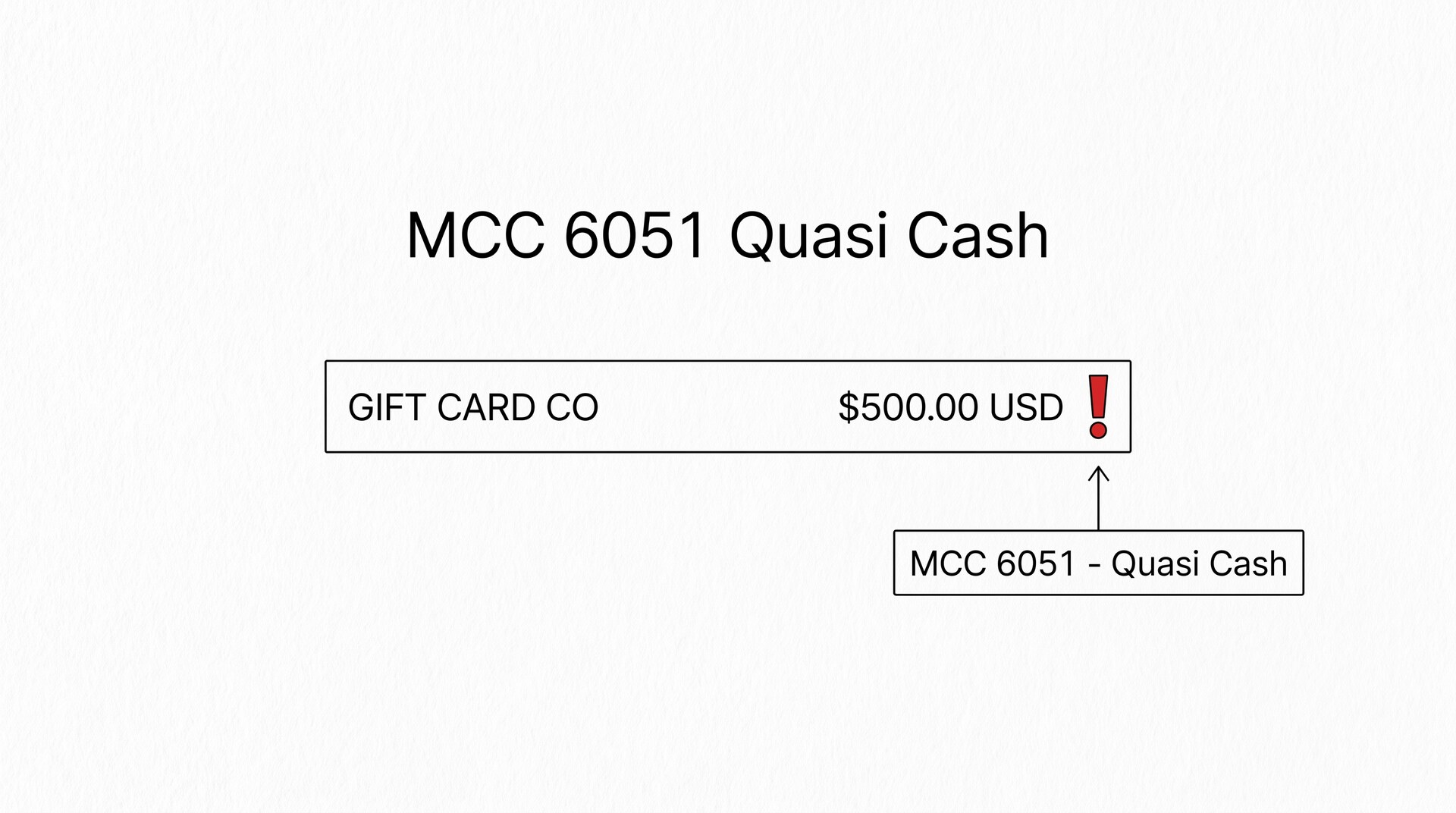

You saw “MCC 6051” on your credit card statement and your card processor flagged the charge. The merchant told you it’s just a gift card. Your processor put it in the highest chargeback risk category. You have 30 days to respond before the dispute is filed.
This article explains what MCC 6051 covers, why it has the highest chargeback rate of any merchant category, and what to do if you see it on either side of a transaction (as the cardholder or as the merchant).
Quick Answers: MCC 6051 is the merchant category code for quasi-cash transactions: gift cards, cryptocurrency, money orders, traveler's checks, casino chips, and similar items that function like cash. The category carries the highest chargeback rate of any merchant code (5x to 10x higher than retail) and triggers tighter fraud monitoring, higher reserves, and faster dispute timelines.
Merchants miscoding under 6051 face penalties; merchants correctly coded face higher costs.
What MCC 6051 covers
MCC 6051 is the merchant category code for Quasi Cash. Quasi cash is a special category used by the card networks (Visa, Mastercard, American Express, Discover) for items that function like cash even though they are technically merchandise or stored value.
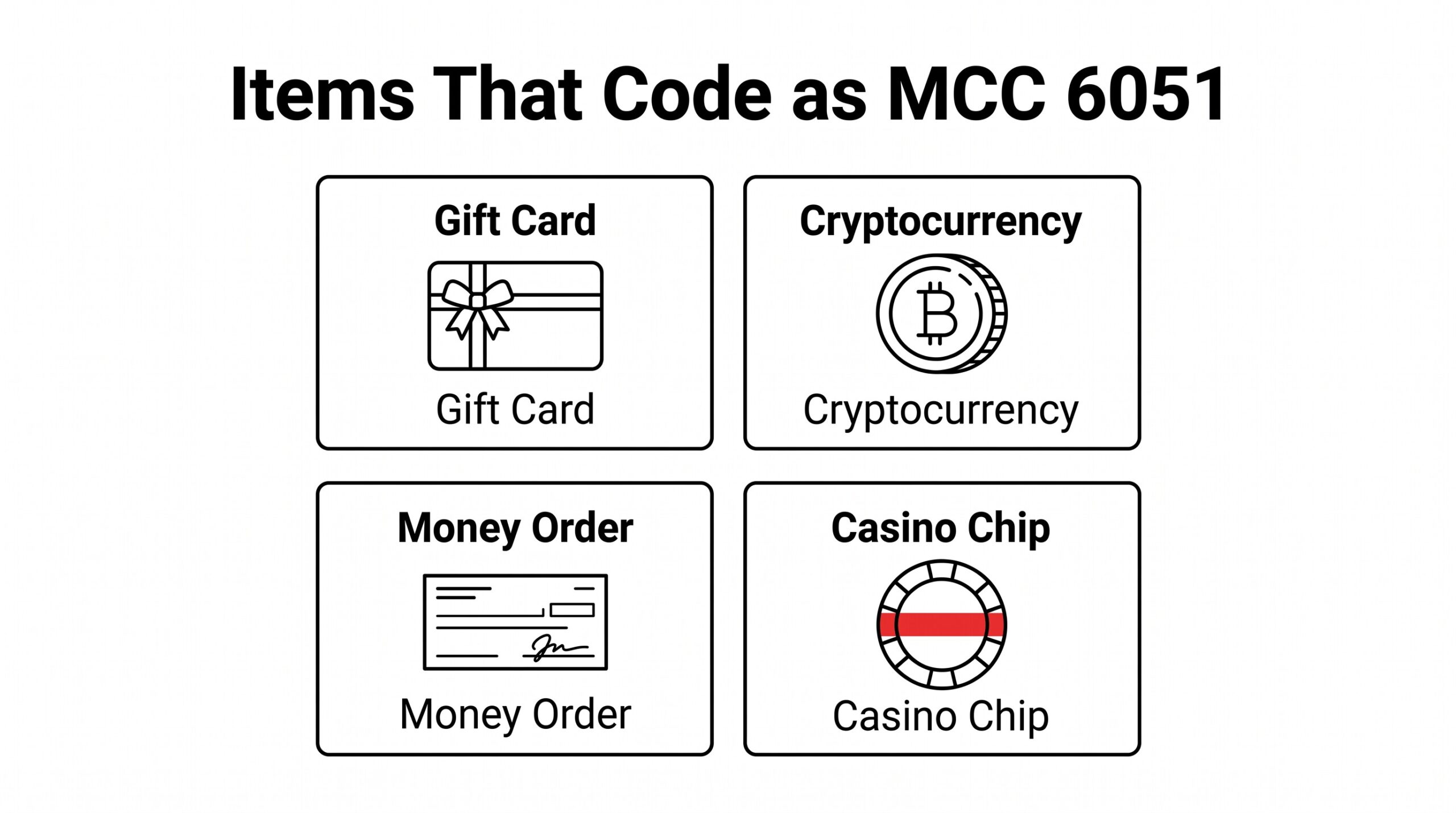
Items that fall under MCC 6051 include:
- Gift cards (store-specific and network-branded Visa/Mastercard/Amex gift cards)
- Cryptocurrency purchases (when purchased directly with a card, not via ACH)
- Money orders
- Traveler’s checks
- Casino chips and gaming tokens (when bought with a card at the cage)
- Prepaid debit cards that can be loaded and used like cash
- Foreign currency purchases at certain exchange services
The category was created because these items share three properties that make them risky for the card networks: they are reversible (the gift card can be spent and the value extracted before fraud is detected), they are anonymous (no name attached to the eventual user), and they can be converted to cash or cash equivalent quickly.
Why MCC 6051 has the highest chargeback rate
Quasi cash transactions have the highest chargeback rates of any merchant category, typically 5x to 10x higher than standard retail. Three reasons drive this.
First, fraud velocity. A gift card bought with a stolen card can be drained in minutes. The legitimate cardholder reports the fraud, the gift card has zero balance, and the merchant gets the chargeback. The window between purchase and drain is too short for most fraud detection to catch.
Second, buyer remorse and friendly fraud. A cardholder who buys a $500 gift card, gives it to a friend, and then forgets about it will sometimes dispute the charge 60 days later thinking it is fraud. The merchant has no way to verify the recipient and gets the chargeback anyway.
Third, regulatory scrutiny. Card networks monitor MCC 6051 merchants more closely than other categories. A merchant whose chargeback rate exceeds 1.5% (compared to the 0.5% baseline for retail) can be put in a monitoring program, then a remediation program, then terminated. The thresholds are tighter for quasi cash than for any other category.
The result: a merchant operating under MCC 6051 needs higher fraud prevention, tighter authorization rules, and more reserve capital than a merchant in any other category.
From Bank Statement to QuickBooks-Ready File
That manual cleanup you just read about? This tool skips it. Turn your PDF into QBO for QuickBooks without storing your data anywhere.
Start ConvertingWhat MCC 6051 means on your credit card statement
If you see a transaction coded MCC 6051 on your personal credit card statement, the charge is one of the items in the list above. Common scenarios:
- You bought a Visa or Mastercard gift card at a grocery store or pharmacy
- You purchased cryptocurrency directly with a credit card (most exchanges avoid this now due to fees)
- You bought traveler’s checks for an upcoming international trip
- You loaded a prepaid debit card with funds from your credit card
- You bought casino chips at a resort using your credit card at the cashier’s cage
If you did not authorize the charge, treat it as fraud. Contact your card issuer immediately. The card networks treat quasi-cash fraud as high priority, so the dispute process usually moves faster than for other categories. You have 60 days from the statement date to dispute, but acting within the first 30 days gives the best chance of recovering the funds.
What MCC 6051 means if you are a merchant
If your business has been assigned MCC 6051 by your card processor, you face specific obligations and risks.
The processor may require a higher reserve. Reserves are funds held back from your settlements to cover potential chargebacks. Standard retail merchants might have 0% to 5% reserve. Quasi cash merchants often face 10% to 25% reserve, sometimes higher for new merchants. The reserve ties up your working capital and can make cash flow difficult.
You will face stricter underwriting. The processor will ask for more documentation: bank statements, business history, ownership details, source of inventory. New merchants in this category can be declined outright. Existing merchants can be re-evaluated annually and downgraded if their volume or chargeback profile does not match expectations.
Your chargeback monitoring program will have tighter thresholds. The standard Visa dispute threshold is 0.9% of sales by transaction count, but for MCC 6051 merchants the threshold is typically 0.5%. Exceeding the threshold triggers fees, then a remediation plan, then potential termination.
If you think your MCC code is wrong, request a re-classification from your processor. The processor submits a request to the card network with documentation of your actual business activity. If approved, your MCC code changes to the correct category and your reserve and monitoring requirements adjust accordingly.
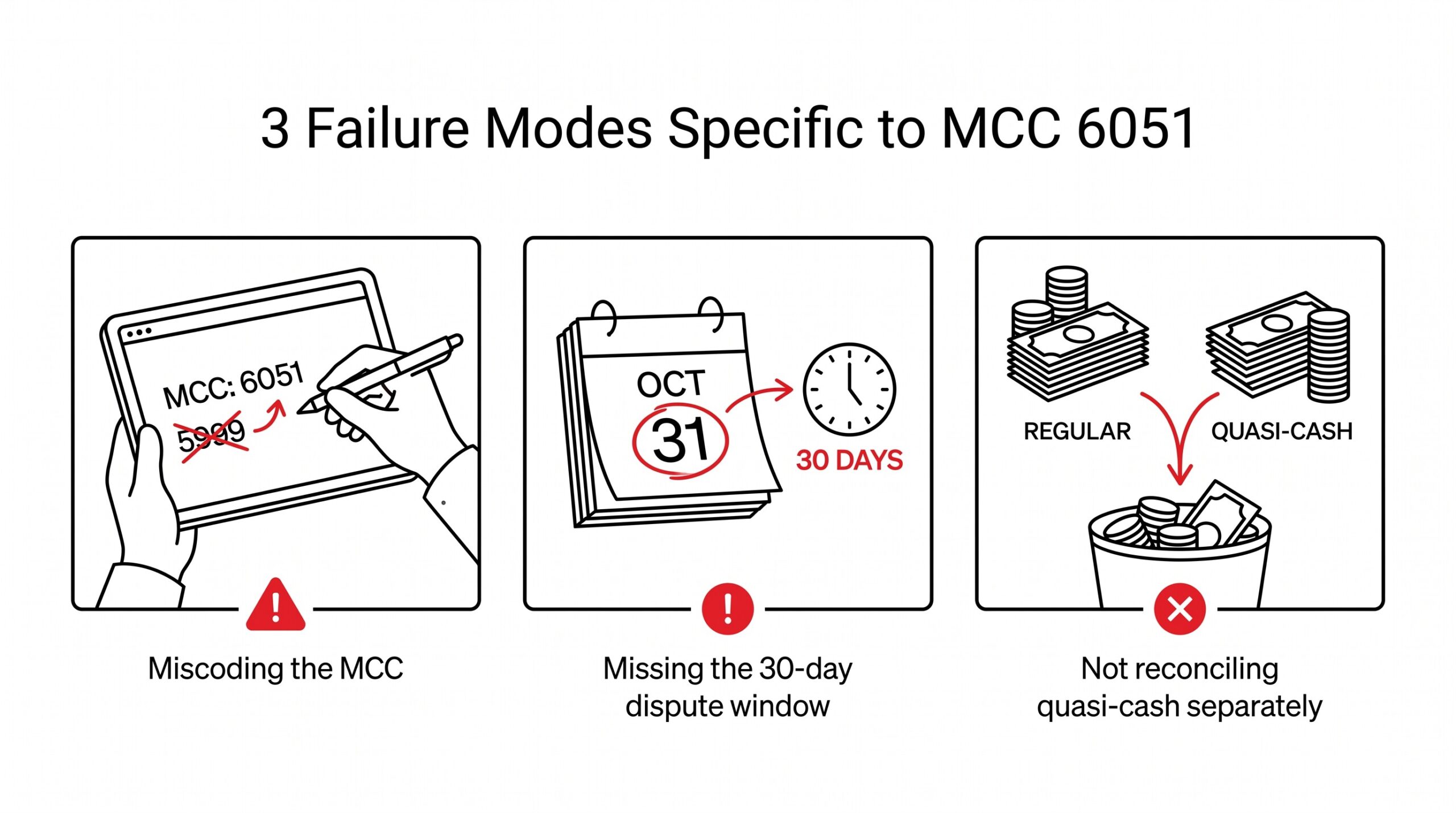
3 failure modes specific to MCC 6051
Failure 1: Miscoding the MCC to avoid the category
A common mistake merchants make is coding their business under a different MCC to avoid the quasi-cash restrictions. A crypto exchange might apply as MCC 5999 (Miscellaneous Retail). A gift card reseller might apply as MCC 5944 (Jewelry). The card networks audit for this and the consequences are severe: a chargeback monitoring program with a termination timeline, plus potential fines for misrepresentation during underwriting.
The fix: be honest about your business activity on the application. If you sell gift cards, you sell quasi cash. Apply under MCC 6051 and accept the higher reserve and tighter monitoring.
Failure 2: Missing the 30-day dispute window
Another common mistake is assuming you have 60 days to dispute a quasi-cash chargeback because that is the standard cardholder window. Quasi-cash merchants sometimes have shorter windows for specific dispute types, and the card networks process MCC 6051 disputes faster. A merchant who waits 45 days to respond may find the dispute already resolved against them.
The fix: respond to every chargeback notification within 7 days of receipt. Do not rely on the 60-day window. Quasi-cash disputes move faster and the evidence requirements are stricter.
Failure 3: Not reconciling quasi-cash transactions separately
A third mistake is treating quasi-cash revenue the same as regular retail revenue in the books. Quasi-cash sales have different margin profiles, different fraud loss rates, and different tax treatment in some states. A merchant who lumps all revenue into one category cannot see which line is profitable.
The fix: separate quasi-cash transactions in your accounting. The business statement conversion workflow can tag quasi-cash deposits with a specific category tag so your chart of accounts reflects the actual business mix.
For US tax filers, the MCC 4814 telecommunications guide covers a separate low-risk category. For the broader merchant context, the merchant category code overview explains how codes are assigned.
What most MCC references miss
Most merchant category code references list MCC 6051 with a one-line description: “Quasi Cash.” They do not explain why the category exists, what triggers it, or what consequences attach.
A merchant looking up their own MCC code deserves to know that the category comes with higher reserves, stricter monitoring, and faster dispute timelines. A cardholder looking up a charge on their statement deserves to know that the code signals a specific type of transaction and a specific dispute path.
What most references also miss is the regulatory layer. The IRS treats certain quasi-cash transactions as cash equivalents for Form 8300 reporting. Businesses receiving over $10,000 in quasi cash in a single transaction or related transactions must file Form 8300 within 15 days. This is independent of the card network requirements and applies even if the card processor has not flagged anything.
How MCC 6051 interacts with anti-money-laundering rules
Financial institutions that process MCC 6051 transactions have additional AML obligations under the Bank Secrecy Act. A merchant receiving over $10,000 in quasi cash from a single buyer in a single transaction or related transactions must file Form 8300 within 15 days. The threshold applies to gross amount, not net of fees. Multiple related transactions that aggregate over $10,000 also trigger the requirement.
The 15 day clock starts on the date of the transaction, not the date the merchant learns about the requirement.
When to challenge your MCC 6051 assignment
If your business was assigned MCC 6051 and you believe the assignment is wrong, you can request a reclassification from your card processor. The processor submits a written request to the card network with documentation of your actual business activity: invoices, contracts, marketing materials, website screenshots. The card network reviews the documentation and either confirms the existing code or assigns a new one.
The process takes 30 to 90 days. While the request is pending, the existing MCC code applies, including all reserve and monitoring requirements.
Related conversions and references for context: bank statement glossary.
For the comprehensive list of every merchant category code, the MCC code reference covers the lookup by industry. For the cash access code category, the MCC 6011 ATM cash guide explains a related high-scrutiny category that also affects fraud monitoring.
See also
The merchant category code overview covers the full 4-digit code system and how codes are assigned. For a sibling high-risk category, the MCC 5968 direct marketing subscription guide explains the recurring billing risks. For the broader conversion context, the MCC 4814 telecommunication services guide covers a standard retail category with lower risk.
For a complete list of every MCC and what it covers, the common MCC codes reference list covers the most frequently seen codes on consumer credit card statements.
See also: MCC 6051 in context
This explainer is one of the merchant category code guides on the site. The consolidated overview of the entire MCC system, including every US card-network overlay, lives in the complete MCC guide. The full code-by-code reference is the complete MCC code reference.
For the broader reading on what every column on a US bank statement means, including the merchant description column where MCC appears, see the expanded bank statement anatomy.
Turn any PDF statement into a clean sheet
Skip the typos and the hours of copying. Our converter handles any bank statement format and outputs Excel, CSV, or QBO for QuickBooks. No file retention, free to try.
Convert your statement