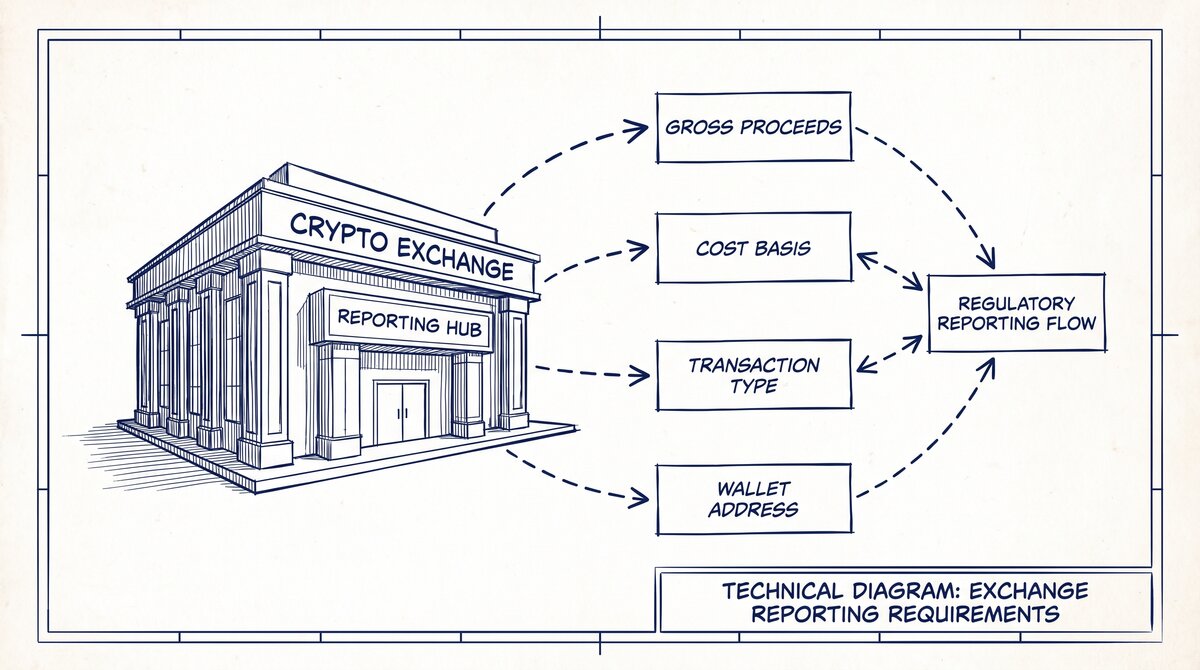

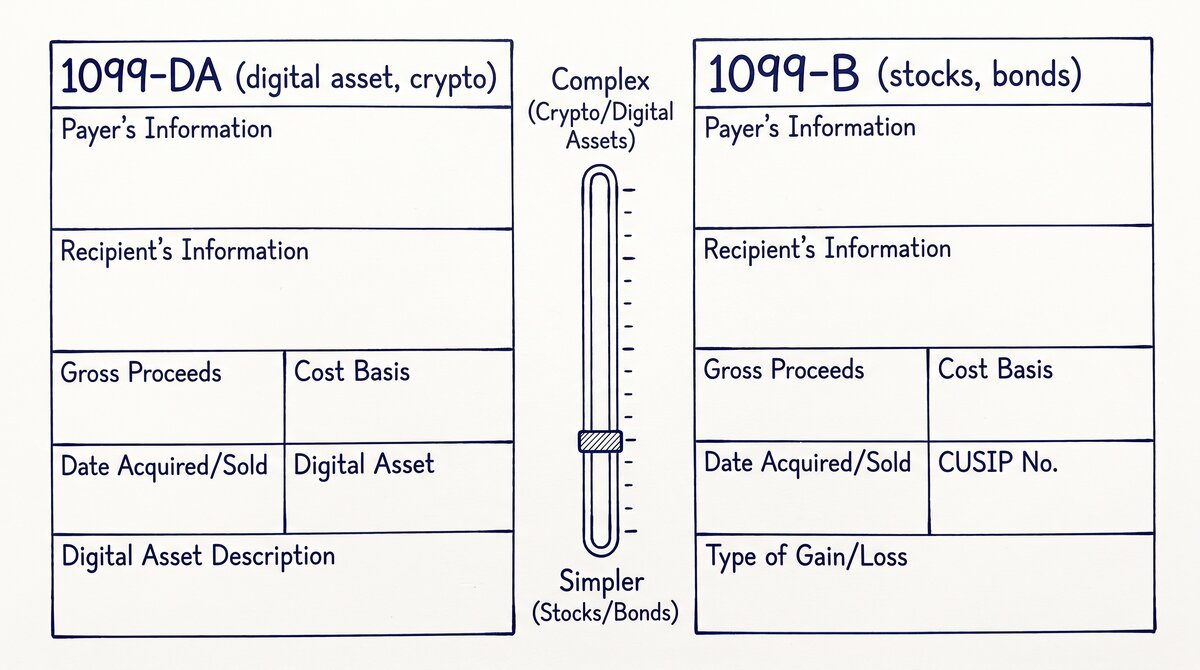
Crypto brokers must report on 1099-DA starting 2025 for 2025 transactions, with gross proceeds in Box A. Starting 2026, cost basis in Box B is required. The IRS definition of “broker” includes exchanges, payment processors, and some custodial wallet providers, but excludes non-custodial wallets. Non-US brokers are not required to issue 1099-DA, so users self-report those transactions on Form 8949.
Who the IRS Considers a “Broker” for 1099-DA
The IRS definition of “broker” for 1099-DA purposes is broader than for traditional securities, but narrower than for some crypto industry interpretations.
Covered Brokers
- Crypto exchanges: Coinbase, Kraken, Gemini, Crypto.com, Robinhood, and any other platform that holds user funds and executes trades. Clearly brokers.
- Crypto payment processors: BitPay, Coinbase Commerce, and other services that merchants use to accept crypto payments. Brokers on the merchant side, reporting the merchant’s transactions.
- Custodial wallet providers: Wallet services that hold user private keys and execute transactions on the user’s behalf. Coinbase Wallet and similar custodial services are brokers.
- Crypto ATMs: Operators of crypto ATMs are brokers in most cases. They must report transactions over a certain threshold.
Non-Covered Brokers
- Non-custodial wallet providers: Most software wallets (MetaMask, Trust Wallet, Phantom) do not hold user private keys and are not brokers. The wallet provider does not have visibility into the user’s transactions and cannot report them.
- Decentralized exchanges (DEXs): Uniswap, SushiSwap, and other DEXs do not have a central operator that can report on behalf of users. The IRS is working on guidance for DEX reporting, but no current requirement.
- DeFi protocols: Lending protocols (Aave, Compound), liquidity pools (Uniswap V3), and staking-as-a-service are not yet classified. The IRS has indicated that protocol-level reporting is coming, but no specific timeline.
- Mining pools: Mining pool operators are not currently considered brokers. Mining rewards are reported by the miner as self-employment income.
The Gray Area
Some entities fall between covered and non-covered. Crypto lending platforms (BlockFi, Nexo) were initially considered brokers, but the classification was reversed in 2023 IRS guidance. NFT marketplaces are partially covered (the marketplace may be a broker, but the underlying NFT transaction may not be reportable).
The user has to know whether the platform they use is a broker for 1099-DA purposes. Most major US-based exchanges are clearly brokers. Non-US exchanges, DEXs, and DeFi protocols are not.
What Transactions Brokers Must Report
Sales
Any sale of a digital asset for fiat currency. The broker reports the gross proceeds in Box A. For 2025 transactions, the broker does not need to report cost basis in Box B.
Exchanges
Any exchange of one digital asset for another. The broker reports the fair market value of the received asset in Box A. The user has to track the cost basis of the disposed asset to calculate the gain.
Transfers (Limited)
Certain transfers between wallets are reportable. The 2024 final regulations require reporting for transfers that involve a change in the broker (e.g., moving crypto from one exchange to another). Pure self-custody transfers (from one user-controlled wallet to another) are not reportable.
Staking Rewards (If the Broker Is the Staking Provider)
If the user stakes on the same platform where they hold the crypto, the broker reports the staking reward as ordinary income at fair market value on the day received. If the user stakes via a separate protocol, the protocol is not a broker, and the user self-reports.
Airdrops and Forks (Limited)
Airdrops and hard forks are reportable if the user receives the new asset on a platform that is a broker. Pure self-custody airdrops are not reportable by the broker; the user self-reports.
From PDF to Excel in one click
Forget retyping line by line. Upload any bank statement, get a spreadsheet you can actually use. Your files are never stored, and you can test the converter with 3 free conversions.
Try it freeThe Phased Rollout: 2025 vs 2026
The 1099-DA reporting is phased over 3 years to give brokers time to build the necessary tracking.
2025 Transactions (Reported in 2026)
Brokers report gross proceeds in Box A only. Cost basis in Box B is optional; brokers may report it if they have it, but they are not required. Many brokers will report Box B as “unknown” or “not reported” for 2025 transactions.
This is the easiest year for brokers. They have to track sale prices (which they already do for customer statements) but not cost basis (which requires tracking per-unit purchase history).
2026 Transactions (Reported in 2027)
Brokers report gross proceeds in Box A and cost basis in Box B. The cost basis tracking is required for covered transactions (acquired after a specific date, typically after the user opens the account).
This is the harder year. Brokers have to build per-unit cost basis tracking, which requires either per-unit wallet tracking or aggregate account tracking with FIFO default.
2027 Transactions and Later (Reported in 2028+)
Brokers report gross proceeds and cost basis for all covered transactions, including transfers to and from non-broker wallets. The reporting expands to cover the full lifecycle of crypto transactions on the broker’s platform.
This is the most comprehensive year. Brokers have to integrate with the broader crypto ecosystem to track transfers and basis across wallets and exchanges.
Backup Withholding and Penalties
Backup Withholding
If the user does not provide a valid TIN (Taxpayer Identification Number) to the broker, the broker must withhold 24% of the gross proceeds as backup withholding. The user reports the withholding on Form 1040 and claims it as a payment, but the 24% is a real cash drag.
The backup withholding applies to 1099-DA, just as it applies to 1099-INT, 1099-DIV, and 1099-B. The broker must withhold if the TIN is missing, invalid, or the IRS has notified the broker that the TIN is incorrect.
Penalties for Non-Filing by Broker
If the broker fails to file 1099-DA, the penalty is $310 per form (inflation-adjusted) for the broker. The penalty increases for intentional non-compliance.
For the user, the consequence of the broker not filing is that the user does not receive a 1099-DA. The user still has to report the transaction on Form 8949; the absence of a 1099-DA does not excuse reporting.
Penalties for Non-Reporting by User
If the user fails to report a 1099-DA transaction on Form 8949, the IRS matches the 1099-DA against the user’s return and flags the omission. The penalty is typically 20-40% of the underpaid tax, plus interest.
For larger omissions, the penalty can be 75% of the underpaid tax for civil fraud. Criminal penalties (tax evasion) are possible but rare for first-time offenders.
A common failure mode bookkeepers report is treating this as a single operation rather than a chain of dependent steps. The temptation is to find a tool that ‘just works’ and stop investigating the mechanism.
The result is a wrong-fix cycle: the tool gives partial output, the bookkeeper spends 30+ minutes troubleshooting, the fix is for the wrong step, and the same error recurs on the next statement. The fix: identify which step failed and apply the right intervention to that step.
What to Do If Your Broker Doesn’t Issue 1099-DA
Non-US Broker
The user self-reports all transactions on Form 8949. The user has to maintain their own records of purchase dates, prices, and quantities to establish cost basis.
The user should also check whether the non-US broker issues an equivalent form in their jurisdiction (e.g., a UK broker issues a Capital Gains Statement). The form may not be 1099-DA, but it provides the supporting documentation for Form 8949.
DEX or DeFi Protocol
The user self-reports all transactions on Form 8949. The user has to reconstruct the transaction history from the protocol’s data (or a block explorer). Crypto tax software (Koinly, CoinTracker) automates this reconstruction.
The user should keep all transaction records for at least 3 years after filing (the IRS audit window). For larger transactions, keep records for 6 years (extended audit window for substantial omissions).
Lost or Stolen Crypto
The user reports the loss on Form 8949 as a theft loss (subject to limitations). The user has to document the loss with police reports (for stolen), blockchain records (showing the transfer to the thief), and any other supporting evidence.
The IRS has been increasingly skeptical of lost crypto claims, especially for “I lost my wallet password” scenarios. The user has to provide solid evidence that the crypto is unrecoverable.
The 1099-DA pillar covers the form’s anatomy. The 1099-DA vs 1099-B sub-pillar covers the form differences. The cost basis methods spoke covers FIFO and Spec ID. The bank statement reconciliation spoke covers the verification workflow.
For a deeper understanding, see: crypto tax statement pillar . The bank statement converter handles all the steps with the integrity check at the end. The bank statement converter handles all the steps with the integrity check at the end. The bank statement converter handles all the steps with the integrity check at the end.
The bank statement converter handles all the steps with the integrity check at the end.
Related: complete 1099-DA crypto tax guide
This topic is part of the broader 1099-DA and crypto-tax cluster on this site. The consolidated hub for the entire topic, including the form mechanics, broker requirements, cost basis methods, reconciling to bank statements, and state-level differences, now lives in the complete 1099-DA crypto tax reporting guide.
For related reading, the complete US bank payment rails guide covers ACH and wire cash flows from crypto exchanges, and the complete MCC guide covers merchant category codes on credit-card statements. The expanded bank statement anatomy pairs naturally with this hub.
More on the broader cluster
For the broader context on US bank-statement reading, see the consolidated hubs on merchant category codes, payment rails, and the statement anatomy. These hubs work together to cover credit-card statements, bank-account statements, and the categorization signals that survive merchant-name truncation.
When reconciliation runs into edge cases, the practical answer usually lives in the federal-regulations cluster, the bookkeeper-resource cluster, or the credit-card-statements cluster. Each offers a domain-specific take on the same underlying signal.
Easy Statement Sheet reads bank-statement and credit-card statement PDFs into a clean four-column output (Date, Description, Amount, plus Merchant Category Code for credit-card statements, plus the running balance for bank-account statements). Files are never stored.
The first three statement conversions are free, no card required. Plans start at $15 per month. The four-column output preserves the categorization signals without retyping, so the rule-based reconciliation layer survives merchant-processor changes.
Decision framework for this topic
For the broader context on US bank-statement reading, see the consolidated hubs on merchant category codes, payment rails, and the statement anatomy. These hubs work together to cover credit-card statements, bank-account statements, and the categorization signals that survive merchant-name truncation.
Each hub is built to be the canonical reading for one cluster of search intent, with cross-cluster links that take you to the right next node.
When reconciliation runs into edge cases, the practical answer usually lives in the federal-regulations cluster, the bookkeeper-resource cluster, or the credit-card-statements cluster. Each offers a domain-specific take on the same underlying signal. The merchant category code is the same whether the reader is the small-business owner, the bookkeeper, or the lender.
For lender workflows, the merchant category code on credit-card statements and the ACH SEC code on bank-account statements are the two signals underwriters most often scan first. Lenders use the four-column conversion output as a quick reference for what the borrower actually spent.
Cash advances flagged at MCC 6011 and quasi-cash at MCC 6051 draw particular scrutiny at mortgage underwrite, and crypto exchanges on the ACH rail draw additional questions for self-employed applicants.
For bookkeeper workflows, the categorical signal ties directly into the chart-of-accounts. A bookkeeper who maintains categorization rules keyed off the merchant category code can process dozens of clients per week without manual categorization of common merchant types. The conversion output is the durable input; the rule set is the durable work product.
Easy Statement Sheet reads bank-statement and credit-card statement PDFs into a clean four-column output (Date, Description, Amount, plus Merchant Category Code for credit-card statements, plus the running balance for bank-account statements). Files are never stored. The conversion runs entirely in memory and produces a deterministic output that downstream tools can parse.
The first three statement conversions are free, no card required. Plans start at $15 per month. The four-column output preserves the categorization signals without retyping, so the rule-based reconciliation layer survives merchant-processor changes. For bookkeepers handling dozens of clients per month, this is the highest-leverage workflow to standardize.
Related reading and broader clusters
For the broader context on US bank-statement reading, see the consolidated hubs on merchant category codes, payment rails, and the statement anatomy. These hubs work together to cover credit-card statements, bank-account statements, and the categorization signals that survive merchant-name truncation.
Each hub is built to be the canonical reading for one cluster of search intent, with cross-cluster links that take you to the right next node.
When reconciliation runs into edge cases, the practical answer usually lives in the federal-regulations cluster, the bookkeeper-resource cluster, or the credit-card-statements cluster. Each offers a domain-specific take on the same underlying signal. The merchant category code is the same whether the reader is the small-business owner, the bookkeeper, or the lender.
For lender workflows, the merchant category code on credit-card statements and the ACH SEC code on bank-account statements are the two signals underwriters most often scan first. Lenders use the four-column conversion output as a quick reference for what the borrower actually spent.
Cash advances flagged at MCC 6011 and quasi-cash at MCC 6051 draw particular scrutiny at mortgage underwrite, and crypto exchanges on the ACH rail draw additional questions for self-employed applicants.
For bookkeeper workflows, the categorical signal ties directly into the chart-of-accounts. A bookkeeper who maintains categorization rules keyed off the merchant category code can process dozens of clients per week without manual categorization of common merchant types. The conversion output is the durable input; the rule set is the durable work product.
Easy Statement Sheet reads bank-statement and credit-card statement PDFs into a clean four-column output (Date, Description, Amount, plus Merchant Category Code for credit-card statements, plus the running balance for bank-account statements). Files are never stored. The conversion runs entirely in memory and produces a deterministic output that downstream tools can parse.
The first three statement conversions are free, no card required. Plans start at $15 per month. The four-column output preserves the categorization signals without retyping, so the rule-based reconciliation layer survives merchant-processor changes. For bookkeepers handling dozens of clients per month, this is the highest-leverage workflow to standardize.
Turn That PDF Into a Spreadsheet in Minutes
You've seen how to do it manually — now let the tool handle the heavy lifting. Upload your bank statement and get Excel, CSV, or QBO in a few clicks.
Try It Free