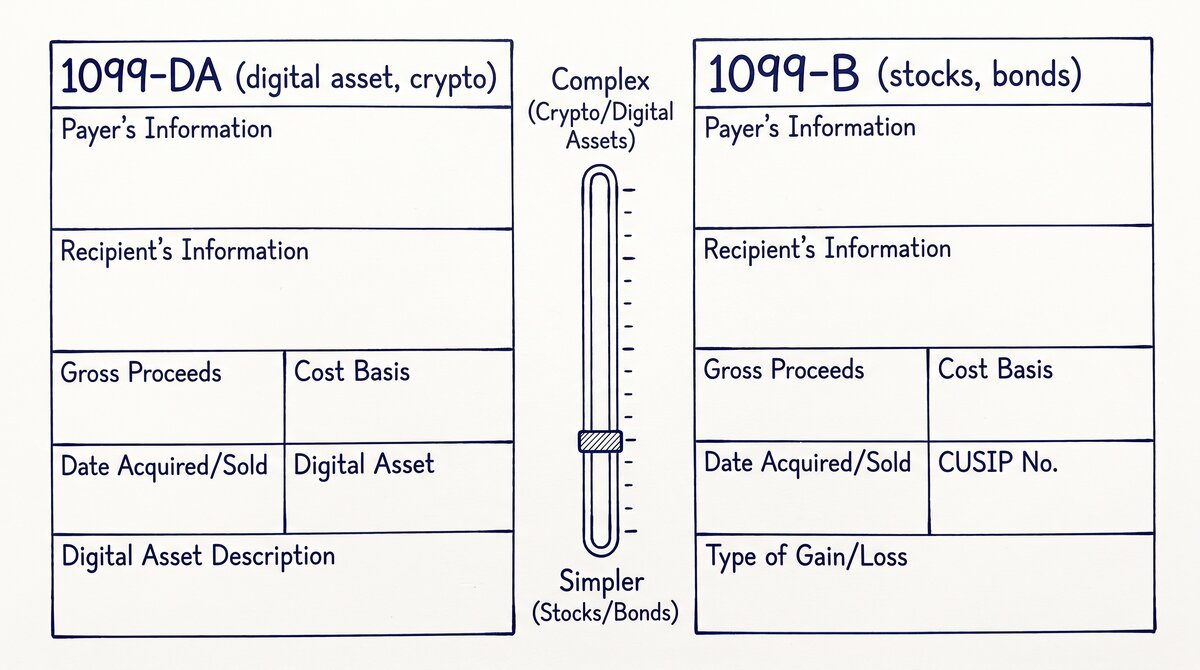

1099-DA is for digital assets (crypto). 1099-B is for securities (stocks, bonds, options, futures). The asset class determines which form the broker issues, and the two forms have different box structures, different cost basis rules, and different filing deadlines. Wrapped crypto (e.g., wBTC traded as an ETF or security token) is the gray area, and the issuer’s classification determines the form.
What 1099-B Covers
1099-B is the broker reporting form for securities transactions. It has been in use since the 1970s and covers:
- Stocks (common and preferred)
- Bonds (corporate, municipal, treasury)
- Options (calls and puts)
- Futures (commodity and financial)
- Mutual funds and ETFs
- Other securities traded on regulated exchanges
The broker issues 1099-B for any sale, exchange, or distribution. The form reports gross proceeds, cost basis, and various adjustments (wash sales, mark-to-market for traders). The user transfers the data to Form 8949 and files.
1099-B has a well-developed tax compliance infrastructure. Brokers have been reporting for 50+ years, and the IRS has automated matching against Form 8949.
What 1099-DA Covers
1099-DA is the digital asset equivalent. It covers:
- Sales of cryptocurrencies for fiat currency
- Exchanges of one cryptocurrency for another
- Certain transfers between wallets (reported for tracking, not necessarily taxable)
- Staking rewards (as ordinary income at fair market value)
- Airdrops and forks (in some cases)
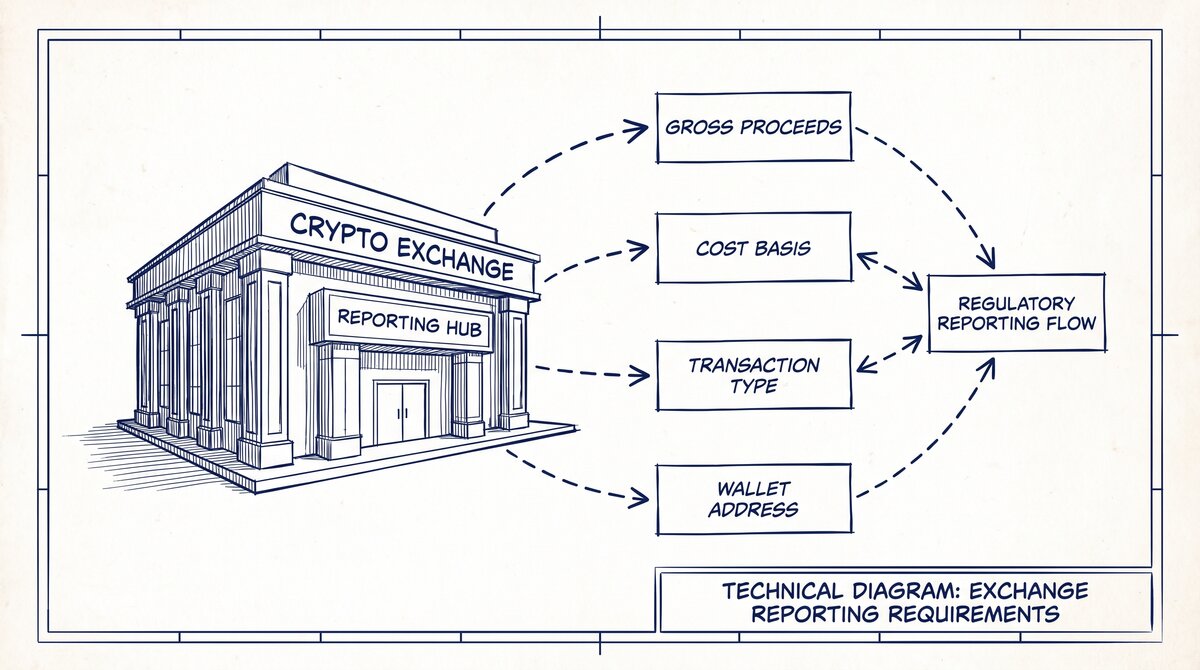
The form reports gross proceeds, cost basis, transaction type, and wallet address. The phased rollout (gross proceeds in 2025, cost basis in 2026+) reflects the difficulty brokers have tracking cost basis for crypto.
1099-DA is new (effective 2025 for 2024 transactions). The compliance infrastructure is still being built. The IRS has indicated that automated matching against Form 8949 will be in place for 2025 tax year filings.
From PDF to Excel in one click
Forget retyping line by line. Upload any bank statement, get a spreadsheet you can actually use. Your files are never stored, and you can test the converter with 3 free conversions.
Try it freeThe 6 Differences
1099-DA and 1099-B differ on 6 measurable dimensions.
1. Asset Class
1099-B: securities (stocks, bonds, options, futures, mutual funds, ETFs). 1099-DA: digital assets (cryptocurrencies, stablecoins, NFTs in some cases, security tokens). The asset class determines the form.
2. Issuer Type
1099-B: stock brokers, broker-dealers, mutual fund companies, ETF issuers. 1099-DA: crypto exchanges, crypto payment processors, certain custodial wallet providers. The IRS has expanded the “broker” definition for 1099-DA to include non-traditional intermediaries.
3. Box Structure
1099-B has 15+ boxes for various adjustments (wash sales, mark-to-market, noncovered securities, etc.). 1099-DA has 4 primary boxes (A: gross proceeds, B: cost basis, C: transaction type, D: wallet address). The simpler structure reflects the relative immaturity of crypto tax compliance.
4. Cost Basis Rules
1099-B: brokers must report cost basis for covered securities (acquired after 2011 for most asset types). 1099-DA: brokers report cost basis starting in 2026 (gross proceeds only in 2025). The phase-in reflects the difficulty of tracking crypto cost basis across wallets and exchanges.
5. Filing Deadline
1099-B: February 15 for brokers, February 15 for recipient copy. 1099-DA: January 31 for both, same as 1099-INT and W-2. The earlier deadline for 1099-DA reflects the IRS’s need to match against Form 8949 before the April 15 filing deadline.
6. Penalty Structure
Both forms have similar penalty structures for non-filing: $310 per form (inflation-adjusted) for the broker, plus potential criminal penalties for willful non-compliance. For the recipient, failing to report income from either form is a separate tax penalty.
Which Form You Get for Wrapped Crypto
Wrapped crypto is the gray area. Wrapped Bitcoin (wBTC), for example, is a token on Ethereum that represents BTC. Whether it is reported on 1099-DA or 1099-B depends on how the wrapper is structured.
Wrapped Native Crypto (wBTC, wETH)
Reported on 1099-DA if the wrapper is held as a token in a user’s wallet and the broker is a crypto platform. The user does not interact with the underlying BTC; the user holds a token. The transaction is reported on 1099-DA.
Crypto Traded as a Security (Bitcoin ETF, Ethereum ETF)
Reported on 1099-B if the crypto is held in a brokerage account as a security. A user who buys a Bitcoin ETF through a stock broker receives 1099-B, not 1099-DA. The transaction is treated as a security sale.
Stablecoins
Reported on 1099-DA if the stablecoin is held as a digital asset (most cases). Stablecoins are not securities under current IRS guidance (though this may change).
NFTs
Reported on 1099-DA if the NFT marketplace issues the form. Many NFT marketplaces are not required to issue 1099-DA in 2025, but the requirement expands in 2026+.
Which Form to Use for a Tax Filing
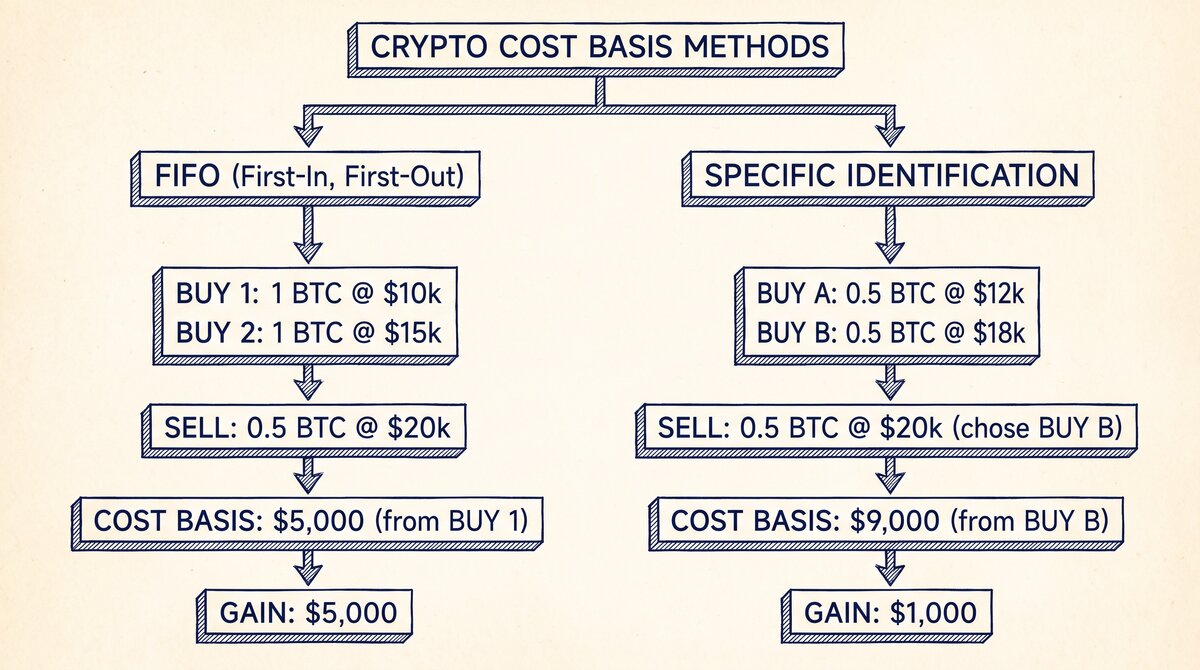
For the tax filing, the user reports the data from both 1099-DA and 1099-B on Form 8949. The form has a column for the basis code (A for FIFO, blank for Spec ID, etc.), and the box structure on 8949 is consistent regardless of which 1099 issued the data.
The user does not need to distinguish 1099-DA from 1099-B on the 8949. The IRS uses the form identifier to route the data, and the user just transcribes the amounts.
The exception: cost basis rules differ. 1099-DA basis rules are new and evolving; 1099-B basis rules are well-established. The user has to apply the rules that match the form, not the asset.
Common Mistakes When Filing Both
The most common mistake is mixing up 1099-DA and 1099-B data. A user who has both crypto and stock transactions may transpose the amounts, apply the wrong basis code, or fail to include one form. The IRS matches both forms against Form 8949, and missing or transposed data is an audit trigger.
The second most common mistake is treating wrapped crypto inconsistently. A user who has wBTC in a self-custody wallet (1099-DA) and a Bitcoin ETF in a brokerage (1099-B) has to report them on the same Form 8949 but with different basis tracking. Missing the difference leads to double-counting or under-counting.
The third most common mistake is failing to reconcile with the bank statement. The bank statement shows the cash that actually moved. A user who reports the 1099-DA and 1099-B amounts without checking the bank statement may include transactions that did not settle, generating phantom income or losses.
The pattern: 1099-DA and 1099-B both feed into Form 8949, but they have different rules and different gray areas. The user has to understand which form applies to each transaction and apply the rules consistently.
The 1099-DA pillar covers the form’s anatomy and the IRS rules. The cost basis methods spoke covers FIFO and Spec ID for digital assets. The bank statement reconciliation spoke covers the verification workflow. The broker reporting requirements spoke covers who counts as a broker and the phased rollout.
For a deeper understanding, see: 1099-DA pillar . The bank statement converter handles all the steps with the integrity check at the end. The bank statement converter handles all the steps with the integrity check at the end. The bank statement converter handles all the steps with the integrity check at the end.
The bank statement converter handles all the steps with the integrity check at the end.
Related: complete 1099-DA crypto tax guide
This topic is part of the broader 1099-DA and crypto-tax cluster on this site. The consolidated hub for the entire topic, including the form mechanics, broker requirements, cost basis methods, reconciling to bank statements, and state-level differences, now lives in the complete 1099-DA crypto tax reporting guide.
For related reading, the complete US bank payment rails guide covers ACH and wire cash flows from crypto exchanges, and the complete MCC guide covers merchant category codes on credit-card statements. The expanded bank statement anatomy pairs naturally with this hub.
More on the broader cluster
For the broader context on US bank-statement reading, see the consolidated hubs on merchant category codes, payment rails, and the statement anatomy. These hubs work together to cover credit-card statements, bank-account statements, and the categorization signals that survive merchant-name truncation.
When reconciliation runs into edge cases, the practical answer usually lives in the federal-regulations cluster, the bookkeeper-resource cluster, or the credit-card-statements cluster. Each offers a domain-specific take on the same underlying signal.
Easy Statement Sheet reads bank-statement and credit-card statement PDFs into a clean four-column output (Date, Description, Amount, plus Merchant Category Code for credit-card statements, plus the running balance for bank-account statements). Files are never stored.
The first three statement conversions are free, no card required. Plans start at $15 per month. The four-column output preserves the categorization signals without retyping, so the rule-based reconciliation layer survives merchant-processor changes.
Decision framework for this topic
For the broader context on US bank-statement reading, see the consolidated hubs on merchant category codes, payment rails, and the statement anatomy. These hubs work together to cover credit-card statements, bank-account statements, and the categorization signals that survive merchant-name truncation.
Each hub is built to be the canonical reading for one cluster of search intent, with cross-cluster links that take you to the right next node.
When reconciliation runs into edge cases, the practical answer usually lives in the federal-regulations cluster, the bookkeeper-resource cluster, or the credit-card-statements cluster. Each offers a domain-specific take on the same underlying signal. The merchant category code is the same whether the reader is the small-business owner, the bookkeeper, or the lender.
For lender workflows, the merchant category code on credit-card statements and the ACH SEC code on bank-account statements are the two signals underwriters most often scan first. Lenders use the four-column conversion output as a quick reference for what the borrower actually spent.
Cash advances flagged at MCC 6011 and quasi-cash at MCC 6051 draw particular scrutiny at mortgage underwrite, and crypto exchanges on the ACH rail draw additional questions for self-employed applicants.
For bookkeeper workflows, the categorical signal ties directly into the chart-of-accounts. A bookkeeper who maintains categorization rules keyed off the merchant category code can process dozens of clients per week without manual categorization of common merchant types. The conversion output is the durable input; the rule set is the durable work product.
Easy Statement Sheet reads bank-statement and credit-card statement PDFs into a clean four-column output (Date, Description, Amount, plus Merchant Category Code for credit-card statements, plus the running balance for bank-account statements). Files are never stored. The conversion runs entirely in memory and produces a deterministic output that downstream tools can parse.
The first three statement conversions are free, no card required. Plans start at $15 per month. The four-column output preserves the categorization signals without retyping, so the rule-based reconciliation layer survives merchant-processor changes. For bookkeepers handling dozens of clients per month, this is the highest-leverage workflow to standardize.
Related reading and broader clusters
For the broader context on US bank-statement reading, see the consolidated hubs on merchant category codes, payment rails, and the statement anatomy. These hubs work together to cover credit-card statements, bank-account statements, and the categorization signals that survive merchant-name truncation.
Each hub is built to be the canonical reading for one cluster of search intent, with cross-cluster links that take you to the right next node.
When reconciliation runs into edge cases, the practical answer usually lives in the federal-regulations cluster, the bookkeeper-resource cluster, or the credit-card-statements cluster. Each offers a domain-specific take on the same underlying signal. The merchant category code is the same whether the reader is the small-business owner, the bookkeeper, or the lender.
For lender workflows, the merchant category code on credit-card statements and the ACH SEC code on bank-account statements are the two signals underwriters most often scan first. Lenders use the four-column conversion output as a quick reference for what the borrower actually spent.
Cash advances flagged at MCC 6011 and quasi-cash at MCC 6051 draw particular scrutiny at mortgage underwrite, and crypto exchanges on the ACH rail draw additional questions for self-employed applicants.
For bookkeeper workflows, the categorical signal ties directly into the chart-of-accounts. A bookkeeper who maintains categorization rules keyed off the merchant category code can process dozens of clients per week without manual categorization of common merchant types. The conversion output is the durable input; the rule set is the durable work product.
Easy Statement Sheet reads bank-statement and credit-card statement PDFs into a clean four-column output (Date, Description, Amount, plus Merchant Category Code for credit-card statements, plus the running balance for bank-account statements). Files are never stored. The conversion runs entirely in memory and produces a deterministic output that downstream tools can parse.
The first three statement conversions are free, no card required. Plans start at $15 per month. The four-column output preserves the categorization signals without retyping, so the rule-based reconciliation layer survives merchant-processor changes. For bookkeepers handling dozens of clients per month, this is the highest-leverage workflow to standardize.
Turn any PDF statement into a clean sheet
Skip the typos and the hours of copying. Our converter handles any bank statement format and outputs Excel, CSV, or QBO for QuickBooks. No file retention, free to try.
Convert your statement