
You are applying for a DSCR rental property loan.
The lender sent you a prequalification email saying your DSCR is 0.95 and they can’t approve the loan unless you get it to 1.20.
You make enough money to cover the mortgage payment, the property generates $4,200/month in rent, and your monthly debt service is $4,400. You want to know what DSCR actually means and how to get it higher before the loan officer reviews your file again.
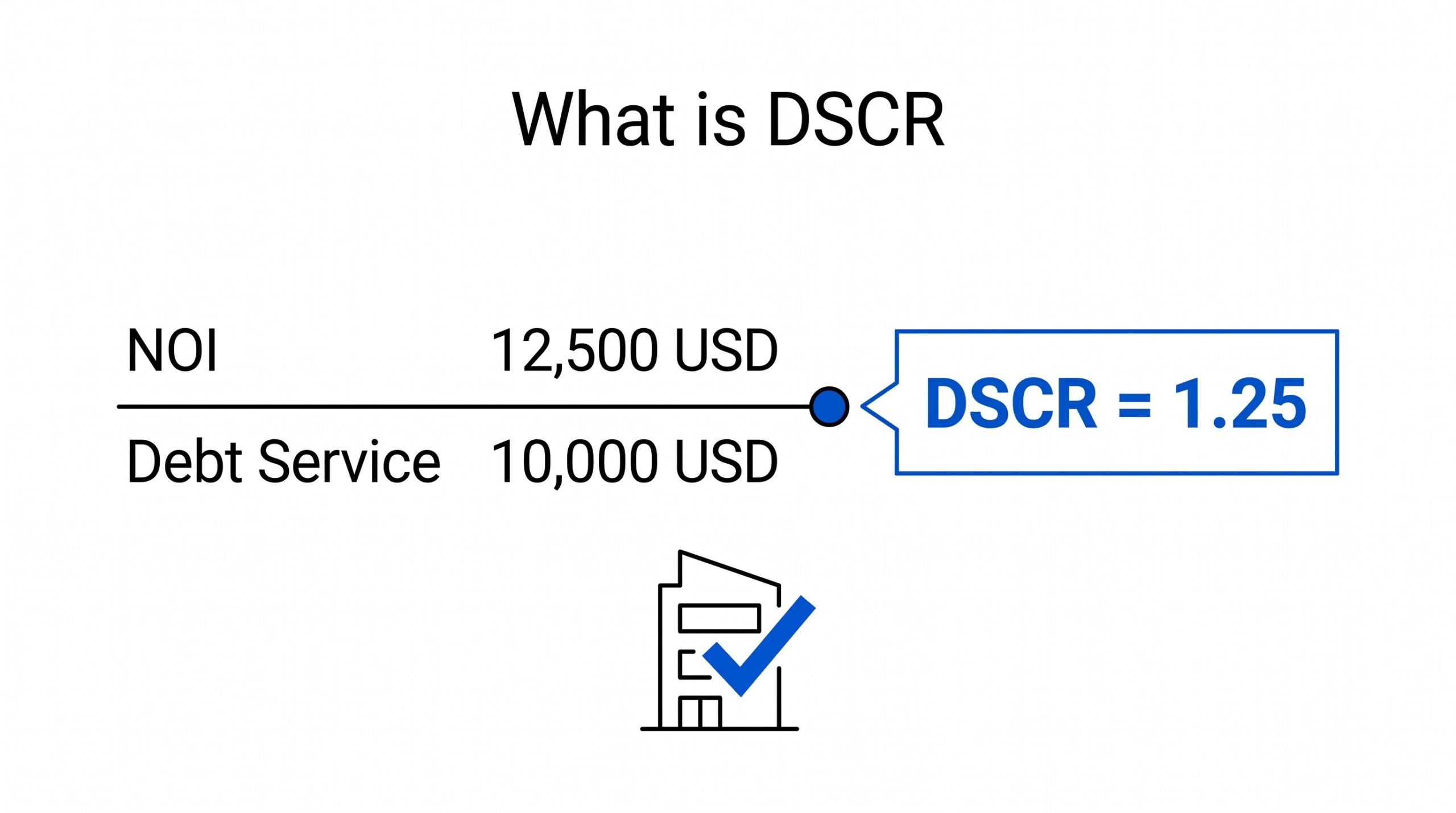
DSCR stands for Debt Service Coverage Ratio.
It is a financial metric that lenders use to assess whether a borrower generates enough cash flow to cover debt obligations.
The DSCR calculation compares monthly net operating income (NOI) to monthly debt service (the total of mortgage principal, interest, taxes, and insurance, abbreviated PITI). A DSCR of 1.0 means the property’s income exactly equals the debt payments. A DSCR above 1.0 means there’s a cushion. A DSCR below 1.0 means the property doesn’t generate enough income to cover the debt service on its own.
Quick Answers: DSCR (Debt Service Coverage Ratio) measures whether income is sufficient to cover debt obligations, calculated as monthly NOI divided by monthly debt service.
The formula is DSCR = NOI / Debt Service. Most lenders require 1.20-1.25 for conventional loans, 1.0-1.15 for government-backed programs, and 1.40+ for high-risk commercial loans. Lenders extract the underlying data (rent deposits, debt payments, operating expenses) from bank statements, typically averaging 3 or 12 months. Borrowers can improve DSCR by increasing qualifying income (rent increases, cash-add-backs) or reducing debt service (refinancing, paying down balances).
The DSCR Formula
The DSCR formula is straightforward: DSCR = Net Operating Income / Debt Service. Both numbers are typically expressed as monthly amounts for rental property loans, or annual amounts for operating business loans.
Imagine a rental property that generates $4,200 per month in gross rent.
The monthly operating expenses (property tax, insurance, maintenance, property management) total $800.
The NOI is $4,200 minus $800, which equals $3,400. The monthly debt service (mortgage P&I plus escrow for taxes and insurance) is $3,000. The DSCR is $3,400 / $3,000 = 1.13. This property would qualify for a loan program requiring DSCR of 1.10 or higher, but not for a program requiring 1.20 or higher.
The reverse scenario: a different property with the same $4,200 rent and same $800 operating expenses, but with a $4,000 monthly debt service.
The DSCR would be $3,400 / $4,000 = 0.85. This property would not qualify for any standard DSCR loan program because the income doesn’t cover the debt service. The borrower would need to either increase rent, reduce operating expenses, or refinance to a lower payment before applying.
The formula is the same for operating business loans, but the income definition differs.
For a business DSCR loan, NOI is the business’s net cash flow before debt service (revenue minus operating expenses excluding debt payments). For a rental property DSCR loan, NOI is the property’s gross rental income minus operating expenses. The debt service definition is consistent across both: PITI for real estate, or principal-plus-interest for business loans.
What Counts as Debt Service
Debt service is the total monthly payment the borrower is obligated to make to service the loan. For real estate loans, debt service includes the full PITI: principal, interest, taxes, and insurance. The full PITI breakdown is similar to what appears on a credit card statement balance.
Some lenders also include HOA fees, ground rent (for leasehold properties), and special assessments in the debt service calculation.
For operating business loans, debt service includes the principal and interest payments on the loan being applied for, plus the principal and interest payments on all other outstanding business debt. A business applying for a $500,000 loan with $50,000/year in existing loan payments would have a debt service that includes both the new $500,000 payment and the existing $50,000/year payments.
The debt service figure used in DSCR is typically the proposed debt service for the loan being applied for, not the borrower’s current debt service. This is because lenders want to know if the property or business can support the new loan, not just whether the borrower is currently meeting existing obligations.
Some lenders also calculate a global DSCR that includes all of the borrower’s personal debt (auto loans, credit cards, student loans) plus the proposed business debt.
This is more common for SBA loans than for DSCR rental property loans. The global DSCR calculation typically uses the borrower’s personal income rather than the property’s NOI, which makes it a different metric than the property-level DSCR described above.
Turn PDF Bank Statements Into Workable Spreadsheets
Your bank statement is a mess of numbers, but your books shouldn't be. Use our converter to get Excel, CSV, or QBO files — ready for QuickBooks.
Try It Free NowWhat Counts as Qualifying Income
For rental property DSCR loans, qualifying income is the property’s gross rental income minus operating expenses. The gross rental income is the actual rent collected, not the market rent or the rent listed in the lease. If a property is listed at $4,500/month but the tenant pays $4,200/month, the qualifying income is $4,200.
Operating expenses include property taxes, insurance, property management fees, maintenance, repairs, utilities (if paid by the landlord), HOA fees, and reserves for vacancy or capital expenditures. Some lenders use a flat operating expense ratio (typically 25-35% of gross rent) rather than calculating actual expenses, which simplifies the DSCR calculation but can be either more or less favorable than actual expenses.
For operating business DSCR loans, qualifying income is the business’s net cash flow before debt service. This is calculated from the business’s bank statements and tax returns. Lenders typically average 3 or 12 months of bank deposits, then subtract operating expenses (excluding debt payments) to arrive at the NOI.
Cash-add-backs are a common adjustment that improves DSCR. Lenders allow borrowers to add back certain non-cash expenses (depreciation, amortization, one-time legal fees, owner draws above market salary) to the income calculation. A business with $100,000 in actual cash flow but $30,000 in depreciation add-backs might use $130,000 as the qualifying income, which improves the DSCR by 30%.
For rental properties, the equivalent add-back is the “vacancy adjustment” (similar to how bank statement glossary entries define pro-forma adjustments). If a property was vacant for one month out of 12, the lender might calculate the qualifying income based on 11/12 of the annual rent, or use a market rent estimate for the vacancy period.
This adjustment can be either favorable or unfavorable depending on the actual vacancy history.
DSCR Thresholds by Loan Program
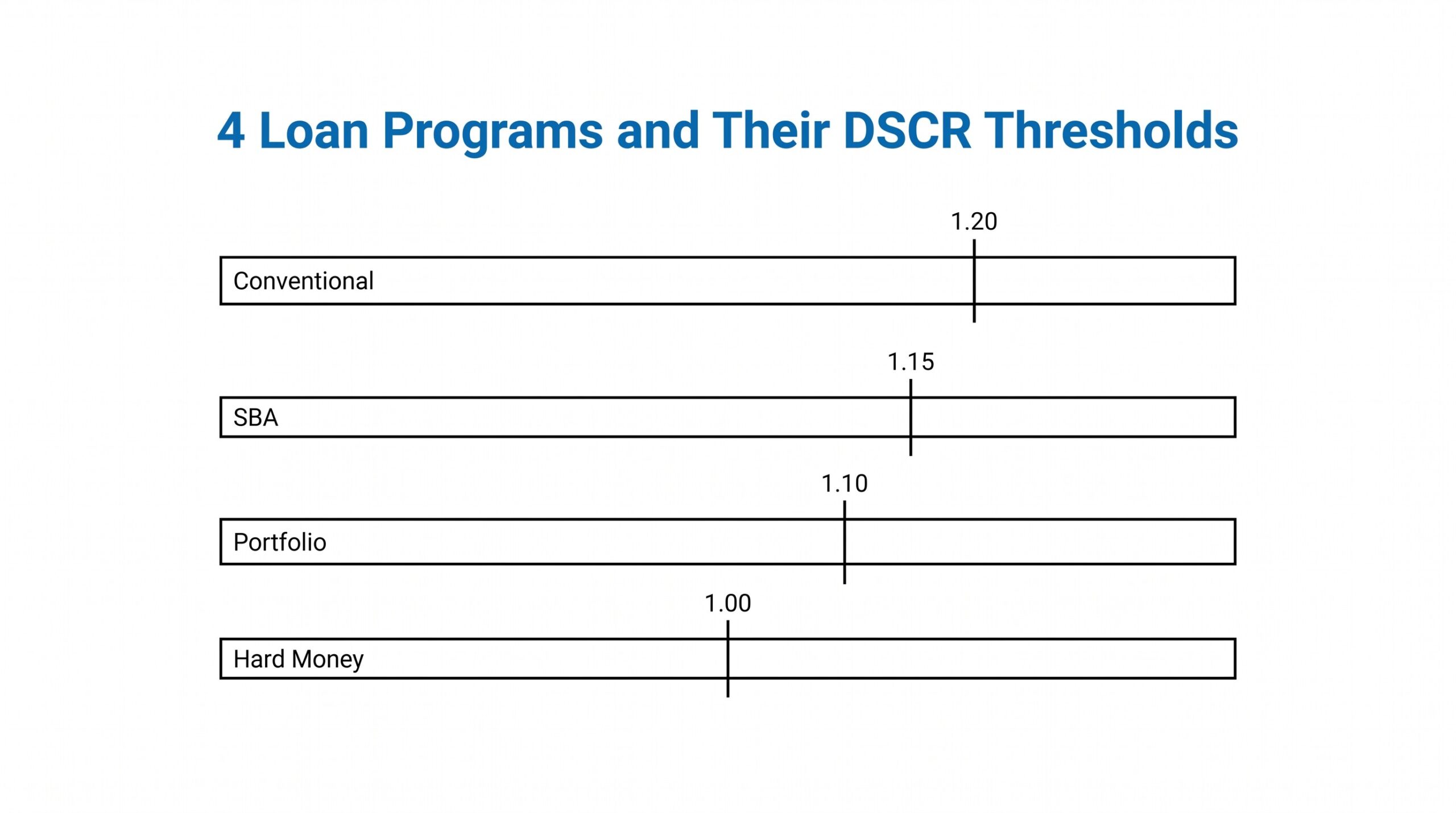
Different loan programs require different DSCR thresholds. The exact thresholds vary by lender, but the industry ranges are well established.
Conventional DSCR loans (Fannie Mae, Freddie Mac): minimum 1.00, with 1.20-1.25 being the practical threshold for most lenders. Loans at 1.00-1.10 typically carry higher interest rates (0.50-1.50% above the 1.25+ rates) to compensate for the lower cushion.
SBA 7(a) loans: minimum 1.15, with 1.25-1.40 being preferred. SBA loans use a global DSCR calculation that includes the borrower’s personal debt, so the threshold applies to the combined business and personal cash flow against all debt obligations.
Bank portfolio loans: vary widely. Some banks require 1.20-1.25, others accept 1.00-1.10 for strong borrowers with low LTV. Portfolio loans are held by the bank rather than sold to investors, which gives the bank flexibility to underwrite based on the full picture rather than strict DSCR thresholds.
Hard money and bridge loans: minimum 1.00, sometimes lower. These lenders focus more on the property’s value (LTV) than on the DSCR, but they still calculate DSCR to assess the borrower’s ability to service the debt during the loan term.
FHA and VA loans: do not use DSCR; they use debt-to-income (DTI) ratios instead. DSCR is specifically a metric for investment property and commercial loans, not for primary residence loans.
How Lenders Extract DSCR Data from Bank Statements
Lenders extract the underlying data points for DSCR from three main sources: bank statements (3 or 12 months), rent rolls (for rental property), and tax returns (for operating businesses). The bank statements provide the cash flow verification.
For rental property DSCR loans, lenders look for the monthly rent deposits on the bank statement.
If the property generates $4,200/month in rent, the lender expects to see 3 or 12 monthly deposits of approximately $4,200 (or $50,400 total for 12 months). The lender matches the deposits to the rent roll (a document listing all tenants, units, and rents) and calculates the average monthly rent collected.
For operating business DSCR loans, lenders look at all deposits to the business bank account over 3 or 12 months, categorize them as revenue (qualifying) or non-revenue (loans, transfers, owner contributions), and calculate the average monthly revenue. The operating expenses come from the bank statement outflows (categorized) and from the business tax return Schedule C or equivalent.
The 3-month vs 12-month averaging matters.
A property with strong summer rent but weak winter rent might show a DSCR of 1.30 in summer and 1.10 in winter. The 3-month average (summer) would show 1.30, while the 12-month average would show 1.18. Most lenders use 12 months for rental property DSCR and 3 months for operating business DSCR, but the choice depends on the lender and the loan program.
Bank statement quality matters for DSCR verification.
A PDF statement with all the merchant names visible, dates accurate, and amounts uncorrupted (the kind produced by a proper PDF to CSV conversion) produces a faster, more accurate DSCR calculation. The general bank statement to Excel workflow covers the conversion step, and the PDF to Google Sheets workflow covers an alternative target format.
For extracting specific transaction types from statements, the bank statement extract transactions workflow covers the technical details.
5 Ways to Improve Your DSCR Before Applying
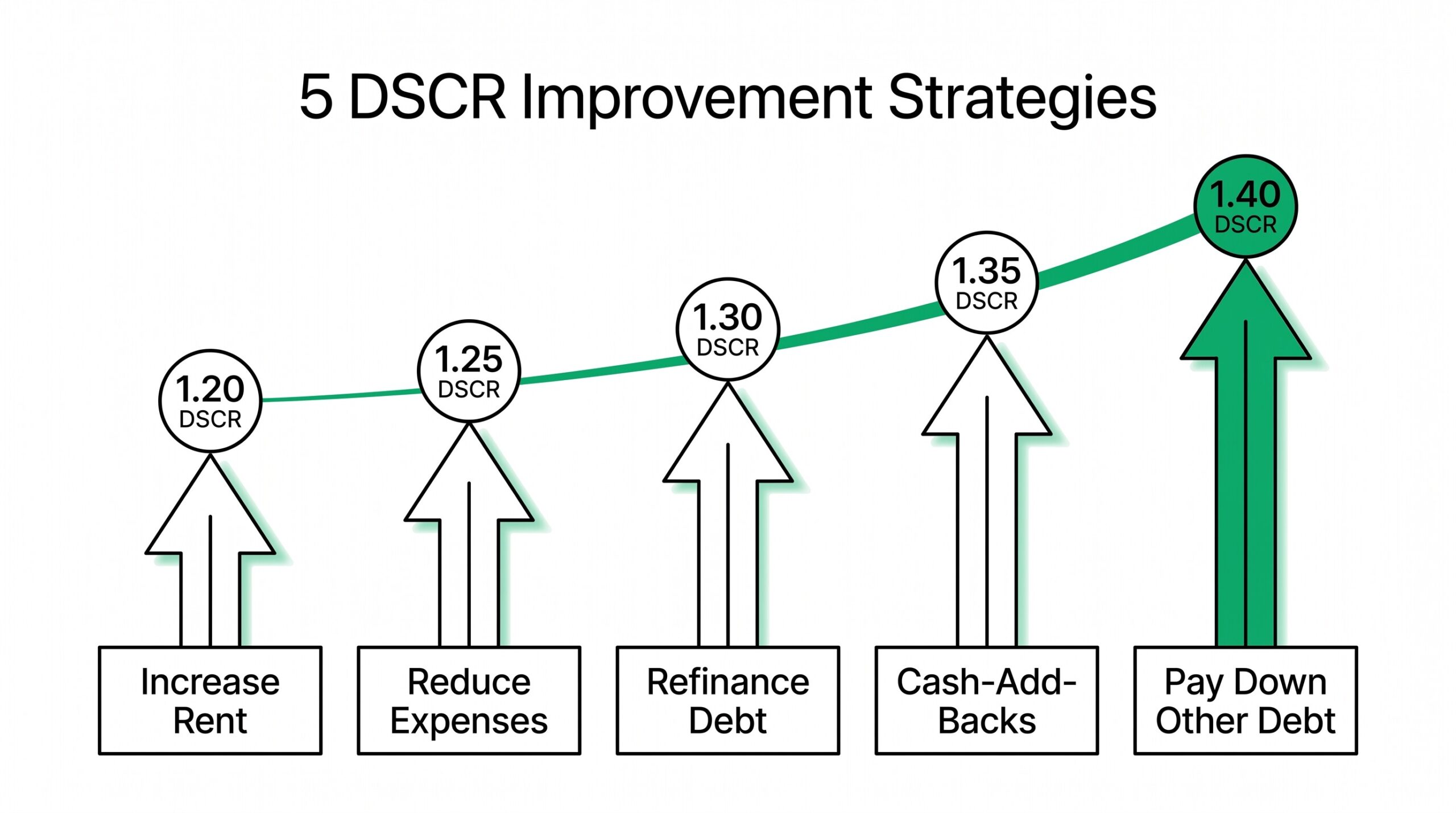
Five practical steps can improve a borrower’s DSCR before applying for a loan. Some steps are faster (rent increases, expense categorization) while others take months (refinancing, paying down balances).
Increase the rent.
The most direct way to improve DSCR is to increase the property’s rental income.
If the current rent is below market, a rent increase (with proper notice to the tenant) immediately improves the qualifying income and the DSCR. Most lenders use the actual rent collected, not the market rent, so the increase has to be in effect for at least one month before the lender reviews the bank statements.
Reduce operating expenses. Lowering operating expenses directly improves NOI. Renegotiating property management fees, refinancing insurance, switching tax assessment appeals, and reducing maintenance costs all improve DSCR. Some lenders use a flat operating expense ratio, so actual expense reductions may not show up in their DSCR calculation, but portfolio lenders typically use actual expenses.
Refinance existing debt. A lower debt service improves DSCR directly. Refinancing from a 7% mortgage to a 6% mortgage reduces the monthly payment, which reduces the denominator in the DSCR formula. The improvement can be 5-15% depending on the rate difference and loan balance.
Apply cash-add-backs. For operating business DSCR, adding back non-cash expenses (depreciation, amortization, owner draws above market salary) improves the qualifying income. A business with $80,000 in actual cash flow and $25,000 in depreciation add-backs might use $105,000 as the qualifying income, which can improve DSCR by 30%.
Pay down other debt. For global DSCR calculations (which include personal debt), paying down credit cards, auto loans, or other personal debt reduces the denominator and improves the global DSCR. This is more relevant for SBA loans than for rental property loans.
DSCR vs LTV: Two Different Metrics
DSCR and LTV (Loan to Value) are the two main metrics lenders use for investment property loans. They measure different things: DSCR measures cash flow adequacy, LTV measures collateral coverage. Lenders typically require minimum thresholds for both.
The LTV overview covers how LTV is calculated and what counts as property value. Most DSCR loans require 70-80% maximum LTV (meaning the loan is 70-80% of the property’s appraised value, similar to how a bank reconciliation cutoff defines balance ranges), with stricter LTV requirements for lower DSCR.
A borrower with a 1.10 DSCR might get a 70% LTV loan, while a borrower with a 1.25 DSCR might get an 80% LTV loan.
The combination of DSCR and LTV determines the loan’s risk profile. Low DSCR with low LTV is more acceptable than low DSCR with high LTV, because the property value provides a cushion for the lender if the borrower defaults. Most lenders offer the best rates for borrowers with both high DSCR (1.25+) and low LTV (under 75%).
See also
For related lending metrics, see the LTV loan to value guide for the other main investment property metric, and the bank statement for mortgage brokers guide for how lenders verify DSCR from statements. For preparing bank statements for loan applications, the loan application bank statement workflow covers the broader application context.
For categorizing transactions during DSCR analysis, the bank transaction categorization workflow covers how to apply consistent categorization across all your charges.
Turn any PDF statement into a clean sheet
Skip the typos and the hours of copying. Our converter handles any bank statement format and outputs Excel, CSV, or QBO for QuickBooks. No file retention, free to try.
Convert your statement