
The bank statement glossary covers 80+ terms used in bank statements, from account number to zero balance. The most common 25 terms
cover 95% of everyday statement reading.
The short answer: this glossary is a reference for the terms that appear on a US bank statement, organized alphabetically. Each term includes a 1-2 sentence definition plus a 1-sentence context. For related terms and broader concepts, see the linked articles at the end of each definition.
TL;DR. The bank statement glossary covers 80+ terms in 4 groups: account terms (account number, available balance, etc.), transaction terms (debit, credit, posted, etc.), fee terms (overdraft, NSF, monthly maintenance, etc.), and regulatory terms (FDIC, Regulation E, etc.). The 10 most important terms: statement balance, available balance, posted date, pending transaction, debit, credit, overdraft, NSF fee, monthly maintenance fee, and FDIC. The 3 most confused: pending vs posted, available vs statement balance, and debit vs credit. The 3 best practices: bookmark the glossary, look up unfamiliar terms, and use the 11-category framework to organize transactions.
Bank Statement Abbreviations: What They Mean on Your Statement
Bank statements use dozens of three-letter abbreviations that appear next to transactions. Most banks do not explain these on the statement itself. Here is what the most common abbreviations mean and where they come from.
| Abbreviation | Full Form | What It Means | For Full Reference |
|---|---|---|---|
| PPD | Prearranged Payment and Deposit | Consumer ACH entry authorized in advance (payroll, bills) | ACH SEC Codes |
| CCD | Corporate Credit or Debit | Business ACH entry between corporate accounts | ACH SEC Codes |
| CTX | Corporate Trade Exchange | Business ACH with invoice addenda | ACH SEC Codes |
| WEB | Internet-Initiated Entry | Online ACH (e-commerce, online bill pay) | ACH SEC Codes |
| TEL | Telephone-Initiated Entry | ACH authorized over the phone | ACH SEC Codes |
| DPC | Deposit Processing Code | Bank internal code for how the deposit was processed (in-person, ATM, mobile) | This guide |
| TFR | Transfer | Generic internal transfer code between accounts at the same bank | This guide |
| FPI | Foreign Payment Instrument | Payment originated from outside the US | This guide |
| TXN | Transaction | Generic transaction reference, not a specific type | This guide |
| OLB | Online Banking | Transaction originated from the bank’s online portal | This guide |
| NDCS | National Draft Clearing System | Older paper draft processing system, rarely seen today | This guide |
| CDSR | Credit Card Settlement and Reporting | Credit card processor internal code | This guide |
| IMAD | Input Message Accountability Data | Unique 16-digit ID for wire transfers (input) | This guide |
| OMAD | Output Message Accountability Data | Unique 16-digit ID for wire transfers (output) | This guide |
PPD, CCD, CTX, WEB, and TEL are SEC codes defined by NACHA. For the complete reference of every active SEC code including when to use each one and how they appear on bank statements, see ACH SEC Codes: the 9 standard entry class codes. The other abbreviations (DPC, TFR, FPI, TXN, OLB, NDCS, CDSR, IMAD, OMAD) are bank-internal codes that vary by institution. They generally do not affect reconciliation but may help understand how the bank processed a transaction.
Why Banks Use These Codes
Three-letter codes are an artifact of legacy banking systems designed for fixed-width record processing. When ACH and card processing moved from paper batches to electronic systems in the 1970s-1990s, banks needed short codes that fit in fixed database fields. Three letters became the standard. They survive today because the systems still expect them and replacing them would require coordination across thousands of financial institutions.
For consumers and small business owners, the practical impact is that bank statements look more cryptic than they need to. Banks have no incentive to add a glossary to statements because customers who understand the codes call support less, and support is a cost center. The codes exist for the bank’s systems, not for the customer’s understanding.
The 4 Groups of Bank Statement Terms
Bank statement terms fall into 4 groups:
What most guides miss about this workflow is that the quality depends on the mechanism, not on the tool. Two tools that look different on the surface often run the same 4-step process underneath: read, find, parse, verify. The difference is in how well each step handles edge cases (merged cells, missing balances, non-standard date formats, scanned vs digital input). Choosing between tools based on UI alone misses the actual quality lever.
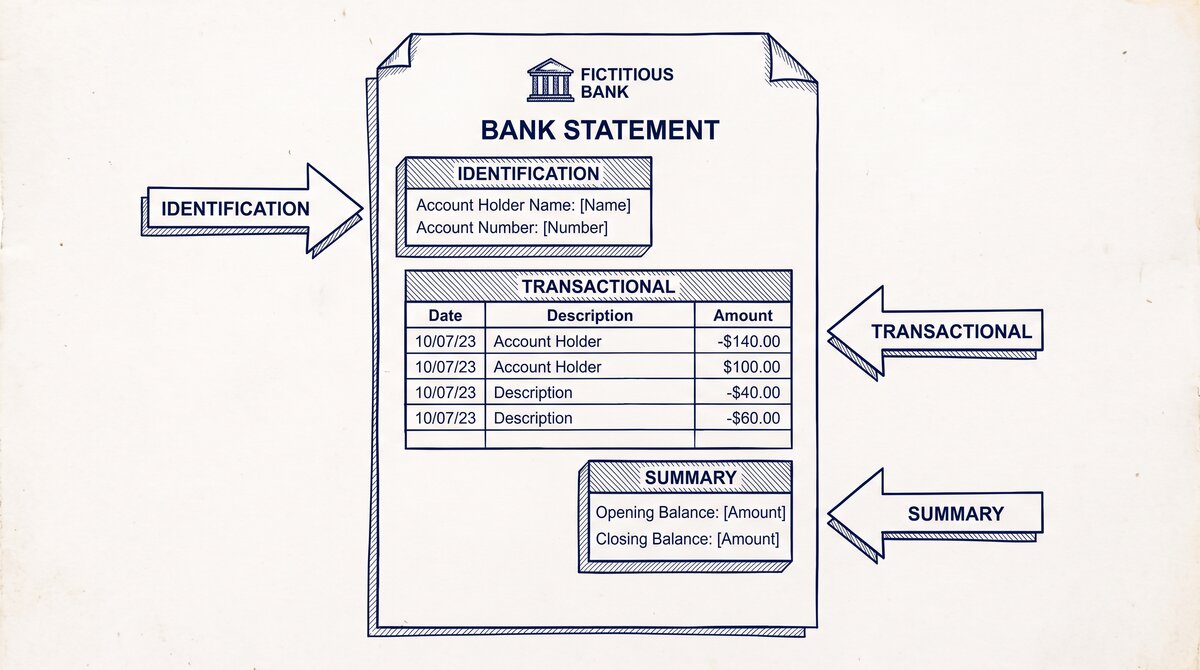
1. Account terms: terms that describe the account itself, including the account holder, account number, account type, statement period, and balances. Examples: account holder, account number, account type, statement period, opening balance, closing balance, available balance, current balance, statement balance, average daily balance, minimum balance, and average balance for the month.
2. Transaction terms: terms that describe individual transactions, including the date, amount, sign convention, and posting status. Examples: transaction, debit, credit, posted, pending, value date, transaction date, posting date, settlement date, hold, authorization hold, and recurring transaction.
3. Fee terms: terms that describe the fees charged by the bank, including the most common fees and the conditions that trigger them. Examples: monthly maintenance fee, overdraft fee, NSF fee, ATM fee, foreign transaction fee, wire transfer fee, early account closure fee, paper statement fee, and excess transaction fee.
4. Regulatory terms: terms that describe the regulatory framework for US bank accounts, including the federal agencies and regulations that govern banking. Examples: FDIC, NCUA, Regulation E, Regulation CC, Regulation DD, Truth in Savings Act, Electronic Funds Transfer Act, and Expedited Funds Availability Act.
From PDF to Excel in one click
Forget retyping line by line. Upload any bank statement, get a spreadsheet you can actually use. Your files are never stored, and you can test the converter with 3 free conversions.
Try it freeThe 10 Most Important Terms
10 terms that cover 95% of everyday bank statement reading:
1. Statement balance: The account balance at the end of the statement period. This is the official balance for the period and is used for verification, interest calculation, and fee assessment.
2. Available balance: The balance available for withdrawal or debit, including pending transactions. This may differ from the statement balance by the amount of pending transactions.
3. Posted date: The date the transaction was applied to the account. The posted date is shown on the statement. A transaction may have a different transaction date (when the customer initiated it) and posted date (when the bank processed it).
4. Pending transaction: A transaction that has been initiated but not yet posted. Pending transactions are shown in online banking but not on the statement. They affect the available balance but not the statement balance.
5. Debit: A withdrawal from the account. The debit reduces the account balance. A debit can be a purchase, a fee, a transfer out, or an ATM withdrawal.
6. Credit: A deposit to the account. The credit increases the account balance. A credit can be a direct deposit, a check deposit, a transfer in, or an interest payment.
7. Overdraft: A transaction that exceeds the available balance. The bank may pay the transaction (and charge an overdraft fee) or decline the transaction. The overdraft fee is typically $30-35 per transaction.
8. NSF fee (non-sufficient funds): A fee charged when a transaction is attempted but the account does not have sufficient funds. The NSF fee is typically $30-35. Some banks charge both an overdraft fee and an NSF fee for the same transaction.
9. Monthly maintenance fee: A recurring fee charged for maintaining the account. The fee is typically $5-25 per month. Most banks waive the fee if the account meets certain conditions (minimum balance, direct deposit, etc.).
10. FDIC (Federal Deposit Insurance Corporation): The US federal agency that insures bank deposits up to $250,000 per depositor, per bank. The FDIC notice appears on every US bank statement.
The 10 Most Confused Terms
10 terms that are commonly confused or misunderstood:
1. Pending vs posted. Pending transactions are initiated but not yet posted. Posted transactions are applied to the account. The statement only shows posted transactions. Online banking shows both pending and posted. A pending transaction affects the available balance but not the statement balance.
2. Available vs statement balance. The available balance includes pending transactions; the statement balance does not. The statement balance is the official balance for the period; the available balance is the real-time balance. A check that has been written but not cashed will reduce the available balance but not the statement balance.
3. Debit vs credit. A debit is a withdrawal (reduces balance); a credit is a deposit (increases balance). Some banks use the opposite convention: a debit card purchase is shown as a credit to the merchant. The bank statement convention is the one to follow: debit = withdrawal, credit = deposit.
4. Overdraft vs NSF. An overdraft is when a transaction is paid despite insufficient funds (and a fee is charged). An NSF is when a transaction is declined (and a fee is charged). Some banks use these terms interchangeably, which adds to the confusion.
5. Routing number vs account number. The routing number is the 9-digit bank identifier. The account number is the customer-specific number. Both appear on checks and statements. The routing number identifies the bank; the account number identifies the specific account.
6. APR vs APY. APR (Annual Percentage Rate) is the simple interest rate. APY (Annual Percentage Yield) includes the effect of compounding. For a savings account, the APY is what you earn. For a loan or credit card, the APR is what you pay.
7. Balance transfer vs wire transfer. A balance transfer moves a balance from one credit card to another (typically to get a lower rate). A wire transfer moves money from one bank account to another (typically for a fee). The terms sound similar but mean very different things.
8. ACH vs wire. ACH (Automated Clearing House) is an electronic transfer that takes 1-3 business days. A wire transfer is an electronic transfer that takes minutes to hours. ACH is cheaper; wire is faster.
9. ATM vs debit card. An ATM card is used only at ATMs (for cash withdrawals). A debit card is used at merchants (for purchases) and at ATMs. Most banks now issue debit cards only.
10. Statement vs transaction history. A statement is the official monthly document. A transaction history is a real-time view of recent transactions. The statement is the legal record; the transaction history is the working view.
The Complete Glossary (A-Z)
The full glossary, organized alphabetically:
Account holder: The person or entity that owns the account. For personal accounts, the customer. For business accounts, the business entity.
Account number: The unique identifier for the account, typically 8-17 digits. Often partially masked on statements for security (showing only the last 4 digits).
Account type: The category of account, which determines the terms and features. Common types: checking, savings, money market, CD (certificate of deposit), IRA (individual retirement account), credit card, line of credit.
ACH (Automated Clearing House): An electronic network for financial transactions. ACH transfers are typically used for direct deposit, bill pay, and bank transfers. ACH transfers take 1-3 business days and cost $0-3 per transfer.
APR (Annual Percentage Rate): The yearly interest rate, expressed as a percentage. For loans and credit cards, the APR is the cost of borrowing. For savings accounts, the APR is less common; APY is used instead.
APY (Annual Percentage Yield): The yearly rate of return, including the effect of compounding. For savings accounts and CDs, the APY is what the depositor earns.
ATM (Automated Teller Machine): A machine that allows customers to perform basic banking transactions: cash withdrawals, deposits, balance inquiries, transfers. ATM usage may be free (at the bank’s ATMs) or fee-based (at out-of-network ATMs).
Authorization hold: A temporary hold on funds when a merchant pre-authorizes a transaction (typical at hotels, car rental agencies, gas stations). The hold is released when the final transaction posts, typically 1-7 days after the hold.
Available balance: The balance available for withdrawal, including pending transactions. May differ from the statement balance by the amount of pending transactions and authorization holds.
Average daily balance: The average of the account balance over a period. Used for interest calculation and some fee waivers.
Available credit: For credit cards, the amount of credit available for new charges. Equal to the credit limit minus the current balance minus pending transactions.
Balance transfer: Moving a balance from one credit card to another, typically to take advantage of a lower interest rate. May have a fee (3-5% of the balance).
CD (Certificate of Deposit): A time deposit with a fixed interest rate and a fixed maturity date. Early withdrawal typically triggers a penalty.
Check: A written order to the bank to pay a specific amount from the account to a specific payee. Checks typically clear in 1-3 business days.
Closing balance: The account balance at the end of the statement period. The closing balance is shown in the statement footer.
Credit: A deposit or addition to the account. Increases the balance.
Debit: A withdrawal or deduction from the account. Decreases the balance.
Direct deposit: An electronic deposit of funds directly into the account, typically used for payroll, Social Security, or other recurring payments.
FDIC (Federal Deposit Insurance Corporation): The US federal agency that insures bank deposits up to $250,000 per depositor, per bank. The FDIC notice appears on every US bank statement.
Foreign transaction fee: A fee charged for transactions in a foreign currency or with a foreign merchant. Typically 1-3% of the transaction amount.
Hold: A delay in making funds available. Common holds: new account hold (7-10 days), large deposit hold (3-7 days), check hold (1-3 days), authorization hold (1-7 days).
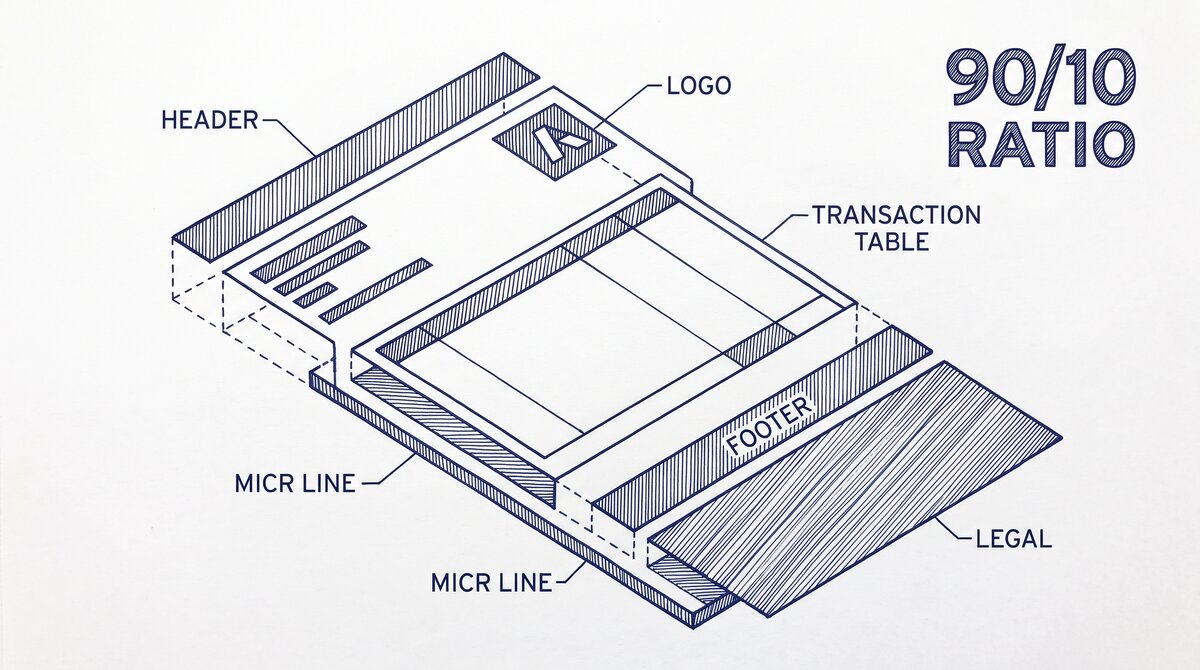
MICR line: The magnetic ink character recognition line at the bottom of a check. Contains the routing number, account number, and check number, encoded in a format the bank can read electronically.
Minimum balance: The minimum balance required to waive a monthly maintenance fee or earn a higher interest rate. Below the minimum, the fee is charged or the rate is reduced.
Monthly maintenance fee: A recurring fee charged for maintaining the account. Typically $5-25 per month. Most banks waive the fee if certain conditions are met.
NCUA (National Credit Union Administration): The US federal agency that insures credit union deposits up to $250,000 per depositor, per credit union. The NCUA is the credit union equivalent of the FDIC.
NSF (non-sufficient funds) fee: A fee charged when a transaction is attempted but the account does not have sufficient funds. The fee is typically $30-35. Some banks charge both an NSF fee and an overdraft fee for the same transaction.
Opening balance: The account balance at the start of the statement period. The opening balance is shown in the statement header.
Overdraft: A transaction that exceeds the available balance. The bank may pay the transaction (and charge an overdraft fee) or decline the transaction (and charge an NSF fee).
Overdraft fee: A fee charged when a transaction is paid despite insufficient funds. The fee is typically $30-35 per transaction.
Pending transaction: A transaction that has been initiated but not yet posted. Affects the available balance but not the statement balance.
Posted transaction: A transaction that has been applied to the account. Shown on the statement. Affects both the available balance and the statement balance.
Regulation E: The federal regulation that protects consumers using electronic funds transfers (debit cards, ATMs, ACH). Provides for error resolution and limited liability for unauthorized transactions.
Routing number: The 9-digit identifier for the bank. Used for check processing, ACH transfers, and wire transfers. Different from the account number.
Statement balance: The official account balance at the end of the statement period. Used for verification, interest calculation, and fee assessment.
Statement period: The date range the statement covers. Typically a calendar month (e.g., January 1 to January 31). Some accounts have non-calendar-month cycles.
Transaction: Any event that changes the account balance: deposit, withdrawal, fee, interest, transfer.
Transaction date: The date the transaction was initiated. May differ from the posted date (when the bank processed the transaction).
Wire transfer: An electronic transfer of funds from one bank to another. Wire transfers take minutes to hours and cost $15-50 per transfer.
3 Best Practices for Using the Glossary
3 best practices that make the glossary useful:
1. Bookmark the glossary. The 80+ terms cover most of what you’ll see on a statement. Bookmark the page for quick reference when you encounter an unfamiliar term.
2. Look up unfamiliar terms. When you see a term you don’t recognize, look it up in the glossary. The 1-2 sentence definition and the 1-sentence context are enough to understand the term in 90% of cases.
3. Use the 11-category framework. The glossary covers the terms on the statement. The 11-category framework covers the categories to assign to each transaction. Use both: the glossary for understanding the statement, the 11-category framework for organizing the transactions.
A common failure mode bookkeepers report is treating this as a single operation rather than a chain of dependent steps. The temptation is to find a tool that ‘just works’ and stop investigating the mechanism. The result is a wrong-fix cycle: the tool gives partial output, the bookkeeper spends 30+ minutes troubleshooting, the fix is for the wrong step, and the same error recurs on the next statement. The fix: identify which step failed and apply the right intervention to that step.
Related Resources
| Resource | What You Get |
|---|---|
| Bank Transaction Categorization | See-also resource |
| Bank Statement Converter | See-also resource |
| Bank Statement Anatomy | See-also resource |
| Bank Statement Conversion Checklist | See-also resource |
For the 11-category framework, see the bank transaction categorization reference. For the conversion step, see the bank statement converter page. For the underlying statement structure, see the bank statement anatomy reference. For the conversion process, see the conversion checklist page.
Related Pages
For the complete ACH SEC code reference covering PPD, CCD, CTX, WEB, TEL and more, see ACH SEC Codes. For how to find and reconcile specific codes on your statement, see how bank reconciliation works. For what to do when a code doesn’t appear in this glossary, see bank statement anatomy.
For how statements are read by automated systems (and why some lines are missed), see how OCR works for bank statements. For how to clean messy statements before they enter the converter, see bank statement vs bank statement loan.
Turn That PDF Into a Spreadsheet in Minutes
You've seen how to do it manually — now let the tool handle the heavy lifting. Upload your bank statement and get Excel, CSV, or QBO in a few clicks.
Try It Free