
Use wire when the cut-off has passed, the amount exceeds $1M, the transfer is international, or the recipient needs same-day certainty. Use ACH when cost matters more than speed, the transfer is under $1M, and reversibility is acceptable. The two rails are not interchangeable; the wrong choice costs either money or time, and sometimes both.
What “Choosing Between ACH and Wire” Actually Means
“Choosing between ACH and wire” sounds like a binary toggle but is really a decision tree with hard rules and soft rules. The hard rules are constraints (international, amount limit, cut-off) where the answer is forced. The soft rules are preferences (cost sensitivity, audit trail, recipient preference) where the answer is negotiable.
A transfer either fits ACH or it does not. If it fits, ACH is almost always the right choice. If it does not fit ACH, wire is the only remaining option. The decision is rarely “ACH or wire” in the abstract; it is “ACH, or wire because ACH cannot do this.”
The 4 Hard Rules
The 4 hard rules are constraints where one rail is the only viable option.
International. ACH is domestic US only (with limited corridors to Canada and Europe). Any transfer to a foreign bank must use wire (via SWIFT) or a third-party service (Wise, OFX). The choice is wire.
Amount. Standard ACH has a $25K per-transaction limit (or $1M for business accounts). Same-day ACH allows up to $1M per transaction. Above $1M, wire is the only option. The choice is wire.
Same-day settlement requirement. If the transfer must settle today and the ACH cut-off has passed, wire is the only option. The choice is wire.
Reversibility requirement. ACH is reversible within 24-60 hours. Wire is not. If reversibility is needed (e.g., escrow, conditional payment, fraud protection), ACH is the only option. The choice is ACH.
The 4 Soft Rules
The 4 soft rules are preferences that nudge the decision but do not force it.
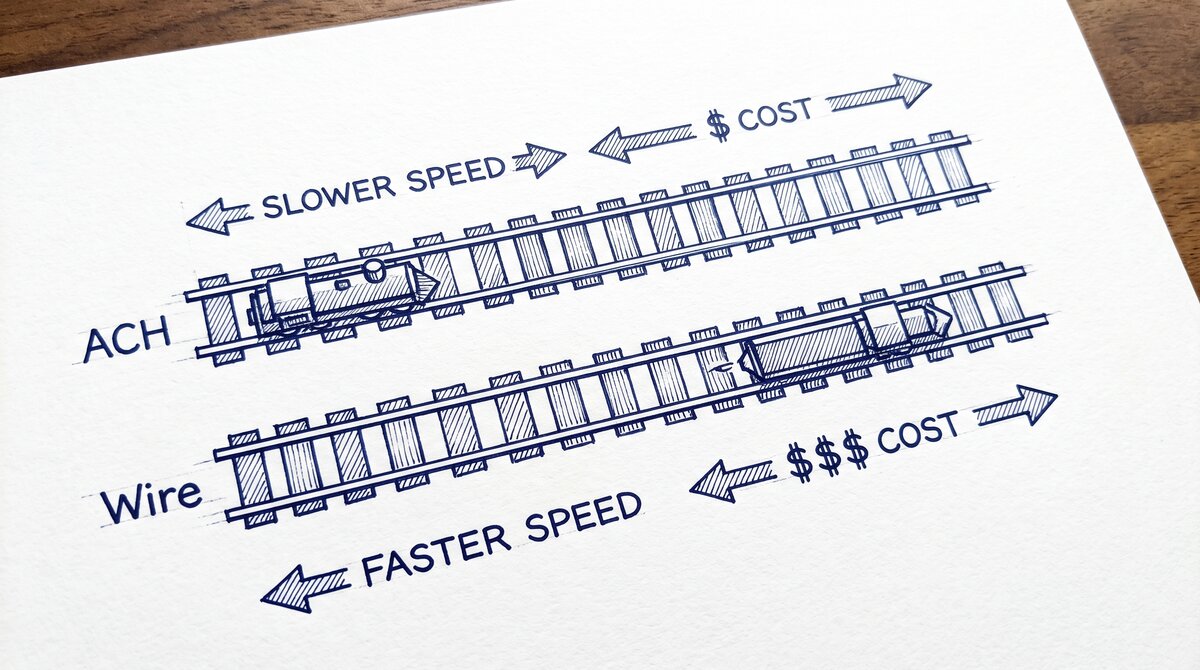
Cost sensitivity. ACH costs $0.20-$1.50. Wire costs $15-$50. For cost-sensitive payments, ACH wins unless a hard rule forces wire.
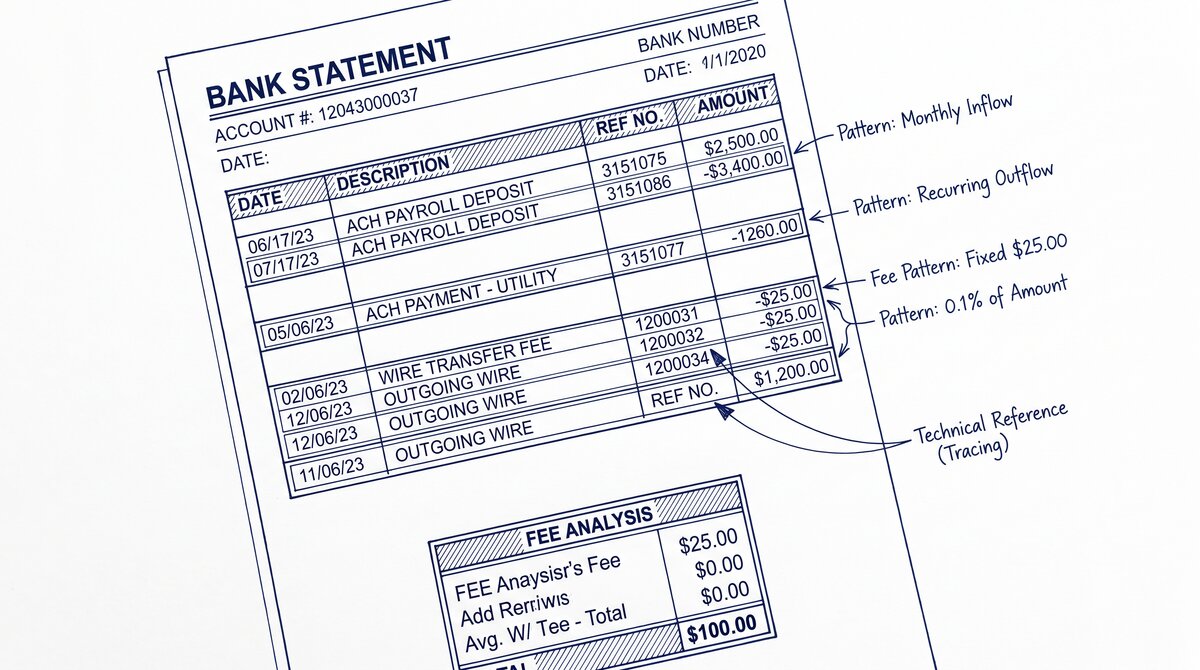
Audit trail. Both rails leave an audit trail, but ACH batches make the trail longer to reconstruct. Wire’s IMAD/OMAD reference number provides a single, traceable identifier. For audit-heavy workflows, wire is cleaner.
Recipient preference. Some recipients (landlords, vendors, government agencies) require wire. The choice follows the recipient’s preference.
Batch vs single. ACH supports batch processing (payroll, vendor payments), which reduces per-transaction cost. Wire is always single. For recurring batch payments, ACH is the right pattern.
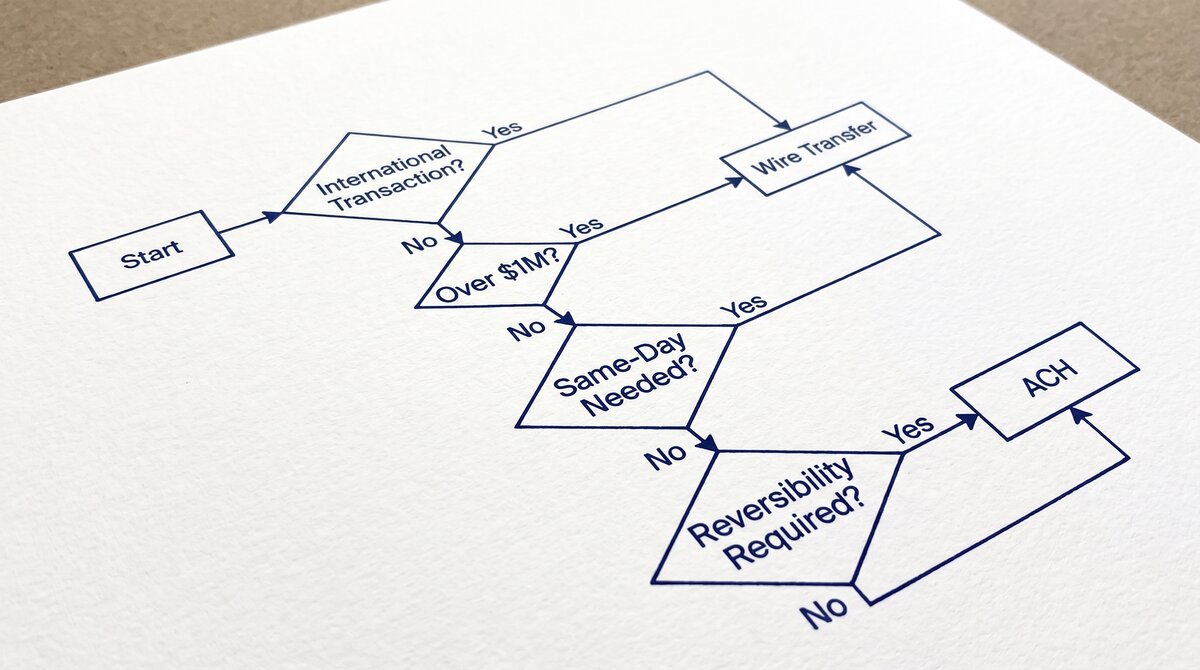
The Decision Tree in 4 Questions
For any transfer, ask these 4 questions in order:
Is the transfer international? If yes: wire. If no: continue.
Is the transfer over $1M? If yes: wire. If no: continue.
Does the transfer need to settle today? If yes: wire. If no: continue.
Is reversibility needed (within 24-60 hours)? If yes: ACH. If no: ACH (cost wins).
The result is almost always ACH. The exceptions are international, large, or time-critical transfers.
From PDF to Excel in one click
Forget retyping line by line. Upload any bank statement, get a spreadsheet you can actually use. Your files are never stored, and you can test the converter with 3 free conversions.
Try it free5 Scenarios Where Wire Is the Only Option
Real Estate Closing
Title companies require wire for closing funds. The amount is typically $50K-$500K, the timing is same-day, and the recipient will not accept ACH. Wire is the only option.
International Vendor Payment
Any payment to a non-US bank requires wire (or a third-party service). ACH does not support most international corridors. Wire is the only direct option.
Court-Ordered Payment
Many court orders specify wire. ACH is not acceptable for court-ordered payments. Wire is the only option.
M&A Closing
M&A transactions settle same-day with certainty. ACH would not settle in time, and the $1M+ amounts often exceed same-day ACH limits. Wire is the standard.
Time-Critical Vendor Payment
A vendor requires payment today to release a shipment. The ACH cut-off has passed, or the amount is above $1M, or the vendor only accepts wire. Wire is the right choice.
Common Mistakes When Choosing
The most common mistake is using ACH for a time-critical payment and missing the cut-off. The transfer sits in the batch overnight, the recipient flags the payment as late, and the user has to send a wire anyway, paying both fees. Bookkeepers report this happens most often at month-end when payroll and vendor payments stack up.
The second most common mistake is using wire when ACH would have worked, paying $25 for a $0.50 transaction. This happens when the user is not sure of the rules and defaults to the “safer” option. Over 12 months, the cost difference is $294 for a single recurring payment.
The third most common mistake is sending wire to the wrong account. Wire is irreversible. Recovery requires the recipient’s cooperation, which is rare in fraud cases. Always verify the account number and routing number (for US wires) or the IBAN and SWIFT/BIC code (for international wires) before sending.
The pattern: the choice between ACH and wire is irreversible. The cost of getting it wrong exceeds the cost of asking the bank which rail is right. A 2-minute call to the bank before a large transfer prevents a $25-$75 mistake.
The ACH vs wire transfer pillar covers the 5-criteria matrix in detail. The cost comparison covers the hidden fee layers. The speed comparison covers the 4 ACH speeds and cut-off times. The statement appearance covers how each appears on a bank statement.
For a deeper understanding, see: payment rails pillar . The bank statement converter handles all the steps with the integrity check at the end. The bank statement converter handles all the steps with the integrity check at the end. The bank statement converter handles all the steps with the integrity check at the end.
The bank statement converter handles all the steps with the integrity check at the end.
See also: when to use wire vs ACH in context
This explainer is part of the payment rails coverage on this site. The consolidated overview of ACH, wire, Zelle, RTP, and FedNow for US banks now lives in the complete US bank payment rails guide, which is the modern hub for the topic.
For parallel reading on the merchant category codes that flow over the card-network rails, see the complete MCC guide. For what every column on a US bank statement means and where the rail labels appear, see the expanded bank statement anatomy.
When wire is the right call over ACH
Wire is the right call for transactions where time, certainty, and finality matter more than cost. Real estate closing is the canonical example: a $400,000 home purchase where the closing must happen at a specific time cannot risk a 3-day ACH delay. Wires also settle on the same day for transactions initiated before the cutoff.
Wire is the right call when the transaction exceeds ACH limits. The standard NACHA limit is $25,000 per entry for CCD and $1 million per entry for IAT, but practical bank-level limits are often lower. Wire has no per-transaction dollar limit on Fedwire.
Wire is the right call when the recipient requires irrevocable funds. Once a wire is sent, it cannot be reversed. ACH can sometimes be reversed within a dispute window. For transactions where reversal risk is unacceptable, wire is the safer rail.
For everything else, ACH wins. Recurring bill pay, payroll, vendor payments, peer business transfers – these all flow over ACH by default. Save wire for the high-trust, time-sensitive, big-dollar transactions. The complete US bank payment rails guide covers ACH, wire, Zelle, and real-time rails in full.
Wire for time-sensitive transactions
When a real estate closing is set for 10 AM on a specific date, the buyer cannot afford a 3-day ACH delay. The cash must arrive by 9 AM at the closing agent’s trust account. Wire is the only rail that handles this with same-day certainty.
When a court-ordered settlement has a deadline, the only rail that finalizes the transfer that day is wire. ACH carries settlement risk that the recipient cannot accept when there is a court order.
When the dollar amount exceeds the ACH limit (NACHA caps most ACH entries at $25,000-$1 million depending on type), wire is the fallback. Some banks have lower practical limits. Wire has no per-transfer cap on Fedwire for domestic transfers.
The decision tree, end to end
Step one: is the dollar amount over $25,000? If yes, default to wire to avoid the ACH entry-level caps. If no, ACH is fine. Step two: is the recipient ready to receive by today’s close? If yes, wire or real-time rail. If no, standard ACH works for 1-2 business day timeline.
Step three: is reversal risk acceptable? For rent, payroll, vendor invoices, ACH is fine because reversal is rare. For high-trust transactions like real estate closing, wire is mandatory.
Step four: does the recipient require same-day settlement? Some vendors and most real estate closings require same-day. ACH cannot guarantee that. Wire or real-time rail is the answer.
Step five: confirm the rail with the recipient before initiating. ACH and wire are both common, but a wrong rail choice causes more friction than the underlying amount justifies.
A worked example
A real estate buyer is closing on a $400,000 home on May 30 at 11 AM ET. The buyer’s bank initiates an outbound wire on May 29 at 4 PM ET. The wire settles same day. The closing agent receives the wire on May 30 morning. The closing proceeds on time.
Had the buyer used ACH, the timeline would be 3-5 business days, exceeding the closing date. ACH is not a viable rail here. Wire is mandatory.
A second example: a small business pays a vendor $8,000 on the 15th of each month. ACH reaches by the 17th or 18th. The vendor’s invoice allows 30 days. ACH is fine.
A third example: a small business sends $12,000 to a contractor for completed work. ACH and wire both work. ACH saves $25 in fees. Choose ACH.
Output format: which one matches the destination?
Picking the right output format is a separate decision from picking the right converter.
XLSX for human spreadsheet review. CSV for downstream scripts and tools. Google Sheets-compatible for shared cloud review. QBO for QuickBooks.
The four canonical columns are preserved across every format. What differs is how the downstream consumer expects the rows.
For a side-by-side rule of thumb that maps destination to format, see the decision framework on the output format pillar.
Read the full output format decision framework
From PDF to Excel in one click
Forget retyping line by line. Upload any bank statement, get a spreadsheet you can actually use. Your files are never stored, and you can test the converter with 3 free conversions.
Try it free