
Wire Transfer Fee on a Bank Statement, What It Means
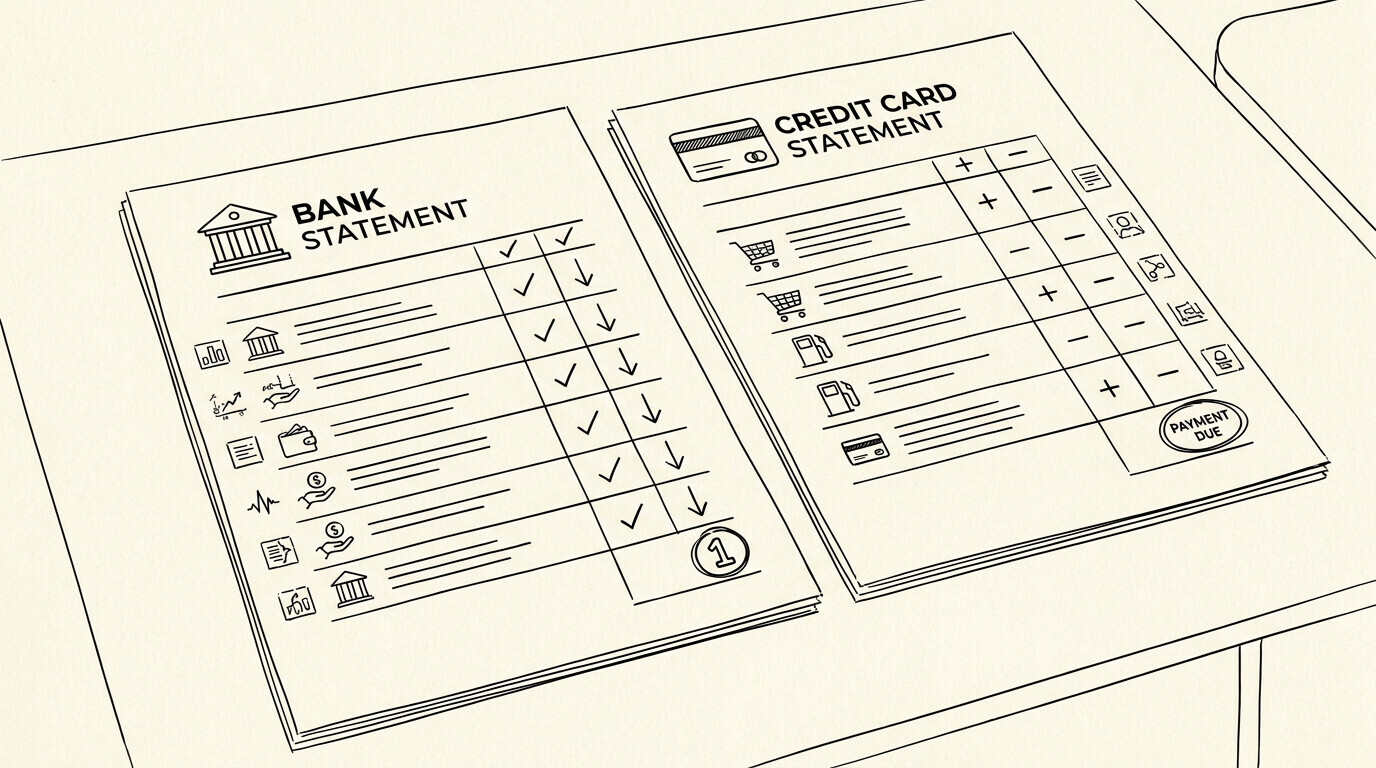
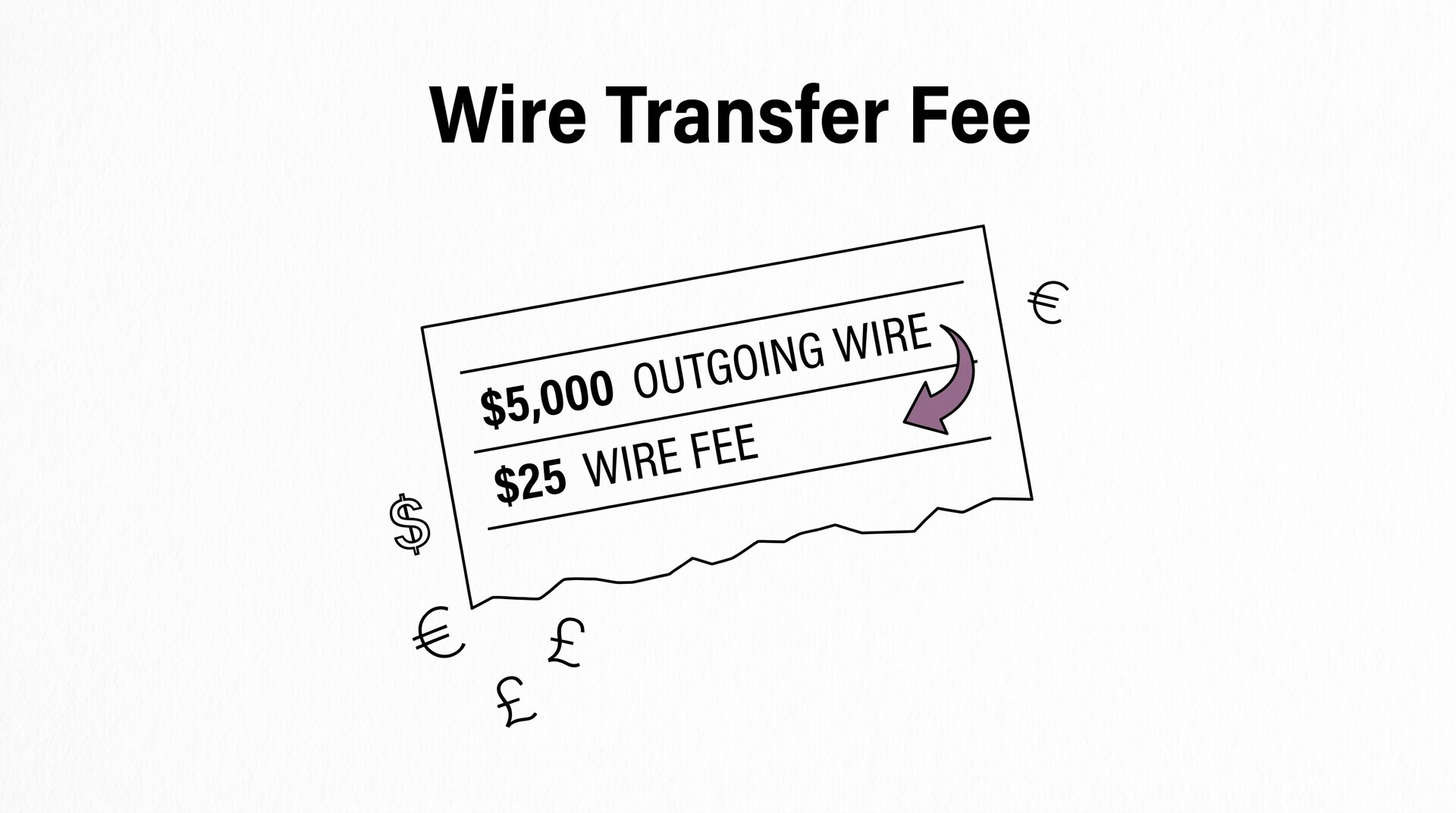
You reconcile a converted bank statement and notice a $25 debit line item labeled “WIRE TRANSFER FEE” sitting below a $5,000 wire to a supplier. Or you spot a $45 charge with the descriptor “OUTGOING INTL WIRE” on your small business checking account, and you’re not sure whether the fee is part of the wire or separate.
Or your bookkeeper groups every wire with its fee as one logical transaction, but the bank shows two lines, so the books don’t reconcile cleanly until you figure out which is which. That small dollar amount you barely notice is doing real bookkeeping work, and it’s worth understanding exactly what it is, when it applies, and where it goes on Schedule C.
Quick Answers: A wire transfer fee is the bank’s charge for processing an outgoing wire transfer, separate from the wire amount itself. Domestic outgoing wire fees typically run $15-35 at most US banks; international outgoing wire fees run $35-50 with possible intermediary bank fees on top. The fee appears on the bank statement as a separate line item, usually labeled “WIRE TRANSFER FEE” or “OUTGOING WIRE FEE.” For self-employed businesses paying vendors via wire, the fee is deductible on Schedule C as Line 27a (Other Expenses) or Line 10 (Commissions and Fees), depending on the bookkeeper’s chart of accounts. International wires often include a third charge for FX conversion markup that bookkeepers should reconcile separately.
What a Wire Transfer Fee Actually Is
A wire transfer fee is the bank’s processing charge for sending a wire transfer. The fee exists because wire transfers are real-time, irrevocable, and routed through separate banking networks (Fedwire domestically, SWIFT internationally), they’re more expensive for banks to process than ACH vs wire transfer.
The fee structure breaks down by type:
- Domestic outgoing wire (within the United States): typically $15-35 at most US banks. Online wires cost less than in-branch wires.
- International outgoing wire (wire transfer vs ACH): typically $35-50 at sending, plus possible intermediary bank fees ($10-25 each) deducted by routing banks along the way.
- Incoming wire (receiving): typically $0-15 at most banks. Some banks charge $0 for incoming wires as a customer benefit.
The fee is charged by the bank originating the wire (your bank, if you’re sending) or the bank receiving it (if the recipient’s bank charges). The Federal Reserve’s Fedwire system charges the originating bank a fee for each transfer, and banks pass that fee (plus their own markup) to their customers.
From PDF to Excel in one click
Forget retyping line by line. Upload any bank statement, get a spreadsheet you can actually use. Your files are never stored, and you can test the converter with 3 free conversions.
Try it freeTurn That PDF Into a Spreadsheet in Minutes
You've seen how to do it manually — now let the tool handle the heavy lifting. Upload your bank statement and get Excel, CSV, or QBO in a few clicks.
Try It FreeHow Wire Fees Appear on Bank Statements
Most banks show the wire transfer and the wire fee as separate line items on the statement. The typical pattern:
| Date | Description | Amount |
|---|---|---|
| 2026-03-04 | OUTGOING WIRE, ACME VENDORS LLC | -$5,000.00 |
| 2026-03-04 | WIRE TRANSFER FEE | -$25.00 |
| 2026-03-04 | OUTGOING INTL WIRE, GLOBAL PARTS GMBH | -$4,830.00 |
| 2026-03-04 | FX CONVERSION MARGIN | -$45.00 |
| 2026-03-04 | INTL WIRE FEE | -$40.00 |
| 2026-03-08 | INCOMING WIRE, CLIENT PAYMENT | +$12,500.00 |
The wire amount and the fee appear on the same date (because banks process them as one wire transaction with separate ledger entries). Some bank PDFs combine them on one line, the bookkeeper’s reconciliation job is to split them when categorizing.
Common descriptors to look for:
- “WIRE TRANSFER FEE”
- “OUTGOING WIRE FEE”
- “INTL WIRE FEE”
- “WIRE FEE”
- “FOREIGN WIRE FEE”
- “FX CONVERSION FEE”
- “INTERMEDIARY BANK FEE” (international)
When a converted CSV shows a small dollar amount (typically $15-75) on the same date as a larger outgoing wire, the small amount is almost always the wire fee.
Typical Wire Fee Ranges at Major US Banks (2026)
Here’s what most US banks charge for outgoing wire transfers in 2026:
| Bank | Domestic Online | Domestic In-Branch | International Online | International In-Branch |
|---|---|---|---|---|
| Chase | $25 | $40 | $40 | $50 |
| Bank of America | $30 | $45 | $35 | $50 |
| Wells Fargo | $25 | $40 | $40 | $50 |
| Citibank | $25 | $35 | $35 | $45 |
| Capital One | $30 | $40 | $40 | $50 |
| US Bank | $30 | $40 | $50 | $65 |
| PNC | $30 | $40 | $45 | $50 |
These are typical fees. Premium account holders (Chase Private Client, BofA Preferred Rewards Platinum) often get domestic wire fees waived. International wires rarely have fee waivers regardless of account tier.
For accounting purposes, a quick rule: budget $25-50 per domestic wire, $50-75 per international wire. Anything dramatically higher is worth questioning with the bank.
Schedule C Mapping: Is a Wire Fee Deductible
Wire fees paid for legitimate business transactions are deductible as ordinary and necessary business expenses under IRS rules. The Schedule C line item depends on the chart of accounts:
| Fee Context | Schedule C Line | Line Name |
|---|---|---|
| Wire fee for paying a vendor | Line 27a | Other Expenses (often labeled “Bank Fees”) |
| Wire fee for paying a contractor | Line 10 OR Line 27a | Commissions and Fees / Bank Charges |
| Wire fee for travel-related payment | Line 24a | Travel |
| Wire fee for international supplier | Line 22 OR Line 27a | Supplies / Other Expenses |
The fee is deductible when used for business purposes. Wire fees paid from a personal account (even if for what turns out to be a business purpose) are not deductible. The fee should be on a business bank account to qualify.
For bookkeeper practice: most write wire fees under Line 27a “Other Expenses” with a subcategory like “Bank Service Charges” or “Wire Transfer Fees.” This keeps the categorization clean and easy to audit. Some bookkeepers prefer Line 10 “Commissions and Fees”, both are valid, and either treatment works as long as it’s consistent.
Wire vs ACH: Cost Comparison at Scale
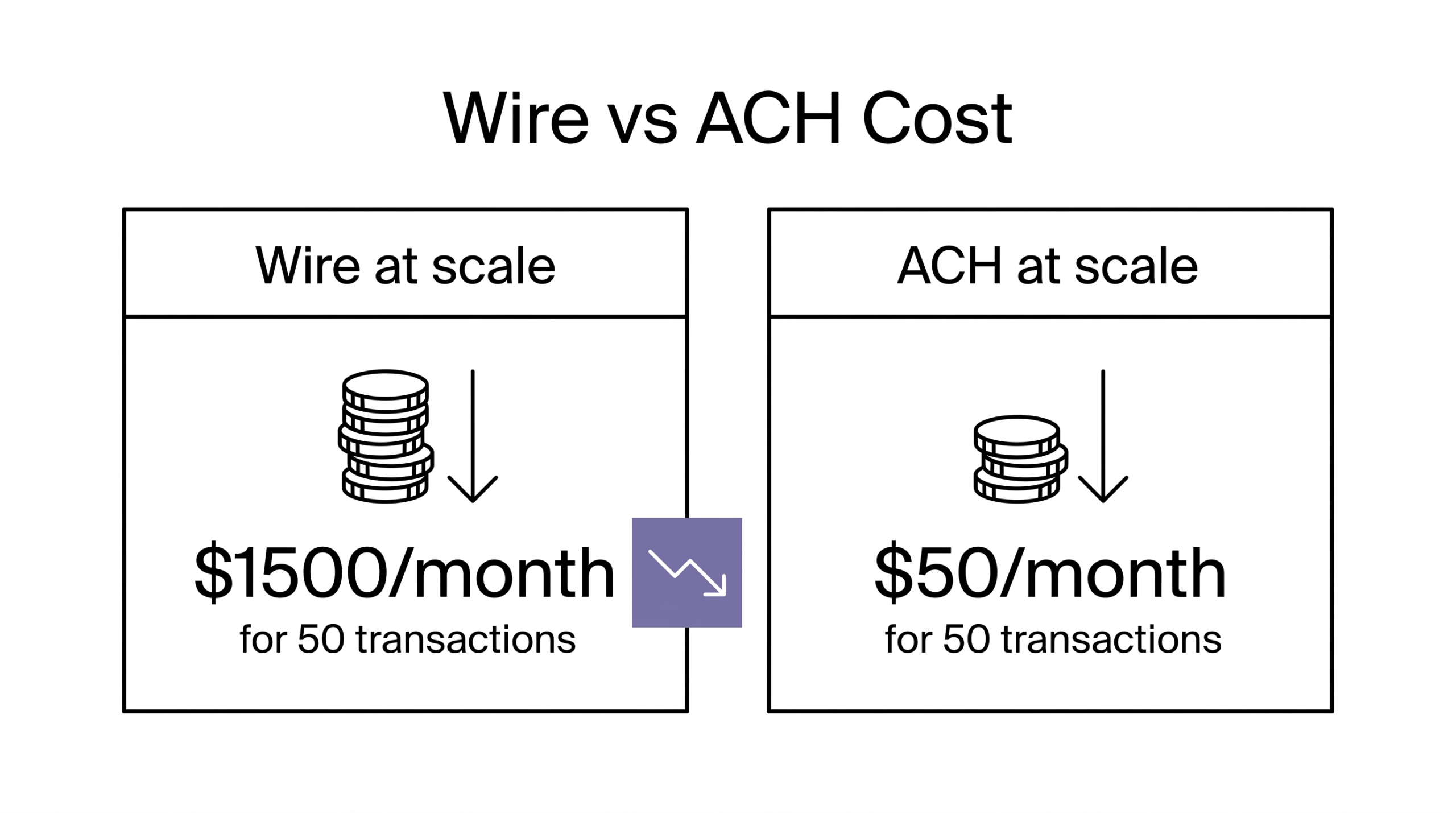
The cost gap between wires and ACH is significant for businesses making frequent payments. A business doing 50 vendor payments per month would see the following:
| Method | Per Transaction | 50 Transactions / Month |
|---|---|---|
| ACH (standard) | $0-2.50 | $0-125 |
| Same-day ACH | $1-5 | $50-250 |
| Online domestic wire | $25-30 | $1,250-1,500 |
| International wire | $40-75 | $2,000-3,750 |
For routine vendor payments, ACH is roughly 10x cheaper than wire. The trade-off is speed and acceptance: ACH vs wire on bank statement, wires settle same-day, and ACH vs wire cost comparison for cross-border payments (most countries don’t support US-style ACH).
Decision rule: use ACH for routine US-based vendor payments, use wires for international payments, time-sensitive payments, or when ACH isn’t supported. For most small US-based businesses, ACH handles 95% of vendor payments; wires are the exception.
Reconciling Wire + Fee as One Logical Transaction
In QuickBooks Online, Xero, or Wave, a wire and its fee should reconcile as one logical transaction with two expense lines. Here’s the practical workflow:
- The bank statement CSV shows two lines: the wire ($5,000) and the fee ($25). Both are debits. Both appear under “Bank Activity” in the imported register.
- Categorize the wire ($5,000) as the appropriate vendor expense (Line 11, Line 17, or Line 22 depending on the vendor type).
- Categorize the fee ($25) as Bank Service Charges (Line 27a “Other Expenses”).
- Match both to the same invoice or bill in the vendor’s record. The bill was for $5,025 total ($5,000 to vendor + $25 in processing fees), but the vendor only sees $5,000; the $25 is the cost of paying them via wire.
- Reconcile the bank balance after both lines are categorized.
The bookkeeper’s job is to split what the bank presents as one transaction with two lines into the accounting system’s view: one vendor expense and one bank fee. Most accounting platforms handle this gracefully when each line is categorized separately.
For bookkeepers using bank rules: most bank rules on wires look for the merchant description “WIRE TRANSFER” and category it as the appropriate expense. The fee can be tagged with a separate rule that triggers on “WIRE TRANSFER FEE” specifically. Building both rules together catches the pattern.
Foreign-Currency Wires, Three Components to Reconcile
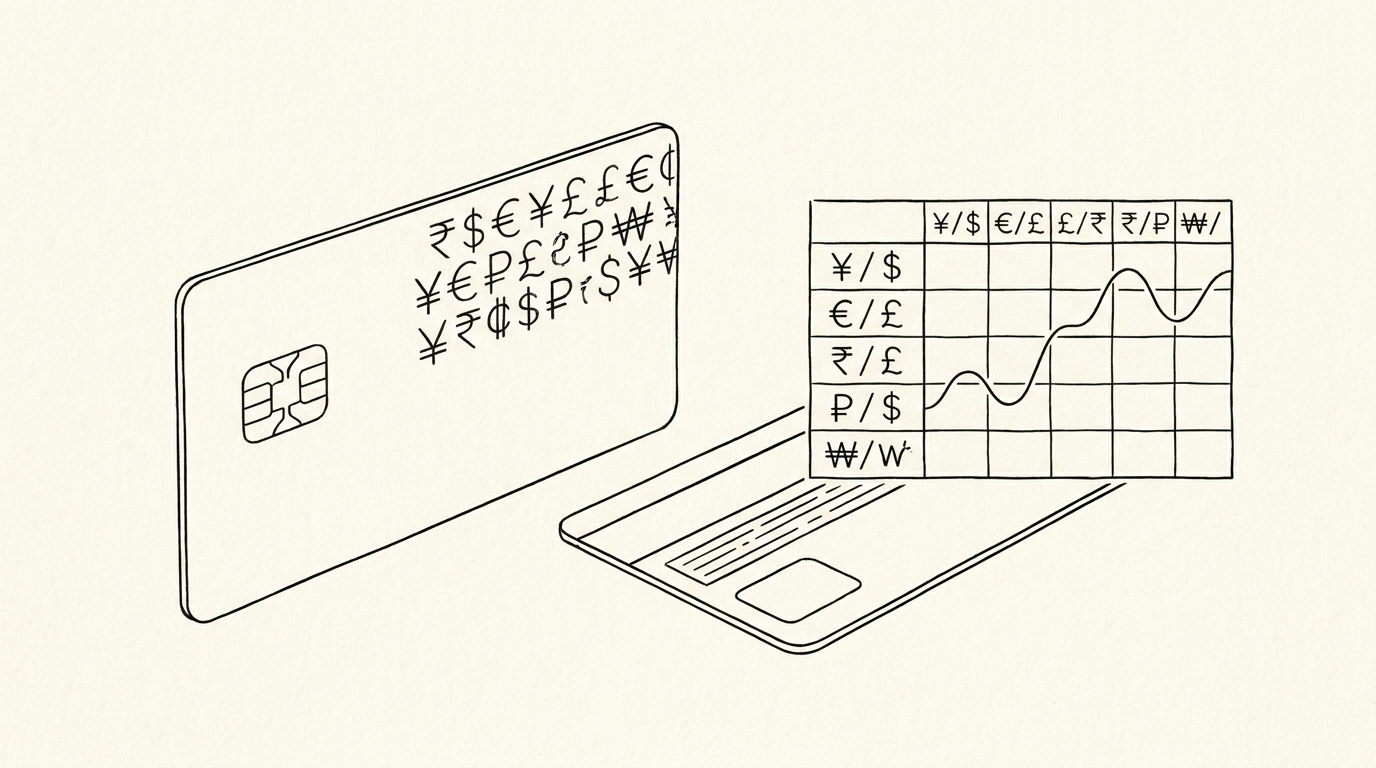
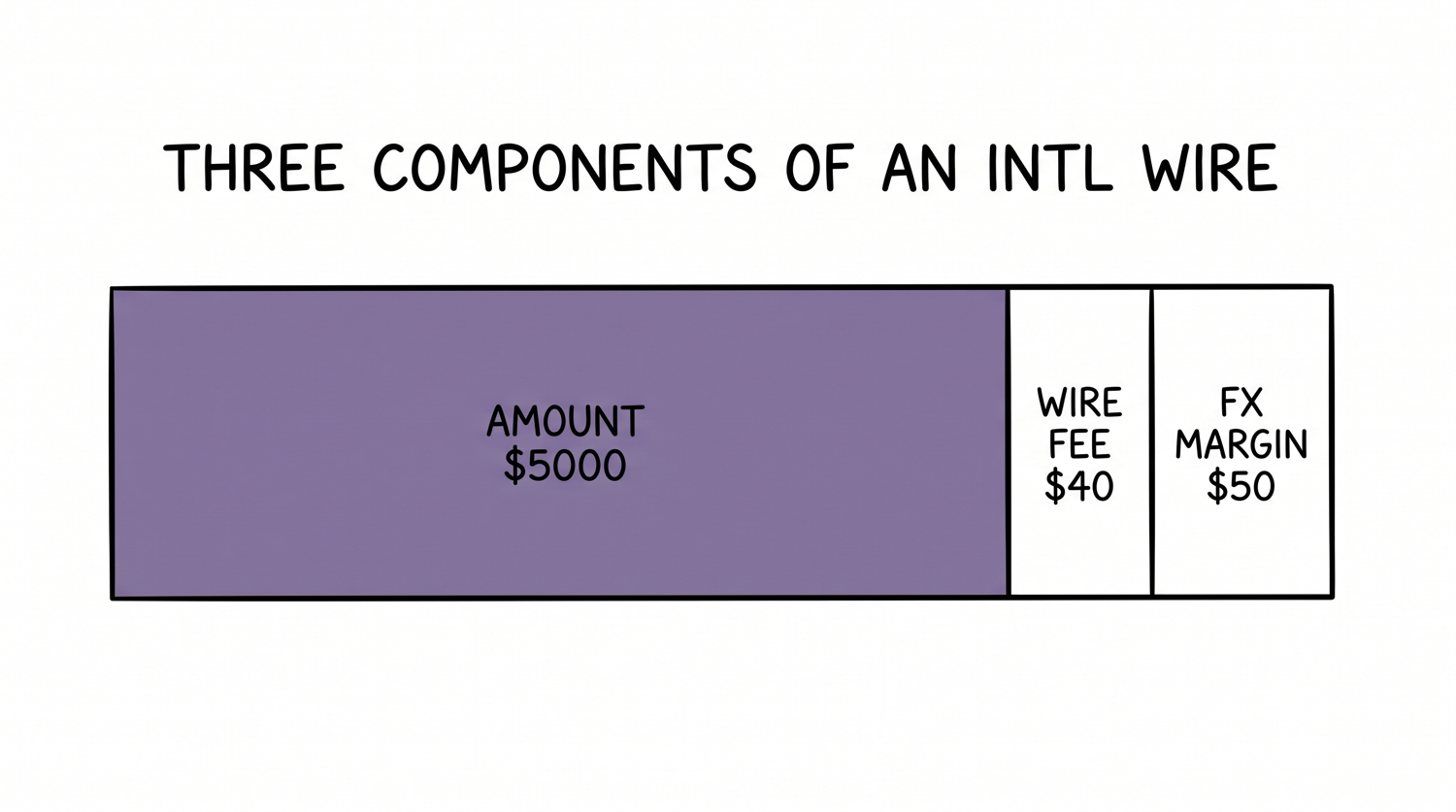
International wires are more complex than domestic wires because they typically include three charges on the statement:
- The converted amount, the recipient receives the local currency equivalent of the dollar amount sent (e.g., sending $5,000 USD, recipient gets 4,830 EUR at the current exchange rate).
- The wire fee, the sending bank’s processing charge, typically $35-50 in USD.
- The FX conversion margin, the markup the bank adds on the exchange rate, often 1-3% of the transfer amount. This isn’t always labeled explicitly; sometimes it’s rolled into the converted amount.
The combined cost of an international wire is often higher than the displayed wire fee. A $5,000 USD-to-EUR transfer might cost: $5,000 sent + $40 wire fee + $50-150 FX margin = $5,090-5,190 effective cost.
Bookkeepers should reconcile all three lines:
- The converted amount goes to the supplier expense (Line 22 or 17 depending).
- The wire fee goes to Bank Service Charges (Line 27a).
- The FX margin also goes to Bank Service Charges or a separate FX Loss account.
When the FX margin isn’t explicitly broken out, the bookkeeper can compute it by comparing the wire amount (in USD) to the daily mid-market rate. The difference is the FX margin.
When to Dispute a Wire Fee Charge
Wire fees are legitimate bank charges, but some situations warrant a dispute:
- Fee is higher than the bank’s published schedule. Contact your bank’s customer service and ask for the difference refunded.
- Fee is charged on a wire that was cancelled or never delivered. Some banks still charge the fee for failed wires; many will refund upon request.
- Fee appears on a wire you didn’t authorize. This is a fraud flag; report to the bank immediately and dispute the charge. Banks typically refund unauthorized wire fees within 10 business days of investigation.
- Fee was charged in error due to a bank system glitch. Contact your account representative; most banks refund documented errors within 5-10 business days.
For bookkeeper practice: when the wire fee seems out of pattern (e.g., $200 fee on a $1,000 wire when the bank normally charges $25), flag it for the client. The bank may apply a fee waiver for premium accounts or refund it on request.
Wire transfer fees are one of the smallest line items on a typical bank statement, but they’re also one of the most consistently deductible. Reconciling them properly, with the wire itself, with the FX margin on international wires, and with the right Schedule C categorization, keeps the books accurate and makes tax time less of a scramble.
Turn PDF Bank Statements Into Workable Spreadsheets
Your bank statement is a mess of numbers, but your books shouldn’t be. Use our converter to get Excel, CSV, or QBO files — ready for QuickBooks.
Try It Free NowFrom PDF to Excel in one click
Forget retyping line by line. Upload any bank statement, get a spreadsheet you can actually use. Your files are never stored, and you can test the converter with 3 free conversions.
Try it free