
You opened your bank statement and saw a line marked “FedNow” with a small dollar amount you don’t recognize. You aren’t alone: this is one of the most-searched bank-statement terms in 2025, and most people have never heard of it until it shows up on their deposit or debit.
Quick Answers: FedNow is a real-time payment service run by the U.S. Federal Reserve that lets banks settle transfers 24/7/365 in roughly 8 seconds, with a $500,000 per-transaction cap and no fee for the receiving bank. It is not the same as ACH (which is batch-processed), the same network that runs ACH SEC codes, not the same as a wire transfer (which costs $15-30), and not the same as RTP (which is run by The Clearing House, a private operator). On your bank statement, FedNow usually appears as “FEDNOW” with a transaction reference, a 0.00 sender fee, and immediate availability in the recipient’s account.
What is FedNow and why does the Federal Reserve run it?
FedNow is an interbank settlement service launched by the U.S. Federal Reserve on July 20, 2023. It lets participating banks move money between accounts in seconds, any time of day, any day of the year, including weekends and bank holidays. The Fed runs it directly, alongside the older Fedwire Funds Service, to give the United States a public-infrastructure option for instant payments.
The reason the Fed operates a real-time payment rail is the gap that existed before 2023. Same-day ACH settled within hours. Wires settled within minutes but cost $15-30 per transaction. RTP (run by The Clearing House) handled instant transfers but only between banks that subscribed to the private network.
FedNow extended real-time settlement to any Federal Reserve member bank that wanted to connect, which by late 2025 included over 950 institutions ranging from the largest national banks to small community banks and credit unions.
If you are a business owner, a freelancer, or a person who has ever waited 1-3 business days for an ACH credit to clear, FedNow is the reason you can now sometimes see a payment land the same minute it was sent.
The Federal Reserve’s stated goal is to make every U.S. payment settle as fast as a debit card swipe does at a point-of-sale terminal.
Which banks offer FedNow in 2025?
The Fed publishes a quarterly FedNow participants list. By Q4 2025, the service has crossed 950 participating banks and credit unions. Large national banks with broad FedNow rollouts include JPMorgan Chase, Bank of America, Wells Fargo, U.S. Bank, PNC, Truist, and Capital One. Mid-size regional banks with full FedNow support include Citizens, Regions, Fifth Third, Huntington, KeyBank, M&T, and BMO.
Credit unions with active FedNow deployment include Navy Federal, PenFed, SchoolsFirst, Golden 1, Alliant, and BECU.
Importantly, “participating” does not always mean “every customer can send and receive.” Many banks initially launched FedNow as receive-only, then added send capability in 2024, then expanded send limits through 2025.
If you cannot find a FedNow option in your bank’s transfer screen, the most likely reasons are: (1) your bank has not enabled send for retail customers yet, (2) your account type is excluded (some banks exclude savings accounts from instant payments), or (3) your transfer exceeds the bank’s per-transaction or daily cap.
The Federal Reserve’s official participant lookup tool lists every bank with live FedNow service. If your bank is not on the list, your incoming FedNow transfers will still work, but you cannot initiate FedNow outbound from your account until your bank joins and enables the feature.
Turn PDF Bank Statements Into Workable Spreadsheets
Your bank statement is a mess of numbers, but your books shouldn't be. Use our converter to get Excel, CSV, or QBO files — ready for QuickBooks.
Try It Free NowHow does a FedNow payment actually settle in 8 seconds?
When you initiate a FedNow transfer from your bank’s app, three things happen roughly simultaneously. First, your bank debits your account and creates a settlement message with the Federal Reserve. Second, the Fed’s FedNow Service validates the message against participant and fraud rules, typically in 1-2 seconds. Third, the receiving bank gets the credit instruction, posts it to the recipient’s account, and returns an acknowledgment.
The Federal Reserve reports a median end-to-end settlement time of about 8 seconds and a 99th percentile under 20 seconds, even on weekends and at 3 a.m. on a Sunday.
This is fundamentally different from how ACH works. ACH is batch-processed: transactions are queued, grouped into files, and submitted to the ACH Operator (the Federal Reserve’s Nacha) several times per business day. Even same-day ACH still has three submission windows and a latest cutoff of 4:30 p.m. ET.
Wire transfers are individual real-time transfers but each one incurs a fee and uses the Fedwire network, which has been live since 1918 and is purpose-built for high-value, urgent transfers. FedNow is purpose-built for low- to mid-value transfers that need to settle instantly, with no batching and no per-transfer fee for the receiving bank.
What does FedNow look like on a bank statement?
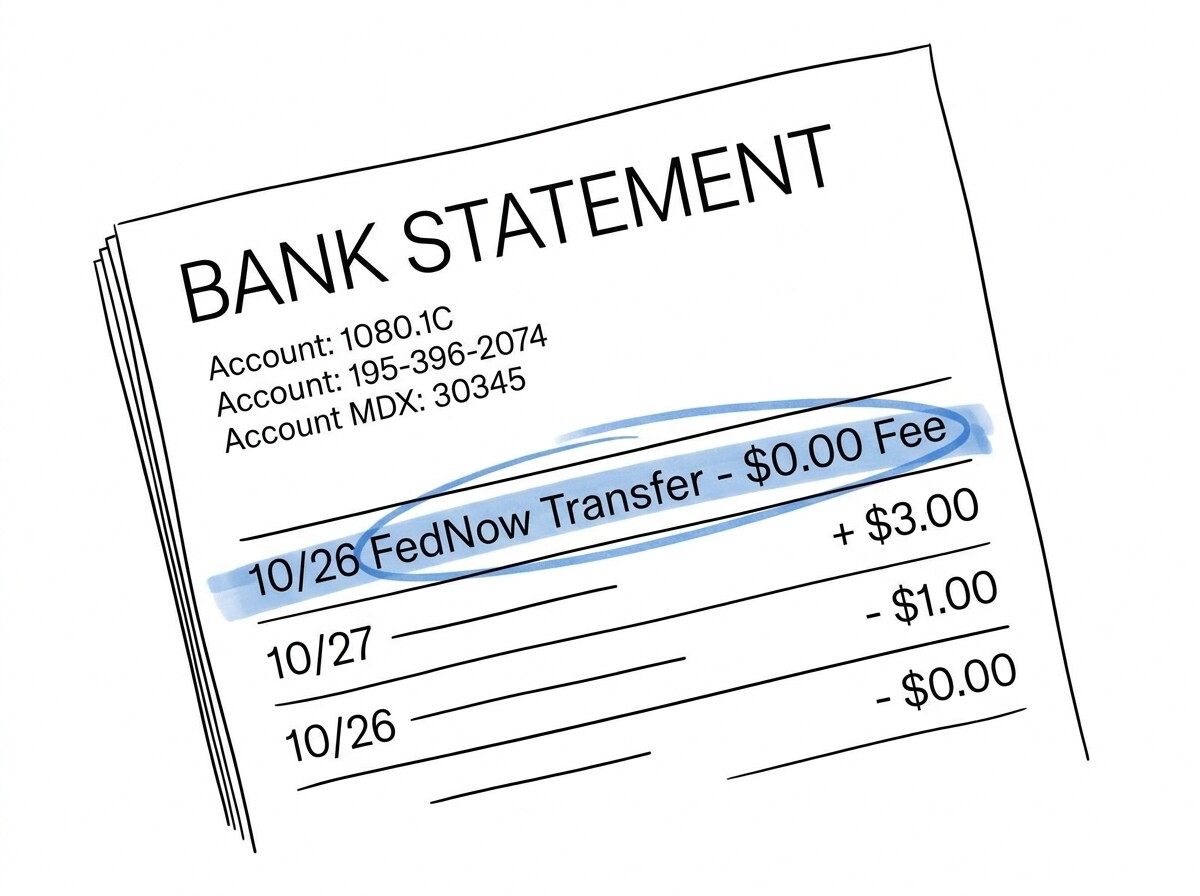
FedNow transactions appear on bank statements with a recognizable but inconsistent label pattern. Common descriptors include “FEDNOW,” “FEDNOW TRANSFER,” “FEDNOW CREDIT,” “FEDNOW DEBIT,” “FedNow Pmt,” or the originating bank’s branded label followed by a FedNow reference number. The transaction posts immediately, meaning it appears in your posted balance the same minute you send or receive it, not 1-3 business days later like ACH.
Three details distinguish a FedNow line from other instant-looking lines on a statement. First, the transaction amount and posted balance both update within the same minute. Second, the description usually includes a reference number in the format FEDNOW-XXXXXXXX or a bank-specific ID.
Third, if you sent the payment, the sender fee is typically 0.00, because the Federal Reserve does not charge senders and most banks do not add a retail markup. If you see a fee attached to a FedNow line, that is your bank’s retail fee, not a FedNow fee, and it varies by institution.
For bookkeepers reconciling converted bank statements, FedNow lines matter, FedNow lines matter because they post in real time and cannot be reversed by the sender once acknowledged. This is closer to the behavior of a wire or a debit card transaction than to an ACH credit, which can be returned for several business days after posting.
If you are building a cash-flow forecast from a converted PDF bank statement, treat FedNow credits as same-day available funds rather than as 1-3-day pending funds.
How is FedNow different from ACH, RTP, and wire transfers?
FedNow, ACH, RTP, and wire are four distinct rails, and the choice between them depends on speed, cost, and amount. ACH is the cheapest (typically 0 to a few cents per transaction) but slowest (1-3 business days, or same-day for a fee). Wire is the most expensive ($15-30 per transfer) but works for any amount and settles within minutes.
the RTP rail is real-time and free for receiving banks but is run by The Clearing House, a private bank-owned operator, and only banks that subscribed to RTP can offer it. FedNow is real-time and free for receiving banks, is run by the Federal Reserve as public infrastructure, and is the rail with the broadest participating-bank list as of late 2025.
| Rail | Operator | Settlement time | Sender fee (typical) | Per-transaction cap |
|---|---|---|---|---|
| FedNow | Federal Reserve | ~8 seconds, 24/7/365 | $0 (bank may add markup) | $500,000 |
| ACH | Nacha / Federal Reserve | 1-3 business days, or same-day | $0 to $0.50 | No hard cap (commonly under $1M) |
| RTP | The Clearing House | Seconds, 24/7/365 | $0 (bank may add markup) | $1,000,000 |
| Wire (Fedwire) | Federal Reserve | Minutes, business hours | $15 to $30 | No hard cap |
The practical implication for bank-statement readers: ACH and FedNow can carry identical-looking dollar amounts, but ACH may show a pending status for 1-3 days while FedNow shows posted immediately.
If you are converting a PDF bank statement to a spreadsheet and your reconciliation software flags a FedNow line as a discrepancy against an invoice, the most common cause is timing: the FedNow credit cleared before the invoice’s expected due date and the system expected it to still be pending (which is what happens with ACH batch settlement).
What are the limits, fees, and operational rules?
The Federal Reserve sets FedNow’s per-transaction cap at $500,000. Individual banks may set lower caps for retail customers (commonly $25,000 per transaction, $50,000 per day) and higher caps for business accounts. Receiving banks cannot charge a FedNow fee, but sending banks can charge whatever they want, and most choose to charge $0 to remain competitive. There are no FedNow-specific cutoffs because the service operates continuously.
Operational rules worth knowing: FedNow credits are irrevocable once acknowledged by the receiving bank, similar to wires and unlike ACH. This means a FedNow payment sent to the wrong account number cannot be reversed by the sender. If you need to recover funds sent in error, you must work with your bank and the receiving bank, which can take days or weeks.
Fraud controls are handled at the bank level, not by the Federal Reserve, which is why some banks add daily send limits or per-transaction holds even within the FedNow rail.
When should a small business use FedNow instead of ACH?
The three situations where FedNow beats ACH for small businesses are: (1) same-day vendor payments that previously required a wire, saving $15-30 per transaction; (2) payroll for hourly workers who need funds the same shift rather than waiting for next-day ACH; (3) marketplace payouts where the platform promises sellers instant access to their earnings.
In all three cases, the speed improvement justifies routing through FedNow rather than ACH, especially since the cost is comparable or lower.
The two situations where ACH still wins are: (1) recurring monthly payments where 1-3 day settlement is fine and ACH’s lower fee structure matters at scale, and (2) high-volume micro-transactions (under $10 each) where any per-transaction overhead matters more than speed. For these use cases, ACH remains the right rail and FedNow is over-engineering.
If you are reviewing a converted bank statement and trying to reconcile a FedNow line against your books, the most common pitfalls are: treating FedNow credit as pending when it is already posted, expecting a FedNow debit to be reversible when it is not, and misclassifying a FedNow vendor payment as a wire transfer in your chart of accounts because the dollar amount looks similar.
The fix in all three cases is to update your reconciliation rules to recognize “FEDNOW” as its own transaction type, separate from ACH and wires, with same-day settlement semantics.
How does FedNow change the way I read a converted PDF bank statement?
For most of banking history, a bank statement was a record of yesterday’s settled activity, posted in batches overnight. FedNow inverts that: the statement now shows transactions that settled seconds ago, even on a Sunday at 2 a.m. If you are reading a converted PDF bank statement, three behavioral changes matter.
First, FedNow credits are immediately available, so they should not appear in a “pending” column. Second, FedNow debits are irrevocable, so any reconciliation rule that assumes ACH-style reversal will misclassify them. Third, FedNow transactions may appear out of chronological order on the statement because they post individually rather than in batch order, which can confuse date-based reconciliation.
The practical workflow: if you see a line marked “FEDNOW” with same-day posted status, treat it as final settled funds. If your reconciliation tool flags it as a discrepancy, check that the tool’s bank-statement parser has been updated to recognize FedNow as a distinct transaction type, separate from ACH and wires. Most modern converters, including EasyStatementSheet, treat FedNow lines correctly as of 2025.
FedNow is still a young service: it has been live just over two years. Adoption is uneven, the participating-bank list grows each quarter, and most consumer-facing bank apps now expose FedNow send/receive somewhere in the transfer flow. If your bank does not offer FedNow yet, your incoming FedNow payments from other banks will still work as long as your bank is a participant.
To send FedNow outbound, your bank must have enabled the feature for your account type.
Turn any PDF statement into a clean sheet
Skip the typos and the hours of copying. Our converter handles any bank statement format and outputs Excel, CSV, or QBO for QuickBooks. No file retention, free to try.
Convert your statement