
You saw “RTP” or “Real-Time Payment” on your bank statement and don’t know what it means. This is one of the fastest-growing bank-statement terms in the United States: as of late 2025, over 600 U.S. banks and credit unions offer RTP for retail customers, and the network processed more than 320 million transactions in 2024 alone.
Quick Answers: RTP (Real-Time Payments) is a payment network run by The Clearing House, a private bank-owned operator, that settles bank transfers in seconds 24/7/365 with a per-transaction cap of $1,000,000. It is similar to FedNow in speed but predates it by five years, has a higher per-transaction cap, and is offered by a different set of banks. On your bank statement, RTP transactions typically appear as “RTP,” “RTP CREDIT,” “RTP DEBIT,” or with the bank’s branded label, with a transaction reference and instant availability.
What is the RTP network and who runs it?
RTP is a real-time payment network launched in 2017 by The Clearing House (TCH), a bank-owned payment company established in 1853 and owned by 24 of the largest U.S. banks. RTP settled its first transaction on November 14, 2017, between JPMorgan Chase and Wells Fargo, and became generally available to U.S. banks in 2018.
As of late 2025, the network has over 600 participating banks and credit unions covering roughly 80% of U.S. demand deposit accounts.
Unlike FedNow, which is public infrastructure operated by the Federal Reserve, RTP is private infrastructure operated by a bank-owned consortium. This matters for two reasons. First, RTP’s bank coverage is determined by which banks pay to join The Clearing House and integrate the RTP API, while FedNow’s coverage is determined by which banks choose to connect to the Federal Reserve’s service.
Second, RTP’s per-transaction cap of $1,000,000 is double FedNow’s $500,000 cap, which makes RTP the preferred rail for higher-value instant transfers.
If you have ever sent or received money through Zelle, you have used a real-time payment rail, but Zelle is built on top of RTP for many bank-to-bank transfers (alongside its own Early Warning Services infrastructure). The Clearing House and Zelle operate independently, but they cooperate at the settlement layer for many consumer transactions.
Which banks offer RTP in 2025?
RTP coverage is concentrated among larger banks because TCH is owned by the 24 largest U.S. banks. The major banks with full RTP rollout include JPMorgan Chase, Bank of America, Wells Fargo, U.S. Bank, PNC, Truist, Capital One, TD Bank, and Citizens. Mid-size regional banks with RTP support include Regions, KeyBank, Fifth Third, Huntington, M&T, BMO, and Comerica.
Several large credit unions have joined in 2024-2025, including Navy Federal, SchoolsFirst, and Golden 1.
Small community banks and credit unions have lagged RTP adoption relative to FedNow adoption. The Federal Reserve offers banks a free FedNow integration, while TCH charges RTP participation fees, which is the main reason smaller institutions have gravitated toward FedNow. If your bank is small and rural, RTP may not be available, but FedNow may be.
The Clearing House maintains an official RTP participants list you can search.
From PDF to Excel in one click
Forget retyping line by line. Upload any bank statement, get a spreadsheet you can actually use. Your files are never stored, and you can test the converter with 3 free conversions.
Try it freeHow does an RTP transaction actually settle?
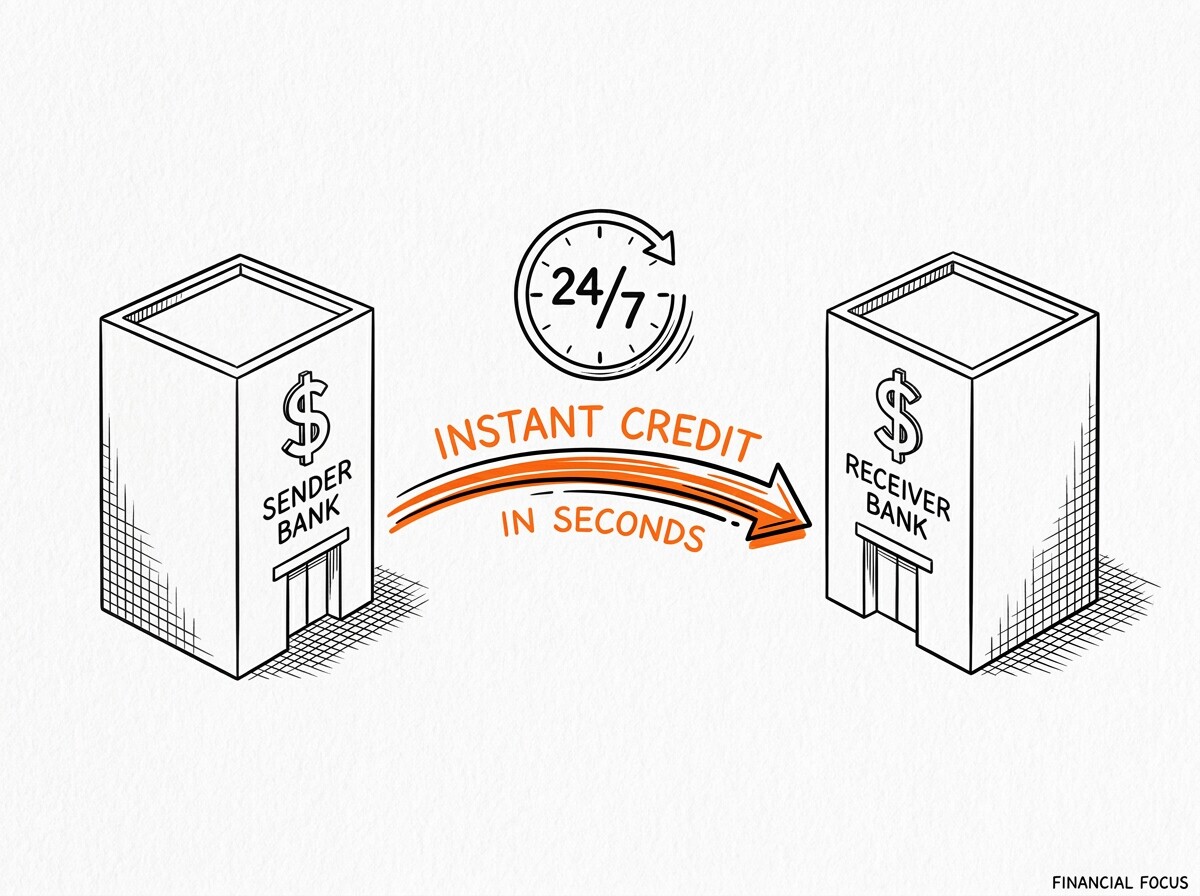
When you initiate an RTP transfer, the sending bank validates your account, checks fraud rules, and submits a payment message to The Clearing House. TCH routes the message to the receiving bank in real time, the receiving bank posts the funds, and both banks receive settlement confirmation.
The whole round-trip takes about 10-15 seconds end-to-end, with 24/7/365 availability including weekends, bank holidays, and the middle of the night.
From the sender’s perspective, the experience is similar to Zelle: you provide the recipient’s bank account or email/phone number, confirm the amount, and the funds leave your account immediately. From the recipient’s perspective, the funds are available in their posted balance within seconds, not 1-3 business days. There is no “pending” period and no overnight batch processing.
What does RTP look like on a bank statement?
RTP transactions on bank statements follow a recognizable but variable labeling pattern. Common descriptors include “RTP,” “RTP TRANSFER,” “RTP CREDIT,” “RTP DEBIT,” “Real-Time Pmt,” or a bank-specific label that includes a transaction reference number. The transaction posts immediately to the recipient’s balance, meaning it does not appear in a “pending” column the way ACH often does.
Three details distinguish an RTP line from a regular ACH or wire on a statement. First, the transaction reference often starts with “RTP” or includes a 16-character alphanumeric code that is the RTP network’s standard settlement identifier. Second, the posted balance updates within seconds of the transfer being initiated.
Third, the recipient bank receives an irrevocable credit, which means once you see “RTP CREDIT” on your statement, the funds are final and cannot be reversed by the sender.
For bookkeepers reconciling converted bank statements, RTP lines behave similarly to wires and FedNow: same-day settlement, no pending status, irrevocable credit or debit.
The main reconciliation trap is when a vendor sends an RTP payment and the receiving company’s chart of accounts maps it to “ACH Receipt” instead of “RTP Receipt”, the timing difference (RTP arrives same day, ACH arrives 1-3 days later) causes reconciliation discrepancies when payment dates are recorded in the invoice system.
How is RTP different from FedNow, ACH, and wire?
RTP and FedNow are the two real-time payment rails in the U.S., and they cover similar use cases. ACH is batch-settled and takes 1-3 business days. Wires settle in minutes but cost $15-30 per transfer.
The choice between RTP and FedNow for a given transaction usually comes down to which banks are involved: if both banks support RTP, RTP is preferred for amounts over $500,000 (since FedNow’s cap is lower); if both banks support FedNow, FedNow may be preferred because the Federal Reserve does not charge a participation fee to banks.
| Rail | Operator | Settlement | Per-txn cap | Sender fee | Bank participation cost |
|---|---|---|---|---|---|
| RTP | The Clearing House | ~10-15 seconds, 24/7/365 | $1,000,000 | $0 (bank may add markup) | TCH charges participating banks |
| FedNow | Federal Reserve | ~8 seconds, 24/7/365 | $500,000 | $0 (bank may add markup) | No Federal Reserve fee |
| ACH | Nacha / Federal Reserve | 1-3 business days | No hard cap | $0 to $0.50 | Standard ACH fees |
| Wire | Federal Reserve | Minutes, business hours | No cap | $15 to $30 | Fedwire fees apply |
For bank-statement readers, the practical question is rarely “which rail was used?” and more often “how do I treat this line in my books?” Most modern accounting software (QuickBooks Online, Xero, FreshBooks, Wave) automatically classifies RTP and FedNow the same way: as instant electronic payments with same-day settlement.
If your accounting software predates 2023, it may still treat them as wires or unclassified transfers, which can create reconciliation gaps.
What are the limits, fees, and operational rules?
The Clearing House sets RTP’s per-transaction cap at $1,000,000. Individual banks may set lower caps for retail customers (typically $25,000 to $100,000 per transaction) and higher caps for business treasury accounts. Most banks charge $0 for retail RTP send/receive, but corporate treasury operations sometimes see a per-transaction fee in the $0.10-$0.50 range depending on volume. There are no RTP cutoffs because the network operates continuously.
Operational rules: RTP credits are irrevocable once acknowledged by the receiving bank, similar to FedNow and wires, and unlike ACH. RTP debits pull funds from the sender’s account via “request for payment” authorization, which the sender must approve before the debit executes.
This request-for-payment model is unique to RTP among the four rails and is the basis for “RTP Request” lines on statements, where a vendor or person requests payment and you approve it.
When should a small business use RTP instead of FedNow or ACH?
RTP wins over FedNow when the transaction amount exceeds $500,000 (FedNow’s cap). RTP wins over ACH when same-day settlement matters: vendor payments, payroll for hourly workers, marketplace payouts, customer refunds, and any situation where the recipient needs funds in their account before the bank closes for the day.
RTP also wins when the receiving bank is a large TCH-member bank that has stronger RTP support than FedNow support.
ACH still wins when cost matters at scale (thousands of transactions per month at $0.10-0.50 each adds up), when 1-3 day settlement is acceptable, and when the recipient’s bank does not support RTP. Wire still wins for very large amounts over $1,000,000, for international transfers (RTP and FedNow are U.S.-only), and for situations where the recipient specifically requests a wire trace number for compliance reasons.
How does RTP change the way I read a PDF bank statement?
RTP has been live longer than FedNow, so most bank statement converters recognize “RTP” lines correctly as of 2025.
The three behavioral changes to internalize when reviewing a converted PDF statement are: RTP credits are same-day available funds, RTP debits are not reversible by the sender once you acknowledge them, and RTP “Request for Payment” lines require your active approval before funds leave your account.
If your reconciliation tool flags an RTP line as a discrepancy, the most common causes are: (1) timing mismatch (RTP credit cleared same day, your system expected 1-3 day ACH), (2) misclassification (treated as wire instead of instant payment), or (3) a duplicate (you have both the RTP request line and the RTP payment line on the same statement, and the system is counting both).
All three are fixable with a one-time categorization rule update.
RTP continues to grow: The Clearing House reports roughly 50% year-over-year growth in transaction volume from 2022 through 2025, and several major U.S. banks that launched RTP for business customers in 2018-2020 have expanded to retail customers in 2023-2025. If your bank offers RTP today, you will likely see more RTP lines on your statement each year.
If your bank does not offer RTP yet, FedNow is the more likely alternative for retail real-time transfers.
See also: RTP in context
This explainer is part of the payment rails coverage on this site. The consolidated overview of ACH, wire, Zelle, RTP, and FedNow for US banks now lives in the complete US bank payment rails guide, which is the modern hub for the topic.
For parallel reading on the merchant category codes that flow over the card-network rails, see the complete MCC guide. For what every column on a US bank statement means and where the rail labels appear, see the expanded bank statement anatomy.
What RTP looks like in everyday statements
Most US bank-account statements will not show an RTP transaction for several years yet because RTP adoption is gradual. Banks that have already deployed RTP include Bank of America, Chase, Citi, and a long tail of regional banks that have integrated with The Clearing House.
When an RTP transaction does appear on a statement it is usually labeled RTP CREDIT or RTP DEBIT along with a 12-character reference number that ties back to the originating invoice or payment instruction. The reference number is the key to reconciling the payment against the underlying obligation.
RTP finality is what distinguishes it from wire and ACH. Once the receiving bank posts the funds, the transaction cannot be reversed. That makes RTP ideal for time-sensitive payments where the recipient needs certainty. For the decision framework comparing RTP with ACH and wire, see the complete US bank payment rails guide.
For mid-size small businesses, RTP often arrives as an inbound payment from a customer or platform. On the reconciliation side, treat an RTP credit as immediate available funds with no settlement window to wait out.
Reading the statement after a real-time payment
After a real-time payment clears, the recipient’s running balance updates within seconds. If you monitor the same statement online, you will see the new balance in real time. That is the operational promise of the rail.
On the originator’s statement, an RTP debit transaction will show up alongside the running-balance update. The reference number ties to the invoice or payment instruction. Easy Statement Sheet reads the rail metadata when it appears in the description column.
Most small businesses experience RTP only as an inbound payment from a customer. The customer-facing experience is identical to a card payment: the funds appear within seconds. Reconciling the inbound RTP requires a reference-number match against the open invoice.
Output format: which one matches the destination?
Picking the right output format is a separate decision from picking the right converter.
XLSX for human spreadsheet review. CSV for downstream scripts and tools. Google Sheets-compatible for shared cloud review. QBO for QuickBooks.
The four canonical columns are preserved across every format. What differs is how the downstream consumer expects the rows.
For a side-by-side rule of thumb that maps destination to format, see the decision framework on the output format pillar.
Read the full output format decision framework
From Bank Statement to QuickBooks-Ready File
That manual cleanup you just read about? This tool skips it. Turn your PDF into QBO for QuickBooks without storing your data anywhere.
Start Converting