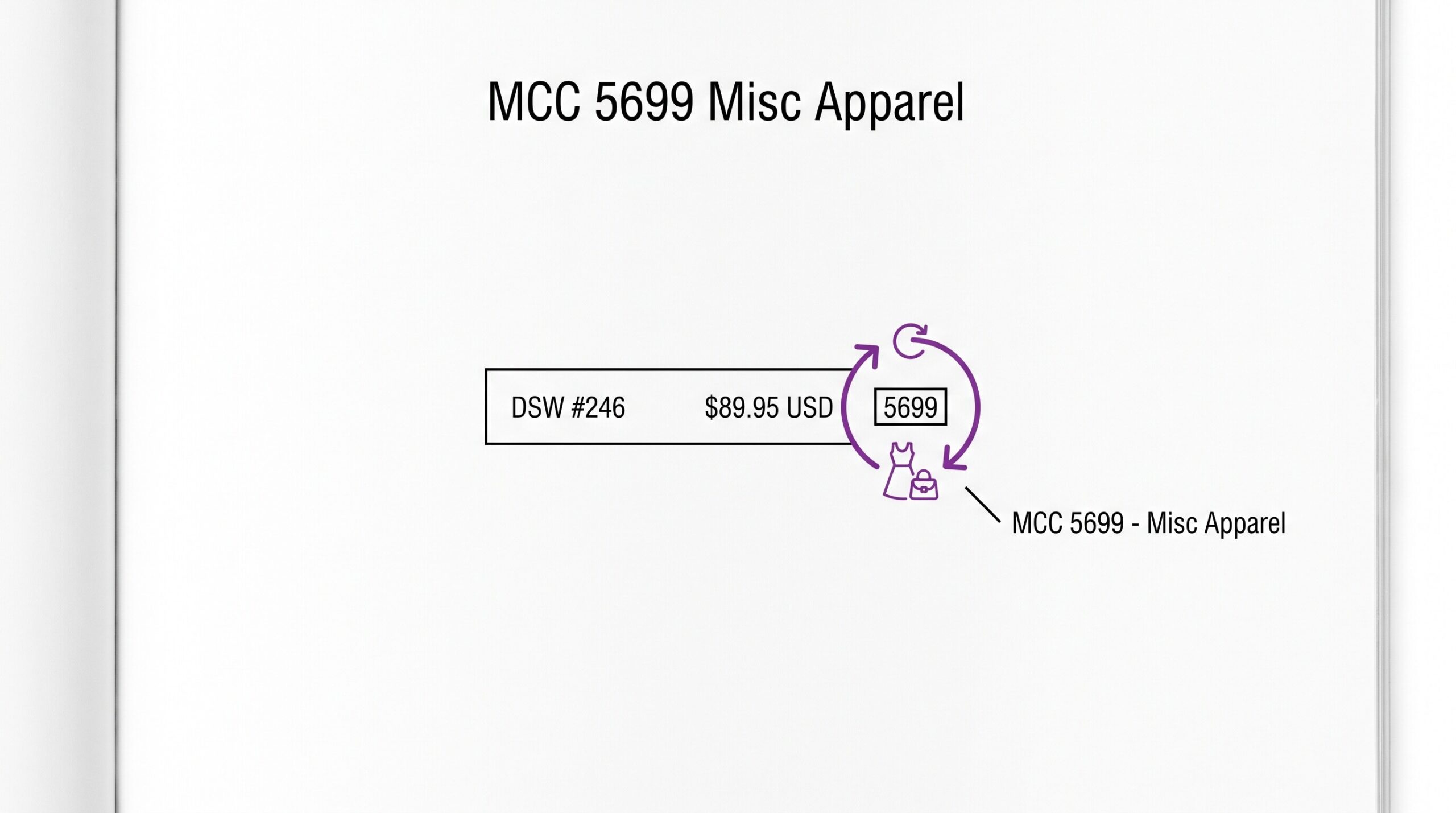

You see DSW #246 on your credit card statement with the code 5699 attached. You are a sole proprietor wondering whether this is a deductible business expense. You are also a fashion reseller who buys inventory from boutique stores that all register as 5699, and you need to know which Schedule C line for cost of goods sold.
You are a small business owner with a uniform allowance policy, and your employees purchase work clothing from specialty vendors that all register as 5699.
MCC 5699 is the 4-digit merchant category code assigned by Visa, Mastercard, American Express, and Discover to merchants whose primary business is apparel and accessories, but who don’t fit a more specific apparel category like family clothing stores (5651), mens and womens clothing stores (5691), or jewelry stores (5944).
The 5699 category covers boutiques, uniform suppliers, accessory stores, costume shops, sports apparel that isn’t recreational (like specialty athletic apparel for non-recreational sports), and the long tail of apparel merchants who fall through the cracks of the more specific codes. About 15-25 apparel sub-codes exist in the ISO 18245 standard, and 5699 is the catch-all for the rest.
Quick Answers: MCC 5699 is the catch-all apparel code for merchants whose primary business is apparel and accessories but who don’t fit the more specific 5651 (family clothing), 5691 (mens and womens), or 5944 (jewelry) categories. The 5699 category covers boutiques, uniform suppliers, accessory stores, costume shops, and specialty apparel that doesn’t fit other codes.
The charges are typically NOT tax-deductible as personal expenses but may be deductible if they are for business uniforms (with documentation) or for resale inventory. Schedule C mapping: Line 2 (Cost of Goods Sold) for resellers, Line 48 (Other Expenses) for deductible uniforms, or non-deductible personal if neither.
The code is distinct from 5651 (specific to family clothing chains like Gap, Old Navy, H&M) and 5691 (general mens and womens clothing stores). The merchant’s registration at their acquiring bank determines the code, not the specific product purchased.
What MCC 5699 Actually Covers
MCC 5699 is the merchant category code for “Miscellaneous Apparel and Accessory Shops” in the ISO 18245 standard. The card networks use 5699 when a merchant’s primary business is selling apparel or accessories, but the merchant doesn’t fit one of the more specific apparel codes.
The merchant’s acquiring bank assigns the code based on the merchant’s stated primary business at the time of merchant account setup.
The apparel category has multiple codes in ISO 18245. The specific codes cover well-defined sub-categories (5651 for family clothing stores like Gap, 5691 for mens and womens clothing stores, 5944 for jewelry and precious stones).
The miscellaneous code 5699 catches everything else: boutiques that sell designer clothing outside the chain-store format, uniform suppliers, accessory stores that primarily sell fashion accessories, costume shops, and other specialty apparel merchants.
The reason 5699 exists is to give merchants a category even when their business doesn’t fit the most common apparel codes. A boutique in a small town that sells 30 designer brands might register as 5699 because the merchant’s primary business is apparel but doesn’t fit the “family clothing store” pattern of Gap or H&M.
A uniform supplier that sells work uniforms to restaurants or hospitals might register as 5699 because their primary business is apparel but they don’t fit “family clothing.” An accessory store that primarily sells scarves, handbags, and belts might register as 5699 because their primary business is accessories (apparel adjacent).
What 5699 does NOT cover: family clothing chains (5651), mens and womens clothing stores (5691), jewelry and precious stones (5944), department stores that sell clothing among other things (5311), and grocery stores that sell clothing (5411). The code is specifically for merchants whose primary business is apparel or accessories but who don’t fit the more granular codes.
3. Uniform Suppliers. Merchants that supply uniforms to specific industries. Work uniforms (restaurant, hospital, security), military surplus apparel, school uniforms, organized-team sports apparel. The uniform-specific nature excludes them from general apparel codes.
4. Costume Shops. Theatrical costume stores, Halloween costume retailers, historical reenactment costume suppliers, cosplay-specific apparel shops. These typically register as 5699 because costumes aren’t general clothing.
5. Bridal Wear and Formal Wear. Wedding dress shops, tuxedo rental stores, formal wear boutiques, mother-of-the-bride stores. The specialized nature excludes them from general apparel categories.
6. Maternity Wear Stores. Dedicated maternity clothing boutiques (rather than general clothing stores with a maternity section). The specific customer base gets them a distinct code.
7. Accessory Stores. Scarves and shawl shops, handbag boutiques, hat shops, jewelry-adjacent accessory stores, belt and leather goods stores. When accessories are the primary product, the merchant typically registers as 5699.
8. Outdoor/Hunting Apparel. Specialty outdoor apparel (camo, blaze orange, hunting-specific clothing), tactical clothing stores, fishing waders shops. These merchants typically register as 5699 because their apparel is purpose-specific.
5699 vs 5944 (Jewelry and Precious Stones). 5944 is for jewelry stores, watch stores, and precious stones retailers. The boundary: a store that primarily sells jewelry (regardless of brand or size) is 5944; a store that primarily sells apparel with some accessory jewelry is 5699.
5699 vs 5311 (Department Stores). 5311 is for department stores (Macy’s, Nordstrom, Kohl’s) that sell clothing among other categories. The boundary: 5311 merchants sell apparel as one category among many (with home goods, beauty, etc.); 5699 merchants sell apparel or accessories as their primary business.
The merchant’s registration determines the code. Two boutiques selling similar clothing in different cities might register differently based on their acquirer’s classification. The 5699 designation isn’t always intuitively obvious from the merchant name.
Personal apparel (most common scenario): For a sole proprietor or single-member LLC, most apparel purchases from 5699 merchants are personal expenses and are NOT deductible. The IRS allows individuals to deduct certain work-related apparel expenses only under specific conditions (uniforms that aren’t suitable for everyday wear, certain safety apparel, theatrical costumes for performing artists).
For most people, the 5699 charge is a personal expense that doesn’t go on Schedule C at all.
Business-required uniforms (deductible): If your employment requires specific apparel that isn’t suitable for everyday wear (military uniforms, police uniforms, firefighter gear, certain work uniforms that are distinctive), the cost is deductible on Schedule C Line 48 (Other Expenses) with documentation. The IRS requires that the apparel be specifically required by the employer and not adaptable to general use as everyday clothing.
Resale inventory (most common for sellers): If your business model includes reselling apparel (boutique owner, online reseller, consignment shop), the cost of inventory purchases from 5699 merchants is Cost of Goods Sold (COGS). COGS appears on Schedule C Line 2 (for inventory-only businesses) or Line 4 (for cost of labor and materials). The 5699 charges become part of your inventory cost, not an expense.
Costume or theatrical apparel (deductible for performers): For performing artists, theatrical costumes that aren’t suitable for everyday wear are deductible on Schedule C Line 22 (Supplies). The costumes must be specific to performance and not adaptable to general use.
A few common failure modes cause 5699 charges to be miscategorized in accounting.
Treating business-required uniforms as non-deductible. A uniform supplier invoice for restaurant server uniforms, hospital scrubs, or security guard apparel is deductible if the employer requires the specific uniform. Treating these as personal expenses loses the deduction.
Treating resale inventory as expense. A reseller who buys 5699 inventory should categorize the cost as COGS (Line 2 or 4), not as an expense line. Mis-categorization distorts gross profit and taxable income.
Mixing personal and business apparel. A sole proprietor who purchases both business-required apparel and personal clothing on the same business credit card may accidentally categorize personal apparel as business expense. The cleaner approach is a separate credit card for business-only purchases.
1. Check your credit card platform. Modern credit card platforms (Chase, Amex, Capital One, Discover, Citi) display the MCC code alongside the merchant name in the transaction details. Click into the transaction for the 4-digit code or “category” field.
2. Use card network lookup tools. The card networks (Visa, Mastercard, Amex, Discover) publish downloadable MCC code lists. The merchant’s registered code appears in the list. The 2026 version is most accurate.
3. Use third-party lookup tools. AwardWallet, classification.codes, and MCC-Codes.com provide searchable MCC databases. Enter the merchant name or 4-digit code to confirm the classification.
Uniform Suppliers: Restaurant uniform companies, hospital supply uniform vendors, security apparel vendors, school uniform suppliers, athletic team uniform suppliers.
Specialty Apparel Stores: Maternity wear boutiques, formal wear shops, bridal wear stores, theatrical costume shops, dance apparel stores, equestrian apparel shops.
Accessory Stores: Hat shops, scarf boutiques, handbag stores, belt and leather goods stores, glove and mitten shops.
Outdoor and Tactical Apparel: Hunting apparel stores, fishing apparel shops, martial arts uniform suppliers, tactical clothing stores, climbing and mountaineering apparel shops.