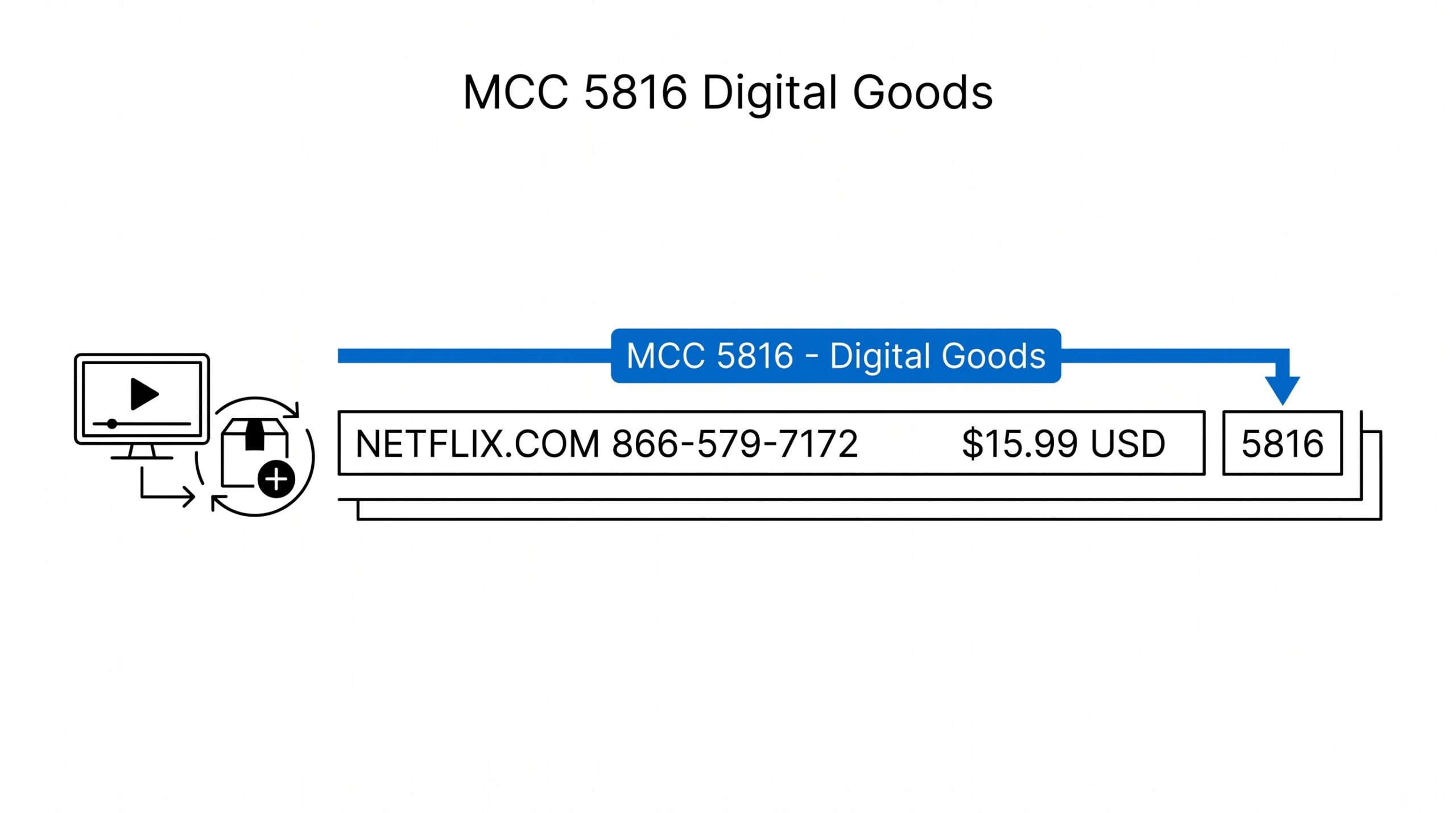

You subscribe to ChatGPT Plus for $20/month, Midjourney for $30/month, and GitHub Copilot for $10/month. All three of those charges show MCC 5816 on your credit card statement. You also have Netflix for streaming, Adobe Creative Cloud for software, and Notion AI for team collaboration. Every one of these charges carries the same 4-digit code.
You are not sure whether to categorize them as Office Expense (Line 18) or Supplies (Line 22) on Schedule C, and your bookkeeper’s auto-categorization tool put them all in the same line.
MCC 5816 is the 4-digit merchant category code assigned by Visa, Mastercard, American Express, and Discover to merchants whose primary business is selling digital goods. Digital goods are products delivered electronically rather than as physical media, including streaming subscriptions, software subscriptions, downloads, in-app purchases, digital media, e-books, and AI tool subscriptions.
The code emerged as a distinct category in 2004 alongside other ISO 18245-compliant codes but has grown rapidly since 2022 due to streaming proliferation, SaaS subscriptions, and the AI tool explosion of 2023-2026. About 70% of consumers and small businesses with modern credit cards now see multiple 5816 charges per month.
Quick Answers: MCC 5816 is the code for digital goods merchants, which include streaming services, software subscriptions, in-app purchases, downloads, e-books, digital media, and AI tool subscriptions. The code covers non-physical goods sold as a merchant’s primary business, distinct from 5734 (physical computer software stores) and 5817 (digital goods – other/aggregated).
Common merchants registered as 5816 in 2026 include Netflix, Spotify, Adobe Creative Cloud, ChatGPT Plus, Midjourney, GitHub Copilot, Microsoft 365, Notion, and Canva. The charges map to Schedule C Line 18 (Office Expense) for general subscriptions or Line 22 (Supplies) for software used in the business product. The 5816 volume has grown 40% year-over-year since 2022 driven by AI tool proliferation.
The code does NOT cover physical software, which falls under 5734, and does NOT cover fast food or restaurant digital ordering.
What MCC 5816 Actually Covers
MCC 5816 is the merchant category code for “Digital Goods – Large Sub-category” in the ISO 18245 standard. The card networks use 5816 when the merchant’s primary business is selling digital goods: products that are delivered electronically rather than as physical media.
The merchant registers with their acquirer (the bank that processes their payments) at the time of merchant account setup, and the acquirer assigns the appropriate code based on the merchant’s stated primary business.
Think of 5816 like a tagging system for the type of business. When you buy something from a merchant registered as 5816, the merchant is selling you digital goods as their primary revenue source. The actual product range may include streaming video, software subscriptions, AI tool access, or digital downloads.
The code does not change based on what you specifically bought; it reflects what the merchant primarily sells.
The 5816 category became more pronounced as physical media (CDs, DVDs, USB-loaded software) declined and streaming + SaaS + AI tools proliferated. Today, Amazon Prime Video is 5816 (streaming video), Spotify is 5816 (streaming music), Adobe Creative Cloud is 5816 (software subscription), ChatGPT Plus is 5816 (AI tool subscription).
Most consumers and small business owners see more 5816 charges on their statements now than 5-10 years ago, when physical media dominated.
What 5816 does NOT cover: physical software sold in a retail store (that is 5734), physical books (that is 5942), food (that is 5812 restaurants, 5814 fast food, 5499 grocery), physical clothing (that is 5651, 5691, 5699 apparel), and any physical product sold by a merchant whose primary business is not digital goods.
1. Streaming Video Services. Video-on-demand platforms that deliver content over the internet rather than via physical media. Netflix, Disney+, Hulu, HBO Max, Amazon Prime Video, Apple TV+, Paramount+. These services all register as 5816 because their primary business is digital video delivery.
2. Streaming Audio Services. Music streaming and audio subscription services. Spotify, Apple Music, Tidal, Pandora, SiriusXM, podcast subscriptions, audiobook subscriptions (Audible). Audio-only services register as 5816.
3. Software Subscriptions. Cloud-based software delivered as a subscription rather than installed locally. Adobe Creative Cloud, Microsoft 365, Notion, Figma, Canva, Slack, Zoom, Dropbox, Google Workspace. The 5816 designation applies when the software is delivered as a subscription service.
4. AI Tool Subscriptions. Subscription access to AI services. ChatGPT Plus, ChatGPT Team, Midjourney, Claude Pro, GitHub Copilot, Cursor, Anthropic API credits, OpenAI API credits. Most major AI services register as 5816 per 2025-2026 card network updates.
5. Digital Downloads. One-time purchases of digital media or files. E-books on Amazon Kindle, digital music downloads on iTunes, indie game purchases on Steam (Steam itself is registered as 5816 because it’s a digital delivery platform), digital art purchases, stock photo purchases.
6. In-App Purchases and Subscriptions. Mobile app subscriptions and in-app content purchases. Apple App Store subscriptions, Google Play subscriptions, premium features within apps, app-content purchases. These charges typically register as 5816 when they go through the App Store or Play Store rails.
MCC 5816 vs 5734 vs 5817 (The Related Codes)
Three MCC codes get confused with 5816. Understanding the differences prevents miscategorization.
5816 vs 5734 (Computer Software Stores). 5734 is for physical retail stores that sell boxed software, computer hardware, and computer peripherals. Best Buy as a merchant is generally 5732 (Electronics Stores), but the specific computer-software-only departments within Best Buy, or a dedicated software store (Micro Center for software), may register as 5734.
The key distinction: 5734 is for retail merchants selling physical software products, 5816 is for digital delivery merchants.
5816 vs 5817 (Digital Goods – Other/Aggregated). 5817 is the catch-all for digital goods that don’t fit 5816 specifically.
The distinction matters when a digital merchant sells multiple categories of digital goods (Amazon as a digital goods merchant, for example, would aggregate purchases as 5817 rather than 5816). 5816 typically applies when the merchant’s primary business is one category of digital goods. 5817 applies to merchants whose digital goods span multiple categories or whose primary classification is hard to pin down.
5816 vs 5968 (Direct Marketing). 5968 covers subscription services with a strong marketing component, where the merchant is primarily a direct-marketing operation selling subscription products. Newsletter subscriptions, subscription boxes with curated physical goods, marketing automation tools. 5816 is for digital content access, 5968 is for marketing-driven subscription services.
The merchant’s registration determines the code, not what you specifically purchased. A streaming service that also sells merchandise (Amazon, in some respects) might have its core digital delivery as 5816 but physical merchandise as 5311 (department store) or 5999 (miscellaneous specialty). The codes reflect what the merchant registered as their primary business at the acquirer.
From Bank Statement to QuickBooks-Ready File
That manual cleanup you just read about? This tool skips it. Turn your PDF into QBO for QuickBooks without storing your data anywhere.
Start ConvertingWhy 5816 Volume Is Growing in 2026
Three forces are increasing the volume of 5816 charges on consumer and business credit card statements in 2026.
The AI tool subscription explosion. The number of paid AI services has grown from a few dozen in 2022 to several hundred by 2026. ChatGPT Plus, ChatGPT Team, ChatGPT Enterprise, Claude Pro, Claude Team, Midjourney, Stability AI, RunwayML, GitHub Copilot, Cursor, Cody, Tabnine, and countless vertical-specific AI services (legal AI, medical AI, accounting AI). Most register as 5816 per the 2025-2026 card network updates.
SaaS consolidation into monthly subscriptions. The 2020-2026 trend away from one-time software purchases toward subscription-based delivery. Where 2018 might have shown one $1,499 boxed software purchase per year on a credit card, 2026 shows 12 monthly $30-300 SaaS subscriptions for the equivalent functionality. Same product, more 5816 charges, more bookkeeping work.
Streaming bundle consolidation. Media companies are bundling streaming services (Disney+, Hulu, Max), tech companies are bundling productivity + storage + AI (Microsoft 365 Copilot), and creators are bundling newsletter + podcast + courses into Substack-style platforms. Each bundle layer adds another 5816 charge.
The practical impact for small business bookkeeping is that 5816 charges have gone from occasional to routine. A small business with even 5 SaaS subscriptions and 2 streaming services sees $200-500 in 5816 charges per month that all need categorization for Schedule C.
Where 5816 Charges Go on Schedule C
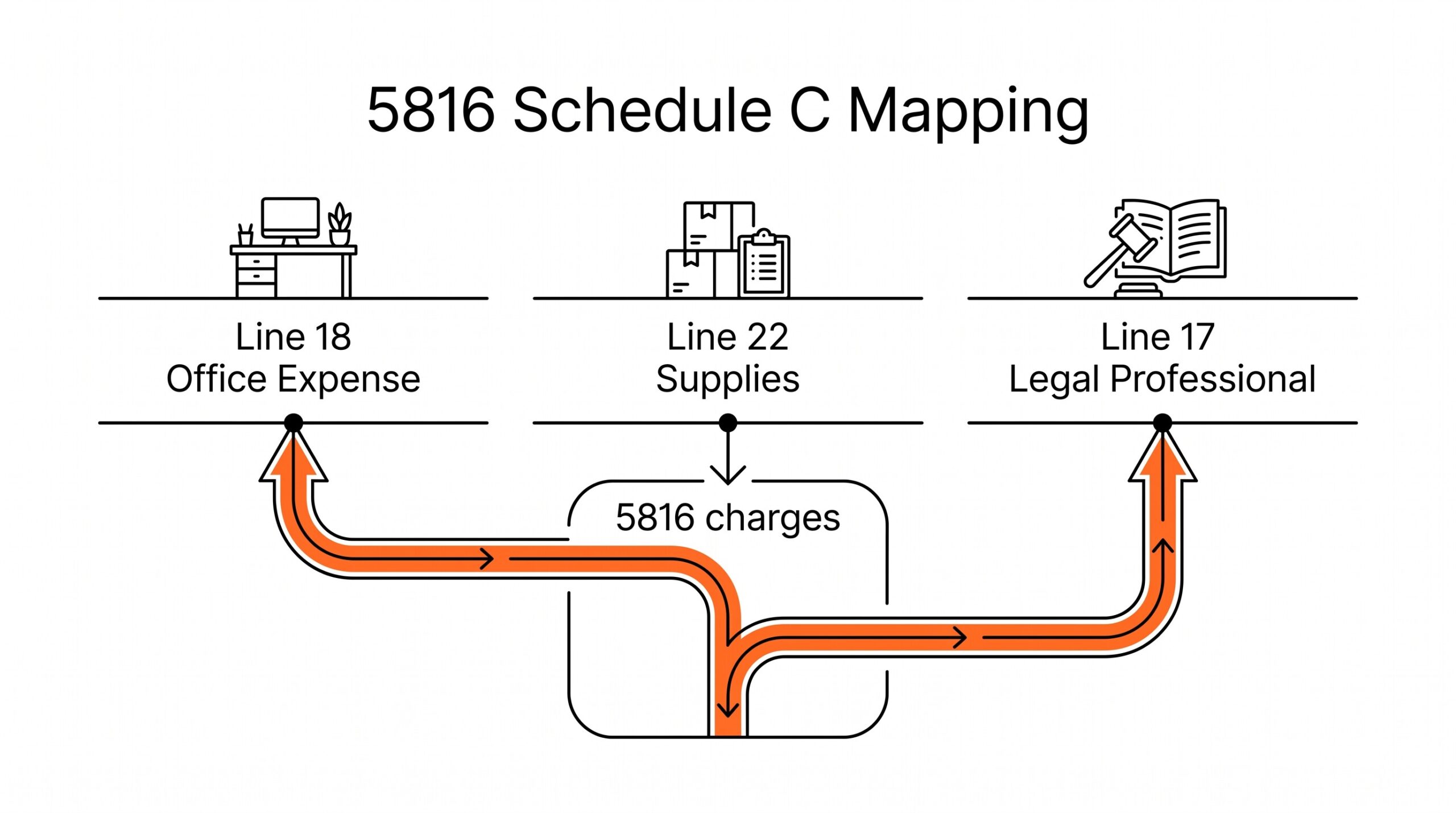
Categorizing 5816 charges on Schedule C depends on what the digital good is used for. There are typically 2-3 lines that 5816 charges can map to, and the choice depends on the business use case.
Schedule C Line 18 (Office Expense). This is the most common line for 5816 charges. Office Expense covers “accounting fees, advertising, insurance, interest, legal and professional fees, office supplies, postage, rent, repairs, software subscriptions, telephone, travel, utilities, and other costs of running an office.” Software subscriptions fall into Office Expense because they support the operations of the office.
Schedule C Line 22 (Supplies). This line covers materials that are consumed in the production of goods or services. For digital goods merchants or businesses that produce digital products (software, video, audio), some 5816 charges may be Supplies (consumed in production). For example, a video producer’s Adobe Creative Cloud subscription could be Supplies if Adobe is consumed in producing client deliverable videos.
Schedule C Line 17 (Legal and Professional Services) or Line 27 (Other Expenses). AI tool subscriptions that provide professional services (AI legal research, AI tax preparation, AI accounting) may be categorized under Legal and Professional Services if the AI is treated as a professional service provider. This is an emerging edge case.
For resale or product-based businesses: if your business model is reselling digital goods (e.g., you buy software subscriptions in bulk and resell access), 5816 charges may be Cost of Goods Sold (COGS) rather than a Schedule C line. The categorization depends on your specific business model and should be discussed with your CPA.
The default for most small businesses is Line 18 (Office Expense). When in doubt, categorize as Office Expense; your CPA can re-categorize during return preparation.
Failure Modes With 5816 Categorization
A few common failure modes cause 5816 charges to be miscategorized in accounting.
Treating all 5816 charges as the same category. The most common failure is dumping all 5816 charges into a single line. In reality, different 5816 sub-categories map to different lines (Office vs Supplies vs Legal). The categorization should be sub-category aware.
Missing AI subscription auto-renewals. AI tools often have auto-renewal charges that escape notice. A $20/month ChatGPT Plus for a year = $240 that should be categorized as Office Expense but may be missed in the credit card statement review.
Treating AI subscriptions as personal. Some bookkeepers treat AI subscriptions as personal expenses because they are accessed by individual employees. For business AI tools (ChatGPT Team, GitHub Copilot Business, Midjourney for teams), they are business expenses even if accessed by individuals.
Mixing personal streaming with business streaming. A Netflix subscription for personal use appearing on a business credit card may be wrongly categorized as a business entertainment expense. The categorization should be reviewed for personal vs business use.
How to Verify a Charge Is Actually 5816
To verify a charge on your statement is actually 5816 (not 5734, 5817, 5968, or another related code), use these 3 approaches.
1. Check your credit card platform. Modern credit card platforms (Chase, Amex, Capital One, Discover, Citi) display the MCC code alongside the merchant name in the transaction details. Click into the transaction and look for the 4-digit code or “category” field.
2. Use card network lookup tools. The card networks (Visa, Mastercard, Amex, Discover) each publish downloadable MCC code lists. Search the list for the merchant name to confirm the registered code. The list refreshes periodically, so the 2026 version is most accurate.
3. Use third-party lookup tools. AwardWallet, classification.codes, and MCC-Codes.com provide searchable MCC databases. Enter the merchant name or 4-digit code and confirm the classification.
Productivity Software: Microsoft 365, Google Workspace, Notion, Figma, Canva, Slack, Zoom, Dropbox, Box, Airtable, Trello, Asana, Monday.com, ClickUp, Evernote.
Creative Software: Adobe Creative Cloud, Affinity Suite, Figma Professional, Procreate (iPad), DaVinci Resolve Studio, Capture One, Luminar Neo, Topaz AI suite.
AI Tools: ChatGPT Plus, ChatGPT Team, ChatGPT Enterprise, Claude Pro, Midjourney, Stable Diffusion services, RunwayML, GitHub Copilot, Cursor, Cody, Tabnine, Jasper AI, Copy.ai, Notion AI.
Developer Tools: GitHub Pro/Team, GitLab Premium, JetBrains All Products Pack, Datadog, Sentry, Vercel Pro, Netlify Pro, Cloudflare Pro, AWS Console (billed by Amazon Web Services, registered separately).