
You are categorizing 2026 transactions and you realize last year’s MCC list may be outdated. The 4-digit code that classified a merchant in 2024 sometimes got reclassified in 2025 and 2026. Buy Now Pay Later platforms that did not exist as a category in 2022 now have their own codes.
AI tool subscriptions that nobody classified in 2023 are showing up on statements with codes you have never seen. The risk of using an outdated list is real: miscategorization means wrong Schedule C line, wrong rewards bonus, possible IRS adjustment.
A Merchant Category Code (MCC) is the 4-digit number that Visa, Mastercard, American Express, and Discover assign to each merchant that accepts their cards. The current 2026 MCC list contains about 600 active codes following the ISO 18245 international standard. About 100 codes cover 95% of consumer and small business transactions. The codes determine rewards categories, interchange fees, and IRS Schedule C mapping.
The 10 major categories are retail outlets (5000s), service providers (7000-7999), transportation (3000-3999), dining (5812/5814), travel and entertainment, business services, professional services, government, and miscellaneous.
Quick Answers: The 2026 MCC list contains about 600 active codes following the ISO 18245 international standard. The top 100 codes cover 95% of consumer and small business transactions. New in 2026: dedicated codes for BNPL (Buy Now Pay Later) transactions and AI tool subscriptions, plus refined sub-categories for crypto exchanges.
The 4 card networks (Visa/Mastercard/Amex/Discover) maintain their own sub-lists but follow ISO 18245. 8949 is NOT an MCC, it is IRS Form 8949 for capital gains. Use the official network lookup tools or our reference guide to find any 2026 code. The full 2026 list updates every 12-18 months; bookmark this page and recheck annually.
What the 2026 MCC List Looks Like
The 2026 MCC list covers the same broad category structure that has existed since 2004, with refinements and new sub-categories each year. The major categories stay stable; what changes is the sub-categorization under each major category, plus completely new categories as new industries emerge. Cryptocurrency exchanges got dedicated codes in the 5968 range in 2022; those codes have been refined through 2024 and 2025.
Buy Now Pay Later platforms got new codes in 2024-2025 that are now stable in 2026.
The structure of the 2026 MCC list follows ISO 18245, which is the international standard for merchant category codes maintained by the International Organization for Standardization. The ISO standard defines the 4-digit structure and the major category ranges, but individual card networks (Visa, Mastercard, Amex, Discover) maintain their own sub-categorization and can add or remove codes at their discretion.
The 10 major MCC categories in 2026 are: Agricultural Services (0764, 0763, 0762, 0761), Contracted Services (1520, 1711, 1731, 1740, 1750, 1761, 1771, 1799), Travel and Entertainment (3000-3999, plus 7011 lodging), Transportation (4000-4999), Retail Outlet Services (5000-5599), Clothing Stores (5300-5699), Miscellaneous Stores (5300-5999), Business Services (7000-7999), Professional Services (8000-8999), and Government Services (9000-9999).
8999 Professional Services (Not Elsewhere Classified), catch-all for professional services not elsewhere classified. Includes consultants, freelancers, specialized services.
This list covers the top 100 of approximately 600 active 2026 MCC codes. For the complete list of all 600+ codes, see our complete MCC code reference or use the network-specific lookup tools below.
What Changed in 2026 (vs 2024 and 2025)
The 2026 MCC list has 3 categories of changes from prior years. These changes matter because your reward categorization and Schedule C mapping depend on which version of the list your bookkeeping is using.
New codes added in 2026. The Buy Now Pay Later (BNPL) category has been further subdivided. Affirm, Klarna, Afterpay now have more granular codes based on transaction type. AI tool subscriptions have dedicated codes in the 5814 / 5734 area as of late 2025 that are stable for 2026. Crypto exchanges have refined codes in the 6051 area for staking rewards versus trading.
Codes reclassified in 2026. Some sub-categories have been moved or redefined. Direct marketing (5968) has been split into subscription services, recurring billing, and one-time direct marketing. Computer software (5734) has been refined for AI-related tools. Quasi-cash (6051) has additional sub-definitions for crypto.
Codes deprecated or rarely used. A handful of codes are being phased out by 2026. These include some older utility codes that have been folded into 4900, and some airline sub-codes that have been consolidated.
The practical impact of these 2026 changes is small for established businesses with consistent merchant categories. The impact is largest for new business types (BNPL, AI, crypto refinements) where the categorization didn’t exist 2 years ago.
From Bank Statement to QuickBooks-Ready File
That manual cleanup you just read about? This tool skips it. Turn your PDF into QBO for QuickBooks without storing your data anywhere.
Start ConvertingHow MCCs Affect Credit Card Rewards Categories in 2026
The merchant category code that the merchant registered with is the code that determines bonus category eligibility for credit card rewards. This means: if you buy dinner at a restaurant that registered as 5812, your dining rewards card will give bonus points.
If you buy the same dinner at a restaurant that registered as 5813 (because they consider themselves a bar), your dining card will give base points only.
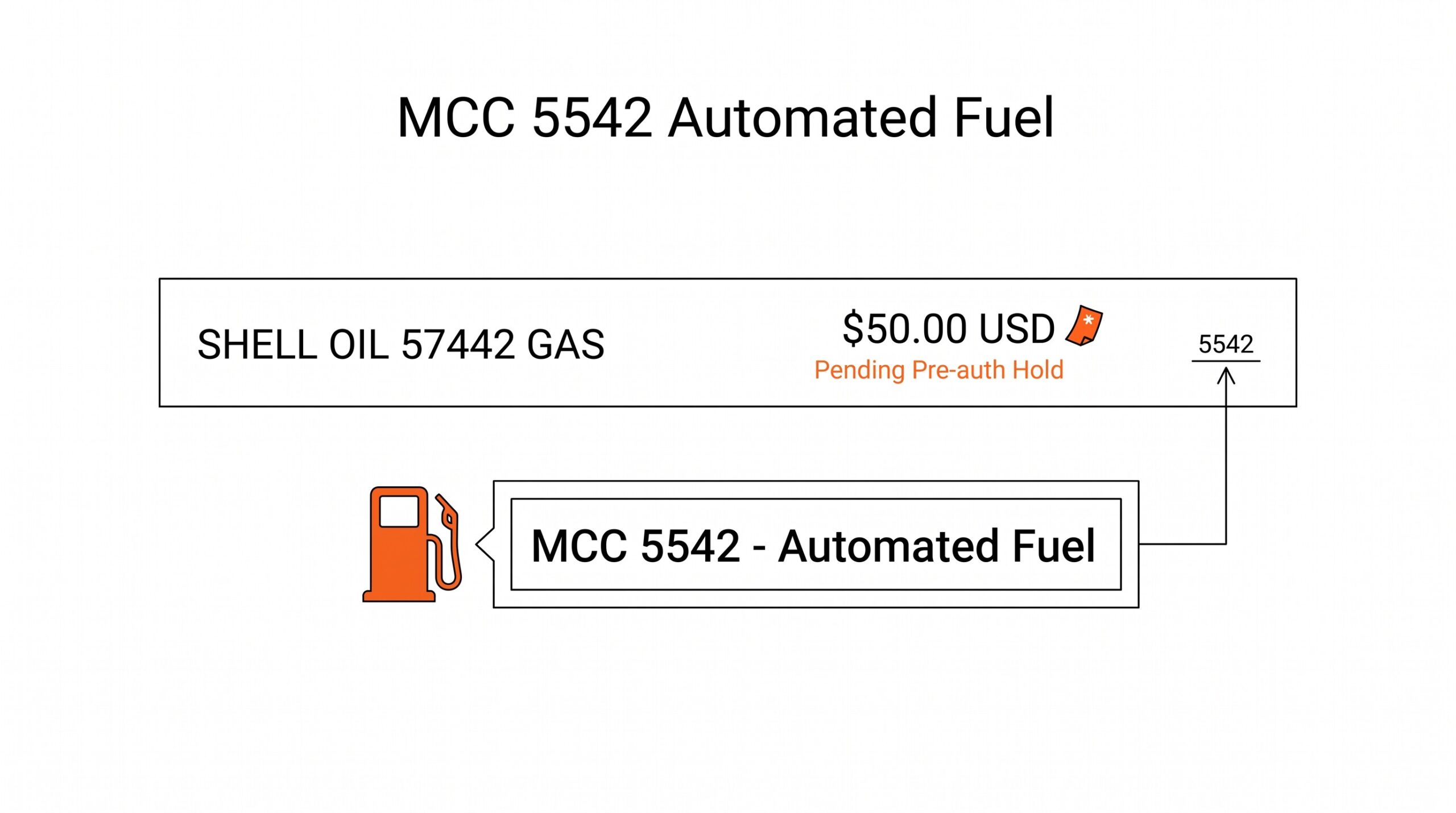
The 2026 reward category structures for major cards are similar to 2024-2025: dining (5812, 5814, sometimes 5813), travel (4511 airlines, 7011 hotels, 4112 rail, 4411 cruise, 7012 timeshares), gas (5541, 5542), grocery (5411), and streaming subscriptions (often 5968).
The common confusion in 2026 is fast casual chains like Chipotle, Panera, and Cava. These chains historically registered as 5814 (fast food) but have been re-classifying as 5812 (eating places) since 2022. Your card may give different bonus categories depending on which code the specific location uses. The transaction receipt typically shows the MCC code; check it if the bonus matters.
The 2026 emergence of BNPL platforms (Affirm, Klarna) created a rewards category gap. Some cards now offer bonus categories for BNPL, but the bonus only triggers if the BNPL charge has the right MCC code (often 6051 or newly-defined BNPL sub-codes). Without checking the actual code on your statement, you may not get the bonus.
If your business has consistent merchant patterns, the rewards optimization question becomes: which of your 2026 expenses could be routed to a different card to maximize 2026 bonus categories? The MCC code lookup is the answer; if a vendor registers as 5499 but you have a 5% grocery bonus that applies to 5411, you may want to use a different vendor.
How MCCs Map to IRS Schedule C Line
IRS Schedule C has 14 expense categories (Lines 8 through 27, plus Lines 28-30 for additional categories). Mapping the 2026 MCC list to Schedule C is the standard approach for small business tax filing. The mapping is approximately 80% straightforward and 20% requires judgment.
Line 9 (Car and Truck Expenses). Maps to MCC 5541 (gas), 5511 (car dealers), 7538 (auto service), 4121 (taxi/ride share). Sub-categorize as business vs personal based on usage records.
Line 18 (Office Expense). Maps to MCC 5111 (stationery), 5943 (office supplies), 5734 (computer software, including subscription software), 5942 (book stores for reference books).
Line 22 (Supplies). Maps to MCC 5193 (florist supplies), 5261 (garden supplies), 5311 (department stores for supplies), 5950 (glassware). Where the merchant doesn’t have a specific MCC, this is the default for general supplies.
Line 24a (Travel). Maps to MCC 4511 (airlines), 7011 (hotels), 4112 (rail), 4411 (cruise), 7012 (timeshares if deductible), 7991 (tourist attractions), 7999 (recreation services).
Line 24b (Meals). Maps to MCC 5812 (restaurants), 5814 (fast food), 5813 (bars for client entertainment). Note the 50% deduction limit on business meals, regardless of MCC.
Line 25 (Utilities). Maps to MCC 4900 (utilities) and 4814 (telecommunications including phone and internet for business).
How to Look Up Any MCC Code in 2026
Looking up any MCC code in 2026 has 3 approaches, each with different trade-offs. The right approach depends on whether you need an exhaustive list, a specific code lookup, or a categorization for transactions.
1. Network-specific lookup tools. Visa publishes a downloadable PDF list. Mastercard maintains a list as well. These are the most authoritative but require manual navigation. Best for: confirming a specific code’s classification.
2. Third-party lookup tools. AwardWallet’s merchant lookup tool, the classification.codes tool, and MCC-Codes.com provide searchable databases. These aggregate the network lists and offer cleaner navigation. Best for: finding the MCC for a specific merchant you can’t find on a statement.
3. Your credit card statement. The actual MCC code is on the merchant descriptor or in your statement details. Most modern credit card platforms expose the MCC code per transaction. Best for: verifying what code your specific transaction actually has.
For converting a year’s worth of bank statements with MCC codes to a Schedule C-categorized spreadsheet, the workflow has 5 steps. First, convert the bank statement PDF to CSV using a tool that handles the conversion.
Second, the CSV includes the merchant name and amount. Third, match each merchant to its MCC code using one of the lookup methods above. Fourth, map the MCC to the relevant Schedule C line. Fifth, aggregate by Schedule C line for the tax filing.
Several things people search for are not actually MCC codes. The confusion often costs bookkeepers time when they try to categorize something as an MCC but the actual code is elsewhere.
8949 is NOT an MCC. It is IRS Form 8949 (Sales and other Dispositions of Capital Assets) for capital gains and losses on stock and crypto sales. People searching for “8949 code” often find form references, not MCC references.
ACH SEC codes are NOT MCCs. ACH transactions use Standard Entry Class (SEC) codes like PPD, CCD, WEB, TEL. These identify the type of ACH transaction, not the merchant category. SEC codes appear in the bank statement details, not as MCCs.
SWIFT/BIC codes are NOT MCCs. International wire transfers use SWIFT codes for the receiving bank. These are financial institution identifiers, not merchant categories.
NAICS codes are NOT MCCs. The North American Industry Classification System has similar purpose to MCCs but is used by the IRS for business classification. A company’s NAICS code is separate from any MCC they may appear under on credit card statements.
SIC codes are NOT MCCs. Standard Industrial Classification codes are an older version of NAICS. Same distinction: SIC is for business classification, MCC is for merchant classification on transactions.
2027 Outlook (What MCC Categories Are Emerging)
The 2027 MCC list is being shaped by 4 emerging merchant categories that didn’t exist in 2022. Each is likely to get further refinement or dedicated codes by 2027.
BNPL (Buy Now Pay Later). Subdivided in 2024-2025, but further refinement is likely as BNPL transaction patterns stabilize. The next likely change: codes distinguishing BNPL consumer transactions from BNPL business-to-business lending.
AI Tool Subscriptions. First added in late 2025 as a sub-category. The 2027 list will likely split this further: AI development tools vs AI end-user subscriptions vs AI-as-a-service.
Embedded Finance. Software platforms that handle payments (like Shopify Payments, Stripe) are getting their own codes separate from the parent platform’s MCC. Refinement likely by 2027.
Stablecoins and Tokenized Assets. Crypto refinements continue. Stablecoin transaction codes (USDC, USDT) and tokenized asset trades will likely get dedicated codes by 2027 as adoption grows.
The categories that are NOT likely to change in 2027 are the established core categories (dining, travel, retail, professional services). The MCC system is mature and stable; the changes are in the sub-categorization for emerging merchant types.
For the established small business with consistent merchant categories, your 2026 list will work through 2027 with maybe 5% of transactions needing different categorization than they would have under a 2024 list. For new-economy businesses (AI, crypto, BNPL), the changes will be more frequent.
See also
For more on specific MCC codes, see the complete MCC definition, the 30 most common MCC codes, the full MCC reference, the 5968 direct marketing code, the 6011 ATM cash code, the 4814 telecommunication code, the 5411 grocery stores code, the 5541 service stations code, the 5812 eating places code, and the 7011 lodging code.
For the conversion workflow that uses these codes, see the bank transaction categorization guide.
How this list relates to the complete MCC reference
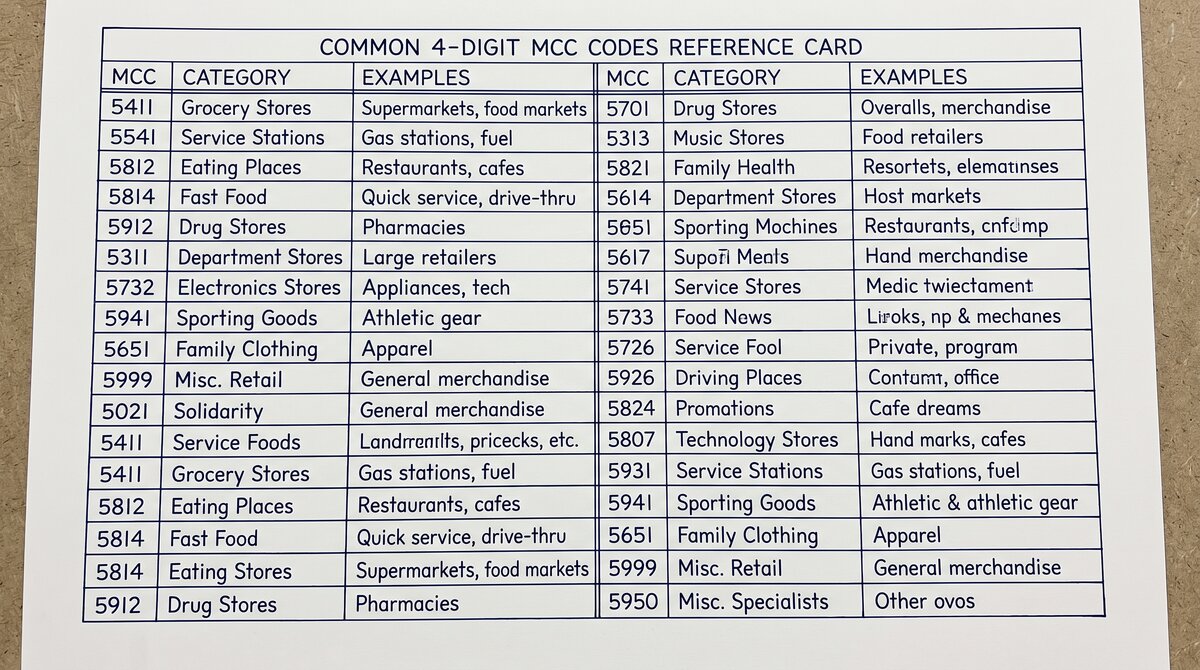
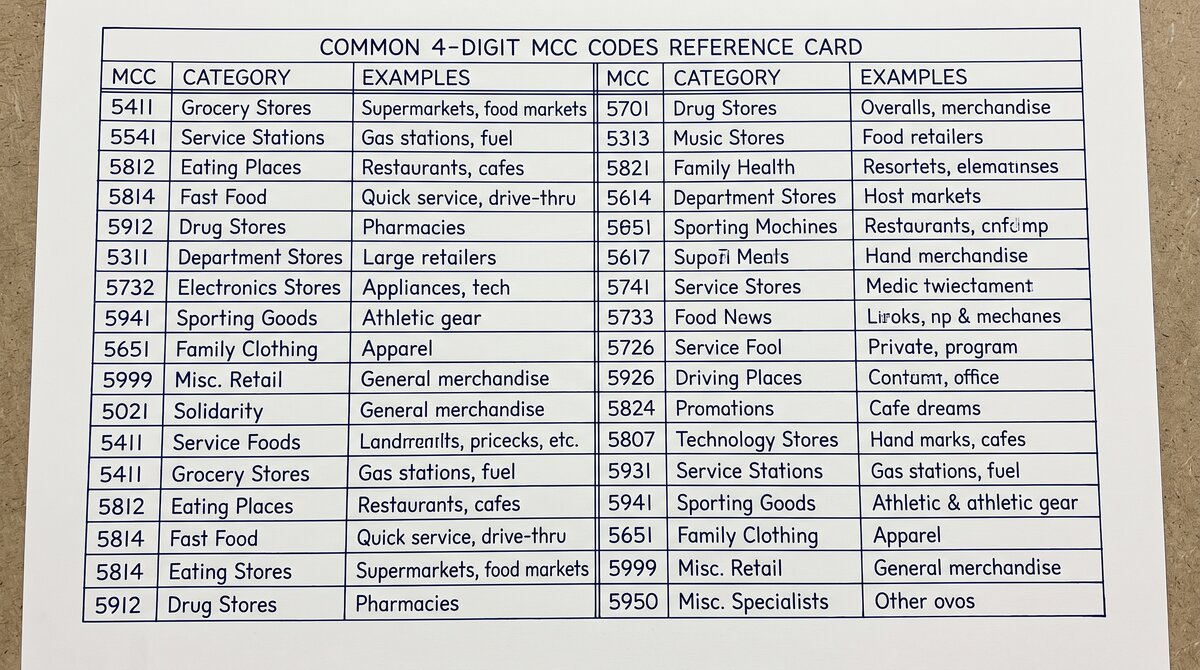
This 50-code list is curated for what US consumers most often see on credit-card and bank statements in 2026. It is not a substitute for the full reference table; it is a shortlist that surfaces the codes 80 percent of statement readers ask about.
For the full code-by-code reference including every US card-network MCC, see the complete merchant category code reference. That hub covers every MCC 0001 through 9999 plus merchant-category-search by network and includes the issuer-level overlays (Visa, Mastercard, Amex, Discover) that diverge on subtle categories.
If you are trying to identify one specific code on your statement, the dedicated explainer pages on this site go deeper per code. The MCC 5816 explainer, the MCC 5541 explainer, and the MCC 6051 explainer are three representative examples.
The consolidated overview for the entire MCC system is the complete guide to MCC codes on bank statements , which covers what an MCC is, where it lives on your statement, why the three US networks use slightly different reference tables, and the four most common dispute scenarios.
Treat the shortlist on this page as the quick lookup; treat the complete reference as the deep dive.
Turn PDF Bank Statements Into Workable Spreadsheets
Your bank statement is a mess of numbers, but your books shouldn't be. Use our converter to get Excel, CSV, or QBO files — ready for QuickBooks.
Try It Free Now