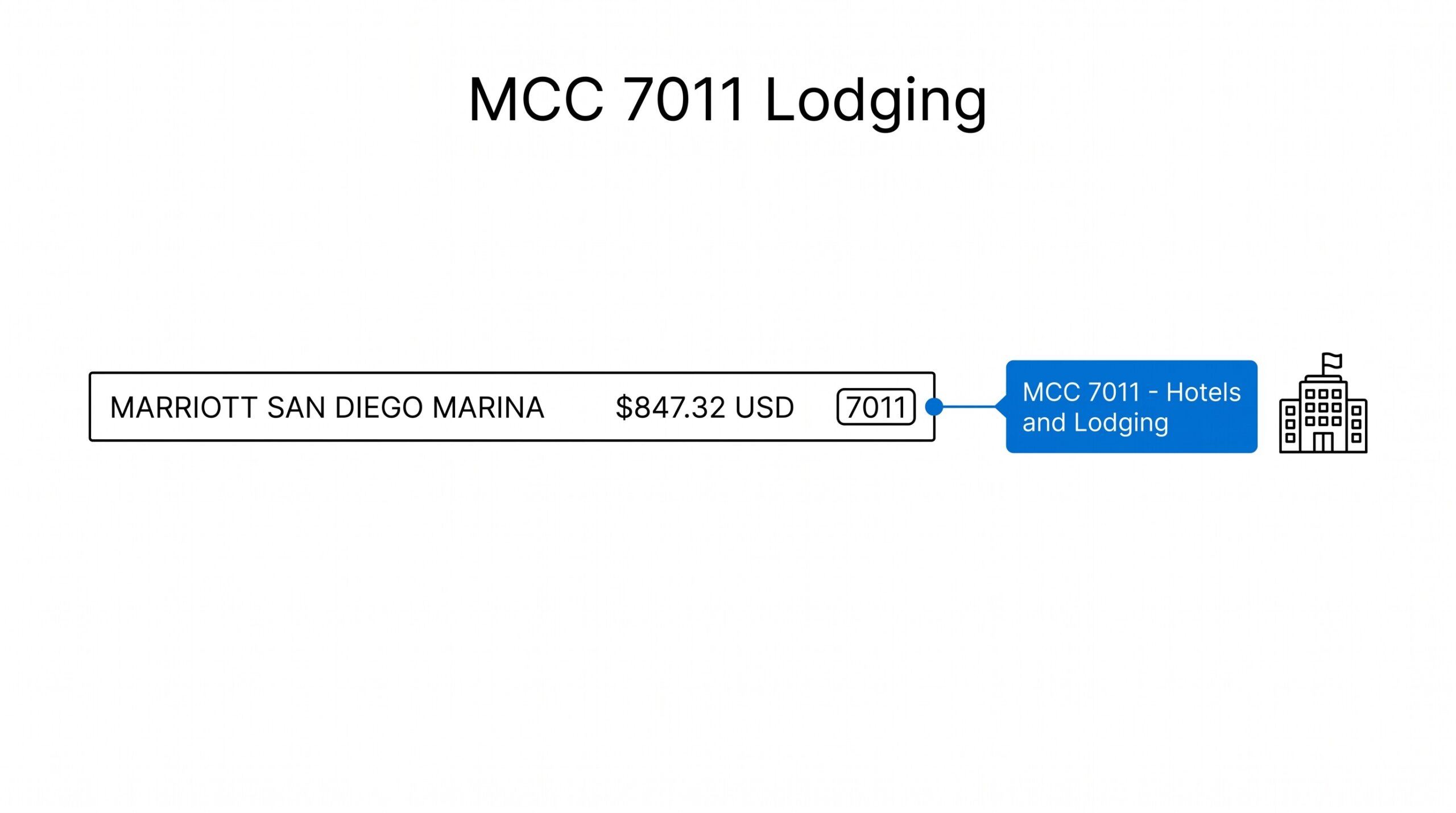

You are reviewing your October credit card statement. A charge for $847.32 at “MARRIOTT SAN DIEGO MARINA” shows “7011” in the merchant code column. Below it, a $24 charge at the same hotel’s restaurant shows “5812”, and a $42 charge for parking shows “7523”. Three charges from one hotel stay, three different codes.
You want to know what 7011 means, whether it covers all the charges or just the room, and what business expense treatment applies.
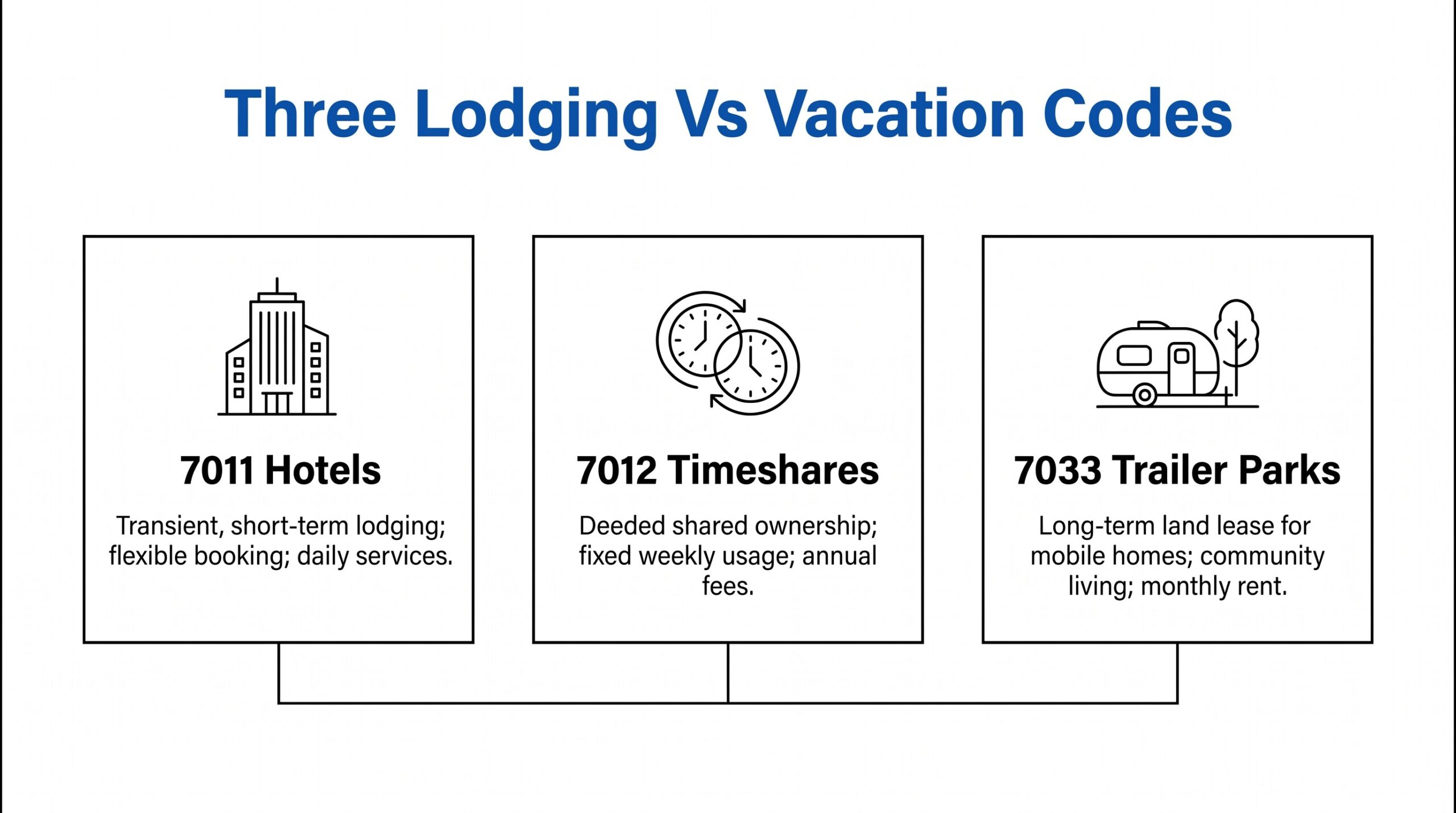
MCC 7011 is the merchant category code that Visa, Mastercard, American Express, and Discover assign to hotels, motels, resorts, and similar lodging establishments under ISO 18245. The code sits inside the four-digit ISO numbering system that classifies every merchant accepting card payments. The 7011 code is the catch-all for traditional lodging, separate from 7012 (timeshares), 7032 (recreation camps), and 7033 (trailer parks).
Quick Answers: MCC 7011 is the ISO 18245 code for hotels, motels, resorts, inns, and lodges. The code typically covers the entire hotel folio (room rate, taxes, resort fees, parking, room service, minibar) but may be split if the merchant uses separate sub-codes for food (5812) or parking (7523). 7011 does NOT cover timeshares (7012), recreation camps (7032), or trailer parks (7033).
Short-term vacation rentals like Airbnb and VRBO often register as 7011 but may use no MCC depending on how the host registered. For self-employed individuals, 7011 charges during business travel are deductible on Schedule C Line 24a (Supplies) or as part of travel expenses, subject to the actual cost.
What MCC 7011 Covers
The 7011 code covers traditional lodging establishments where guests stay overnight or longer in exchange for payment. The most common merchants that fall under 7011 include hotels (Marriott, Hilton, Hyatt, IHG, Wyndham chains), motels (typically roadside locations with exterior room entry), resorts (destination properties with extensive amenities), inns and bed-and-breakfasts (smaller establishments, often independently owned), and lodges (rustic properties in mountain or wilderness areas).
Imagine you check into a Marriott for a 3-night business conference. The hotel’s primary merchant code is 7011. The room rate, occupancy taxes, resort fee, destination fee, parking charge, in-room dining (if billed to the room), minibar purchases, and even the spa charge typically all show 7011 because they’re billed by the hotel merchant, not separate sub-merchants.
The exception is when the hotel operates distinct sub-merchants (like a separate gift shop or restaurant) that have their own merchant codes.
What 7011 does NOT cover is just as important as what it does. Marriott Vacation Club properties register as 7012 (timeshares) rather than 7011. KOA campgrounds and similar RV/camping operations use 7033 (trailer parks and campgrounds). Summer camps for children register as 7032 (sporting and recreation camps).
Vacation rental platforms (Airbnb, VRBO) often use 7011 for the host’s registration, but individual hosts may register under other codes depending on their merchant setup. The broader framework of how these codes work sits inside the MCC overview for credit card statements.
The Difference Between 7011 and Related Codes
This is the most common source of confusion about MCC 7011. Marriott, Hilton, and Hyatt properties may show as 7011, 7012, or no MCC depending on which specific property and how it’s registered. The reason depends on how the merchant registered with their acquirer, not the brand alone.
Marriott International operates multiple brands that register differently. Marriott Hotels, JW Marriott, Renaissance, and Westin typically register as 7011. Marriott Vacation Club and Ritz-Carlton Destination Club register as 7012 (timeshares). Residence Inn and TownePlace Suites (extended-stay brands) typically register as 7011 because they’re treated as hotels despite the apartment-like configuration. The acquirer makes this decision based on the property type and operation model.