
MCC 1799 on Your Credit Card Statement, What It Means
You hand the fencing contractor a credit card payment and see MCC 1799 on the merchant statement. Or your business books a $4,200 invoice from a demolition company, and the bank statement shows 1799 next to the line. Or you are a self-employed glazier reconciling charges on your own credit card and can’t find what 1799 covers.
That 4-digit code is doing more classification work than you might realize, and it’s worth understanding exactly what it means, where it appears, and how to use it.
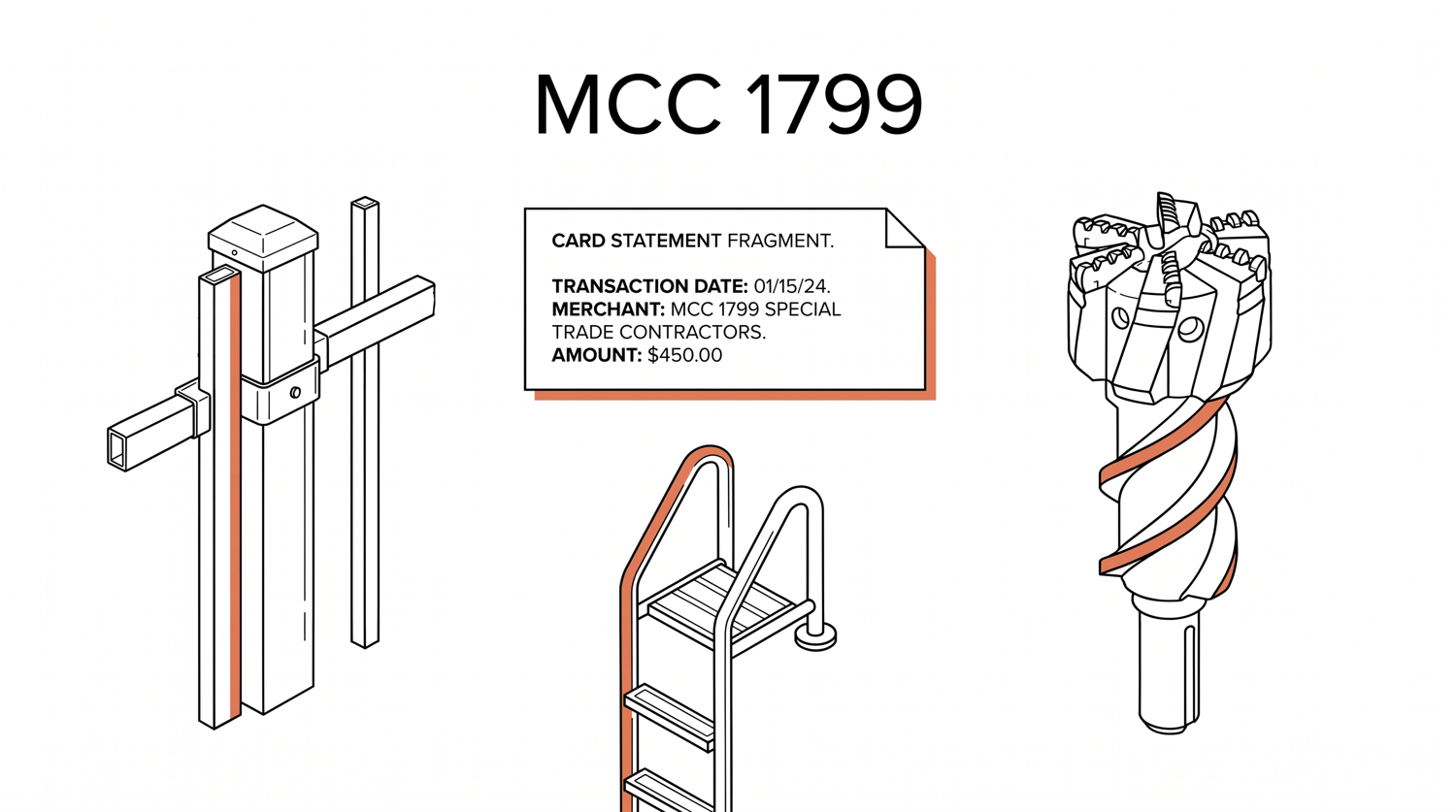
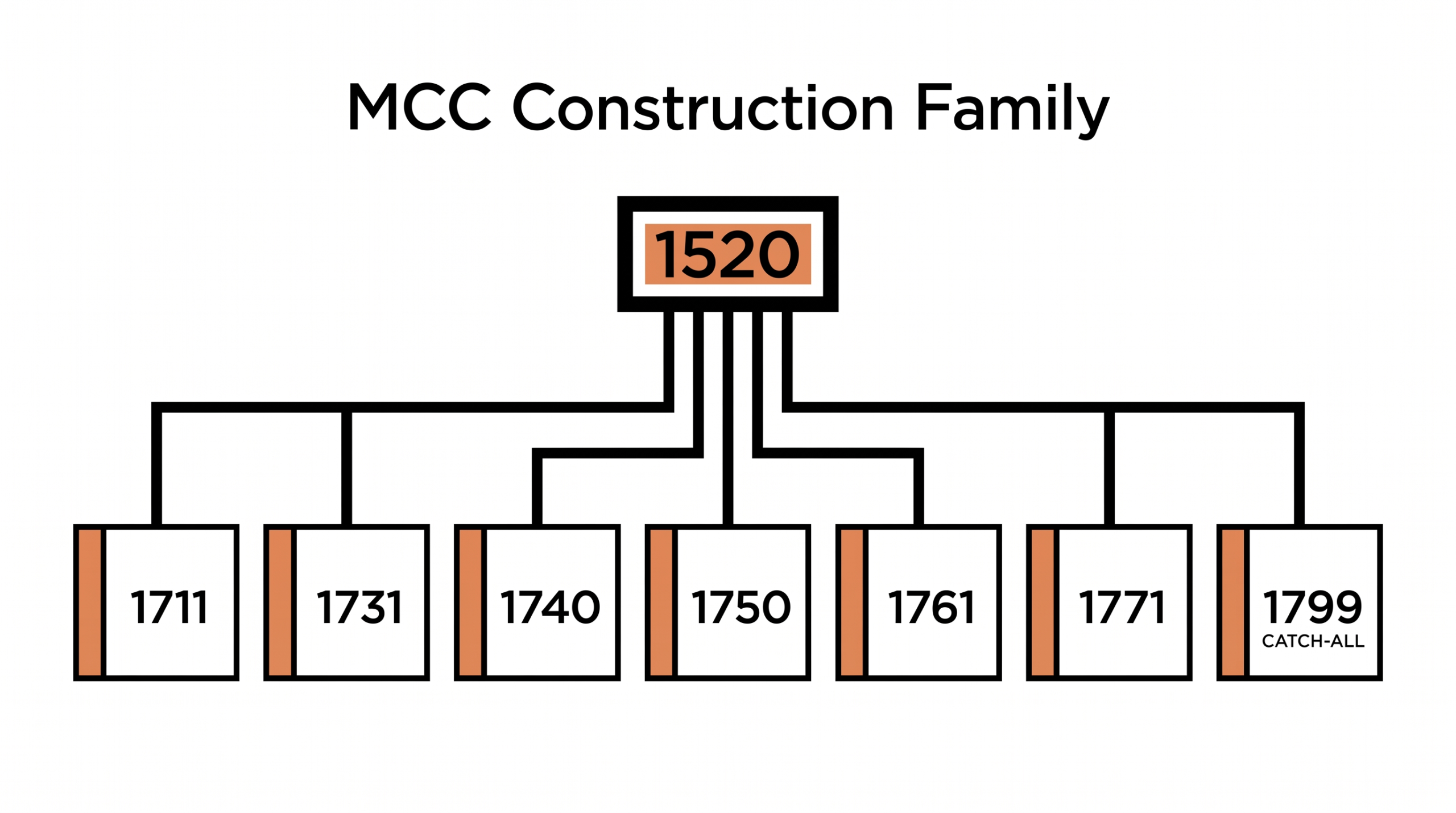
Quick Answers: MCC 1799 is the merchant category code that card networks (Visa, Mastercard, Amex, Discover) assign to special trade contractors whose work doesn’t fit a more specific construction code. It covers specialty trades like fencing, swimming pools, demolition, glazing, well drilling, awning installation, asbestos removal, sandblasting, and ornamental metalwork. MCC 1799 is a catch-all for construction work not classified under 1520 (general contractors), 1711 (HVAC/plumbing), 1731 (electrical), 1740 (masonry), 1750 (carpentry), 1761 (roofing), or 1771 (concrete). For self-employed contractors, 1799 charges from subcontractors typically go on Schedule C Line 11 (Contract Labor) or Line 17 (Legal and Professional Services), depending on the relationship.
What MCC 1799 Actually Means
MCC 1799 stands for “Contractors, Special Trade, Not Elsewhere Classified.” The ISO 18245 standard governs merchant category codes globally, and each code describes the primary business activity of the merchant. The 1799 code is the catch-all for specialty trade contractors whose specific trade doesn’t have its own dedicated code.
The official Mastercard Quick Reference Booklet describes 1799 merchants as: “Special trade contractors that perform construction work not elsewhere classified. Examples include awning installation, bathtub refinishing, fence construction, fire escape installation, house moving, home window replacement, garage door installation, floor covering installation, ornamental metal work, swimming pool construction, glasswork, well drilling, wallpaper services, and waterproofing.”
Card networks assign the code when a merchant sets up a merchant account with their acquiring bank, based on the merchant’s stated primary business activity. Customers who pay that merchant see the code on their credit card statement, alongside the merchant’s billing descriptor.
Easy Statement Sheet reads MCCs as one of the four columns in every converted statement. The first three statement conversions are free, no card required.
Easy Statement Sheet reads MCCs as one of the four columns in every converted statement. The first three statement conversions are free, no card required.
From PDF to Excel in one click
Forget retyping line by line. Upload any bank statement, get a spreadsheet you can actually use. Your files are never stored, and you can test the converter with 3 free conversions.
Try it freeWhich Contractors Trigger MCC 1799 (The Full List)
The scope of 1799 is broader than most guides suggest. Here is the comprehensive enumeration, drawn from the ISO 18245 standard and the card networks’ merchant classifications:
| Trade | Example Work |
|---|---|
| Landscape services | Garden design, lawn maintenance, irrigation install |
| Fencing contractors | Residential and commercial fence installation and repair |
| Swimming pool construction | Design, build, install, retrofit |
| Underground storage installation | Oil, water, fuel tanks below grade |
| Awning installation | Storefront and home awnings |
| Bathtub refinishing | Resurfacing and reglazing |
| Fire escape installation | Commercial and residential safety |
| House moving | Structural relocation services |
| Home window replacement | Window swap-out and upgrades |
| Garage door installation | Residential and commercial doors |
| Floor covering installation | Carpet, tile, vinyl, hardwood install |
| Ornamental metal work | Decorative iron, gates, railings |
| Glasswork / glazing | Custom glass install and replacement |
| Well drilling | Water well drilling and service |
| Wallpaper services | Hang, remove, prep walls |
| Waterproofing | Foundation, basement, roof coatings |
| Asbestos removal | Hazmat abatement |
| Sandblasting | Surface preparation, paint removal |
| Demolition services | Tear-down and haul-away |
| Excavation | Site prep, dig, fill |
| Scaffolding | Erection and rental with setup |
The common thread is construction-related services that don’t have a more specific 4-digit code. If the work involves plumbing specifically, it goes to 1711. If it’s electrical, 1731. If it’s masonry or insulation, 1740. Everything else falls under 1799.
MCC 1799 vs 1520 vs 1711 vs 1731
The construction family of MCC codes breaks down by trade specialty. Here’s the decision logic when determining which code applies:
| MCC | Code Name | When to Use |
|---|---|---|
| 1520 | General Contractors (Residential and Commercial) | Primary business is residential or commercial general construction (whole-building projects, remodeling management) |
| 1711 | Air Conditioning, Heating, and Plumbing Contractors | HVAC, plumbing, drainage, sewer, lawn sprinkler systems |
| 1731 | Electrical Contractors | Electrical work, wiring, panel install, low-voltage |
| 1740 | Insulation, Masonry, Plastering, Stonework, Tile Setting | Insulation, masonry, plaster, stone, ceramic tile work |
| 1750 | Carpentry Contractors | Carpentry work, framing, trim, finish, doors, cabinetry at construction site |
| 1761 | Roofing, Siding, and Sheet Metal Work Contractors | Roofing, roofing siding, gutters, sheet metal |
| 1771 | Concrete Work Contractors | Concrete pouring, finishing, cutting, repair |
| 1799 | Special Trade Contractors (Not Elsewhere Classified) | Any construction specialty not covered above |
The distinction between 1520 (general) and 1799 (specialty) is often about scope. A general contractor coordinates whole projects and may hire subcontractors for each trade. A specialty trade contractor does one specific kind of work. If a contractor’s primary business is installing fences exclusively, their MCC is 1799. If their primary business is general remodeling that includes fencing work, the MCC is more likely 1520.
When the line is unclear, for example, a contractor that does both general work and specialty work, the merchant’s acquiring bank makes the call during account setup, based on the merchant’s stated primary business activity. The merchant can request a code review if they believe the assigned MCC doesn’t match their actual business.
Real-World 1799 Statement Descriptors
The descriptors you see on a credit card statement when a 1799 merchant processes a charge include:
| Industry | Common Statement Descriptors |
|---|---|
| Landscape | LANDSCAPE SVC, LAWN CARE, IRRIGATION PRO |
| Fencing | FENCE & GATE, FENCE PRO, GATE SERVICE |
| Pool construction | POOL CONSTRUCTION, POOLS R US, AQUA BUILD |
| Demolition | DEMOLITION LLC, DEMO PRO, TEAR DOWN |
| Glasswork | GLASS INSTALL, GLAZING PRO, GLASS WORKS |
| Awnings | AWNING WORLD, SHADE PRO, AWNING DEPOT |
| Well drilling | WELL DRILLING, WATER WELL CO, WELL PRO |
| Waterproofing | WATERPROOFING CO, FOUNDATION PRO |
| Excavation | EXCAVATION SVC, DIG SAFE, EXCAV PRO |
| Asbestos / hazmat | HAZMAT ABATEMENT, ASBESTOS PRO |
| Garage doors | GARAGE DOOR PRO, DOOR SERVICE |
| Scaffolding | SCAFFOLD PRO, SCAFFOLD RENTAL |
When a credit card statement shows one of these descriptors, the MCC is almost always 1799. This gives bookkeepers and business owners a fast pattern-matching shortcut.
Schedule C Mapping for 1799 Charges
For self-employed contractors and bookkeepers reconciling statements, the IRS line treatment of a 1799 charge depends on who the merchant is and what category the expense falls into:
| Transaction Context | Schedule C Line | Line Name |
|---|---|---|
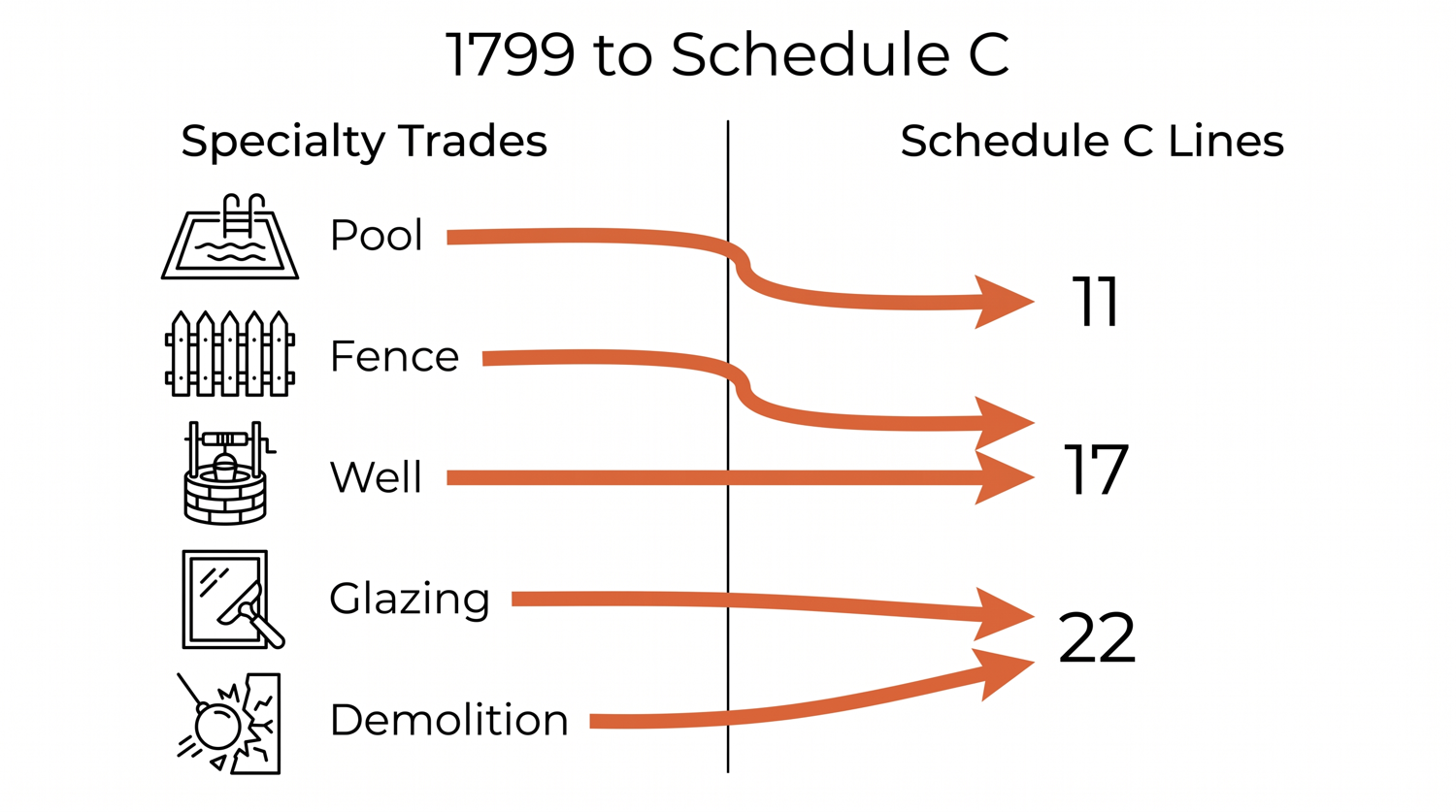
| Paid a 1799 subcontractor for project work | Line 11 | Contract Labor |
| Paid a 1799 professional (architect, surveyor, engineer) | Line 17 | Legal and Professional Services |
| Purchased materials from a 1799 merchant | Line 22 | Supplies |
| 1799 work was part of a vehicle fleet / truck | Line 9 | Car and Truck Expenses |
| 1799 service was home-office related | Line 30 | Utilities / Form 8829 |
| Bank fee from a 1799 merchant account | Line 27a | Other Expenses |
The most common treatment is Line 11 (Contract Labor) when the 1799 charge represents a payment to a specialty trade contractor for project-specific work. This applies both when the business owner is paying a subcontractor and when reconciling a converted bank statement on the contractor’s own books.
For self-employed specialty contractors seeing 1799 charges on their own credit card statement, categorize each charge by its actual nature: a 1799 charge for landscaping tools is supplies (Line 22); a 1799 charge for fence post materials is supplies (Line 22); a 1799 charge for a subcontractor to assist on a project is contract labor (Line 11).
How to Dispute a Wrong 1799 Assignment
Merchants who have been assigned MCC 1799 but whose primary business actually fits a more specific code can request a code review. The dispute process:
- Call your merchant services provider (the company that set up your merchant account, usually your acquiring bank or a third-party processor like Stripe, Square, or PayPal).
- Request an MCC code review, providing documentation: state contractor license, primary business description, samples of invoices, business formation documents.
- The processor reviews against ISO 18245 and card network rules. Approval depends on whether the proposed code better matches the merchant’s primary activity.
- Recoding typically takes 30-60 days. Charges during that period continue with the previous code.
Common reasons merchants dispute 1799: they’re actually primarily HVAC (1711), they’re primarily a general contractor (1520), or they’re primarily a retail operation with 1799 as a side business. The merchant services provider reviews each case individually.
1799 and Credit Card Reward Categories
Some credit cards offer 2-5% cash back or points on specific spending categories. The categories are usually defined by MCC code. A 1799 charge might or might not qualify for a “home improvement” or “construction” bonus category on a given card:
- Some cards list specific MCCs that earn bonus rates. A card may have a 5% home improvement bonus that includes 1520 general contractors but not 1799 specialty trades.
- Other cards define categories by merchant type rather than specific MCC, in which case the descriptor matters more than the MCC.
- When a category bonus exists for a related code (1711, 1761) but not 1799, a cardholder may be missing out on the bonus because the merchant’s MCC is the catch-all.
Cardholders can sometimes request a category review with their card issuer if a specific merchant they frequent is charged under 1799 but should be earning the higher rate. The issuer may allow a manual adjustment for that merchant’s pattern of transactions.
Working with 1799 Charges on Converted Statements
When a bookkeeper processes a converted bank statement (PDF to CSV or Excel), 1799 charges look identical to other transactions on the surface. The CSV row typically includes date, merchant description, amount (positive for credit, negative for debit), and sometimes the MCC if the conversion tool preserves it.
The bookkeeper’s workflow for a 1799 line item:
- Match the merchant description against the chart of accounts. If the merchant is a known subcontractor, the description maps to Line 11 (Contract Labor). If the merchant is a known materials supplier, Line 22 (Supplies).
- Check the bank rules for any existing auto-categorization. Most payroll-derived patterns and recurring subscriptions have rules set up.
- Verify the categorization against the prior month’s pattern for the same merchant. Most recurring merchants stay consistent.
- For unusual or new 1799 charges, look at the source receipt (purchase order, invoice) before finalizing the category.
The MCC code itself rarely appears in the converted CSV unless the conversion tool preserves the merchant category data from the original PDF. Most conversion tools extract only date, description, amount, and balance. The MCC sits as a hidden field on the bank’s processor-side record; rarely does it make it into the converted output the bookkeeper sees.
MCC 1799 is one of the longest-tenured catch-all construction codes on the ISO 18245 list, and it remains a frequent match for specialty trade work across the United States.
The category covers more ground than most contractor-friendly guides suggest, and when a charge shows up on your statement, knowing it’s a specialty trade, and not a general construction or retail charge, is the first step to correct reconciliation and Schedule C mapping.
Easy Statement Sheet reads MCCs as one of the four columns in every converted statement. The first three statement conversions are free, no card required.
Easy Statement Sheet reads MCCs as one of the four columns in every converted statement. The first three statement conversions are free, no card required.
See also: MCC 1799 in context
This explainer is one of the merchant category code guides on the site. The consolidated overview of the entire MCC system, including every US card-network overlay, lives in the complete MCC guide. The full code-by-code reference is the complete MCC code reference.
For the broader reading on what every column on a US bank statement means, including the merchant description column where MCC appears, see the expanded bank statement anatomy.
More on MCC 1799 in context
MCC 1799 covers a wide range of special-trade services that do not fit cleanly into retail or wholesale categories. Contractors, consultants, repair services, and small specialty trades often flow under MCC 1799. The code is most seen on credit-card statements for self-employed borrowers and small-business operators.
For lenders underwriting a mortgage, MCC 1799 charges rarely draw individual scrutiny. A single contractor charge is small and isolated. Multiple MCC 1799 charges for similar amounts over several weeks can be a flag because that pattern suggests multiple cash payments that the borrower may not have reported as income on tax filings.
For bookkeepers, MCC 1799 charges typically flow into the Outside Services or Contract Labor category rather than the general operating expense bucket. Easy Statement Sheet reads the MCC as one of the four columns in every converted credit-card statement, so the categorization flows directly into QuickBooks Online or Xero with no manual override.
If you are a self-employed borrower preparing a mortgage packet, MCC 1799 charges are the kind of line items where lenders may ask questions. Prepare explanations for cash or contractor expenses that exceed a few hundred dollars, especially those that look like personal spending rather than business expenses.
For the full MCC code reference and the consolidated overview of every merchant category code on US statements, see the complete MCC guide. The companion explainer on this site covers all 16+ existing MCC code pages in the credit-card-statements category and how each maps to a real-world merchant.
Quick answers at a glance
MCC 1799 is the merchant category code assigned to specialty trades that do not fit a more specific construction code. Coverage includes fencing, swimming pools, demolition, glazing, and other special contractors.
MCC 1799 also covers direct contractors and labor-only services that aren’t otherwise classified. The card networks use this catch-all code when no other specific MCC applies.
On a credit-card statement, MCC 1799 charges usually appear alongside the merchant name. On a small-business bank statement, MCC 1799 only shows up if the merchant’s debit-card transaction routes through card networks rather than ACH.
For self-employed borrowers, MCC 1799 charges are routine. For lenders, they are a flag for unusual activity only when the patterns deviate. Easy Statement Sheet reads MCC 1799 as part of the four-column output, ready for whatever reconciliation rules the user maintains.
More on the merchant-category-code system
On a US credit-card statement, MCCs flow alongside Date, Description, and Amount. The four-column output preserves that data through every conversion into a spreadsheet or QuickBooks import. Easy Statement Sheet handles the conversion in memory, so files are never stored.
On a small-business bank statement, MCCs are not visible because ACH debit transactions use a different categorization scheme. The merchant description column is the primary signal there. For a credit-card statement, the MCC is the primary signal.
The complete MCC guide covers what an MCC is, where it shows up on a statement, why the three US card networks use slightly different reference tables, and how disputes play out. The full code reference covers every code 0001 through 9999 across all four US networks.
The merchant-category-code explainer covers what the codes mean in practice, and the credit-card-statement explainer covers how to read them on Chase, Amex, Capital One, Citi, and Wells Fargo statements specifically. Each explainer cross-links to the others.
MCC codes are stable across merchant-processor changes. When the same merchant changes payment processors mid-year, the description column may shift but the MCC stays the same. That stability is what makes them the right primary signal for rule-based reconciliation in QuickBooks Online, Xero, Wave, or NetSuite.
From PDF to Excel in one click
Forget retyping line by line. Upload any bank statement, get a spreadsheet you can actually use. Your files are never stored, and you can test the converter with 3 free conversions.
Try it free