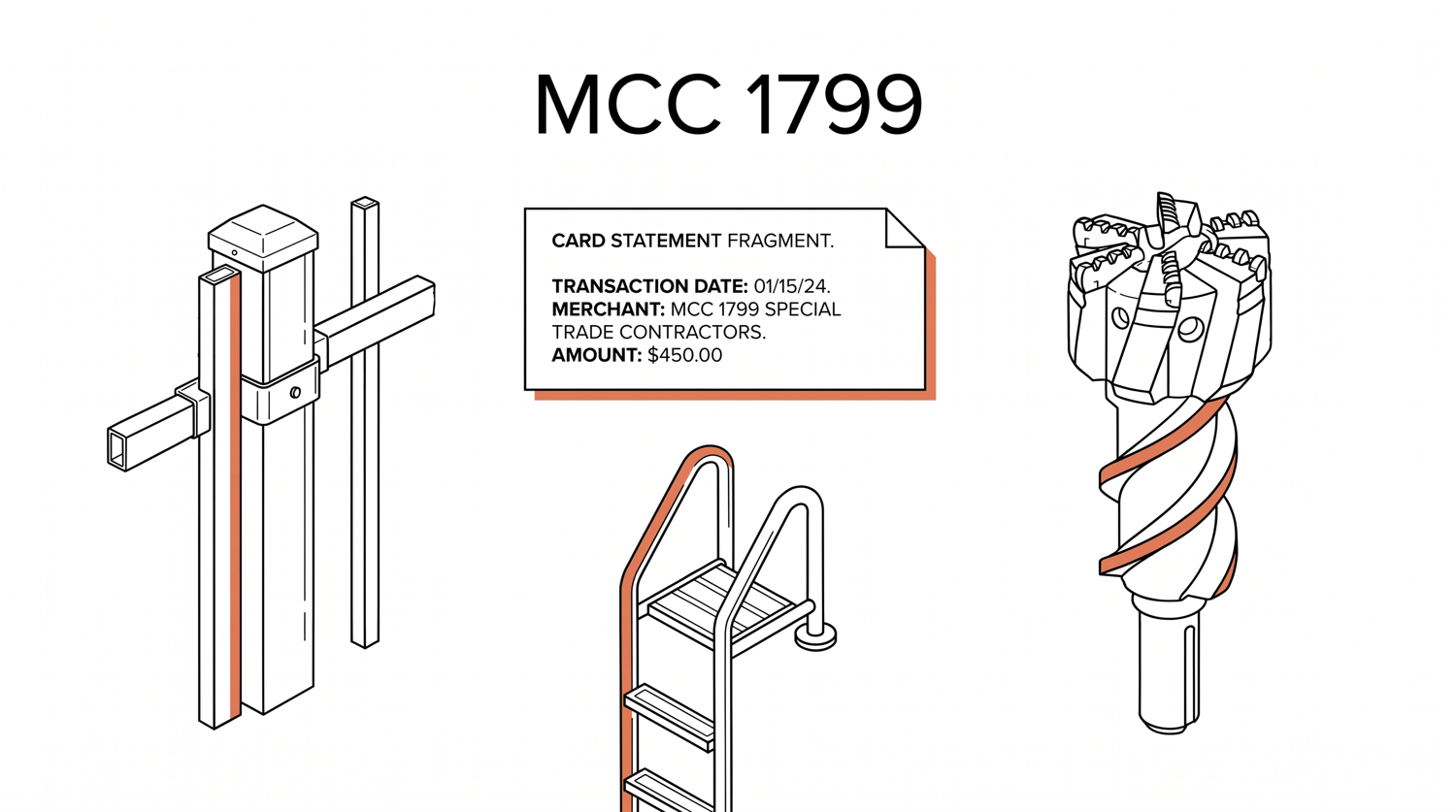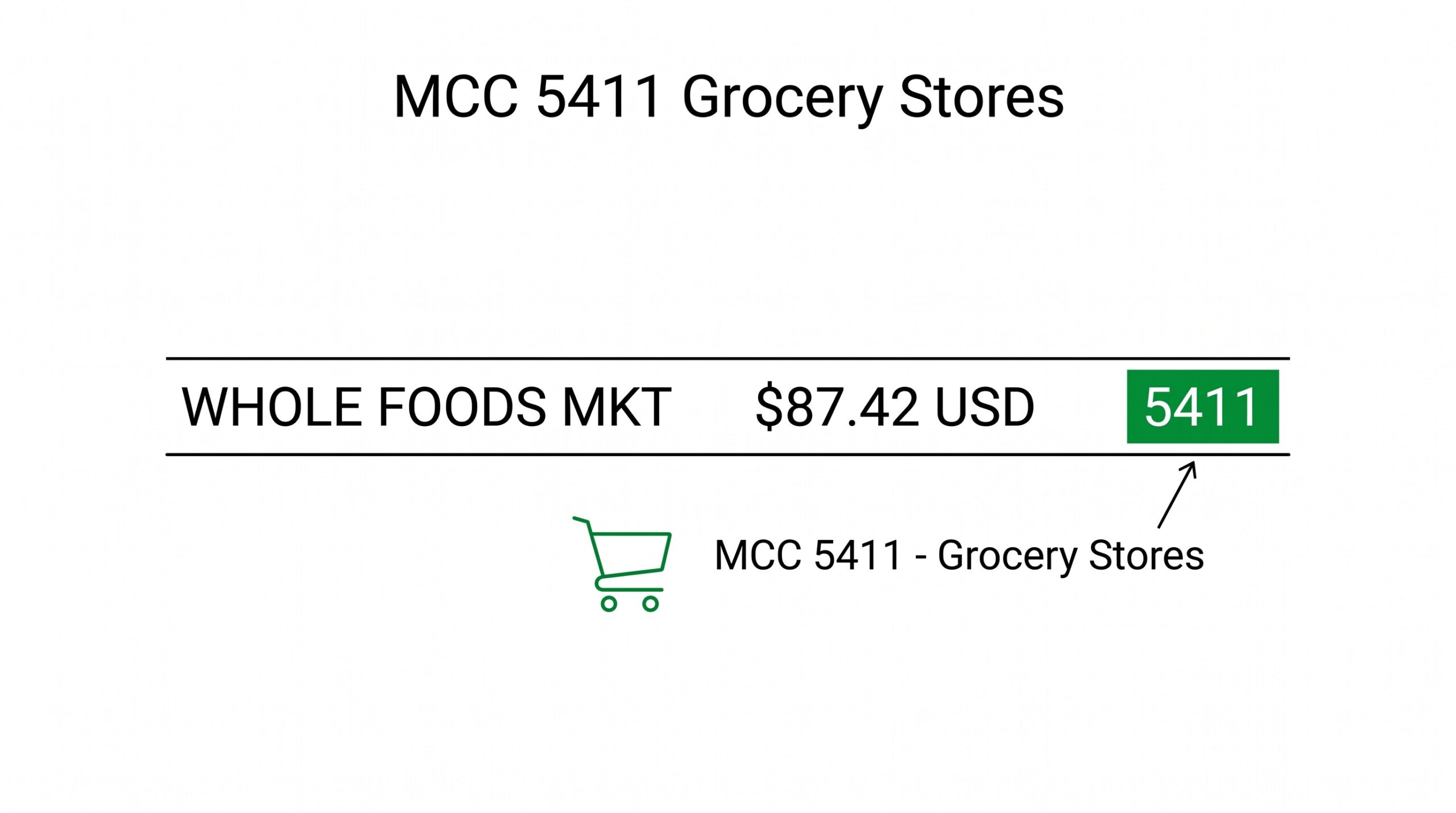

You are looking at your credit card statement in March. The first row shows “WHOLEFDS MKT #10234” for $87.42, and right next to the merchant name sits a small 4-digit code: 5411. Your bookkeeper said to “categorize by MCC,” and now you are staring at a code that nobody explained.
That 5411 is doing more work than it looks like, and the line between a “groceries” expense and a “meals” expense on your books often comes down to whether the merchant was classified as 5411 or something close to it.
MCC 5411 is the Merchant Category Code that card networks, including Visa, Mastercard, American Express, and Discover, assign to grocery stores and supermarkets. The code sits inside a four-digit numbering system called ISO 18245, which the International Organization for Standardization published to give every kind of merchant a consistent classification.
When you swipe your card at a participating grocery store, the merchant’s acquirer reports the MCC to the network, and the network passes that code along to your statement. The MCC is set by the merchant and its payment processor, not by you, and it is the same code on every transaction at that merchant regardless of what you actually bought.
If you are new to MCCs and want the full picture of how this system works across credit card statements, the MCC overview for credit card statements covers the broader framework. For the complete list of 50+ commonly searched codes, see the MCC reference page.
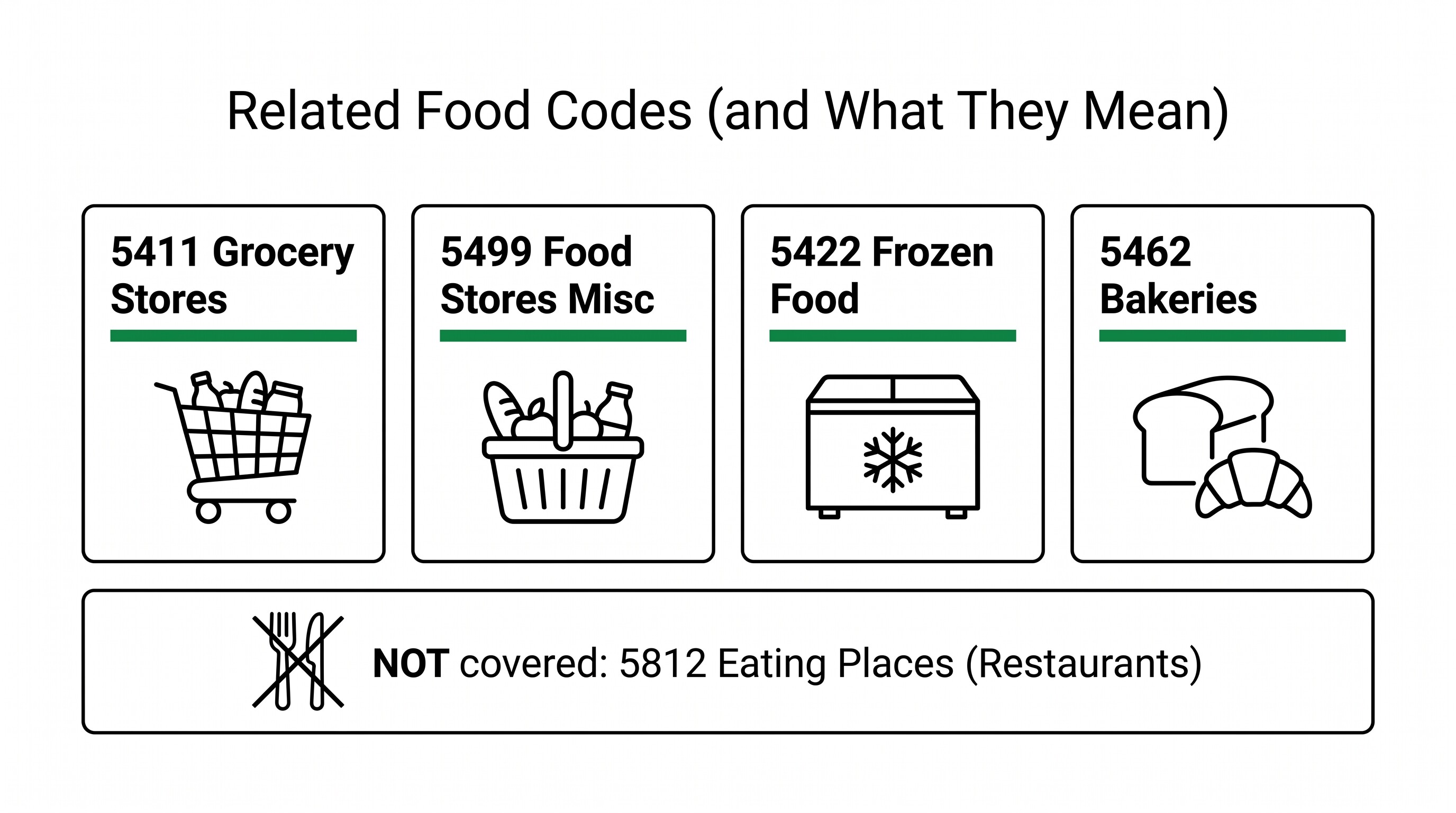
Quick Answers: MCC 5411 is the ISO 18245 code for grocery stores and supermarkets. It appears on credit card statements next to the merchant name. It typically covers supermarkets, grocery chains, and warehouse grocery stores like Costco’s grocery section. It does not cover restaurants (5812), specialty food markets (5499), bakeries (5462), or convenience stores (which often fall under 5499 in some networks).
What MCC 5411 Covers
The 5411 classification applies to businesses that primarily sell food, beverages, and household consumables for off-premises preparation and consumption. In plain terms: stores you walk into, fill a cart, and bring groceries home to cook. The card networks decide which merchants fall into this category when the merchant first signs up with its acquirer, and the merchant generally cannot pick a different code.
Common merchants that typically appear as 5411 include:
- Kroger, Ralphs, Harris Teeter, Fry’s, and other regional supermarket chains
- Whole Foods Market
- Walmart Supercenter (when buying groceries, though the merchant may be coded 5310 or 5399 in some networks)
- Costco (warehouse club with grocery focus)
- Safeway, Albertsons, Vons, Pavilions
- Publix
- HEB (Texas)
- Meijer (Midwest)
- Hy-Vee
- Giant, Stop & Shop, Hannaford (East Coast)
The classification depends on how the merchant registered with its acquirer. A standalone Walmart Neighborhood Market, for example, is more likely to be coded 5411 than a Walmart Supercenter, because the Supercenter sells a wider mix of groceries and general merchandise and may end up under a different MCC depending on the acquirer’s choice.
Warehouse club stores sit in a gray area. Costco is generally classified as 5411 by most card networks, but BJ’s and Sam’s Club sometimes appear as 5300 (Wholesale Clubs) or 5411 depending on the merchant’s acquirer and the dominant product mix. If you see a warehouse club charge and need to classify it for expense reporting, check the MCC rather than the merchant name alone.
The Difference Between 5411 and Related Food Codes
The MCC system has several codes that all touch food, and the differences between them matter for both bookkeeping accuracy and IRS reporting. Three codes in particular get confused with 5411 often enough to be worth distinguishing clearly.
MCC 5499 (Food Stores, Miscellaneous) covers specialty food markets that don’t fit the standard supermarket model. Think cheese shops, ethnic grocers, health food stores, gourmet markets, and farmers market vendors that accept credit cards. If you see 5499 on a statement, the merchant is selling food, but it isn’t a chain supermarket. For Schedule C, 5499 generally books the same way as 5411.
MCC 5422 (Frozen Food) is a narrower category covering merchants that primarily sell frozen meat, seafood, dairy, and prepared frozen meals. A store like BJs Wholesale Club’s freezer section or a specialty frozen foods distributor might show as 5422. This is rarely used on consumer statements, and many frozen food purchases still appear as 5411 because the merchant’s primary category is broader grocery.
MCC 5812 (Eating Places and Restaurants) is the one that creates the most accounting confusion. If you buy a hot rotisserie chicken from a grocery store deli counter and eat it at home, the merchant is still 5411 because you bought grocery food for home preparation.
If you sit down and eat a meal at the grocery store’s in-house cafe, the merchant may report that as 5812 instead. The classification follows the merchant’s primary business model, not what you actually did with the food.
For the broader MCC reference (all 50+ most-searched codes), see the complete MCC list with quick lookup table.
Turn That PDF Into a Spreadsheet in Minutes
You've seen how to do it manually — now let the tool handle the heavy lifting. Upload your bank statement and get Excel, CSV, or QBO in a few clicks.
Try It FreeHow MCC 5411 Maps to IRS Schedule C
For self-employed individuals filing Schedule C, MCC 5411 charges typically fall into one of three categories, and the right one depends on why you made the purchase. The MCC alone doesn’t tell you which line item to use. Your reason for buying does.
Supplies (Line 22) covers consumable items used in your trade or business. If you run a small daycare out of your home and buy snacks for the children in your care, that 5411 charge typically books to Supplies. If you run a consulting practice and stock your office kitchen with coffee and paper towels, the same rule applies.
Cost of Goods Sold (Line 4) applies when you buy groceries that you resell or use to produce a product. A small bakery buying flour, sugar, and eggs in bulk would book those charges here. A catering business purchasing ingredients for an event would also book to COGS, even if the merchant is coded 5411.
Meals (Line 24b, subject to 50% deduction limit) applies when you buy prepared food. The IRS treats most grocery purchases as Supplies rather than Meals because you are buying ingredients for home preparation, not a prepared meal at a restaurant. The 5411 MCC is generally a strong signal that the charge is NOT a deductible business meal, even if you ate the food at work.
The restaurant MCC 5812, by contrast, is the IRS-friendly signal for deductible meals.
The IRS does not publish a list mapping MCCs to Schedule C line items, so this is interpretive guidance rather than a hard rule. For tax preparation involving multiple 5411 charges, working with a CPA or tax professional is often worthwhile. The IRS Publication 552 recordkeeping guidance provides additional context on documenting these transactions.
For businesses tracking multiple expense categories from the same statement, categorizing bank transactions walks through how to apply MCC codes consistently across a month of charges, and the MCC 6011 ATM code covers another common confusion point.
What Most MCC References Miss About 5411
Most MCC reference pages list 5411 as “Grocery Stores” without explaining what merchants actually qualify under that classification. The card networks do not publish a definitive list of which businesses get 5411 versus a related code, and the classification is set by the merchant’s acquirer rather than the merchant itself.
This means a grocery store chain may be coded 5411 in one state and 5499 in another, depending on how each franchise registered.
The deeper issue is that the MCC system was designed for payment routing and risk assessment, not for consumer categorization. The networks chose 5411 because grocery transactions have predictable volume and low chargeback rates, which makes them attractive from a payment risk perspective. The consumer-facing categorization is a side effect rather than the primary purpose.
For an idea of how MCC codes work across statement formats, see the MCC overview for credit card statements with examples of how each MCC code appears on statements from Chase, Wells Fargo, Bank of America, and other major issuers.
Common 5411 Transaction Patterns on Bank Statements
How 5411 actually appears on a bank statement depends on the bank and the statement format. Credit card statements typically show the MCC as a small 4-digit number next to or below the merchant name. Bank account statements (debit cards, checking account transactions) generally do not show MCC at all, because MCC is a credit card network concept rather than a banking one.
On a typical Chase credit card statement, you might see:
03/15 WHOLEFDS MKT #10234 SEATTLE WA $87.42 5411
The 5411 appears at the end of the line, after the amount. On a Wells Fargo statement, the format is similar but the MCC may appear in a separate column when you view the statement online:
03/15 WHOLE FOODS MKT 10234 $87.42 MCC 5411
Bank of America statements put the MCC in the transaction detail view rather than the main transaction list. To see it, you typically need to click on the individual transaction or download the statement as a PDF and look at the detail page.
When you convert a bank statement PDF to CSV, the MCC label, when present in the source credit-card PDF, is one of the fields that often requiress explicit extraction because banks vary in where they place it.
Debit card transactions through a checking account do not show MCC because the debit card network does not report MCC to your bank statement in the same way.
If you are tracking expenses on a debit card and need the MCC, you would need to check the merchant’s classification through your bank’s transaction detail view, which may or may not show it depending on the bank.
For developers building tools that read statement files, the bank statement API for developers guide covers how MCC fields appear in different statement parsing libraries.
How MCC 5411 Affects Credit Card Rewards
MCC 5411 has a special status in many credit card rewards programs. Several major issuers, including American Express, Chase, and Bank of America, exclude 5411 from bonus category spending.
A grocery purchase at a 5411 merchant might earn 1 point per dollar on a card that otherwise offers 4 points per dollar on dining, because the issuer classifies grocery (5411) and restaurant (5812) as different categories.
For a household trying to maximize rewards, this distinction matters because grocery spending is often a major budget category. If your card earns 4x on dining and 1x on groceries, you would actually prefer to use a different card for grocery purchases if the card issuer has a general 1x or 2x rate that beats 1x on your main card.
The reverse also happens. Some cards specifically reward grocery spending with 4x or 5x points on 5411 purchases, recognizing that grocery is a recurring expense category for most households. Knowing which card earns what on 5411 transactions is the first step toward maximizing rewards on a budget.
When 5411 Should Be a Different Code
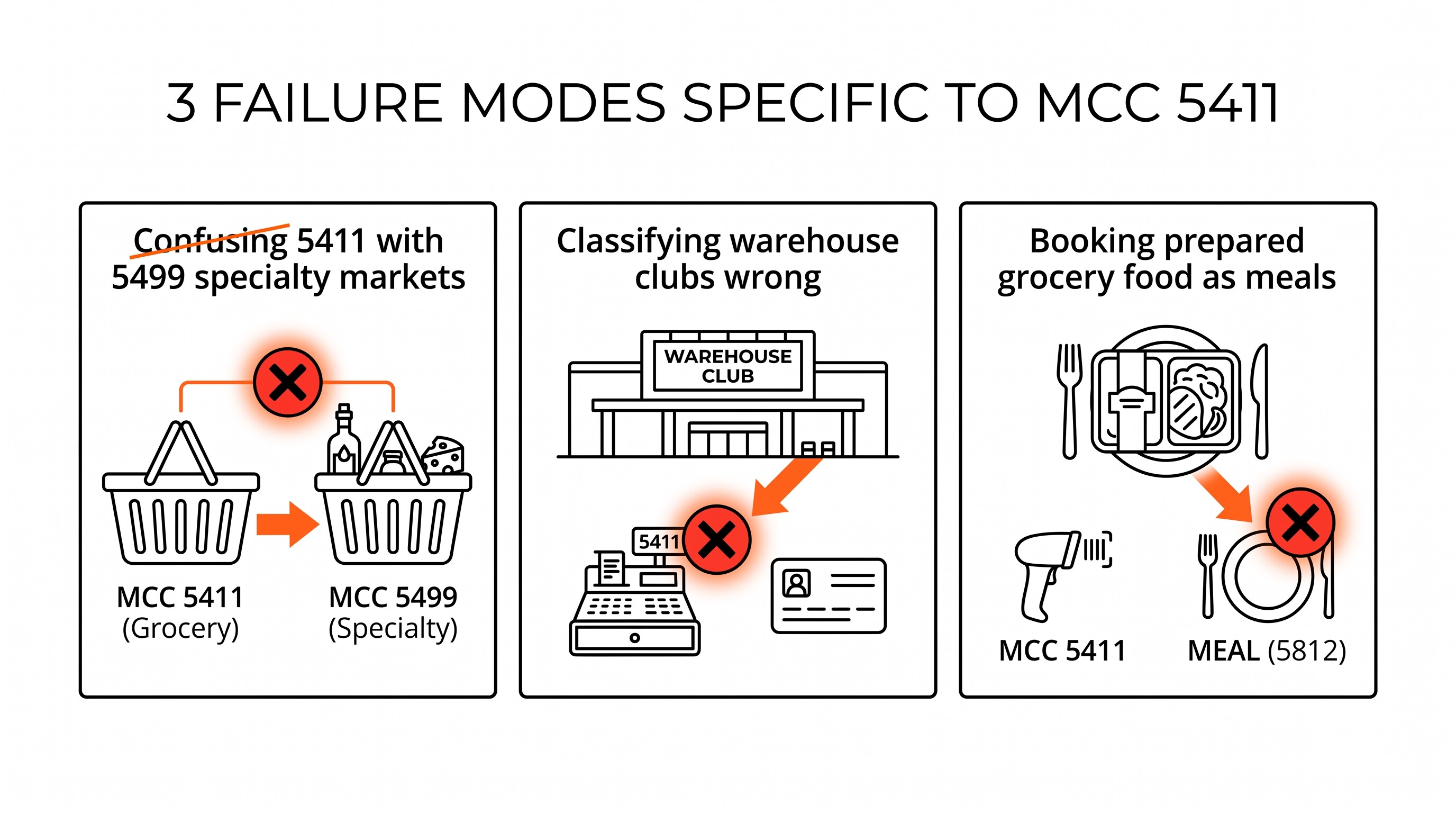
Merchants sometimes get classified in ways that don’t match what most consumers expect. Three cases are worth knowing about because they create expense categorization surprises.
Gas station with a grocery section. A gas station that sells snacks, drinks, and basic groceries will typically be classified as MCC 5541 (Service Stations) or 5542 (Automated Fuel Dispensers), not 5411. Even if you bought a sandwich and chips inside the station, the charge will be coded as a fuel merchant. This affects how businesses with fuel expense budgets categorize the charges.
Warehouse clubs with general merchandise. Costco and BJ’s sell everything from groceries to electronics to tires. The MCC depends on how the merchant registered with its acquirer. Costco typically appears as 5411, but BJ’s sometimes appears as 5300 (Wholesale Clubs). If your business tracks wholesale club purchases separately from grocery purchases, check the MCC before booking rather than relying on the merchant name.
Delivery-only grocery services. Instacart, DoorDash (grocery mode), and similar delivery services that pick up from grocery stores may appear as 5411 (if they pass through the merchant’s MCC) or as 5812 (if the delivery service is classified as a restaurant-style delivery). The classification depends on how the delivery service is structured and which MCC it reported to the network.
For IRS reporting, this distinction matters because a 5812 charge is more likely to qualify as a deductible meal than a 5411 charge.
For more on how MCC codes appear across statement formats, the PDF extraction workflow walks through reading these fields from real statement files.
If you have seen 5968 charges on your statement, that’s the dedicated code for subscription services, which often get billed to recurring cards alongside grocery purchases. Understanding the differences between these codes helps you categorize recurring vs one-time food expenses accurately on your books.
See also
For other food-related codes, see the common MCC codes reference with quick lookup for 50+ codes. For the cash equivalent codes that get confused with grocery and food purchases, the MCC 6051 quasi-cash guide covers the boundary between cash-equivalent and merchant purchases.
See also: MCC 5411 in context
This explainer is one of the merchant category code guides on the site. The consolidated overview of the entire MCC system, including every US card-network overlay, lives in the complete MCC guide. The full code-by-code reference is the complete MCC code reference.
For the broader reading on what every column on a US bank statement means, including the merchant description column where MCC appears, see the expanded bank statement anatomy.
Output format: which one matches the destination?
Picking the right output format is a separate decision from picking the right converter.
XLSX for human spreadsheet review. CSV for downstream scripts and tools. Google Sheets-compatible for shared cloud review. QBO for QuickBooks.
The four canonical columns are preserved across every format. What differs is how the downstream consumer expects the rows.
For a side-by-side rule of thumb that maps destination to format, see the decision framework on the output format pillar.
Read the full output format decision framework
Turn That PDF Into a Spreadsheet in Minutes
You've seen how to do it manually — now let the tool handle the heavy lifting. Upload your bank statement and get Excel, CSV, or QBO in a few clicks.
Try It Free