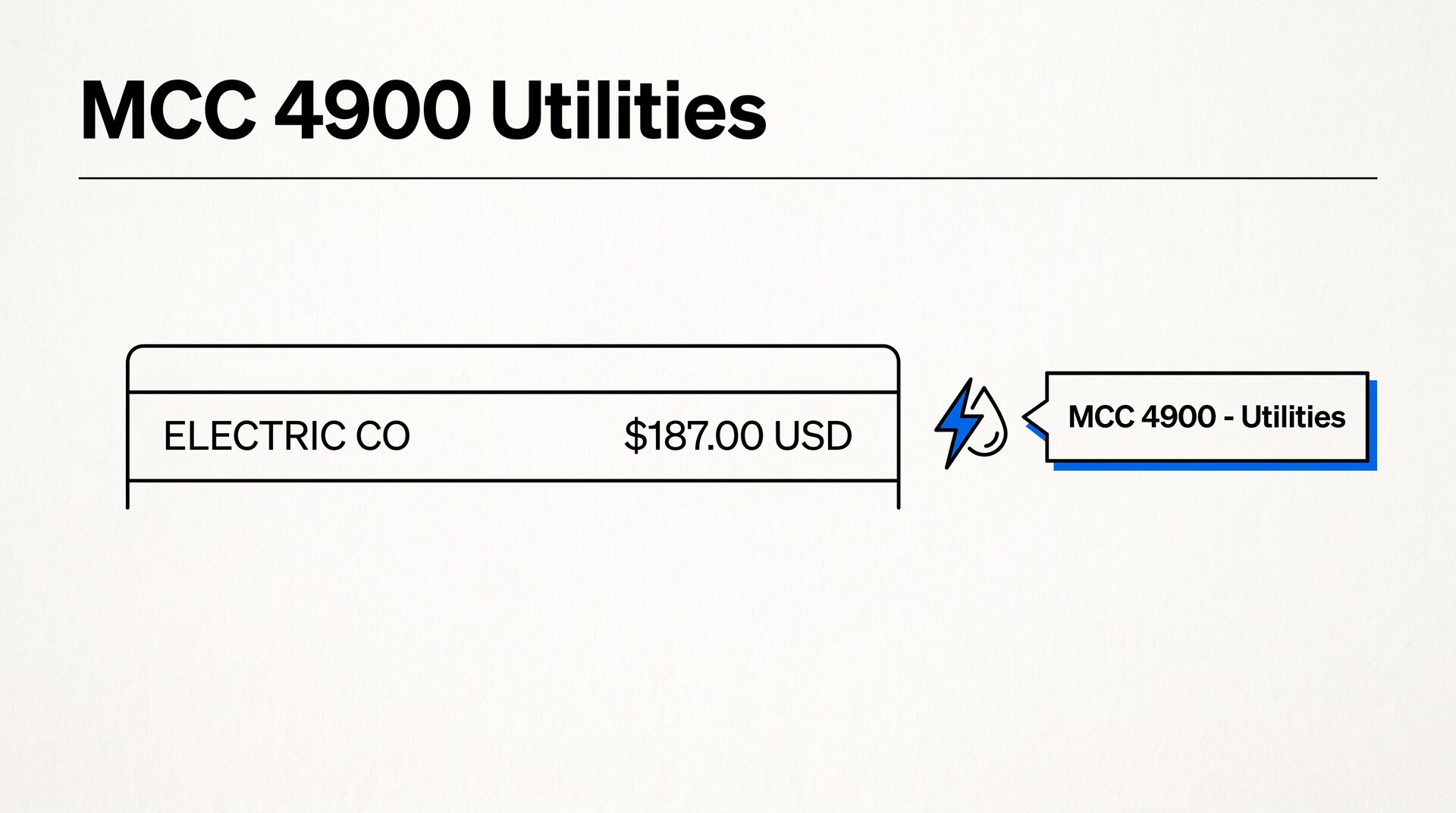

You saw “MCC 4900” on your credit card statement next to a $187 charge from a utility company. You thought it was a single utility bill. Your card rewards rate shows 1x points. The merchant is actually an electric utility, not a phone company or internet provider.
This article explains what MCC 4900 covers, what it does NOT cover (internet, mobile, cable all have different codes), and how the code affects rewards rates and landlord reimbursement tracking.
Quick Answers: MCC 4900 covers traditional utilities only: electric, gas, water, and sanitary. Internet, mobile, and cable are NOT in this category (they have codes 4814, 4816, 4899). Utility bills appear on predictable cycles, useful for fraud detection.
The MCC code determines the rewards rate on your credit card, so a 4900 charge on a 1x utility card gives less rewards than the same merchant would give on a 2x everything card.
What MCC 4900 covers
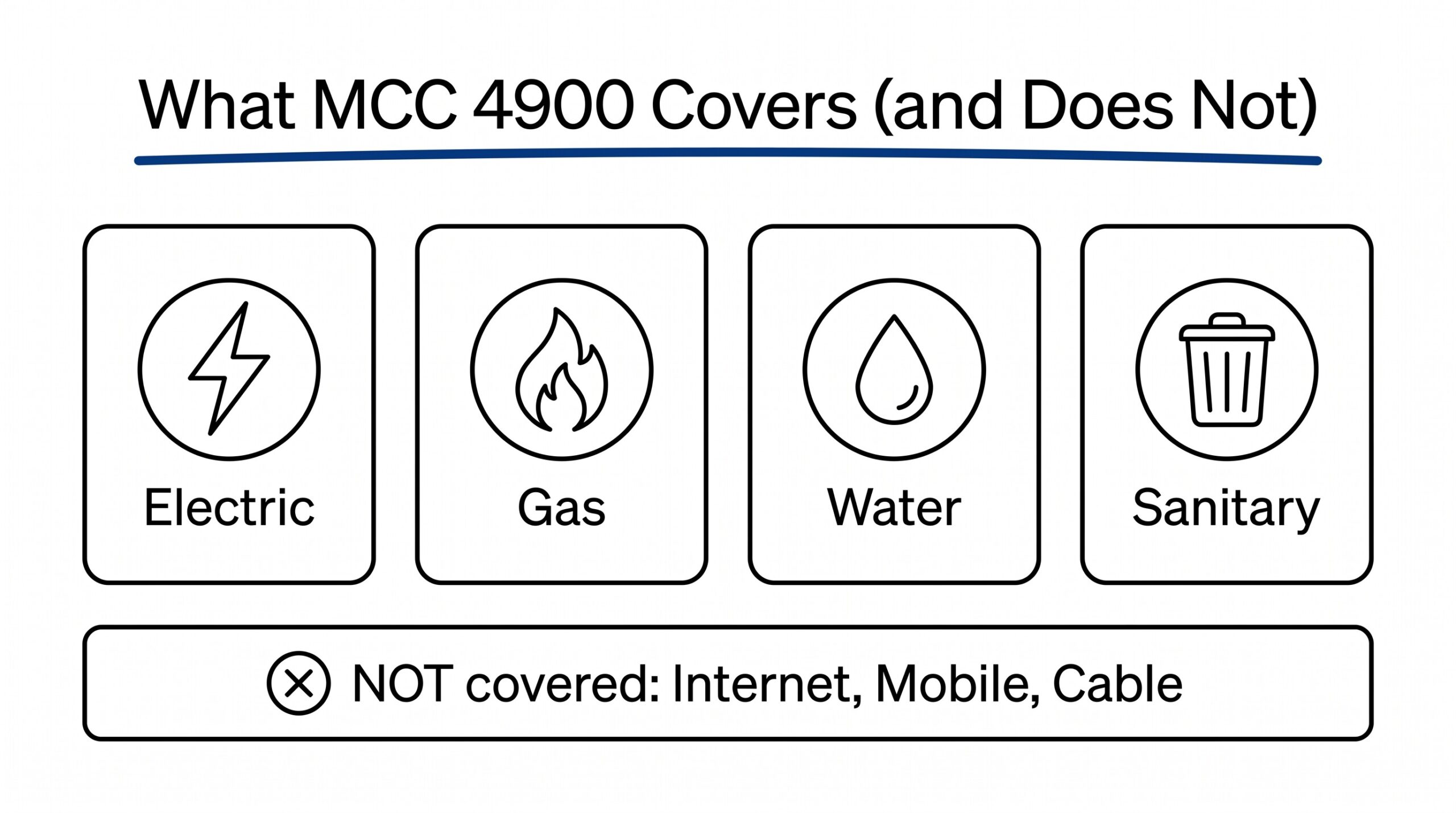
MCC 4900 is the merchant category code for Utilities. The category covers the four traditional regulated utility services that get billed to homes and businesses: electric, gas, water, and sanitary (sewer and waste).
The category was created before broadband internet became a utility-like service. The current codes for related services are:
- MCC 4900: Utilities (electric, gas, water, sanitary)
- MCC 4814: Telecommunication services (landline phone, mobile phone)
- MCC 4816: Computer network and information services (internet, cloud)
- MCC 4899: Cable, satellite, and pay television
If your internet bill posts to your credit card, it is coded under MCC 4816, not MCC 4900. If your mobile phone bill posts, it is MCC 4814. The distinction matters for rewards rates because some cards treat utilities (MCC 4900) differently from internet and phone charges.
Why MCC 4900 appears on predictable dates
Utility companies bill on fixed monthly or bi-monthly cycles. The same dollar amount (or close to it) posts to your card on the same date each month, with seasonal variation for electric (higher in summer for AC, higher in winter for gas heat) and water (higher in summer for irrigation).
This predictability is useful for fraud detection. If you have a $187 charge from your electric utility on the 15th of every month, and a $1,200 charge appears on the 3rd of the month from the same MCC 4900 merchant, the $1,200 is either a billing error or unauthorized use. The predictable cycle makes the unusual amount obvious.
For personal finance tracking, the predictable cycle also means you can estimate your utility expenses for the year by multiplying one month by 12 (with seasonal adjustment). This is useful for budgeting and for tax deductions if you work from home.
Turn any PDF statement into a clean sheet
Skip the typos and the hours of copying. Our converter handles any bank statement format and outputs Excel, CSV, or QBO for QuickBooks. No file retention, free to try.
Convert your statementHow MCC 4900 affects credit card rewards
Most credit cards give 1x points on utility payments. Some cards give higher rewards (2x to 5x) on specific categories like dining or travel, with utilities excluded or given the base 1x rate. A few cards specifically include utilities in their bonus categories.
Chase Sapphire Reserve: 1x on utilities (base rate, not bonus)
Amex Gold Card: 1x on utilities (base rate, not the 4x dining or 4x grocery bonus)
Citi Custom Cash: 5x on your selected bonus category (which could be utilities if you select it), otherwise 1x
Capital One Venture X: 2x miles on all purchases including utilities
Bank of America Customized Cash: 3x on your selected category (which could be utilities), otherwise 1x
If you want to maximize rewards on utility payments, choose a card where utilities are in the bonus category or where everything is 2x+. The MCC code determines which rate applies, so a charge that happens to be coded differently could get the wrong rewards rate.
MCC 4900 for landlords
For landlords who pay utilities on behalf of tenants (sub-metered water, common-area electricity, trash collection), MCC 4900 charges have a specific accounting treatment.
Utility payments for tenant spaces are pass-through expenses. The landlord pays the bill (the MCC 4900 charge on the credit card), bills the tenant for reimbursement, and records both transactions in the books. The tenant reimbursement is other income on Schedule E. The utility payment is neither income nor expense to the landlord, it is a receivable that gets collected.
To track this correctly, the landlord tags MCC 4900 charges separately from other business expenses. A typical setup uses two categories in the chart of accounts: Utility Reimbursement Receivable (for the original charge) and Tenant Utility Reimbursement (for the collection).
The business statement conversion workflow can tag MCC 4900 charges with the Utility Reimbursement category automatically if the converter preserves the MCC label inline within the merchant description.
For landlords who use property management software (Buildium, AppFolio, RentRedi), the software expects utility pass-throughs to be tagged separately so the year-end owner statement can show the net rental income accurately. Miscoding MCC 4900 charges as general expenses inflates the expense side and understates the net rental income.
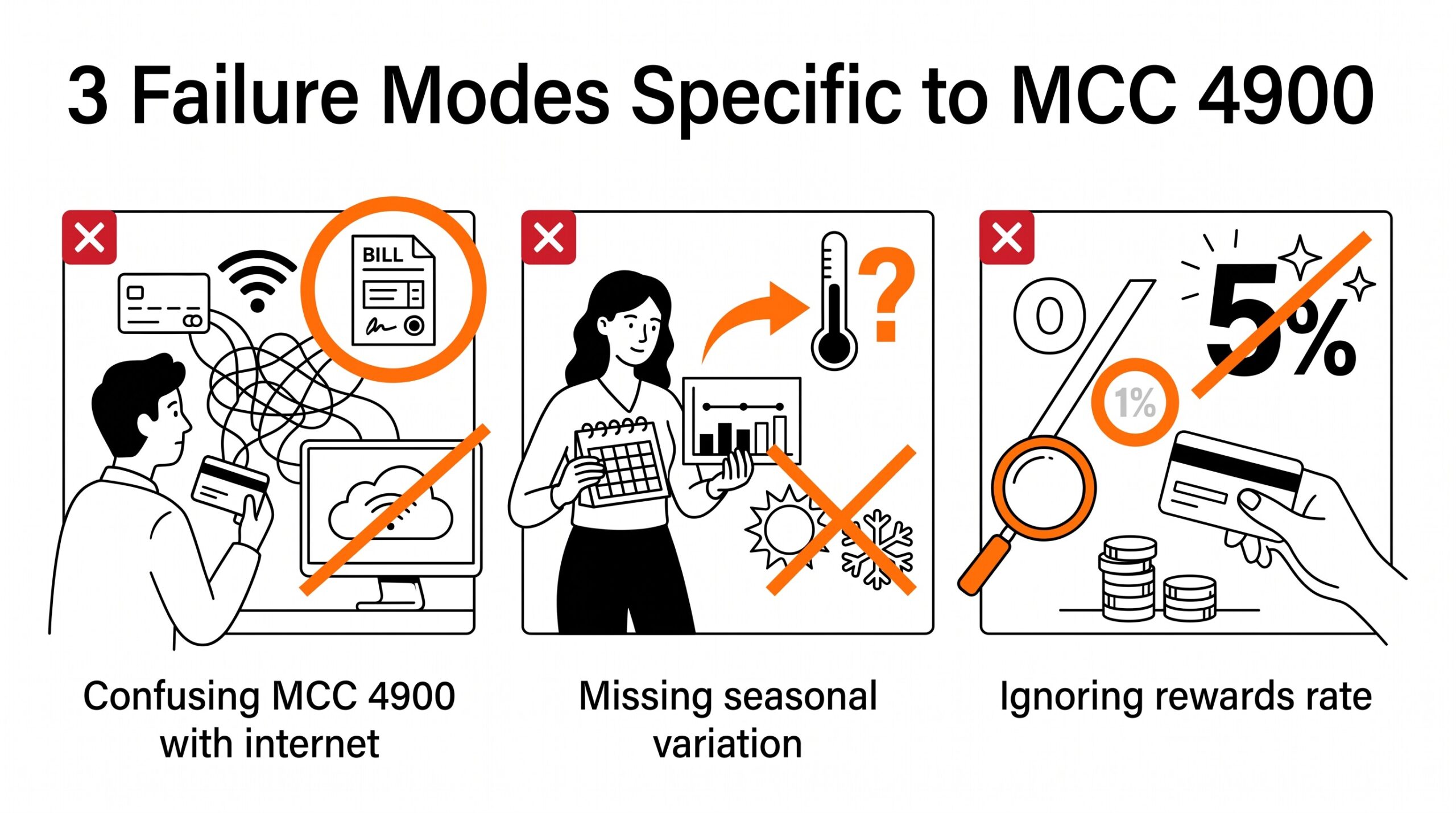
3 failure modes specific to MCC 4900
Failure 1: Confusing MCC 4900 with internet or mobile bills
A common mistake cardholders make is assuming that all their utility-type bills are coded MCC 4900. Internet, mobile, and cable are NOT in this category. If you are tracking expenses by MCC and you lump internet into MCC 4900, your utility total will be inflated and your internet total will be missing.
The fix is to verify the MCC code on each recurring bill and tag each one correctly.
How to verify: log into your credit card account, find the charge, and look at the posted MCC. Most card issuer websites show the MCC code under the merchant detail on each transaction. Some mobile apps require clicking through to the transaction detail.
Failure 2: Missing seasonal variation in expense estimates
Another common mistake is multiplying one month of utility bills by 12 to estimate the annual total. Electric bills vary by season: summer AC and winter heat can double the monthly average. Water bills vary by season too. A flat 12x multiplication underestimates the annual utility expense for most US households.
The fix: use the trailing 12 month total from your credit card or bank statement rather than a flat 12x estimate. The actual annual total accounts for seasonal variation and any one-time charges (move-in fees, equipment rentals).
Failure 3: Ignoring MCC 4900 in rewards optimization
A third mistake is paying utilities on a card with low rewards and not realizing the MCC code determines which rate you get. If you have a card that gives 5x on utilities and you are paying utilities on a card that gives 1x on utilities, you are leaving rewards on the table.
Switch the payment method to the higher rewards card if the merchant accepts it. Most utility companies do accept credit cards.
For tenant reimbursement accounting, the rental application bank statement guide covers the pass-through expense treatment. For the landlord accounting context, the business statement conversion guide covers the chart of accounts setup.
What most MCC references miss
Most merchant category code references list MCC 4900 with a one-line description: “Utilities Electric, Gas, Water, Sanitary.” They do not explain that the category predates broadband and therefore excludes internet and mobile. They do not explain the rewards rate implication. They do not explain the landlord reimbursement use case.
A cardholder looking up MCC 4900 deserves to know that the category covers traditional utilities only, that the charges appear on predictable cycles (useful for fraud detection), and that the rewards rate depends on the card. A landlord looking up MCC 4900 deserves to know the pass-through accounting treatment and how to tag the charges correctly in the books.
How utility billing cycles vary by region and season
Utility billing cycles vary significantly by geography and climate. Northern states have winter-peaking electric bills (gas heat supplement). Southern states have summer-peaking bills (AC). Western states with irrigation have summer-peaking water bills. Tropical states have year-round high electric use.
The billing cycle also varies by company: some bill on the same date each month (predictable), others bill based on meter read dates which shift each month (variable). For a household or business budget, the trailing 12 month actual is more accurate than any flat 12x estimate.
MCC 4900 versus utility subsidy and assistance programs
Some utility companies offer subsidy or assistance programs for low income households. The subsidy reduces the amount billed. On the credit card statement, the subsidy appears as a separate credit line (negative amount) under MCC 4900, not as a reduced charge. For accounting purposes, the subsidy is not income to the household.
For businesses receiving utility subsidies (rare, but possible for nonprofits or rural cooperatives), the subsidy is grant income, not utility expense. The MCC code does not distinguish subsidy from regular charges, so the categorization step must happen in the chart of accounts.
Related conversions and references for context: bank statement glossary.
For the complete list of merchant category codes, the common MCC codes reference list covers the most frequently seen codes. For the cable and internet utility category, the MCC 4814 telecommunications guide covers the related codes that are NOT in MCC 4900.
For the full list of every merchant category code from 3000 to 9999, the MCC code reference covers the lookup by industry.
See also
The merchant category code overview covers the full 4-digit code system and how codes are assigned. For the related internet and phone categories, the MCC 4814 telecommunication services guide covers phone bills and the MCC 5968 direct marketing guide covers subscription charges. For the landlord accounting context, the business statement conversion workflow covers the chart of accounts setup for tracking utility reimbursements.
See also: MCC 4900 in context
This explainer is one of the merchant category code guides on the site. The consolidated overview of the entire MCC system, including every US card-network overlay, lives in the complete MCC guide. The full code-by-code reference is the complete MCC code reference.
For the broader reading on what every column on a US bank statement means, including the merchant description column where MCC appears, see the expanded bank statement anatomy.
Output format: which one matches the destination?
Picking the right output format is a separate decision from picking the right converter.
XLSX for human spreadsheet review. CSV for downstream scripts and tools. Google Sheets-compatible for shared cloud review. QBO for QuickBooks.
The four canonical columns are preserved across every format. What differs is how the downstream consumer expects the rows.
For a side-by-side rule of thumb that maps destination to format, see the decision framework on the output format pillar.
Read the full output format decision framework
Turn any PDF statement into a clean sheet
Skip the typos and the hours of copying. Our converter handles any bank statement format and outputs Excel, CSV, or QBO for QuickBooks. No file retention, free to try.
Convert your statement