
You are setting up direct deposit for your five employees through your bank’s ACH payment system.
Before choosing the SEC code, it helps to understand the broader bank statement terminology, the full ACH SEC codes reference covering all 9 codes (this page focuses specifically on CCD vs PPD), and the ACH vs Wire speed comparison that often drives whether ACH is even the right payment method for your use case.
You walk into your bank’s ACH payment system to set up direct deposit for your employees. The form asks which Standard Entry Class (SEC) code to use. Your payroll software offers CCD and PPD as the two options. You have heard of both but never understood the difference, and the form does not explain it beyond a sentence each.
Picking the wrong one means rejected payments, returned fees, or worse, transactions that go through but show up wrong on the recipient’s statement. The choice between CCD and PPD is not a technicality. It is a regulatory distinction that determines who is on the transaction and how the ACH network treats it.
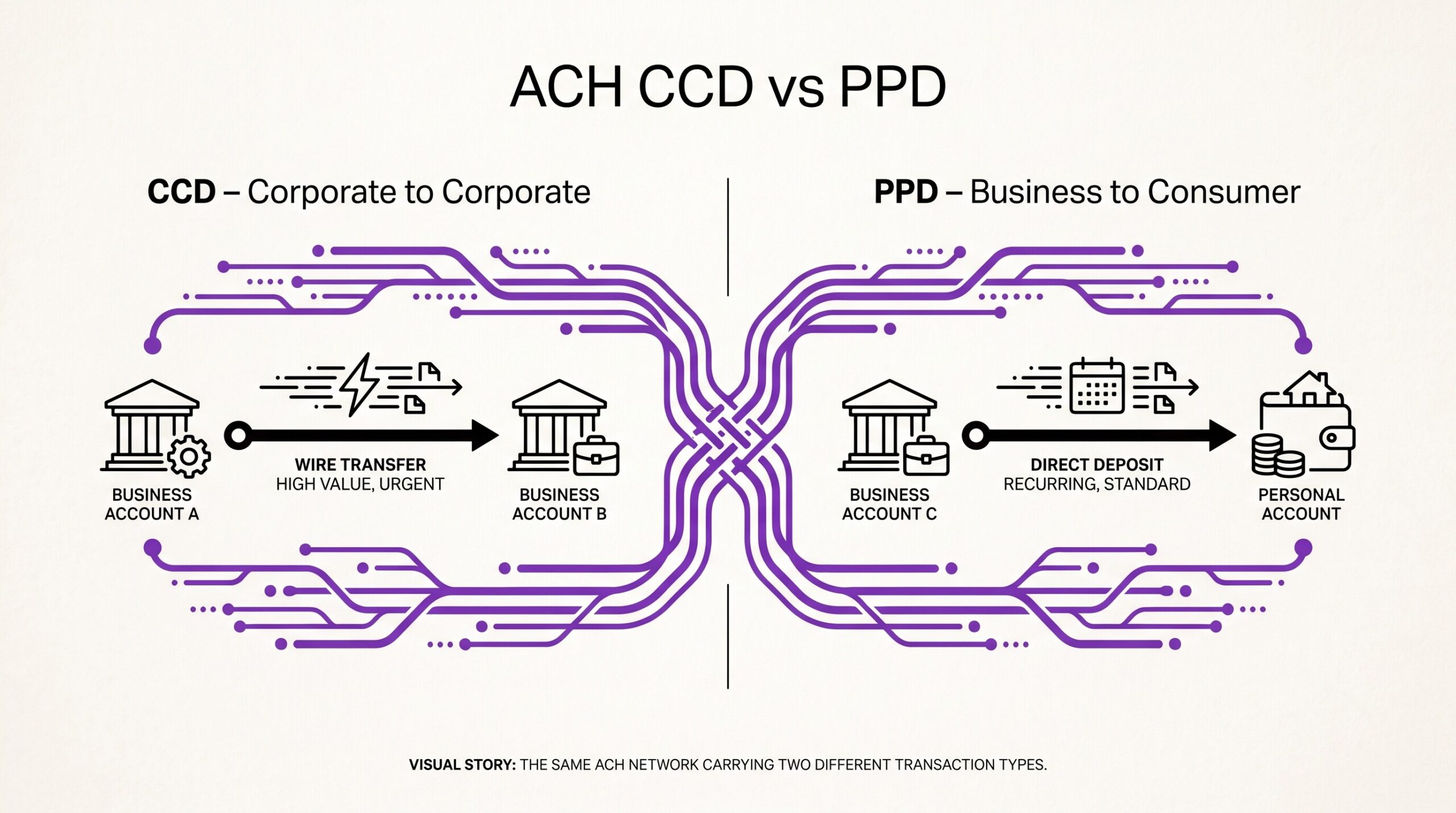
CCD and PPD are both Standard Entry Class codes, the SEC codes that NACHA (the National Automated Clearing House Association, which governs the ACH network) uses to classify every ACH transaction. The difference comes down to who is on each side of the transaction. CCD stands for Corporate Credit or Debit and is used for transactions between two business entities.
PPD stands for Prearranged Payment and Deposit and is used for transactions between a business and a consumer. That distinction drives everything else: the addenda record format, the authorization process, the way the transaction appears on a bank statement, and the SEC code that appears in the originator’s records.
Quick Answers: CCD (Corporate Credit or Debit) is the ACH SEC code for transactions between two businesses, typically B2B vendor payments, business-to-business collections, and corporate disbursements. PPD (Prearranged Payment and Deposit) is for transactions between a business and a consumer, typically direct deposit payroll, consumer bill payments, and recurring debits from a customer’s account. The same dollar amount and the same ACH network, but the legal and regulatory treatment is different.
What Each Code Actually Means
CCD, Corporate Credit or Debit, is the ACH code for transactions where both the originator (the party initiating the ACH) and the recipient (the receiver) are businesses or organizational entities. The originator holds the funds in a business account, and the recipient receives them into a business account.
Examples include a small business paying a vendor invoice, a SaaS company collecting monthly subscription fees from another company, or a holding company distributing funds to a subsidiary.
PPD, Prearranged Payment and Deposit, is the ACH code for transactions where one side is a business and the other side is a consumer (an individual person). The originator is typically a business, but the recipient is a person.
Examples include employer direct deposit of payroll into an employee’s personal checking account, a utility company debiting a customer’s monthly bill, or a gym collecting recurring membership fees from a member.
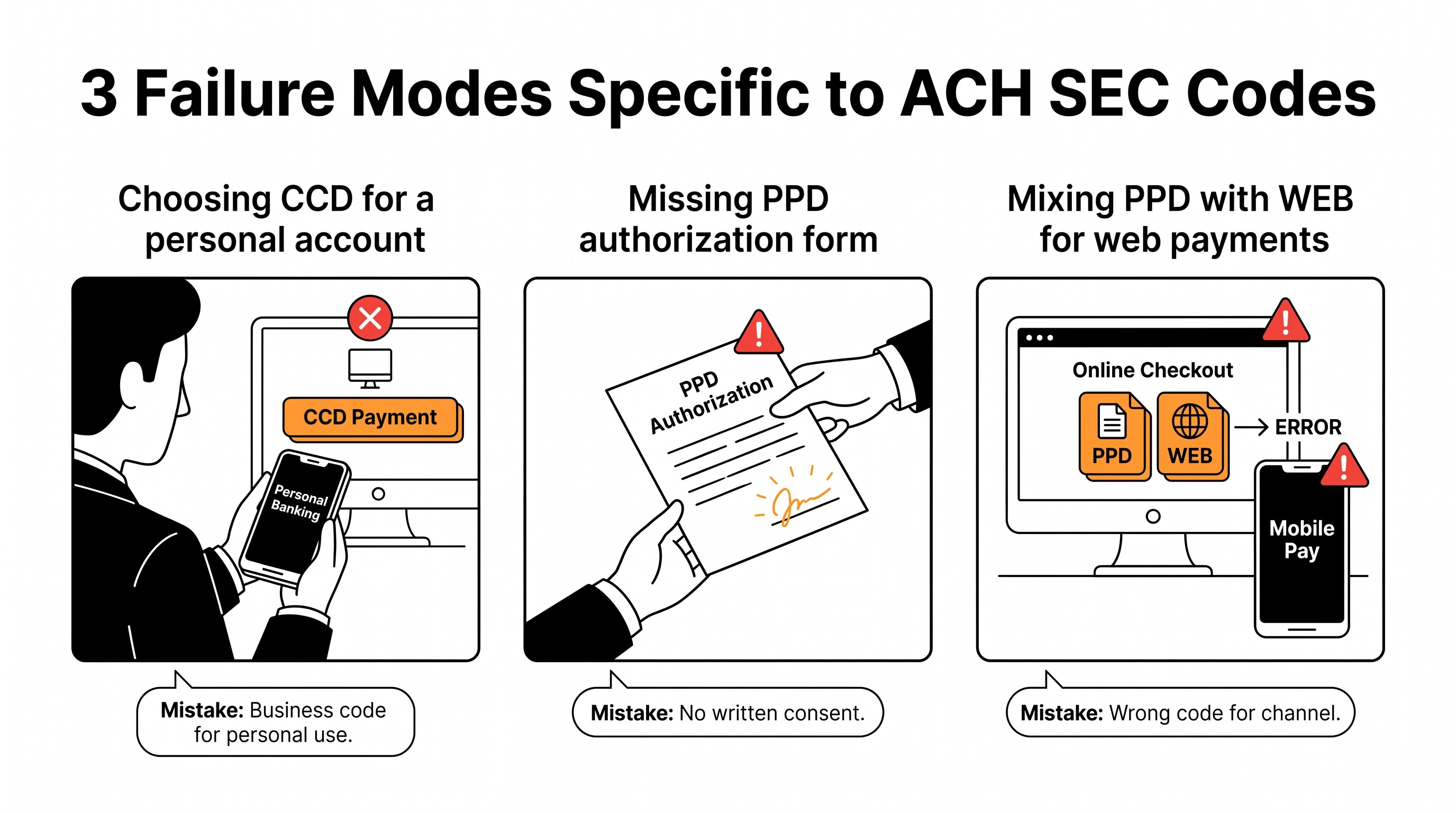
The “Prearranged” in PPD refers to the authorization requirement. PPD transactions require prearrangement between the originator and the receiver, typically documented through a signed authorization form. The authorization may be for a single transaction or for recurring transactions (like monthly bill pay). Without this authorization, the PPD transaction is not valid under NACHA rules.
CCD transactions do not require explicit prearrangement authorization in the same way. CCD is governed by an agreement between two businesses, and the legal contract between them typically covers the payment terms. The authorization is implicit in the contract rather than explicit in a separate form.
When to Choose CCD
Use CCD when both sides of the ACH transaction are businesses or organizational entities. The clearest indicators are:
Both accounts are business accounts. The originating account is a business checking account at your bank, and the receiving account is a business checking account at the vendor’s bank. Personal accounts on either side make the transaction PPD or another code instead.
The transaction is for goods or services between companies. A B2B invoice payment, a wholesale order settlement, a SaaS subscription between two companies, or a contractor payment where the contractor operates as an LLC or corporation (with a business account) all typically use CCD.
The transaction involves a corporate entity, nonprofit, or government agency. Payments from one corporation to another, grants from a foundation to a nonprofit, or tax payments from a business to a government agency are typically CCD, regardless of whether they recur.
CCD also supports addenda records, which allow the transaction to carry additional structured information beyond the basic amount and routing. A CCD transaction can include an invoice number, a customer reference, or other data that the recipient’s accounting system can parse automatically. This makes CCD valuable for B2B workflows where reconciliation matters.
For a deeper comparison of payment methods beyond ACH, the what is ACH vs Wire overview covers the cost and speed trade-offs that often drive the choice between ACH and wire for B2B payments.
For businesses processing large volumes of B2B payments, the CCD format reduces reconciliation friction because both sides can automate the matching of incoming payments to open invoices. The ACH vs Wire comparison covers the broader decision of when ACH makes sense versus a wire transfer for these B2B payments.
Turn any PDF statement into a clean sheet
Skip the typos and the hours of copying. Our converter handles any bank statement format and outputs Excel, CSV, or QBO for QuickBooks. No file retention, free to try.
Convert your statementWhen to Choose PPD
Use PPD when one side of the ACH transaction is a consumer (an individual person). The clearest indicators are:
The receiving account is a personal checking or savings account. Direct deposit of payroll, Social Security benefits, tax refunds, and pension payments all use PPD because the receiving account is a personal account, not a business one.
The transaction is a recurring bill payment from a consumer. Utility bills, gym memberships, subscription services, insurance premiums, and loan payments that come out of a customer’s personal account each month are typically PPD. The consumer signed an authorization form, and the business debits the personal account on a recurring schedule.
The transaction is a one-time payment from a personal account. A customer paying an invoice from their personal checking account, a person donating to a charity, or a borrower making a loan payment from a personal account all use PPD.
PPD also requires the originator to retain a written authorization from the receiver for at least two years after the last transaction. This authorization must include specific language required by NACHA, including the account to be debited, the amount or frequency, the consumer’s right to revoke, and the consumer’s right to receive a refund for an unauthorized debit.
Without this authorization on file, the PPD transaction violates NACHA rules, and the originator bears the loss if the transaction is disputed.
For businesses managing recurring consumer payments, the wire vs ACH decision guide covers the broader question of when to use ACH at all versus a wire transfer, which often comes up alongside the SEC code selection.
How CCD and PPD Appear on Bank Statements
Both CCD and PPD transactions appear on the receiving party’s bank statement as ACH credits or debits, but the SEC code itself typically shows in the originator’s records and the bank’s transaction detail rather than on the customer’s printed statement. For most consumer bank statements, the difference between CCD and PPD is invisible at the statement level.
What shows up is the originator’s name, the amount, and possibly a transaction description like “DIRECT DEPOSIT” or “ACH DEBIT.”
For businesses reconciling ACH transactions, the SEC code matters because it determines how the transaction should be categorized. A CCD credit from a known vendor matches an open invoice. A PPD credit from a customer’s personal account is a bill payment. The codes help accounting software apply the right label automatically.
On a payroll example, an employee’s direct deposit shows on their personal bank statement as something like “ACME PAYROLL DIRECT DEP” with the amount credited. The SEC code PPD does not appear in the printed statement, but it does appear in the ACH file that the employer’s bank processes.
The employer’s payroll software reads the PPD code to confirm that the transaction was processed as a consumer-direct deposit and not as a business transfer. For developers building reconciliation tools, the bank statement API for developers guide covers how to parse these fields from raw ACH files.
For businesses reconciling multiple incoming ACH payments, the bank statement glossary covers the terminology used in ACH files and how the various fields map to standard reconciliation practices.
The Other SEC Codes You May Encounter
CCD and PPD are the two most common SEC codes for everyday business, but NACHA defines several others, each for specific transaction patterns. Knowing when they apply helps you avoid picking the wrong code.
CTX (Corporate Trade Exchange) is similar to CCD but designed for B2B payments that need to carry remittance data with multiple invoices or line items. CTX supports up to 9,999 addenda records, which makes it useful for complex payments like a manufacturer paying a distributor for multiple SKUs at once. Most small businesses do not need CTX because CCD covers their simpler B2B scenarios.
WEB (Web-Initiated Entry) is for ACH transactions initiated through a web browser, typically by a consumer authorizing a one-time or recurring payment from their personal account. Online bill pay through your bank’s website, donation forms on a charity’s website, and e-commerce checkout payments that pull from a checking account all use WEB.
WEB requires the originator to authenticate the consumer through a commercially reasonable method, including verifying the routing and account number, obtaining a signed authorization, and using a fraud detection system.
TEL (Telephone-Initiated Entry) is for ACH transactions initiated over the phone, typically a consumer calling a business to authorize a payment from their personal account. TEL has stricter authentication requirements than WEB because the phone channel is harder to verify. Most consumer-facing businesses now prefer WEB over TEL because the web channel provides better audit trails and lower dispute rates.
RCK (Re-Presented Check Entry) is for converting a bounced paper check into an electronic ACH debit. When a customer writes you a check that bounces, you can use RCK to re-present the check electronically through the ACH network rather than going through the paper collection process.
RCK has specific eligibility requirements, including the original check must have been under $2,500 and must have been presented to the bank within the last 90 days.
PPD vs WEB vs TEL all touch consumer transactions, and the right code depends on how the authorization was obtained. PPD is for prearranged recurring payments where the consumer signed a separate authorization form. WEB is for one-time or recurring payments authorized through a web interface. TEL is for one-time or recurring payments authorized over the phone.
If your authorization is prearranged and recurring, PPD is typically the right choice.
What About the Independent Contractor Payment
The independent contractor payment is the gray area where CCD vs PPD gets confusing. A small business paying a contractor whose business entity is a sole proprietorship with a personal bank account (not a separate business account) typically uses PPD because the receiving account is personal. The same small business paying an LLC contractor with a dedicated business bank account typically uses CCD.
Most ACH origination platforms let the sender specify the SEC code regardless of the underlying account type, which means the choice comes down to legal and accounting practice rather than technical capability. A sole proprietor who receives payments into a personal account should be paid with PPD because that matches the SEC code’s intent: business-to-consumer.
An LLC contractor who receives payments into a business account should be paid with CCD because that matches the business-to-business intent.
If you are unsure which side of the line your contractor falls on, the simplest test is: does the contractor have a separate EIN or business tax ID, and do they have a business bank account? If yes, they likely fit CCD. If they operate under their personal SSN and use their personal bank account, they fit PPD.
ACH SEC Codes in Payroll Software
Most payroll software platforms (Gusto, ADP, Paychex, QuickBooks Payroll) handle the CCD vs PPD distinction automatically. The platform knows whether a payment is going to a business account or a personal account based on the recipient record, and it sets the SEC code accordingly. An employer running payroll does not typically need to choose between CCD and PPD manually because the software does it.
The exception is when the same employer makes payments to vendors (CCD) and employees (PPD) through the same ACH origination system. The employer’s bank or ACH processor must be configured to support both SEC codes, and the employer must specify the right code at the transaction level.
Most ACH origination platforms (Modern Treasury, Plaid ACH, even direct bank ACH APIs) expose the SEC code as a parameter, but they typically default to PPD unless told otherwise.
For a deeper comparison of payment methods beyond ACH, the what is ACH vs Wire overview covers the cost and speed trade-offs that often drive the choice between ACH and wire for B2B payments.
For developers integrating ACH payments programmatically, the bank statement API for developers guide covers how ACH fields appear in parsed bank statement data and how the SEC code shows up alongside the originator name and amount.
Decision Framework: CCD or PPD
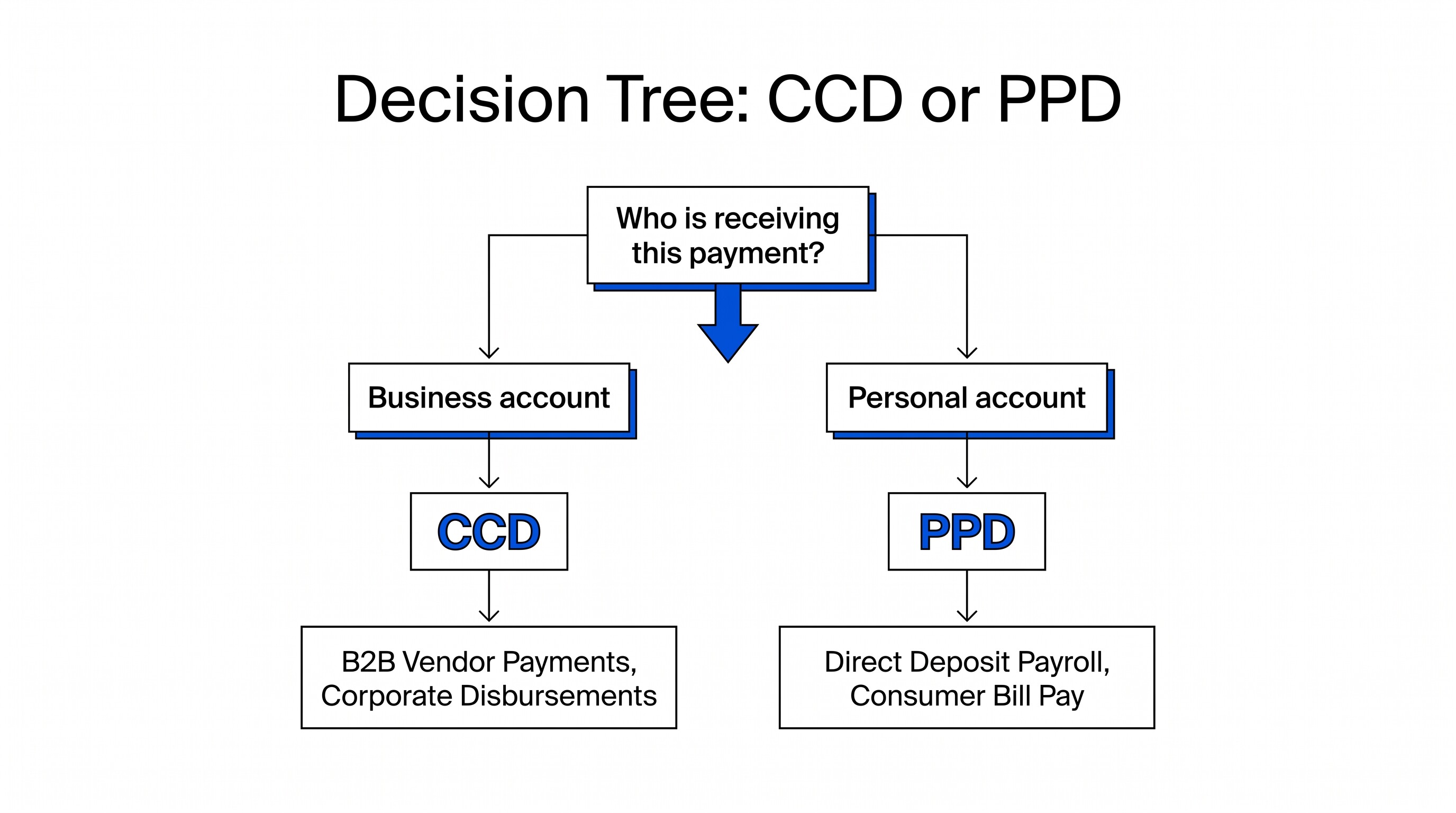
If the receiving account is a business account, the answer is almost always CCD. If the receiving account is a personal account, the answer is almost always PPD. The gray area is the contractor payment.
If you pay an independent contractor and the contractor has a business account (LLC, S-Corp, sole proprietor with a dedicated business account), the payment can technically be CCD because both accounts are business accounts. If the contractor accepts payment into a personal checking account, the payment must be PPD because one side is a personal account.
The distinction matters because some banks’ ACH origination systems restrict certain SEC codes. A small business bank may only support PPD for outgoing payments, which forces the contractor payment into PPD even if both accounts are technically business accounts.
The reverse is also true: a corporate banking platform may default to CCD for all outgoing payments, which can be wrong if the recipient’s account is personal.
For businesses processing ACH payments at volume, building a routing rule into the payment system that automatically picks the SEC code based on the recipient’s account type eliminates the manual decision and reduces errors. The system should validate that CCD payments go to business accounts (verified by the routing number and bank account type) and that PPD payments go to personal accounts.
If you are converting bank statements that contain ACH transactions to a spreadsheet format, the PDF transaction extraction workflow covers how ACH entries appear in parsed statement files. The choice between CCD and PPD is one of those ACH details that seems small until a payment is rejected or disputed.
Picking the right code up front keeps the transaction flowing and the records clean, and recognizing the distinction on a bank statement helps when reconciling entries that don’t quite match what you expected to see. The SEC code is doing more classification work than a printed bank statement shows, and that classification affects everything from authorization compliance to dispute resolution.
See also
For the broader ACH vs wire transfer comparison, the ACH vs Wire on bank statements guide covers how each appears on monthly bank statements. For businesses reconciling B2B payments, the ACH vs Wire cost comparison breaks down the fee structure that often influences whether ACH or wire makes sense for a given payment.
From Bank Statement to QuickBooks-Ready File
That manual cleanup you just read about? This tool skips it. Turn your PDF into QBO for QuickBooks without storing your data anywhere.
Start Converting