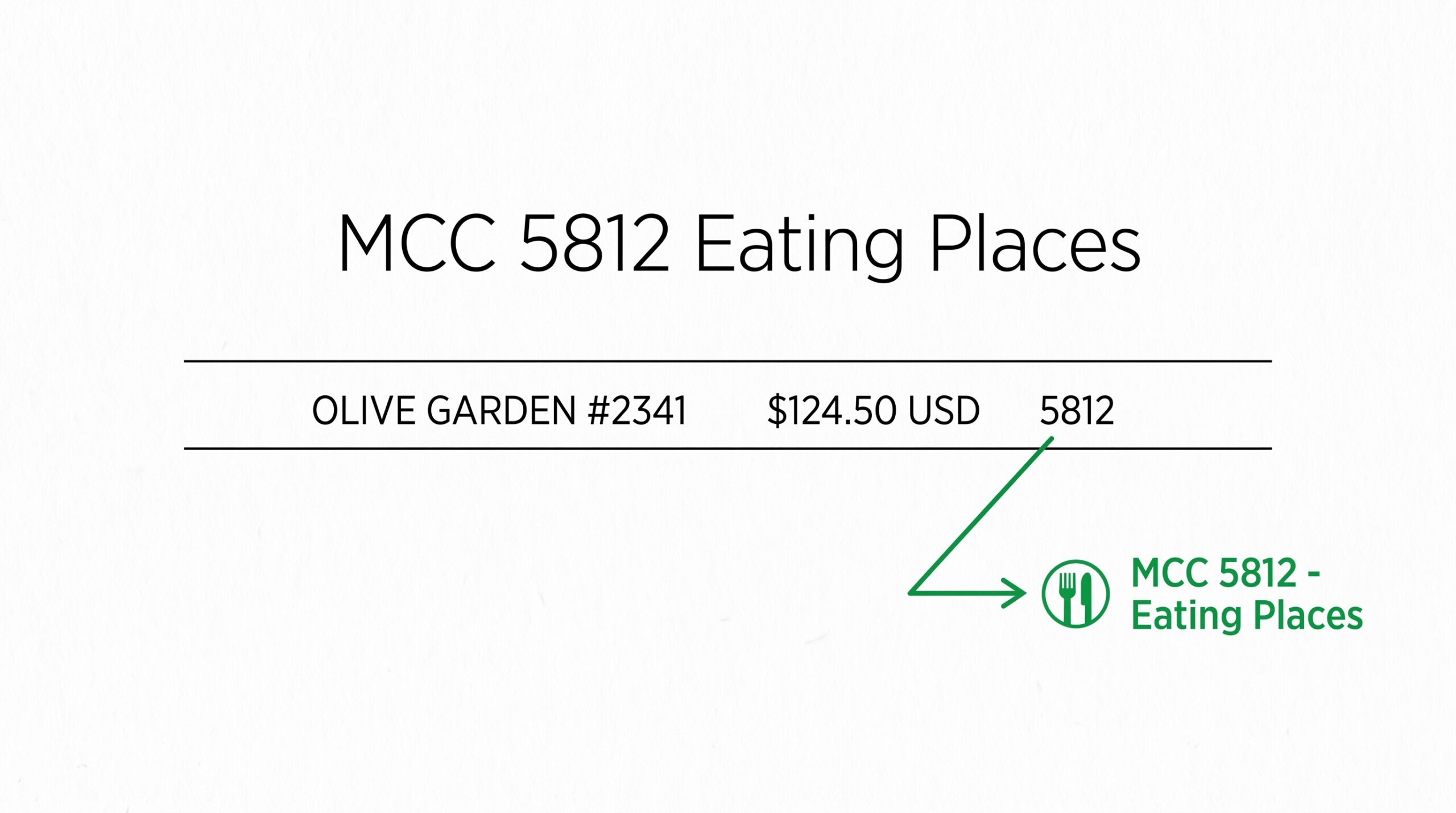

You are looking at your credit card statement in September. The first row shows “OLIVE GARDEN #2341” for $124.50, with a small 4-digit code 5812 next to it. Below it, a charge from STARBUCKS shows 5814, and a charge from a local pub shows 5813. You are reconciling these for your monthly expense report, and your bookkeeper asked you to categorize them by MCC.
Three codes, all on food, all close to each other but technically different. That little 4-digit number is doing more classification work than it looks like, and the distinction between 5812, 5813, and 5814 determines whether the charge counts as a deductible business meal on Schedule C or just a personal expense.
MCC 5812 is the Merchant Category Code that Visa, Mastercard, American Express, and Discover assign to eating places, restaurants, and similar establishments where customers buy prepared food and beverages for on-premises consumption or takeout. The code sits inside the four-digit ISO 18245 numbering system, which is the standard the card networks use to classify every merchant that accepts their cards.
When you pay at a participating restaurant, the merchant’s acquirer reports the MCC to the network, the network passes that code along to your statement, and the code becomes part of the transaction record.
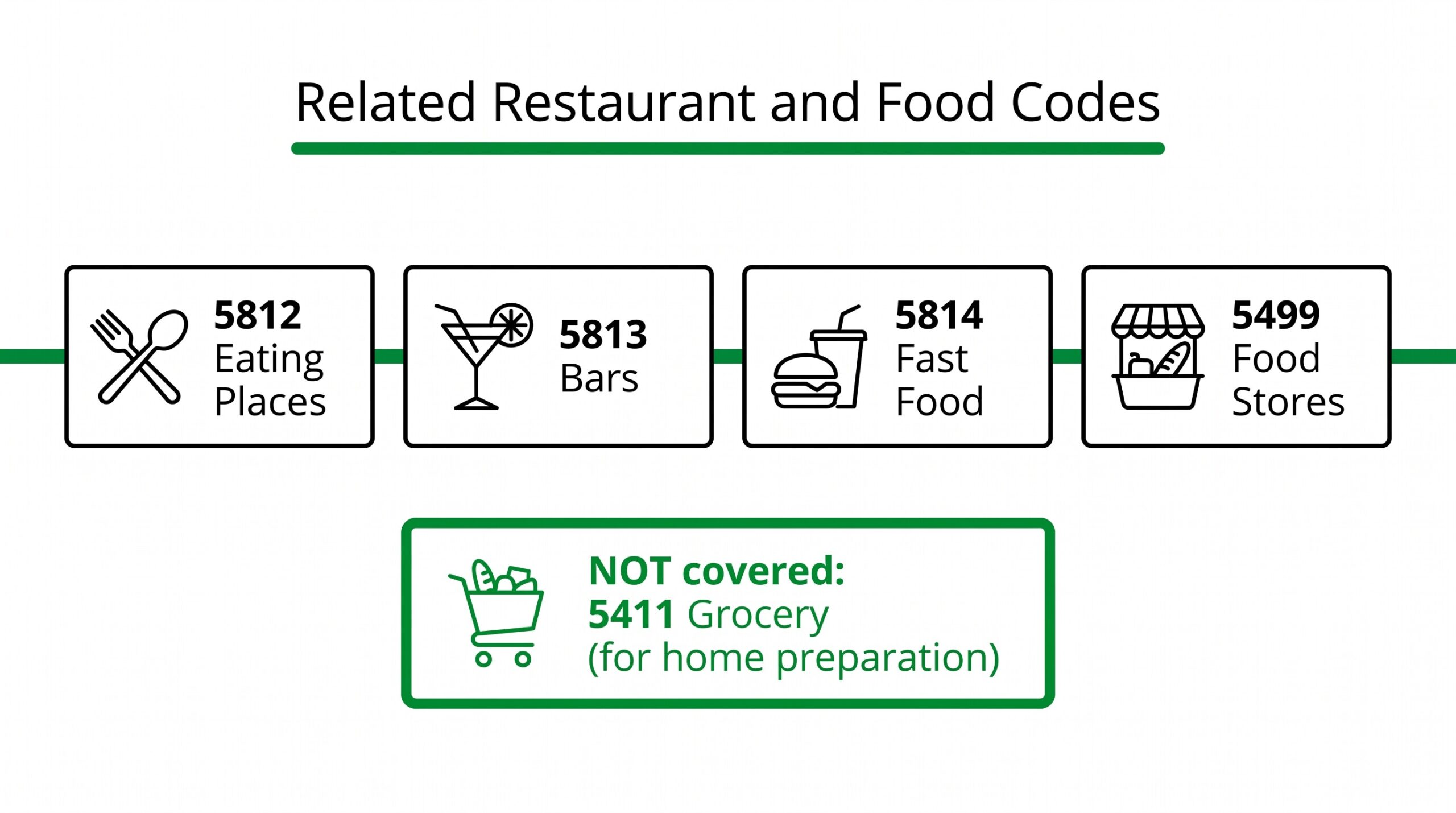
Quick Answers: MCC 5812 is the ISO 18245 code for eating places, restaurants, cafes, and similar establishments that sell prepared food and beverages. It covers sit-down restaurants, takeout, food delivery from restaurants, and cafes. It does not cover bars and nightclubs (5813), fast food restaurants (5814), grocery stores (5411), or specialty food markets (5499).
On credit card statements, 5812 charges typically appear next to the merchant name. For Schedule C, 5812 charges typically map to Line 24b (Meals), which is 50% deductible for self-employed individuals.
What MCC 5812 Covers
The 5812 classification applies to businesses whose primary activity is preparing and serving food and beverages to customers for immediate consumption. The card networks decide which merchants fall into this category when the merchant first signs up with its acquirer, and the merchant generally cannot pick a different code.
The classification depends on how the merchant registered, what kind of business they run, and what their dominant product mix looks like.
Imagine you are sitting at a coffee shop reviewing your January credit card statement. Three charges from three different coffee shops all appear as 5812 even though one was a counter-service kiosk, one was a sit-down cafe with a full pastry case, and one was a grab-and-go drive-through window.
The acquirers for each merchant made different classification choices, and the MCC system is not perfect at handling that nuance.
Common merchants that typically appear as 5812 include:
- Sit-down chain restaurants: Olive Garden, Cheesecake Factory, Applebee’s, Chili’s, Outback Steakhouse, Red Lobster
- Independent restaurants and bistros
- Cafes and coffee shops that serve food (Starbucks with food → 5814 fast food, but a dedicated cafe with full menu → 5812)
- Takeout-focused restaurants
- Food delivery from restaurants (DoorDash restaurant mode, Grubhub restaurant orders, Uber Eats restaurant orders)
- Hotel restaurants (when billed to room and charged to credit card)
- Bakery cafes (with sit-down service)
- Steakhouses
- Seafood restaurants
- Italian restaurants, sushi restaurants, Indian restaurants, Mexican restaurants, etc.
- Food trucks that accept card payments (when classified by acquirer)
The classification depends on how the merchant registered with its acquirer. A restaurant that primarily serves alcohol but also has a full food menu may be classified as 5812 (eating place) rather than 5813 (bar) if the food sales dominate.
A cafe that primarily sells coffee and pastries with minimal seating may end up as 5814 (fast food) rather than 5812 if the acquirer classifies it as quick service. The MCC system is not perfect, and merchants that straddle categories often end up coded based on what their acquirer chose at signup.
For the broader picture of how MCC codes work across credit card statements, the MCC overview for credit card statements covers the framework these distinctions sit inside. For a quick reference of all 50+ commonly searched codes, see the complete MCC code list.
The Difference Between 5812 and Related Restaurant Codes
The MCC system has three codes that all touch restaurants and food service, plus two that touch food more broadly. The differences between them matter for both bookkeeping accuracy and IRS reporting. Five codes in particular get confused with 5812 often enough to be worth distinguishing clearly.
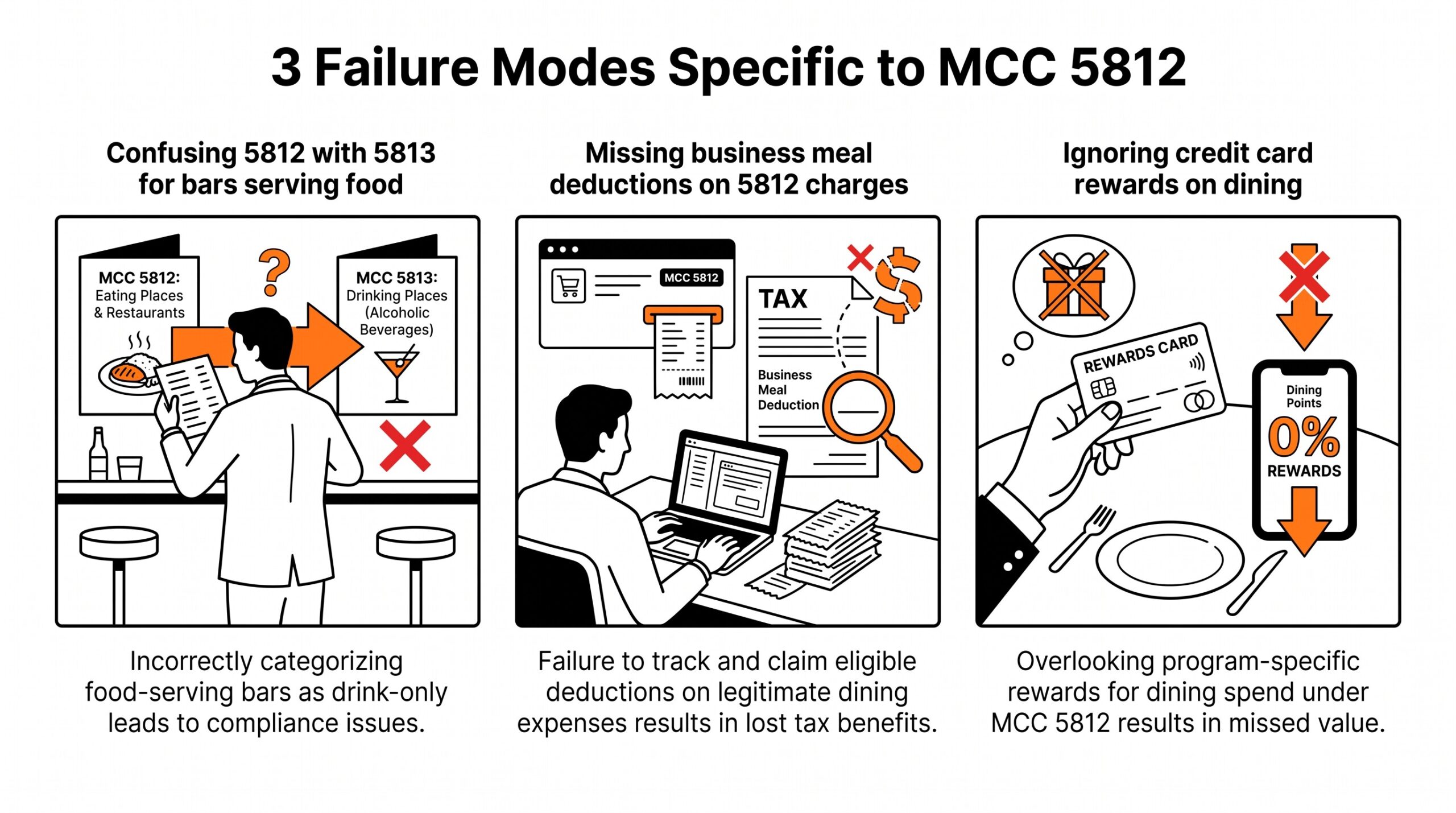
MCC 5813 (Drinking Places, Bars, Taverns, Nightclubs) covers establishments whose primary activity is serving alcoholic beverages. Examples include local pubs, wine bars, cocktail lounges, sports bars (when alcohol sales dominate), and nightclubs. If a bar also serves a full food menu and the food sales are significant, the merchant may be coded as 5812 instead.
The distinction matters for Schedule C because alcohol consumed at a bar typically does NOT qualify for the 50% meals deduction (Line 24b), while food at the same bar might qualify if the establishment is coded 5812.
MCC 5814 (Fast Food Restaurants) covers quick-service establishments with limited menus, fast preparation, and typically lower check averages. Examples include McDonald’s, Burger King, Wendy’s, Taco Bell, Subway, Chick-fil-A, and similar chains. The line between 5812 and 5814 is blurry for some merchants. A pizza place that is sit-down with wait service may be 5812.
A pizza place that is counter-service only with delivery may be 5814. Card networks classify based on the merchant’s primary operating model.
MCC 5499 (Food Stores, Miscellaneous) covers specialty food markets, gourmet shops, cheese stores, ethnic grocers, and similar establishments that primarily sell unprepared food for home preparation. If you buy a $40 wedge of cheese from a specialty shop, that charge is 5499, not 5812.
The distinction matters because 5499 charges are grocery-like (for home preparation) rather than restaurant-like (for immediate consumption), which affects Schedule C categorization.
MCC 5411 (Grocery Stores and Supermarkets) is the dedicated dedicated grocery code covered in our MCC 5411 grocery stores guide. The 5411 vs 5812 distinction is one of the most common accounting confusions. If you buy prepared food at a grocery deli counter and eat it at home, the merchant is 5411 (grocery) because the food was purchased for home preparation.
If you buy the same food at a restaurant that happens to be inside a grocery store, the merchant may be 5812 if it operates as a separate restaurant entity. The classification follows the merchant’s primary business model, not what you actually did with the food.
MCC 5968 (Direct Marketing Subscription Services) is sometimes confused with 5812 because of the food subscription category. If you subscribe to a meal kit service like Blue Apron or HelloFresh, those charges typically appear as 5968 (subscription) rather than 5812 (restaurant). The distinction matters because 5968 charges are typically not deductible as meals, while a similar purchase at a restaurant would be.
For more on subscription codes, see our MCC 5968 direct marketing guide.
From Bank Statement to QuickBooks-Ready File
That manual cleanup you just read about? This tool skips it. Turn your PDF into QBO for QuickBooks without storing your data anywhere.
Start ConvertingHow MCC 5812 Maps to IRS Schedule C
For self-employed individuals filing Schedule C, 5812 charges typically fall into one of three categories, and the right category depends on the purpose of the meal and the people involved. The MCC alone doesn’t tell you which line item to use. Your business purpose for the meal does.
Meals (Line 24b, subject to 50% deduction limit) is the most common destination for 5812 charges. If you take a client to lunch to discuss a project, that 5812 charge typically books to Line 24b. If you take a prospect to dinner as part of business development, the same rule applies. The 50% limit means you can deduct half the actual cost.
The other 50% is treated as a non-deductible personal expense, even though the meal was 100% for business purposes.
Travel meals (Line 24a) applies when you are traveling away from home for business and the meal is part of that travel. A dinner in a hotel restaurant while on a multi-day business trip typically books to Line 24a (Travel) rather than Line 24b (Meals). The 50% limit still applies.
The distinction between 24a and 24b matters because some tax preparation software handles the categories differently, but the actual deduction amount is the same.
Entertainment (no longer deductible, but trackable) used to be a separate category before the Tax Cuts and Jobs Act of 2017 eliminated the entertainment deduction. Today, if you take a client to a sports event and then dinner, only the dinner is potentially deductible (as a meal). The sports event tickets are not deductible.
The 5812 dinner charge still gets tracked and reported, but it falls under the meals deduction rather than entertainment.
The IRS does not publish a list mapping MCCs to Schedule C line items, so this is interpretive guidance rather than a hard rule. For broader IRS recordkeeping guidance on bank statement transactions, the IRS Publication 552 recordkeeping guide provides context that applies across multiple MCC codes including 5812.
What Most MCC References Miss About 5812
Most MCC reference pages treat 5812 as “Restaurants” without explaining the operational subtleties that affect how the code is assigned and how it shows up on statements. Three things are worth understanding that the typical reference does not cover.
The tip handling on credit card charges creates a multi-stage authorization pattern that confuses some reconciliation tools. When you pay $100 for a meal and add a $20 tip, the restaurant may process the original $100 charge first, then run a separate $20 charge for the tip.
On a credit card statement, this often shows as two distinct transactions: $100 OLIVE GARDEN 5812 and $20 OLIVE GARDEN TIP 5812. Some restaurants combine them into one $120 charge. The split vs combined format depends on the restaurant’s POS system and how they process tips.
Travel-related 5812 charges often appear with location data that helps with expense categorization. A charge from “OLIVE GARDEN #2341 SEATTLE WA 5812” with a city name is clearly a travel meal. A charge from “OLIVE GARDEN #101 HOME TOWN 5812” without travel context is a local meal.
The location data is part of the merchant descriptor that the restaurant controls, and it can be useful when reviewing monthly statements for travel vs local categorization.
Food delivery services sit in a gray area. A DoorDash order from a sit-down restaurant may be coded as 5812 (because the underlying restaurant is the merchant) or 5812 (because DoorDash is the merchant) depending on how DoorDash structured the transaction. In most cases, DoorDash restaurant orders appear as 5812 because the restaurant is the primary merchant.
Grocery delivery through DoorDash or Instacart, by contrast, typically appears as 5411 because the underlying grocery store is the merchant.
For more on how these distinctions appear in parsed bank statements, the PDF transaction extraction workflow covers how merchant descriptors and MCC codes flow through statement parsing libraries. For the broader banking context around restaurant charges, the bank statement API for developers guide covers how 5812 appears in different statement parsing tools.
The 4 Most Common 5812 Transaction Patterns
Across personal and business credit card statements, 5812 charges appear in four common patterns. Recognizing the pattern helps determine how to categorize the charge for expense reports and Schedule C.
Client business meal. The most common business context: lunch or dinner with a current or prospective client, usually with a clear business purpose documented in your calendar or notes. The charge typically appears as a single amount from a specific restaurant merchant. Books to Line 24b (Meals), 50% deductible.
Team meal or employee meal. When you treat your team to lunch or dinner, the charge is still 5812 but the IRS treatment is different. Meals provided for the convenience of the employer (such as working lunches) may be 100% deductible, while meals for employee morale are 50% deductible.
The distinction depends on the specific circumstances, and a CPA can help apply the right rule for your situation.
Travel meal while on business trip. Restaurant charges during a multi-day business trip typically fall under Travel meals (Line 24a) rather than regular meals (Line 24b). The deduction percentage is the same (50%), but the categorization on Schedule C may differ for state tax purposes or for tracking purposes.
Personal meal (not deductible). Restaurant charges for personal consumption (with friends, family, dates) are not deductible on Schedule C. The MCC 5812 alone does not tell you whether the charge is deductible. Your business purpose for the meal determines deductibility, and the merchant category is just one input. Tracking business purpose contemporaneously is the IRS-friendly way to document which meals are deductible.
How MCC 5812 Affects Credit Card Rewards
MCC 5812 is one of the most rewarded merchant categories across credit card programs. Most major issuers offer 3x to 5x points on dining charges coded as 5812 or 5814. Some issuers specifically distinguish between 5812 and 5814 in their rewards terms. American Express Gold card, for example, earns 4x on dining at restaurants (5812) but only 1x on fast food (5814).
The Chase Sapphire Reserve earns 3x on dining that typically covers both 5812 and 5814.
For a household maximizing dining rewards, this distinction matters because dining is often a major budget category. If your card earns 4x on 5812 but only 1x on 5814, you would prefer to use that card at sit-down restaurants rather than fast food chains.
Conversely, if you have a card that earns 4x on groceries (5411) but only 1x on dining (5812), you would use the grocery card at the supermarket and the dining card at restaurants.
The reverse also happens. Some cards treat 5812 as a generic category that does not earn bonus rewards, even when those same cards offer 3x on travel or 2x on gas. In that case, dining charges earn the base 1x, which is essentially negligible on a per-dollar basis.
Tracking which cards earn what on dining is the first step toward maximizing the value of credit card rewards on a budget.
When 5812 Differs from Related Codes
Three cases are worth knowing about because they create expense categorization surprises that frequently trip up bookkeepers and self-employed individuals.
Restaurants inside other establishments. A restaurant inside a hotel, airport, or shopping mall may be coded as 5812 (restaurant) or sometimes as a sub-category depending on how the merchant registered. A hotel restaurant charged to your room and then to your credit card typically appears as the hotel’s MCC (often 7011 for lodging), not 5812. This affects how business travelers categorize meals.
Brewpubs and gastropubs. These establishments serve both food and alcohol, and the merchant classification often defaults to one or the other depending on which sales dominate. A brewpub with a serious food menu may be 5812. A brewery with limited food (just pretzels and small plates) may be 5813 (bar).
The classification matters for Schedule C because alcohol at a 5813 bar typically does not qualify for the meal deduction.