
You are reviewing your August credit card statement.
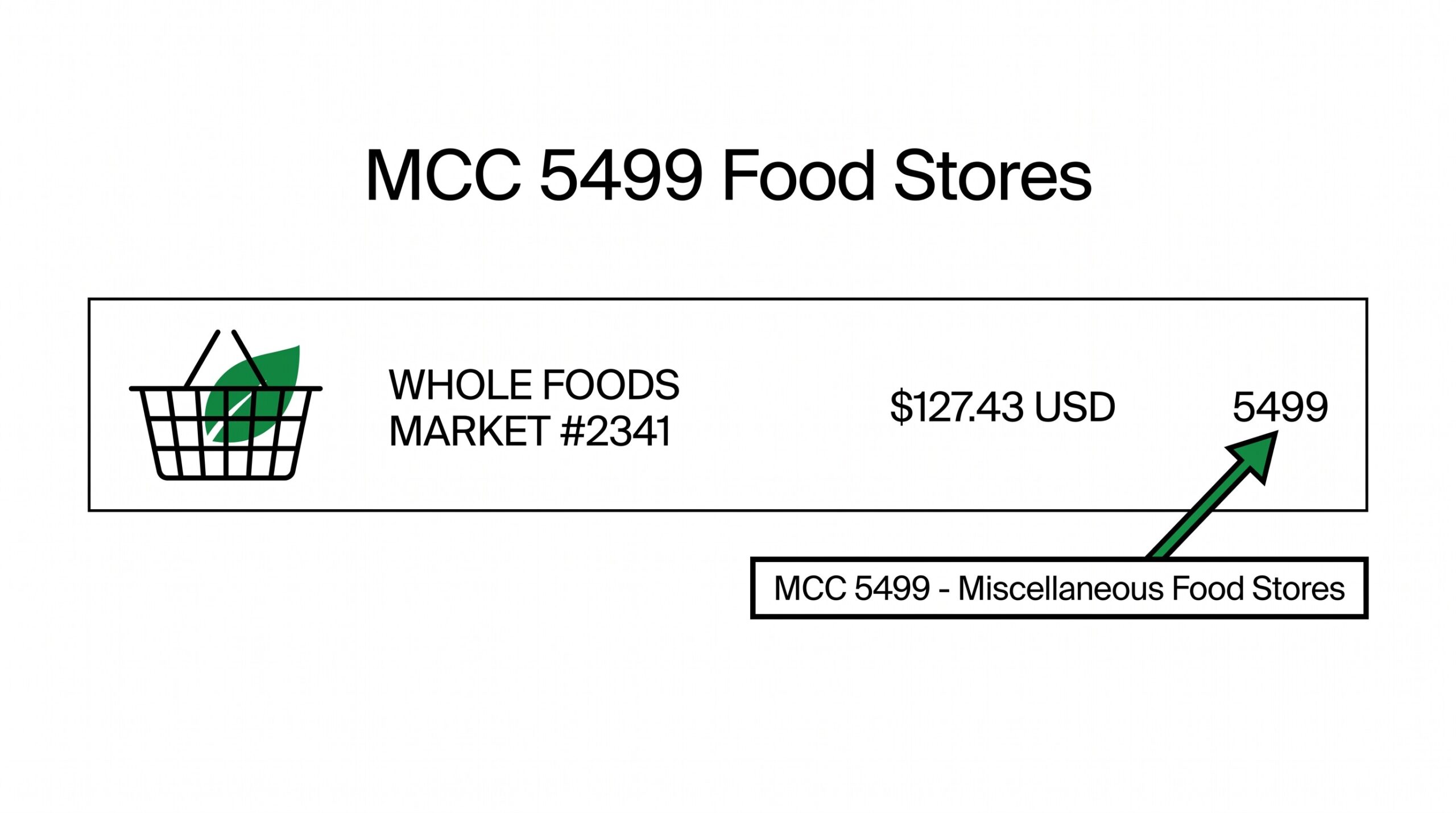
A $127.43 charge at WHOLE FOODS MARKET shows “5499” in the merchant code column. Below it, a $54.20 charge at TRADER JOE’S #143 also shows “5499”. A $42.18 charge at SAFEWAY shows “5411”. Three grocery-style purchases, two different MCC codes. You want to know why the codes differ and what it means for your expense categorization and tax treatment.
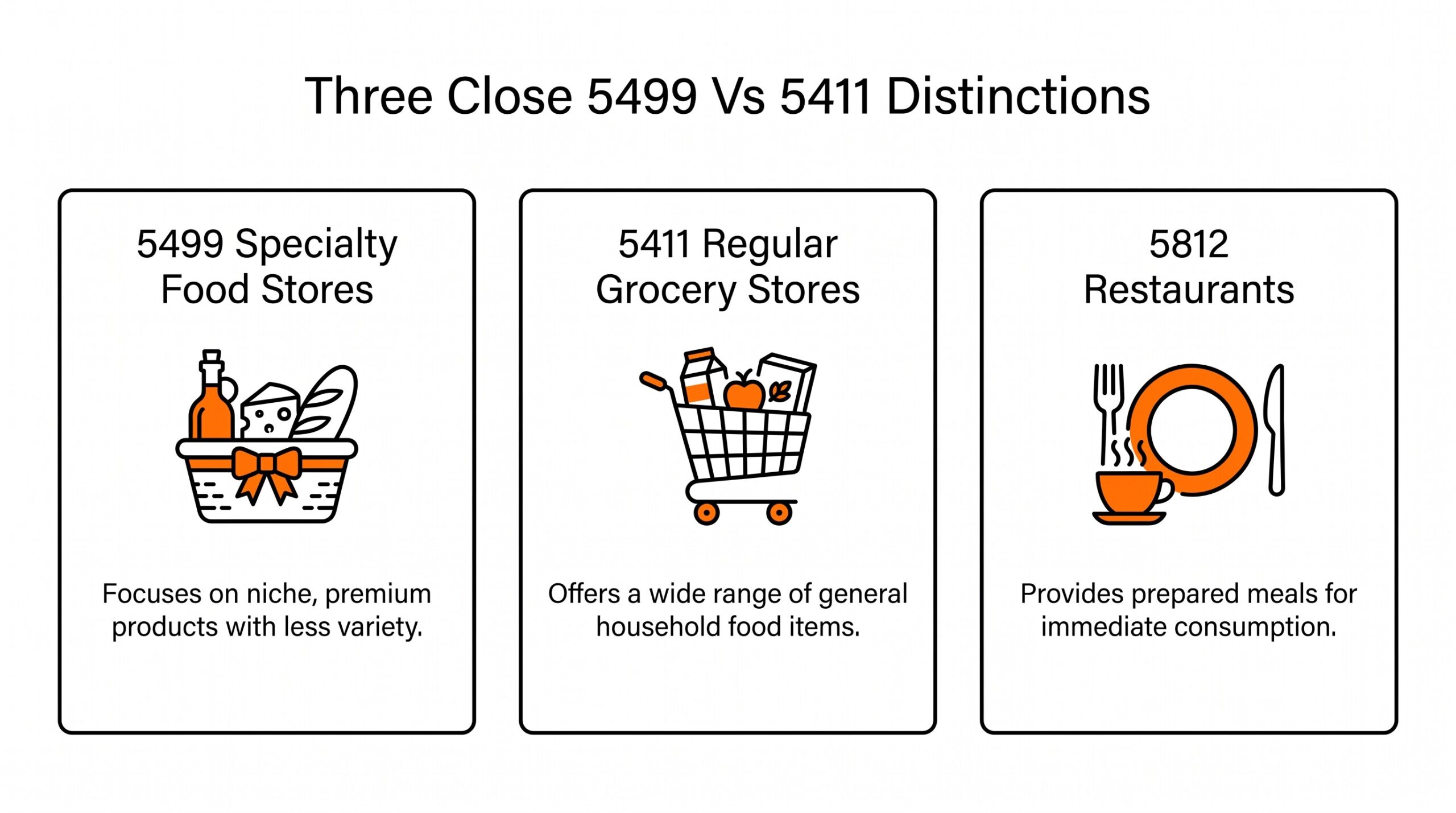
MCC 5499 is the merchant category code for Miscellaneous Food Stores, including specialty food markets, health food stores, vitamin shops, bakeries, butchers, and fish markets.
The code sits inside the four-digit ISO 18245 numbering system that Visa, Mastercard, American Express, and Discover use to classify every merchant that accepts their cards. The 5499 code is one of several food-related codes (5411, 5812, 5813, 5814) and the distinction between them depends on how the merchant registered with their acquirer, not the store name alone.
Quick Answers: MCC 5499 is the ISO 18245 code for Miscellaneous Food Stores, including specialty food markets, health food stores, vitamin shops, bakeries, butchers, and fish markets.
It does NOT cover regular grocery stores and supermarkets (5411), restaurants (5812), fast food (5814), or bars (5813).
Whole Foods, Trader Joe’s, and Sprouts can show as either 5499 or 5411 depending on the merchant’s acquirer registration. For self-employed individuals, 5499 charges typically fall into Schedule C Line 24a (Supplies) for resale inventory or Line 24b (Meals) for personal consumption, with the same 50% deduction limit as restaurant meals.
What MCC 5499 Covers
The 5499 code covers a broad range of food retailers that don’t fit into the standard grocery or restaurant categories.
The most common merchants that fall under 5499 include specialty food markets (Whole Foods in many locations, Trader Joe’s in some, Sprouts Farmers Market), health food stores (independent natural food markets, GNC-type vitamin retailers), bakeries that sell primarily for home consumption (not in-store dining), butcher shops and fish markets, and specialty beverage retailers (wine shops, beer shops with limited food).
Imagine walking into a local Italian bakery and ordering a $40 tray of cannoli for a dinner party. The bakery’s merchant code is 5499 because it sells prepared baked goods for home consumption. A different bakery that operates as a sit-down café with table service uses 5812 instead. The distinction depends on whether the merchant’s primary business model is “food retailer” or “food service establishment.”
What 5499 does NOT cover is just as important as what it does.
Regular grocery stores and supermarkets use 5411 (covered in the MCC 5411 grocery stores guide).
Restaurants and sit-down eating places use 5812 (covered in the MCC 5812 eating places guide). Fast food restaurants use 5814. Bars and drinking places use 5813. Convenience stores that primarily sell fuel use 5541 (covered in the MCC 5541 service stations guide). The broader framework of how these codes work together sits inside the MCC overview for credit card statements.
The Difference Between 5499 and 5411
This is the most common source of confusion about MCC 5499. Whole Foods Market, Trader Joe’s, and Sprouts Farmers Market all sell groceries, but they often show as 5499 instead of 5411. The reason depends on how the merchant registered with their acquirer, not the store name itself.
Some Whole Foods locations register as 5411 (regular grocery stores), while others register as 5499 (specialty food stores). The acquirer makes this decision based on the merchant’s business classification, store format, and product mix. Two Whole Foods stores in different cities can show different MCC codes on a credit card statement because each store has its own acquirer registration.
For expense tracking, the difference is mostly cosmetic.
Both 5499 and 5411 represent grocery-style purchases, and most credit card rewards programs treat them the same way (see the broader MCC 6011 financial institution code for ATM-related distinctions) (typically 1% cashback or 1x points, since neither falls into a specific bonus category).
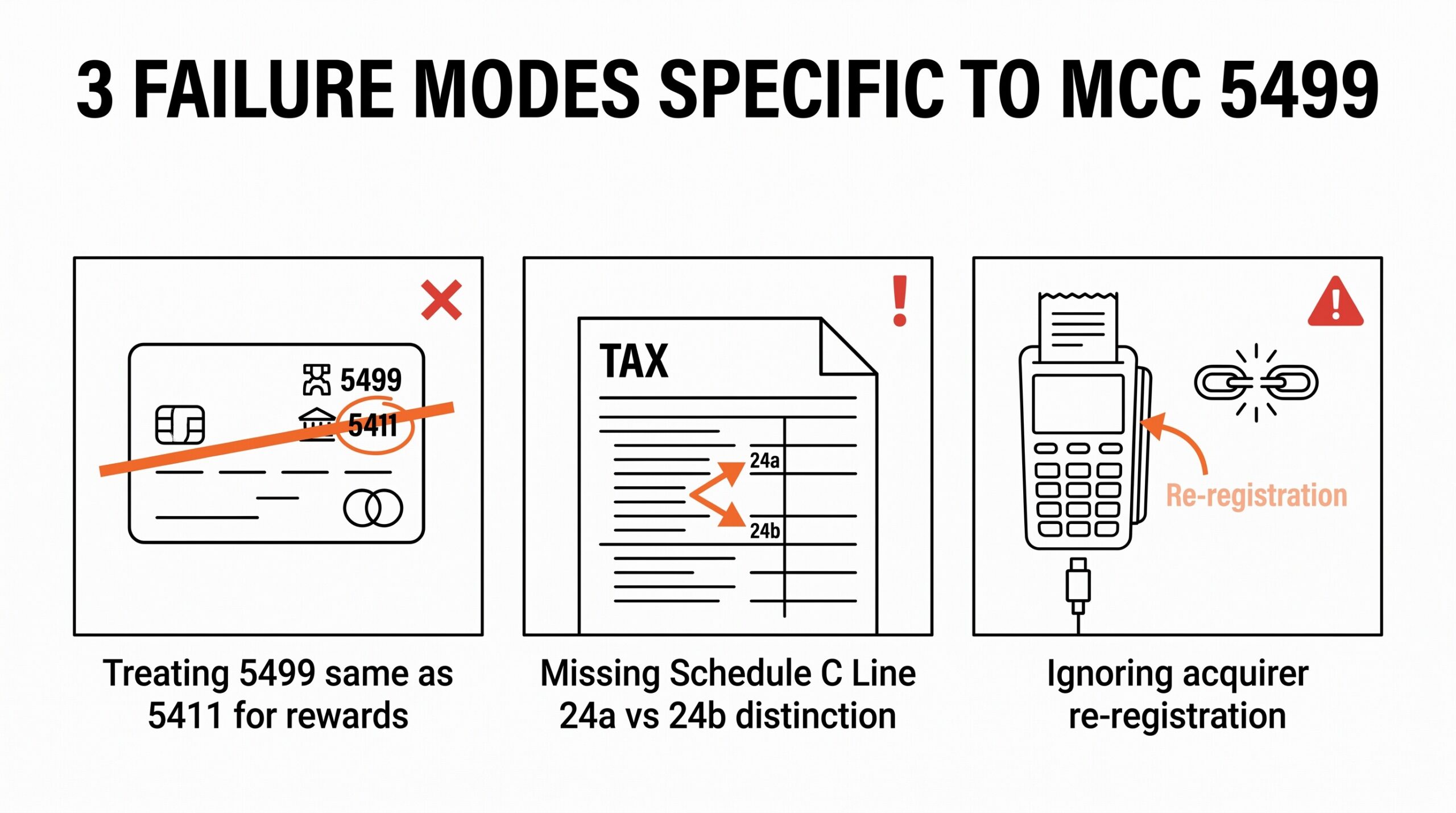
The IRS Schedule C treatment is also similar: both codes typically map to Line 24a (Supplies) for resale inventory or Line 24b (Meals) for personal consumption.
Where the codes diverge is in some niche rewards programs.
A few credit cards offer enhanced cashback at “grocery stores” (5411) but exclude specialty food markets (5499) from the bonus. The Amex Gold card, for example, offers 4x Membership Rewards points at US supermarkets (defined as 5411), and a 5499 charge at Whole Foods would earn only the base 1x points. This is one of the more common surprise deductions from credit card rewards.
The reverse can also happen. Some merchant category-restricted cards (like a closed-loop restaurant gift card) accept 5812 but not 5411 or 5499. The distinction matters when you’re trying to maximize rewards on food-adjacent purchases.
From Bank Statement to QuickBooks-Ready File
That manual cleanup you just read about? This tool skips it. Turn your PDF into QBO for QuickBooks without storing your data anywhere.
Start ConvertingHow MCC 5499 Maps to IRS Schedule C
For self-employed individuals and small business owners, 5499 charges on a business credit card typically fall into one of two Schedule C categories, depending on whether the items were for resale or for business operations.
Schedule C Line 24a (Supplies) applies when the food or merchandise purchased at a 5499 merchant is for resale or as a supply used in the business.
A catering company buying ingredients at Whole Foods for events would categorize the charge as Supplies. A vitamin retailer buying inventory from a wholesale distributor coded as 5499 would categorize the charge as Cost of Goods Sold (Line 42) or Supplies depending on the accounting method.
Schedule C Line 24b (Meals) applies when the food purchased is consumed by the business owner, employees, or clients. A consultant buying lunch at Whole Foods’ prepared food section to eat during a client meeting would categorize the charge as Meals, subject to the 50% deduction limit. The 50% limit applies to most business meals regardless of MCC code (5499, 5411, 5812).
The distinction can be subtle.
Whole Foods’ prepared food counter sells hot bars, soups, and sandwiches that are clearly meals (Line 24b).
Whole Foods’ grocery aisles sell ingredients that could be either meals (if the business owner cooks them) or supplies (if used for client gifting or resale).
For most small business owners, the simple rule is: 5499 charges for prepared food consumed by people = Meals (Line 24b, 50% deduction). 5499 charges for groceries or merchandise used in the business = Supplies (Line 24a, 100% deduction) or COGS depending on context.
For businesses that need to track the distinction carefully (caterers, food retailers, restaurants), the conversion to a spreadsheet makes it easier to tag each 5499 charge with the right category. The general bank statement to Excel workflow covers the conversion step, and the bank transaction categorization workflow covers how to apply consistent categorization across all your MCC-coded charges.
What Most MCC References Miss About 5499
Most MCC reference sites list 5499 as “Miscellaneous Food Stores” without explaining the operational reality. Three details that matter for actual use:
Acquirer registration can change.
A merchant that registered as 5499 in 2020 can re-register as 5411 or 5812 in 2024 if their business model shifts.
A bakery that adds a sit-down café section might re-register as 5812. A vitamin shop that expands into fresh produce might re-register as 5411. The MCC code on a credit card statement reflects the registration at the time of the transaction, not a permanent classification.
Inside-store purchases can have split codes. Some larger 5499 merchants operate inside-store cafes or coffee bars. The merchant’s primary code is 5499, but the in-store café might register as 5812 (eating places). The credit card statement shows the merchant-level code, not the sub-section code, so you’d see 5499 for both the groceries and the café purchase in some cases.
Online vs in-store codes can differ. Some 5499 merchants use different MCC codes for online vs in-store purchases. Amazon’s Whole Foods online orders might show as 5411 (Amazon’s grocery classification) while in-store Whole Foods purchases show as 5499. The merchant chooses codes per sales channel, and acquirers honor those choices.
These details matter for expense reporting and rewards maximization, but most reference sites don’t surface them. The implication for tracking is that the MCC code on a statement tells you how the merchant classified the transaction, not the nature of the purchase itself.
The 4 Most Common 5499 Transaction Patterns
Four recurring patterns appear in 5499 charges across personal and business credit card statements. Recognizing the patterns helps with expense categorization.
Specialty grocery runs. The most common 5499 pattern is a $80-200 charge at Whole Foods, Sprouts, Trader Joe’s, or a local natural foods market. These are typically recurring weekly or biweekly purchases for household consumption. The amount is usually consistent month-over-month, which makes them easy to identify in a converted spreadsheet.
Health and supplement purchases. Charges at GNC, Vitamin Shoppe, Whole Foods’ supplement aisle, or local health food stores typically show as 5499. The amounts vary widely ($15-300) and the merchants are less recurring than grocery stores. For businesses that buy supplements as inventory or employee wellness perks, these categorize differently than personal-use supplement purchases.
Bakery and prepared food purchases. A $30-80 charge at a local bakery, pastry shop, or specialty food market (cheese shop, chocolatier) typically shows as 5499. These are often event-related (dinner party, holiday gifts, client appreciation) and the categorization depends on the business context.
Specialty beverage purchases. Charges at wine shops, beer specialty stores, and craft beverage retailers typically show as 5499. For businesses that buy alcohol for client entertainment or resale, these are important to track separately because alcohol-related 5499 charges sometimes have different treatment for business deductions (especially in states with specific alcohol tax rules).
How 5499 Affects Credit Card Rewards
Credit card rewards programs treat 5499 inconsistently. Some programs treat 5499 as grocery spending (eligible for grocery bonus categories), others treat it as a separate category (lower or no bonus), and a few treat it as a general retail purchase.
The Amex Gold card’s 4x Membership Rewards at US supermarkets typically applies to 5411 only, not 5499.
A Whole Foods charge showing 5499 would earn 1x points, not 4x. The Capital One Savor card’s 4% cashback on dining and entertainment typically applies to 5812 and 5813, not 5499 or 5411. The Chase Sapphire Reserve’s 3x on dining applies to 5812, 5813, 5814, not 5499 or 5411.
For maximum rewards on 5499 purchases, the best cards are typically those that offer flat-rate rewards on all purchases (Chase Freedom Unlimited 1.5x, Citi Double Cash 2%, or the Apple Card 2% on Apple Pay transactions). The category-restricted cards rarely include 5499 in their bonus categories.
When 5499 Differs from Related Codes
Three cases are worth knowing because they create expense categorization surprises that trip up bookkeepers and self-employed individuals.
Prepared food at specialty markets.
Whole Foods’ hot bar, prepared meals section, and in-store cafés can show as either 5499 (the merchant-level code) or 5812 (if the sub-section is registered separately).
The credit card statement shows whichever code the acquirer assigned to the transaction, not the type of food purchased. A $15 lunch at the hot bar might show as 5499 (specialty food) or 5812 (eating place) depending on how Whole Foods registered that specific location.
Bakeries that add seating. A bakery that started as a 5499 retail bakery and later added tables for in-store dining might re-register as 5812 to reflect the expanded business. A bookkeeper tracking expenses for a year would see the same bakery showing different codes in different months, which complicates the categorization.
Vitamin shops with food. GNC-type stores that primarily sell supplements but also sell protein bars, drinks, and snacks typically register as 5499. The food-vs-supplement distinction is irrelevant for MCC coding; everything at the merchant is 5499 regardless of what’s purchased.
See also
For related codes, see the MCC 5411 grocery stores guide for the most common confusion point with 5499, the MCC 5812 eating places guide for restaurant charges, the MCC 5541 service stations guide for fuel-related food purchases, and the MCC 6051 quasi-cash guide for cash-equivalent charges sometimes seen at food retailers.
For tracking all your charges on monthly statements, the bank transaction categorization workflow covers how to apply consistent categorization. For converting multiple months of statements into a single dataset, the multi-currency statement conversion workflow handles the file-format variations across banks.
See also: MCC 5499 in context
This explainer is one of the merchant category code guides on the site. The consolidated overview of the entire MCC system, including every US card-network overlay, lives in the complete MCC guide. The full code-by-code reference is the complete MCC code reference.
For the broader reading on what every column on a US bank statement means, including the merchant description column where MCC appears, see the expanded bank statement anatomy.
Output format: which one matches the destination?
Picking the right output format is a separate decision from picking the right converter.
XLSX for human spreadsheet review. CSV for downstream scripts and tools. Google Sheets-compatible for shared cloud review. QBO for QuickBooks.
The four canonical columns are preserved across every format. What differs is how the downstream consumer expects the rows.
For a side-by-side rule of thumb that maps destination to format, see the decision framework on the output format pillar.
Read the full output format decision framework
Turn PDF Bank Statements Into Workable Spreadsheets
Your bank statement is a mess of numbers, but your books shouldn't be. Use our converter to get Excel, CSV, or QBO files — ready for QuickBooks.
Try It Free Now