
You need to send or receive money instantly in the United States and want to know whether FedNow or the RTP rail is the right rail for your specific situation.
This is the most-asked comparison question in U.S. payments in 2025, and the answer depends on three things: which banks you and your recipient use, how much money you are moving, and whether the transfer must work on weekends and bank holidays.
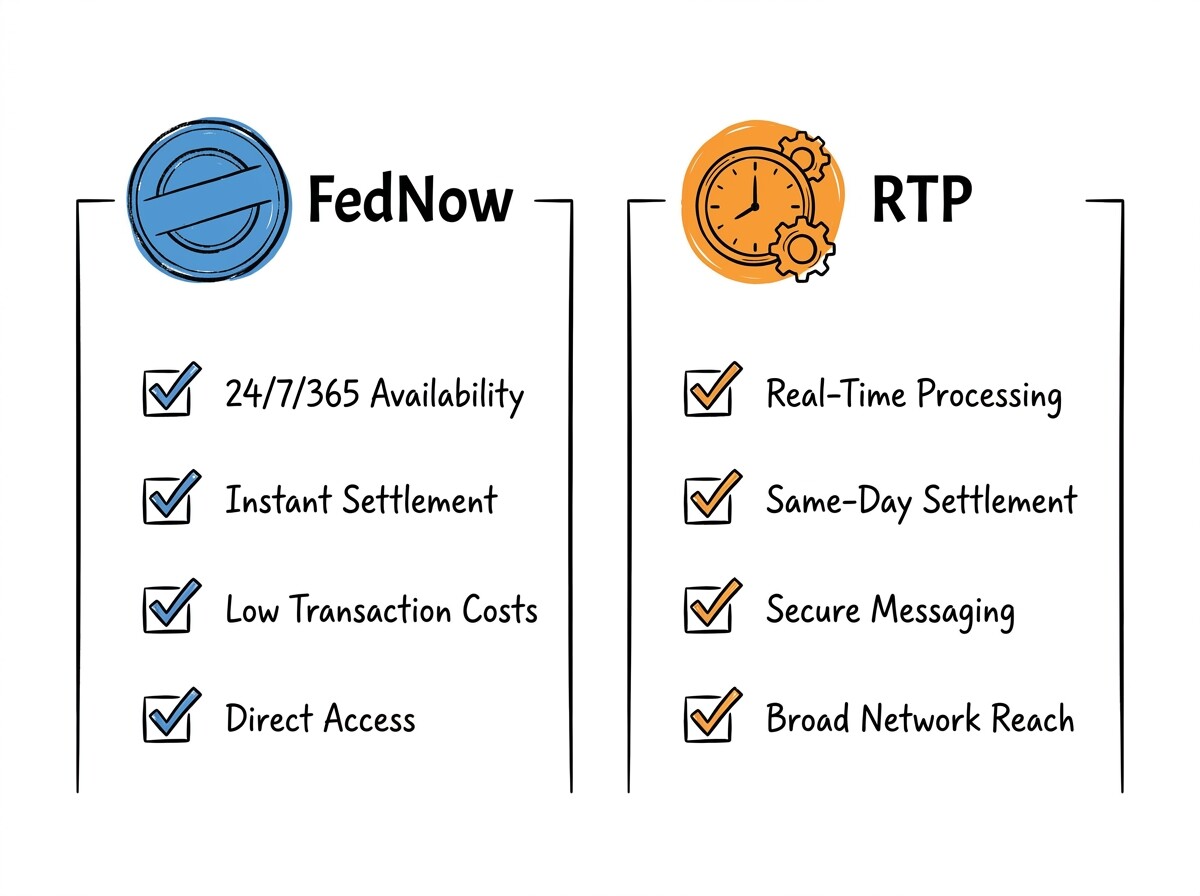
Quick Answers: FedNow (Federal Reserve, launched July 2023) and RTP (The Clearing House, launched November 2017) are the two U.S. real-time payment rails, both settling in seconds 24/7/365 with no sender fee. FedNow has a $500,000 per-transaction cap and 950+ participating banks; RTP has a $1,000,000 per-transaction cap and 600+ participating banks. For amounts under $500,000 between banks that support both, the rails are functionally interchangeable. For amounts over $500,000, RTP is the only option. For amounts under $500,000 between a small community bank and any other bank, FedNow is more likely to work because the Federal Reserve does not charge banks a participation fee.
How are FedNow and RTP the same?
FedNow and RTP are both real-time gross settlement systems for U.S. bank transfers, and they share five characteristics. Both settle in roughly 8-15 seconds. Both operate 24 hours a day, 7 days a week, 365 days a year, including weekends, bank holidays, and the middle of the night. Both are irrevocable once acknowledged by the receiving bank.
Both charge no fee to the receiving bank and no fee from the rail operator to the sender, leaving individual banks free to add retail markups (most choose $0). Both use ISO 20022 messaging standards, which is why the two networks are interoperable at the message layer even though they are operated by different organizations.
From the user’s perspective, sending $100 to a friend through either rail looks identical: you initiate the transfer, the recipient gets a notification, and the funds are available in their account within seconds.
The bank statement line for the recipient may say “FEDNOW” or “RTP” depending on which rail the sender’s bank used, but the settlement speed, the irreversibility, and the no-fee economics are the same.
How are FedNow and RTP different?
The differences come down to who runs each rail, how banks participate, and what limits apply. FedNow is run by the Federal Reserve as public infrastructure, with no participation fee charged to banks. RTP is run by The Clearing House as private infrastructure, with participation fees charged to banks that join.
FedNow launched in July 2023 and has grown rapidly to 950+ participating banks by late 2025, with strong uptake among community banks and credit unions. RTP launched in November 2017 and has 600+ participating banks, with stronger concentration among the largest U.S. banks.
The per-transaction cap is the most consequential operational difference. FedNow caps each transfer at $500,000. RTP caps each transfer at $1,000,000. If you need to send $750,000 instantly, RTP is the only option (or you split the transfer into multiple FedNow transactions if both banks support it).
The two rails are not interoperable for amounts over $500,000 because FedNow simply rejects them at the network level.
| Attribute | FedNow | RTP |
|---|---|---|
| Operator | Federal Reserve | The Clearing House |
| Launched | July 20, 2023 | November 14, 2017 |
| Settlement time | ~8 seconds median | ~10-15 seconds median |
| Per-transaction cap | $500,000 | $1,000,000 |
| Participating banks | 950+ (late 2025) | 600+ (late 2025) |
| Bank participation fee | $0 to banks | TCH charges participating banks |
| Request-for-payment | Limited support | Full support |
| Coverage bias | Stronger at community banks and credit unions | Stronger at large national banks |
RTP supports a “request for payment” feature that FedNow does not fully match: a vendor or person can send a payment request to your account, and you approve it before funds leave. This is the basis for “RTP Request” lines on bank statements. FedNow is primarily push-based (you initiate the transfer) and has limited pull-based capability as of 2025.
From Bank Statement to QuickBooks-Ready File
That manual cleanup you just read about? This tool skips it. Turn your PDF into QBO for QuickBooks without storing your data anywhere.
Start ConvertingWhich rail should you use for a typical transfer?
For amounts under $500,000 between two banks that both support FedNow and RTP, the choice is functionally invisible to the user. The sending bank decides which rail to use based on its own routing logic: typically, large TCH-member banks default to RTP, mid-size and community banks default to FedNow, and most banks will try both and use whichever succeeds first.
If your bank shows “FEDNOW” on your statement, the bank chose the Federal Reserve rail. If your bank shows “RTP,” the bank chose The Clearing House rail. The user almost never has to choose manually.
The three situations where the rail choice matters to the user are: (1) amounts over $500,000 where you must use RTP because FedNow rejects them (2) cross-bank transfers where one bank supports only one rail in which case the supporting rail is forced (3) rare cases where one rail is temporarily down for maintenance or experiencing an outage.
in which case the sending bank will route through the other rail or fall back to ACH .
How do the costs compare for businesses?
For receiving banks, the cost structure favors FedNow because the Federal Reserve charges nothing to participating banks, while The Clearing House charges RTP participants an annual fee plus per-transaction fees that vary by volume. This is why smaller community banks and credit unions have gravitated toward FedNow: they get a real-time payment rail without the cost of joining the private TCH network.
For large banks that are already TCH members (because they have historically used TCH’s check-image exchange and other services), RTP is essentially free at the margin, which is why the largest U.S. banks are heavy RTP users.
For sending banks, the cost to the bank is similar between FedNow and RTP (both are essentially free or low-cost per transaction), and most banks pass no fee through to retail customers. For business customers with high transaction volumes, banks may charge a small per-transaction fee (typically $0.10-$0.50) on either rail, with the fee structure varying by bank rather than by rail.
The competitive dynamic is that banks offering free FedNow or RTP have a marketing advantage over banks that charge for real-time transfers.
For end users (consumers and small businesses sending transfers under $50,000), the cost is almost always $0 regardless of which rail is used. This is one of the most consistent findings across both rails: retail customers do not pay for real-time transfers, and the competition between FedNow and RTP is happening entirely at the bank-to-bank infrastructure layer, not at the consumer-facing fee layer.
How do settlement guarantees compare?
Both FedNow and RTP provide irrevocable settlement once the receiving bank acknowledges the payment. This is similar to wire transfer settlement and different from ACH settlement. For practical purposes, this means a FedNow or RTP credit that appears in your account is final: the sender cannot reverse it without your cooperation, and your bank cannot claw it back without going through a dispute process.
The irreversibility is both a feature and a risk. It is a feature because it eliminates the “ACH reversal” problem where a vendor’s payment gets clawed back days later. It is a risk because if you accidentally send money to the wrong account, you have limited recourse.
Both rails handle fraud at the bank level, meaning the Federal Reserve and The Clearing House do not provide fraud protection; that responsibility sits with the sending and receiving banks.
What does each rail look like on a bank statement?
FedNow transactions on a bank statement are labeled with descriptors like “FEDNOW,” “FEDNOW TRANSFER,” “FEDNOW CREDIT,” “FEDNOW DEBIT,” “FedNow Pmt,” or a bank-specific branded label followed by a FedNow reference number. RTP transactions are labeled with descriptors like “RTP,” “RTP TRANSFER,” “RTP CREDIT,” “RTP DEBIT,” “Real-Time Pmt,” or a bank-specific label with a 16-character alphanumeric RTP reference code.
For bank statement reconciliation, the two are functionally identical: same-day settlement, no pending status, irrevocable credit or debit. The main reconciliation pitfall is when a vendor sends via one rail and your system expects the other rail’s timing.
If your system assumes “ACH = 1-3 days” and a vendor sends via FedNow or RTP, the funds arrive same day and may be misclassified as a duplicate or an unexpected credit.
If your bank statement converter recognizes both “FEDNOW” and “RTP” as instant payment rails with same-day settlement, your reconciliation will work correctly. If it only recognizes one of them (an older converter from before 2023), the other rail’s lines may be misclassified, which causes reconciliation discrepancies that have to be manually fixed.
Which rail will dominate over the next 5 years?
The U.S. is unusual in having two competing real-time payment rails; most other countries have one (PIX in Brazil, UPI in India, SEPA Instant in Europe, Faster Payments in the UK). The U.S. has two because FedNow (public infrastructure) was launched six years after RTP (private infrastructure), and there was no political appetite to shut down RTP after FedNow launched.
Both rails are expected to coexist for the foreseeable future.
The likely long-term outcome is that both rails grow, both expand their participating bank lists, and interoperability between them becomes seamless at the bank level. Most banks are likely to support both rails and route transactions through whichever is cheaper or more reliable at the moment.
From a user perspective, the choice between FedNow and RTP will become less visible over time, with most users simply seeing “instant transfer” in their banking app without knowing which rail was used.
What should a consumer or small business actually do with this comparison?
If you are a consumer or small business owner who just wants to send or receive money instantly, the FedNow versus RTP distinction matters less than you might think. Both rails settle in seconds, both are fee-free for retail users, both are irrevocable once acknowledged, and both appear on your bank statement as a same-day posted credit or debit.
Your choice is really between (1) using your bank’s built-in real-time transfer feature if it has one, (2) using Zelle if both you and your recipient have it (which routes over RTP or ACH depending on the bank pair), or (3) using ACH if same-day settlement is not required.
The situations where the rail choice matters to a non-bank user are narrow: amounts over $500,000 (use RTP because FedNow rejects them), transfers involving a bank that supports only one rail (use whichever that bank supports), or transfers that absolutely must work on weekends or holidays at a specific time (both FedNow and RTP work 24/7/365, so this is rarely a constraint).
For everything else, the rail is invisible to the user, and that is by design.
For now, the practical advice is: if your bank offers FedNow or RTP for the transfer you need to make, use it. Do not overthink which rail is “better.” Both are real-time, both are irrevocable, both are fee-free for retail users, and both appear the same on your bank statement from a settlement perspective.
The rail choice matters only for amounts over $500,000 (use RTP) and for transfers between banks that support only one of the two rails (use whichever the sending bank supports).
See also: FedNow vs RTP in context
This explainer is part of the payment rails coverage on this site. The consolidated overview of ACH, wire, Zelle, RTP, and FedNow for US banks now lives in the complete US bank payment rails guide, which is the modern hub for the topic.
For parallel reading on the merchant category codes that flow over the card-network rails, see the complete MCC guide. For what every column on a US bank statement means and where the rail labels appear, see the expanded bank statement anatomy.
Output format: which one matches the destination?
Picking the right output format is a separate decision from picking the right converter.
XLSX for human spreadsheet review. CSV for downstream scripts and tools. Google Sheets-compatible for shared cloud review. QBO for QuickBooks.
The four canonical columns are preserved across every format. What differs is how the downstream consumer expects the rows.
For a side-by-side rule of thumb that maps destination to format, see the decision framework on the output format pillar.
Read the full output format decision framework
Turn PDF Bank Statements Into Workable Spreadsheets
Your bank statement is a mess of numbers, but your books shouldn't be. Use our converter to get Excel, CSV, or QBO files — ready for QuickBooks.
Try It Free Now