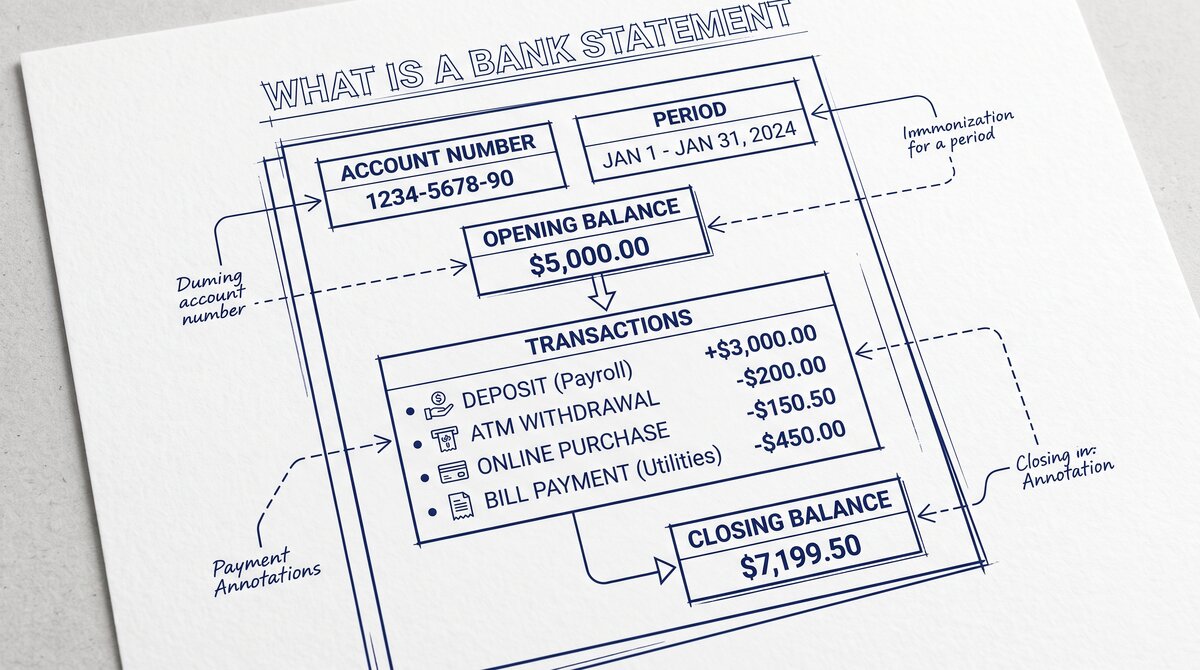

A bank statement is a regulated document issued by a depository institution (bank, credit union, savings & loan) that summarizes the transactions in a customer’s account over a defined period (typically monthly). It is a legal record under the Truth in Savings Act and Regulation E, not just a printout. The 5 things that make it a bank statement: issued by a bank, covers a defined period, contains a transaction list, includes opening and closing balance, and serves as an official record.
TL;DR. A bank statement is a monthly (or quarterly) document from your bank showing every transaction in your account plus the opening/closing balance. It is a regulated document under the Truth in Savings Act and Regulation E, not a marketing piece or a printout. The 5 required components: bank identification, statement period, opening balance, transaction list, closing balance. The 7 common use cases: loan applications, rental applications, tax preparation, bookkeeping, expense reimbursement, account verification, dispute resolution.
What a Bank Statement Is
A bank statement is a document your bank sends you (or makes available electronically) that summarizes the activity in your account over a defined period. The period is typically one month, but can be quarterly for some accounts or weekly for business accounts with high transaction volume.
What most guides miss about this workflow is that the quality depends on the mechanism, not on the tool. Two tools that look different on the surface often run the same 4-step process underneath: read, find, parse, verify. The difference is in how well each step handles edge cases (merged cells, missing balances, non-standard date formats, scanned vs digital input). Choosing between tools based on UI alone misses the actual quality lever.
The statement is not just a record of transactions. It is a legally regulated document with specific content requirements and specific purposes. The legal framework is the Truth in Savings Act (for deposit accounts) and Regulation E (for electronic fund transfers). These laws require the bank to provide certain disclosures, to use certain formats, and to make the statement available within a specific time period after the cycle ends.
The 5 Things That Make It a Bank Statement
A document qualifies as a bank statement if it has 5 things:
Issued by a depository institution: a bank, credit union, savings and loan, or similar institution regulated by a federal or state banking authority. A brokerage statement or a credit card statement is not technically a bank statement.
Covers a defined period: the statement has a clear start date and end date (e.g., “January 1, 2025 to January 31, 2025”). The period is typically a month but can be different.
Contains a transaction list: every deposit, withdrawal, fee, and interest credit in the period, with date, description, and amount. The transaction list is the core of the statement.
Includes opening and closing balance: the balance at the start of the period and the balance at the end. The closing balance is calculated from the opening balance plus the sum of all transactions.
Serves as an official record: the statement is the bank’s official record of the account activity. It can be used as evidence in disputes, tax preparation, loan applications, and legal proceedings.
A document that is missing any of these 5 is not technically a bank statement. A real-time transaction list (e.g., the activity feed in your banking app) has transactions but no defined period and no opening/closing balance. An account summary may have the balances but not the transactions. A transaction history has the transactions but is not a regulated document.
The Legal Status: Why a Bank Statement Is a Regulated Document
A bank statement is a regulated document under two federal laws:
The Truth in Savings Act (TISA)
TISA, implemented by Regulation DD, requires banks to provide uniform disclosures to depositors. The disclosures include:
- Account terms: the interest rate, the annual percentage yield (APY), the minimum balance requirements, the fees
- Periodic statements: the bank must provide a statement for each statement cycle, showing the transactions, the interest earned, the fees charged, and the closing balance
- Notice of changes: the bank must give advance notice of any changes to the account terms
The TISA statement requirements are what define the content of a bank statement. If your statement is missing the interest earned or the fees charged, the bank is violating TISA.
Regulation E (Electronic Fund Transfers)
Regulation E, which implements the Electronic Fund Transfers Act, requires banks to:
- Provide documentation of electronic transfers: every electronic transfer (ATM, ACH, debit card) must be reflected on the periodic statement
- Disclose fees: any fees associated with electronic transfers must be disclosed
- Error resolution procedures: the statement must include information about how to report errors and the bank’s error resolution procedures
- Liability limits: the statement must disclose the customer’s liability for unauthorized transfers
The error resolution procedures are a key reason a bank statement is more than a printout. The statement itself is part of the legal framework for resolving disputes.
What the Legal Status Means in Practice
For the customer, the legal status of the bank statement means:
- The statement is admissible as evidence in disputes
- The bank is required to provide the statement within a specific time period (typically 30 days after the cycle ends)
- The customer has the right to dispute errors within 60 days of receiving the statement
- The statement content is governed by specific rules, not by what the bank chooses to include
For the bank, the legal status means the statement is a compliance document, not just a customer service document. The bank must produce the statement according to specific rules, and the customer can hold the bank accountable if the rules are not followed.
From PDF to Excel in one click
Forget retyping line by line. Upload any bank statement, get a spreadsheet you can actually use. Your files are never stored, and you can test the converter with 3 free conversions.
Try it freeThe 5 Parts of Every Bank Statement
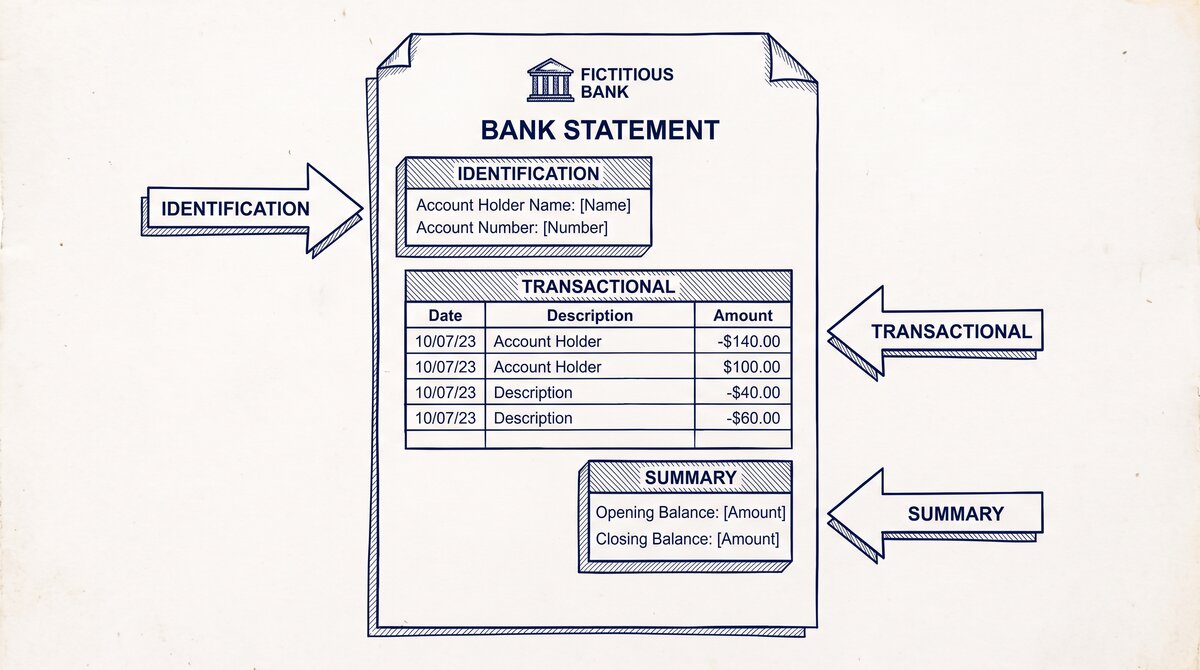
Every bank statement has 5 parts:
1. Bank Identification
The name of the bank, the bank’s logo, the bank’s address, and the customer service contact information. The bank identification is typically at the top of the first page.
2. Account Identification
The account holder’s name, the account number (often partially masked for security), and the account type (checking, savings, money market, etc.).
3. Statement Period
The start and end dates of the statement cycle. The period is the official “scope” of the statement; transactions before the start date or after the end date are not included.
4. Transaction List
The list of every deposit, withdrawal, fee, and interest credit in the period. Each transaction has a date, a description, an amount, and (typically) a running balance.
5. Account Summary
The opening balance (from the prior statement’s closing balance), the closing balance, the total deposits, the total withdrawals, the total fees, the interest earned, and the year-to-date totals.
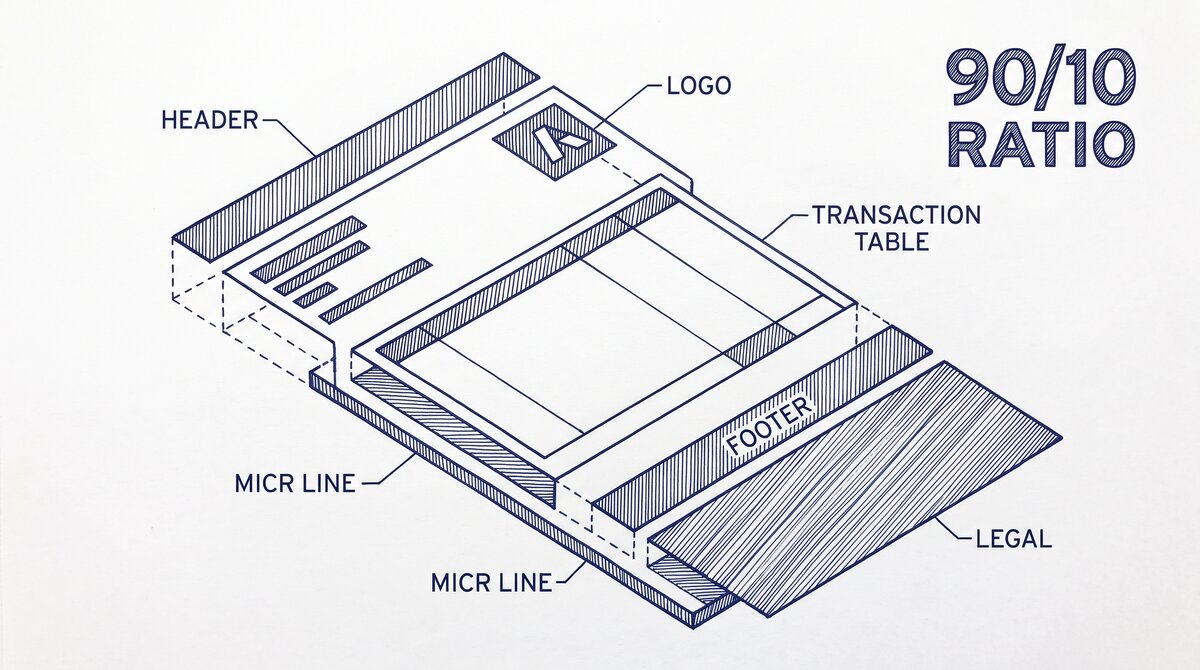
The bank statement anatomy guide covers the structure of these 5 parts in detail, including the 90/10 split between the parts that matter for conversion and the parts that are noise.
Electronic and Digital Bank Statements
An electronic bank statement (also called an e-statement or digital statement) is the same regulated document as a paper statement, delivered as a PDF through your bank’s online portal instead of by mail. The legal status is identical: the Truth in Savings Act and Regulation E apply equally to e-statements and paper statements. The content is identical: the same header, transaction list, opening/closing balance, and summary information.
The difference is delivery and format. A paper statement arrives in your mailbox, on paper, with the transaction list printed. An e-statement arrives in your bank’s online portal, as a PDF, with the same transaction list as digital text you can select, copy, and search. Most US banks default to e-statements for customers who signed up for online banking. You can opt back into paper statements, but e-statements are faster, more searchable, and easier to archive.
The conversion workflow works identically for paper statements (which become scanned PDFs) and e-statements (which are digital PDFs). The only difference is the extraction path: a digital e-statement PDF converts in 1-2 minutes with high accuracy. A scanned paper statement needs OCR and takes 3-5 minutes with a visual review pass. For more on the scanned path, see convert scanned bank statement to Excel.
Who Issues Bank Statements and to Whom
Who Issues
Bank statements are issued by depository institutions: banks, credit unions, savings and loans, and similar institutions. The institution is regulated by a federal agency (FDIC, NCUA, OCC, Federal Reserve) or a state banking regulator.
A non-bank (e.g., a fintech, a brokerage, a money service business) does not issue a bank statement. They may issue a similar document (a “statement of account,” a “transaction report”) but it is not technically a bank statement unless issued by a bank.
Who Receives
The account holder receives the statement. For personal accounts, the account holder is the customer named on the account. For business accounts, the account holder is the business entity, and the statement may go to the business address, to a designated employee, or to an accountant or bookkeeper with authorization.
A bank may also provide the statement to a third party (a lender, a landlord, a tax preparer) at the customer’s request. The third party receives a copy, not the original; the customer retains control of the original.
The 7 Common Use Cases
The 7 common use cases for a bank statement:
1. Loan Applications
Mortgage lenders, auto lenders, and personal loan lenders require bank statements to verify the borrower’s income, assets, and cash flow. Typically 2-3 months of statements are required for a personal loan; 2-3 years for a mortgage.
2. Rental Applications
Landlords and property management companies require bank statements to verify the tenant’s ability to pay rent. Typically 2-3 months of statements are required.
3. Tax Preparation
Self-employed individuals and small business owners use bank statements to prepare Schedule C, to verify income, and to substantiate deductions. The 1099 contractor and small business use case is covered in bank statements for tax preparers.
4. Bookkeeping
Bookkeepers use bank statements to reconcile the bank account in the accounting system (QuickBooks, Xero, Wave). The statement is the source of truth for the account activity.
5. Expense Reimbursement
Employees submit bank statements to verify business expenses paid from personal accounts. The employer uses the statement to confirm the expense was actually paid.
6. Account Verification
Some institutions (brokerages, government agencies, employers) require a bank statement to verify that the customer has a bank account. The statement serves as proof of the account.
7. Dispute Resolution
Customers use bank statements to dispute unauthorized transactions, errors, or fees. The statement is the evidence in the dispute.
The bank statement for applications guide covers the loan and rental use cases. The bank statement for real estate agents covers the real estate workflow.
A common failure mode bookkeepers report is treating this as a single operation rather than a chain of dependent steps. The temptation is to find a tool that ‘just works’ and stop investigating the mechanism. The result is a wrong-fix cycle: the tool gives partial output, the bookkeeper spends 30+ minutes troubleshooting, the fix is for the wrong step, and the same error recurs on the next statement. The fix: identify which step failed and apply the right intervention to that step.
The Difference Between a Bank Statement, a Transaction History, and an Account Summary
A bank statement is not the same as a transaction history or an account summary. The three documents serve different purposes.
| Document | Frequency | Content | Legal Status | Use Case |
|---|---|---|---|---|
| Bank statement | Monthly or quarterly | Transactions + summary | Regulated (TISA, Reg E) | Loan, tax, dispute, official record |
| Transaction history | Real-time | Transactions only | Not regulated | Quick check, working document |
| Account summary | On demand | Balances only | Not regulated | Quick balance check |
The bank statement vs transaction history article covers the comparison in detail, including the 6 specific differences and the 3 edge cases where the documents overlap.
If you want to know how a bank statement is laid out, see bank statement anatomy. For a column-by-column field reference, see bank statement fields explained. For the output spec, see bank statement CSV format.
If you want to know what each part of a statement means, read what information is on a bank statement. To see how the data is pulled out, see bank statement data extraction. If you want to convert a statement, use the bank statement converter. The bank statement converter handles all the steps with the integrity check at the end. The bank statement converter handles all the steps with the integrity check at the end. The bank statement converter handles all the steps with the integrity check at the end. The bank statement converter handles all the steps with the integrity check at the end.
Turn any PDF statement into a clean sheet
Skip the typos and the hours of copying. Our converter handles any bank statement format and outputs Excel, CSV, or QBO for QuickBooks. No file retention, free to try.
Convert your statement