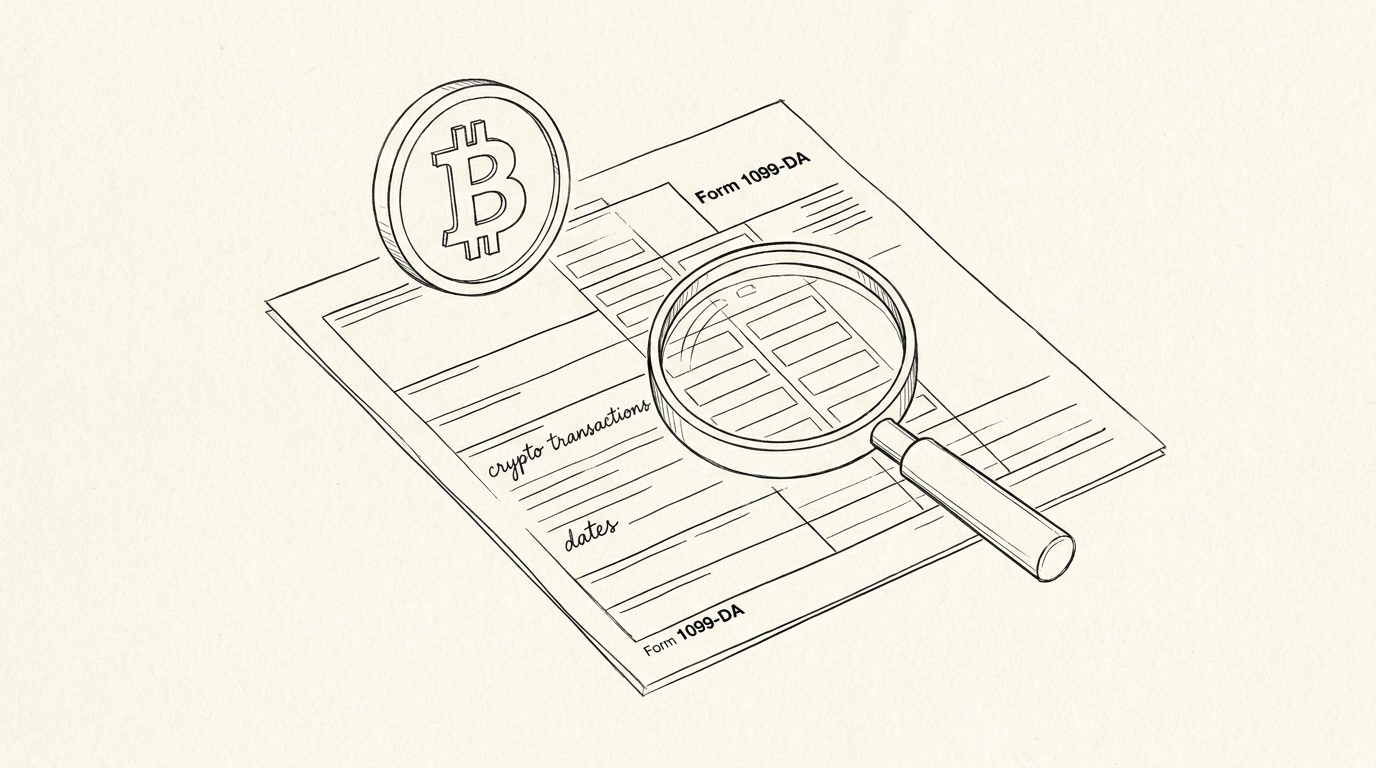

If you handle your own crypto taxes, the IRS now has a paper trail that may not match yours.
Form 1099-DA, the new digital-asset reporting form, went live for the 2025 tax year (transactions in 2025, forms issued in early 2026).
It changes what a do-it-yourself filer can rely on, what they still have to track, and where the rough edges are.
The short answer: 1099-DA is the IRS’s broker reporting form for digital asset transactions.
For the first time, the agency gets a copy of your crypto sales, exchanges, and cost basis directly from your broker.
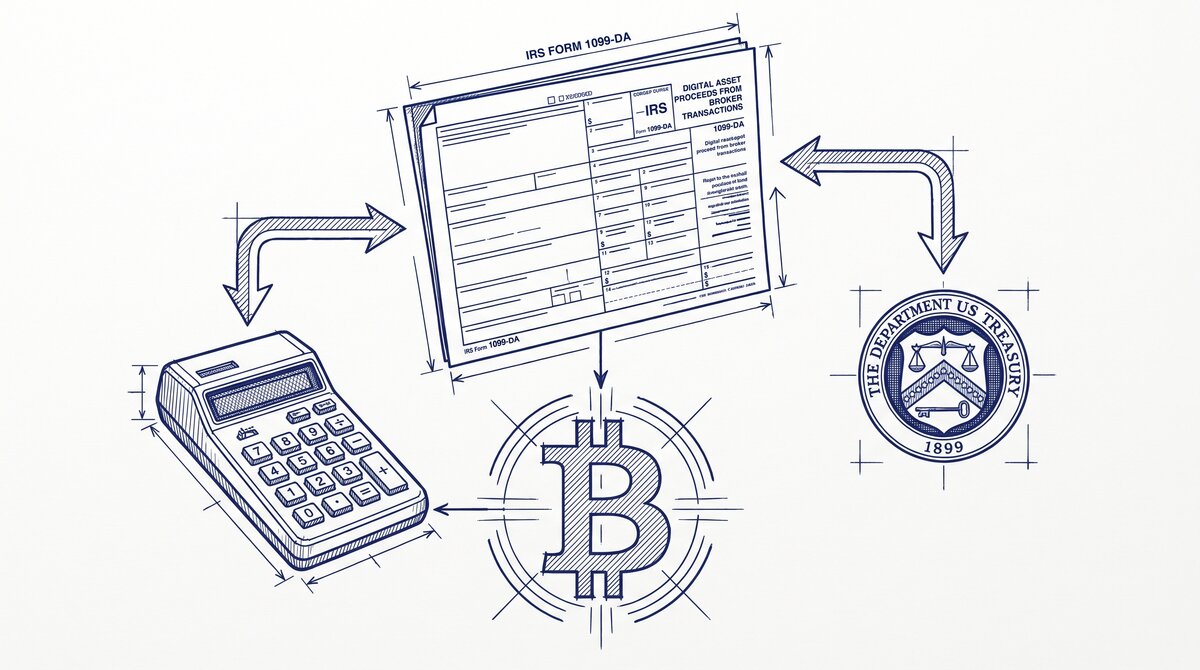
It is the bridge from broker records to the wider 1099-DA workflow the rest of your tax return sits on.
This article is for the small-business owner or independent investor who is still doing their own crypto tax prep.
It covers what to expect, what is automated, and what is still on them.
1099-DA is the new IRS digital-asset reporting form.
Brokers must send it to you and the IRS for 2025 transactions.
It reports gross proceeds and (starting later) cost basis, but it does not cover every transaction you made.
It does not replace your own records.
DIY filers still need to reconcile 1099-DA against their own transaction history before filing.
When in doubt, consult your tax professional.
Why 1099-DA Exists and What Changed in 2025
For most of crypto’s history, the IRS had almost no broker-issued paperwork on digital assets.
Brokers were not required to issue transaction forms.
The agency relied on taxpayers to self-report, with predictably inconsistent results.
Form 1099-DA is the IRS’s fix: a dedicated reporting form modeled on the long-standing 1099-B for securities, but built for digital assets like Bitcoin, Ethereum, stablecoins, and NFTs.
The phased rollout
- 2025 tax year (forms issued in early 2026): brokers must report gross proceeds from digital asset sales and exchanges.
- 2026 tax year (forms issued in early 2027): brokers must also report cost basis, where tracked.
- 2027 tax year onward: full cost basis reporting and additional transaction types.
For a DIY filer, the immediate change is practical.
Starting with your 2025 return, you should expect a 1099-DA from every broker you used: Coinbase, Kraken, Gemini, Robinhood Crypto, and others.
The IRS will receive a copy at the same time.
The full mechanics of the form, including which boxes matter, are covered in the 1099-DA form explainer.
The 4 Things 1099-DA Reports About Your Crypto
Form 1099-DA is not a complete record of your crypto activity.
It is a broker’s view of the transactions they processed for you.
The four things it actually covers are:
- Box A: gross proceeds from every sale of digital assets for cash (for example, selling BTC for USD).
- Box B: cost basis for covered transactions, phased in starting with the 2026 tax year.
- Transaction type (sale, exchange, transfer, or other) to help match the entry to a tax form.
- Asset identifier and quantity so the IRS can reconcile your report against what the broker reported.
For DIY filers, the practical takeaway is that 1099-DA gives you the dollar amounts the IRS already knows about.
If your records do not match, the IRS will see the gap.
That is why the 1099-DA pillar emphasizes reconciliation as the first operational step.
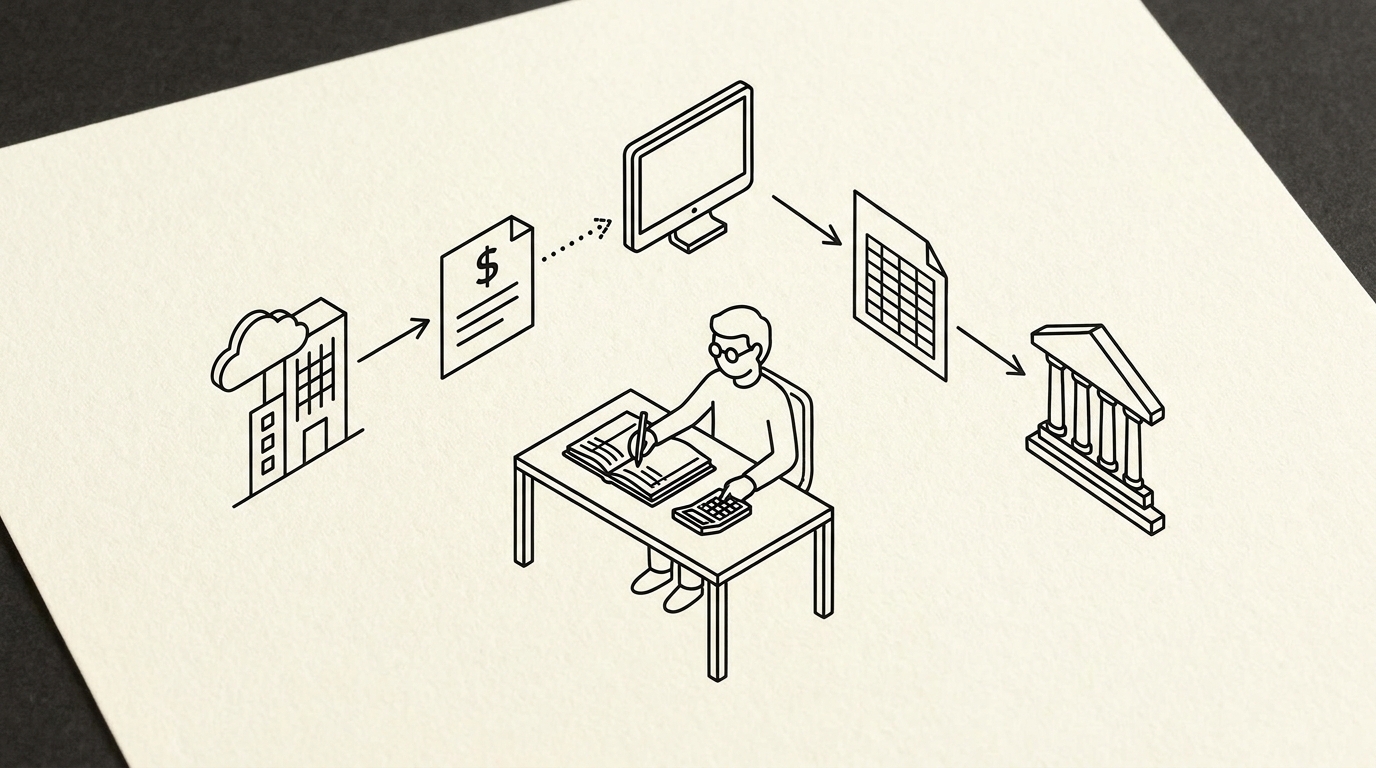
Pull the form, line it up against your own transaction history, and resolve differences before you file.
Turn That PDF Into a Spreadsheet in Minutes
You've seen how to do it manually — now let the tool handle the heavy lifting. Upload your bank statement and get Excel, CSV, or QBO in a few clicks.
Try It FreeThe 3 Things 1099-DA Does Not Report
Equally important for DIY filers is what 1099-DA leaves out.
The form is a broker-to-IRS document, not a comprehensive crypto tax statement.
Three things are not on it:
- On-chain activity without a broker. If you moved crypto between your own wallets, used decentralized exchanges, bridged assets across chains, or earned staking or airdrop income that did not pass through a custodial broker, those transactions are not reported to the IRS on a 1099-DA. You are still on the hook for tracking and reporting them yourself.
- Pre-2025 transactions. The first wave of 1099-DA forms covers 2025 activity. Anything that happened in 2024 or earlier still relies on the same self-reporting approach that was used before the form existed.
- Income character classification. 1099-DA reports the dollar amount and the transaction, but it does not tell the IRS, or you, whether a transaction is a capital gain, ordinary income, or a non-taxable transfer. The form hands you data; the tax characterization is still on you.
For a small-business owner doing their own books, this is the part that is easy to underestimate.
The 1099-DA is a useful starting dataset, but it is not the same as a complete crypto tax statement built from your actual transaction history.
The 1099-DA shows what your broker saw.
Your tax return needs to cover everything.
What 1099-DA Means If You Are a DIY Filer
The form changes the work in two ways: it removes some of it and creates new work elsewhere.
What gets easier
You no longer need to dig through exchange transaction histories to recover the dollar amount of every sale and exchange your broker processed.
The 1099-DA gives you a single broker-issued total for gross proceeds.
Starting in 2026, you also get a single broker-issued total for cost basis.
The number on the form is the number on the form.
The IRS has the same one.
What gets harder
Because the IRS now has broker data, mismatches are easier to spot.
A 1099-DA showing a $40,000 gross proceeds figure that does not appear anywhere in your tax return is a flag, not a footnote.
DIY filers who previously skipped a few small transactions, rounded exchange totals, or used a single cost basis assumption across brokers now have to reconcile against a third party: the broker.
That broker has its own record.
How to avoid the most common reconciliation errors is summarized in the crypto tax mistakes guide.
For a DIY filer, the rule of thumb is: the 1099-DA is the floor, not the ceiling.
It tells you what the IRS already knows.
Your return should at least cover that, and, if you had on-chain activity, more than that.
Any specific reporting decision (for example, how to treat a wallet-to-wallet transfer, or whether a particular staking reward is ordinary income) should be discussed with your tax professional before you file.
The 5 Gaps DIY Filers Need to Fill Manually
Even with a clean 1099-DA in hand, five categories of work stay on the DIY filer.
None of these are complicated individually, but together they are the difference between a tax return that reconciles and one that does not.
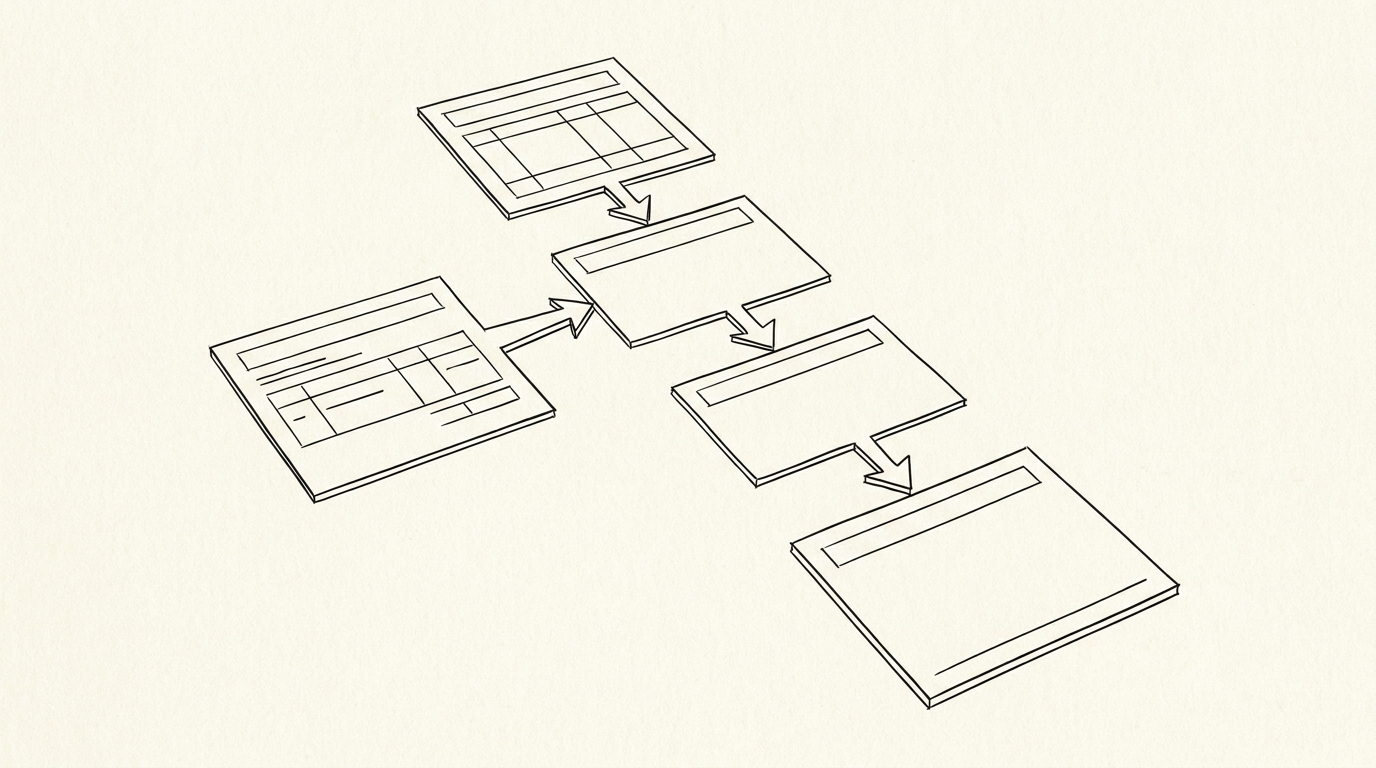
Reconcile broker totals to your own records
Pull every 1099-DA, sum gross proceeds by broker, and compare against your own year-end transaction exports.
Mismatches under a few dollars are usually rounding.
Larger gaps need investigation.
Reconstruct on-chain activity
Pull a complete transaction history from every self-custody wallet and DeFi protocol you used.
Map each transaction to a tax category (sale, exchange, income, transfer) and a fair-market value at the time of the transaction.
Apply a consistent cost basis method
FIFO, specific identification, and HIFO produce different numbers.
1099-DA does not pick one for you.
The choice has to be consistent across all your crypto, and applied correctly to every lot.
Classify income transactions
Staking rewards, airdrops, mining income, and interest from lending protocols are ordinary income at fair market value when received.
They may later be sold and trigger a capital gain.
1099-DA does not split these out.
Track cost basis for non-covered assets
For assets acquired before the relevant 1099-DA coverage date, or in transactions your broker did not process, you need to track cost basis yourself.
Without it, gains default to the full sale price.
Each of these steps is mechanical, but they are not free.
The volume of data is the real issue.
A year of moderate DeFi activity can mean hundreds or thousands of transactions.
Doing this by hand in a spreadsheet is possible, but the error rate is high.
This is the part of DIY crypto tax prep where most filers underestimate the work and where a small-business owner balancing books has the least time.
The 3 Best Practices for DIY Crypto Tax Filing
If you are filing your own crypto taxes under 1099-DA, three practices reduce the chance of a mismatched return or a follow-up letter from the IRS.
None of them require a CPA, but they all benefit from a review by one before you file.
Treat the 1099-DA as a reconciliation document, not a tax return
The form is data.
Your tax return is the result.
Pull the form, reconcile it against your own records, and only then transfer numbers to your return.
Skipping the reconciliation step is the single most common cause of IRS notices for crypto filers in 2025 and beyond.
Keep a single, dated, year-end record
Whether you use a spreadsheet or a crypto tax tool, the output should be one consolidated file per year: every transaction, with date, asset, quantity, cost basis, proceeds, gain/loss, and the data source.
This is the file you can hand to a tax professional, an auditor, or your future self if the cost basis question comes up two years later.
The crypto tax statement format covers the columns and structure that hold up under review.
Have a tax professional review the final return
Even if you prepare the numbers yourself, a CPA or Enrolled Agent with crypto experience will catch classification errors, basis-method mistakes, and missing income events that are easy to miss.
This is especially important for the first year you file with a 1099-DA, because the rules and the broker reporting are both still settling.
Consult your tax professional on the specific reporting choices before you submit.
1099-DA is a structural change, not a workflow change.
The new form makes broker-reported transactions visible to the IRS for the first time.
However, it does not change what is taxable or how it is reported.
The work that was already yours (tracking on-chain activity, applying a cost basis method, classifying income, and reconciling against broker data) is still yours.
The new form just makes it visible when that work is skipped.
For a small-business owner or independent investor doing their own crypto tax prep, the practical impact is this: pull every 1099-DA, reconcile it against your own year-end records, fill in the gaps your broker did not see, and have the result reviewed by a qualified tax professional before you file.
The form helps, but it does not replace the work.
When a specific reporting question comes up (which form a wrapped crypto transaction goes on, how a particular DeFi event is classified, whether a transfer is taxable), consult your tax professional rather than guess.
If you trade on Coinbase, Kraken, or Gemini, the cleanest first step is converting the year’s monthly statements to Excel.
That way you can review what the broker 1099-DA does not tell you.
Related: complete 1099-DA crypto tax guide
This topic is part of the broader 1099-DA and crypto-tax cluster on this site. The consolidated hub for the entire topic, including the form mechanics, broker requirements, cost basis methods, reconciling to bank statements, and state-level differences, now lives in the complete 1099-DA crypto tax reporting guide.
For related reading, the complete US bank payment rails guide covers ACH and wire cash flows from crypto exchanges, and the complete MCC guide covers merchant category codes on credit-card statements. The expanded bank statement anatomy pairs naturally with this hub.
From Bank Statement to QuickBooks-Ready File
That manual cleanup you just read about? This tool skips it. Turn your PDF into QBO for QuickBooks without storing your data anywhere.
Start Converting