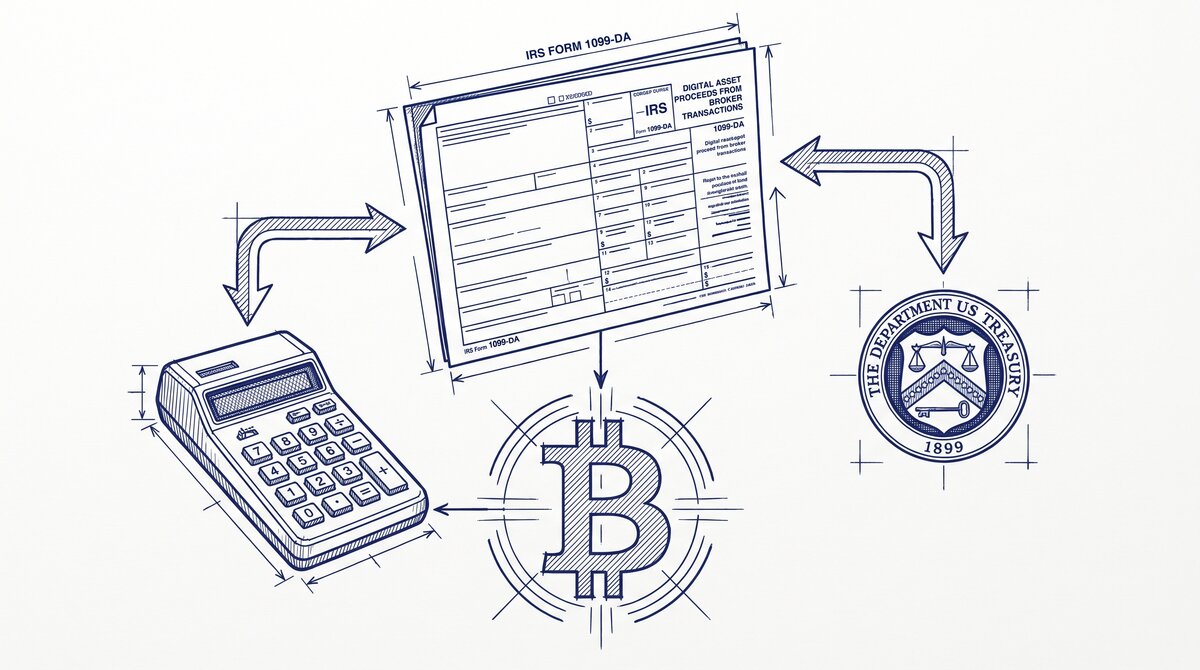

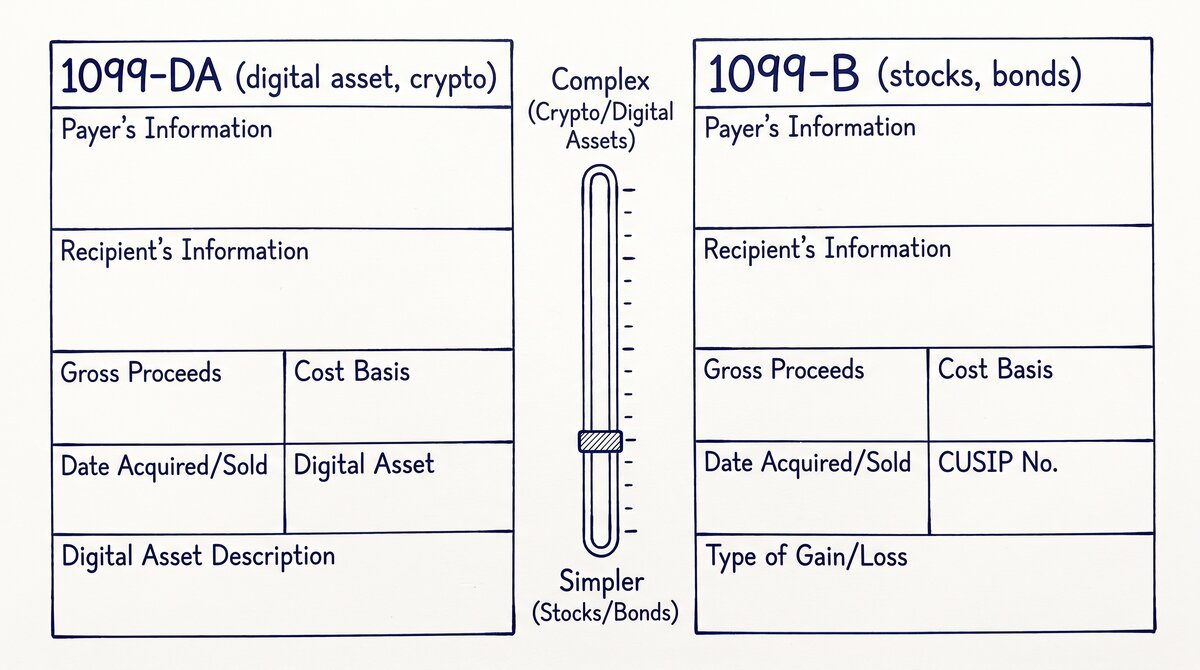
Form 1099-DA is the new IRS form for digital asset transactions, required from brokers starting with the 2025 tax year. The short answer: 1099-DA is the IRS form that brokers must issue to customers and the IRS for every digital asset transaction in 2025 and beyond. The form includes gross proceeds, cost basis, and gain/loss for each transaction. The form simplifies tax preparation but also reduces the taxpayer’s flexibility in choosing the cost basis method.
TL;DR. 1099-DA is the new IRS form for digital asset transactions starting with the 2025 tax year. The 4 sections: broker info, customer info, transaction details (gross proceeds, cost basis, gain/loss), tax summary. The 3 main impacts: (1) brokers must report to the IRS, not just to the customer, (2) cost basis on the form is binding, (3) the form simplifies reconciliation across brokers. The 3 common questions: what to do if the form is wrong, how to handle transfers between wallets, and how to handle staking/airdrops. The 3 best practices: keep records of all transactions, verify the form against your own records, and consult a crypto-knowledgeable CPA.
Why 1099-DA Exists
1099-DA exists because digital assets grew from a niche market to a major asset class, and the existing tax reporting framework (1099-B for stocks, no form for crypto) was inadequate. The IRS estimated that the tax gap from unreported crypto transactions was in the billions of dollars annually. The 1099-DA form closes that gap by requiring brokers to report every transaction to the IRS.
What most guides miss about crypto tax reporting is that the quality depends on the mechanism, not on the tool. Two tools that look different on the surface often run the same 4-step process underneath: read, find, parse, verify. The difference is in how well each step handles edge cases (merged cells, missing balances, non-standard date formats, scanned vs digital input). Choosing between tools based on UI alone misses the actual quality lever.
The form was proposed in 2023 and finalized in 2024. The first reporting year is 2025, with the first forms issued in early 2026. The form applies to all digital assets (cryptocurrencies, NFTs, stablecoins) and to all brokers (centralized exchanges, payment processors, and certain wallet providers). The form does not apply to non-custodial wallets (where the user holds their own keys).
For the form definition, see the what is 1099-DA form reference.
The 4 Sections of 1099-DA
4 sections that cover the complete reporting for digital asset transactions:
1. Broker information. The broker’s name, address, EIN, and contact information. The broker is the entity that issued the form. For most taxpayers, the broker is the exchange (Coinbase, Kraken, Gemini, etc.).
2. Customer information. The customer’s name, address, SSN/TIN, and account number. The customer is the taxpayer who owned the digital asset. The information matches the information on the customer’s tax return.
3. Transaction details. The transaction-by-transaction list including: date of acquisition, date of sale, proceeds from the sale, cost basis, gain/loss, and the digital asset identifier (typically the ticker symbol like BTC or ETH). The transaction details are the core of the form and are the data the customer uses for tax filing.
4. Tax summary. The aggregate totals for the year: total proceeds, total cost basis, total gain/loss, total number of transactions. The tax summary is a quick reference for the customer and the IRS. The summary should match the sum of the transaction details.
From Bank Statement to QuickBooks-Ready File
That manual cleanup you just read about? This tool skips it. Turn your PDF into QBO for QuickBooks without storing your data anywhere.
Start ConvertingThe 3 Main Impacts
3 main impacts of 1099-DA on taxpayers:
1. Brokers must report to the IRS. Before 1099-DA, brokers reported transactions to the customer but not to the IRS. The customer was responsible for self-reporting. With 1099-DA, the IRS receives a copy of every form. The IRS can match the form against the customer’s tax return, and any discrepancy is flagged for review. The result: the customer must report accurately.
2. Cost basis on the form is binding (in most cases). The 1099-DA form reports the cost basis as calculated by the broker. If the customer’s own records show a different cost basis, the form is typically the source of truth. The customer cannot choose a different cost basis method if the broker has already reported one. The result: the customer must verify the form and reconcile with their own records.
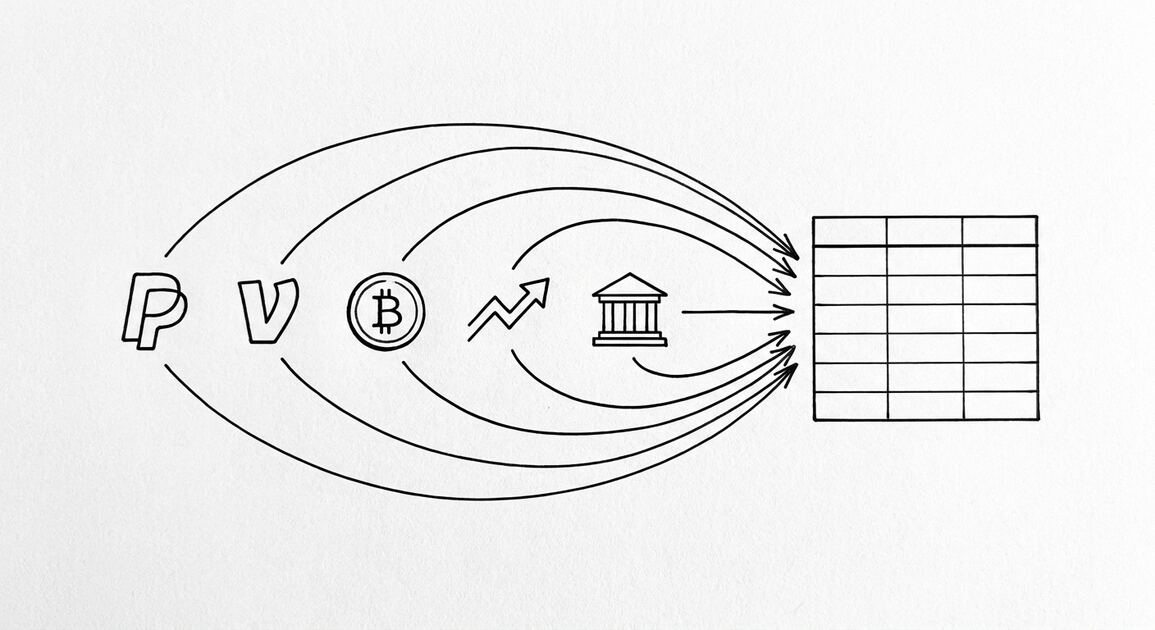
3. The form simplifies reconciliation across brokers. The standardized form makes it easier to combine data from multiple brokers. The customer can match each transaction in their records to the form. The result: a single tax filing is easier with multiple broker accounts.
The 3 Common Questions
3 questions that come up frequently with 1099-DA:
1. What to do if the form is wrong. The form may be wrong if the broker has a different cost basis than the customer’s records, or if the broker has missing or duplicate transactions. The fix: contact the broker to correct the form. The broker issues a corrected form, and the customer uses the corrected form for the tax return. The customer should not file based on an incorrect form.
2. How to handle transfers between wallets. A transfer from one wallet to another is not a taxable event (no gain/loss is realized). The form should not include transfers between the customer’s own wallets. If the form incorrectly includes a transfer, the customer should report it as a non-taxable transfer on the tax return (typically with a disclosure).
3. How to handle staking and airdrops. Staking rewards and airdrops are taxable income at the time of receipt. The form should include the fair market value at the time of receipt. If the form does not include staking or airdrops, the customer must add them to the tax return based on their own records.
For the 1099-DA context, see the 1099-DA broker reporting requirements reference. For the reconciliation, see the 1099-DA bank statement reconciliation page.
The 5-Step Filing Process
5 steps to file taxes with 1099-DA:
- Collect 1099-DA forms from all brokers. The forms are issued in January-February for the prior tax year. The collection is 1-2 weeks (forms arrive at different times).
- Reconcile each form with your own records. Compare the form to the customer’s own transaction records (from the exchange’s tax report or from the wallet). The reconciliation is 30-60 minutes per broker.
- Identify any discrepancies and request corrected forms. If the form has errors, contact the broker for a corrected form. The corrected form is typically issued within 30-60 days.
- Generate Form 8949 and Schedule D. The 8949 lists every transaction with the date, proceeds, cost basis, and gain/loss. The Schedule D summarizes the 8949 by short-term and long-term gains/losses. The generation is 1-2 hours for 50-200 transactions.
- Include the digital asset question on Form 1040. The 1040 has a yes/no question: “At any time during 2025, did you receive, sell, exchange, or otherwise dispose of any digital asset?” The answer is yes for any taxpayer with crypto activity.
Total time: 3-5 hours for a typical taxpayer with 1-3 brokers and 50-200 transactions. For more complex situations (multiple wallets, DeFi, staking), the time is 10-20 hours.
The 3 Cost Basis Methods on 1099-DA
3 cost basis methods that may appear on 1099-DA:
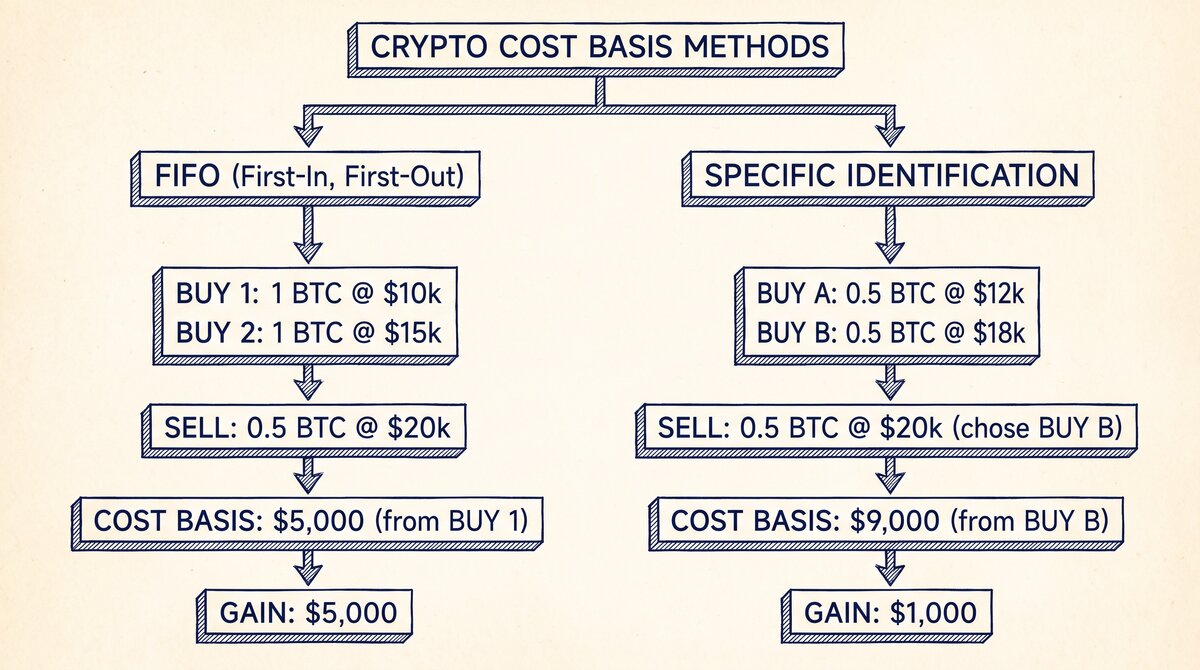
1. FIFO (first-in-first-out). The default. The broker uses FIFO to calculate the cost basis for every sale. The form reports the FIFO cost basis. The customer cannot choose a different method if the broker has reported FIFO.
2. Specific identification. The customer can choose specific lots to sell. The broker must support specific identification, and the customer must elect it before the sale. The form reports the specific lots used.
3. Average cost. Some brokers offer average cost for mutual funds and similar assets. The form reports the average cost. Average cost is rare for crypto and is typically not used.
The 3 methods are the standard options. The form reports the method used. The customer should verify the method is consistent with their preferences and the broker’s capabilities.
The 4 Most Common Issues
4 issues that come up frequently with 1099-DA:
1. Missing forms from some brokers. The customer used 2 exchanges during the year, but only 1 issued a 1099-DA. The other may be late, or may not be subject to the requirement. The fix: contact the broker that didn’t issue a form to confirm. If the broker is required but didn’t issue, the customer must report based on their own records.
2. Incorrect cost basis. The form reports a different cost basis than the customer’s records. The cause is typically a different method (FIFO vs specific ID) or a different acquisition source (e.g., the broker didn’t have a record of an acquisition from another platform). The fix: contact the broker for a corrected form or document the discrepancy on the tax return.
3. Missing or duplicate transactions. The form has transactions the customer doesn’t have, or is missing transactions the customer has. The fix: reconcile against the customer’s records and request a corrected form if needed.
4. Transfers between the customer’s own wallets reported as sales. A transfer between two wallets the customer owns is not a sale. The form should not report it. If the form does, the customer should report it as a non-taxable transfer on the tax return (with a disclosure).
The 3 Best Practices
3 best practices for handling 1099-DA:
1. Keep records of all transactions. The customer should maintain a transaction log that includes every buy, sell, swap, stake, unstake, transfer, airdrop, and gift. The log is the source of truth for any discrepancy with the form.
2. Verify the form against your own records. The reconciliation takes 30-60 minutes per broker. The investment prevents errors on the tax return. The IRS may match the form to the return, and any discrepancy may trigger an audit or inquiry.
3. Consult a crypto-knowledgeable CPA. The crypto tax rules are complex and evolving. A CPA who is familiar with crypto can help with the reconciliation, the cost basis method, and any unusual transactions (DeFi, staking, airdrops, forks).
Tools and Resources
3 tools that make 1099-DA handling faster:
A common failure mode bookkeepers report is treating this as a single operation rather than a chain of dependent steps. The temptation is to find a tool that ‘just works’ and stop investigating the mechanism. The result is a wrong-fix cycle: the tool gives partial output, the bookkeeper spends 30+ minutes troubleshooting, the fix is for the wrong step, and the same error recurs on the next statement. The fix: identify which step failed and apply the right intervention to that step.
Related Resources
| Resource | What You Get |
|---|---|
| Bank Statement Converter | Convert to Excel |
| What Is 1099-Da Form | See reference |
| 1099-Da Broker Requirements | See reference |
| 1099-Da Cost Basis | See reference |
| 1099-Da Bank Statement Reconciliation | See reference |
- Crypto tax software: CoinTracker, Koinly, or TokenTax. The software can import the 1099-DA form and match it against the customer’s records. The matching is automatic and flags any discrepancies.
- Spreadsheet for manual reconciliation: Excel or Google Sheets with the form data on one tab and the customer’s records on another tab. The reconciliation uses VLOOKUP or INDEX/MATCH to match transactions.
- Crypto-knowledgeable CPA: For complex situations, a CPA can handle the reconciliation and the tax filing. The CPA fee is $500-2,000 for a typical 1099-DA filing.
For the 1099-DA context, see the what is 1099-DA form reference. For the broker requirements, see the 1099-DA broker reporting requirements page. For the cost basis methods, see the 1099-DA cost basis methods reference. For the bank statement reconciliation, see the 1099-DA bank statement reconciliation page. For the comparison to 1099-B, see the 1099-DA vs 1099-B difference reference. The bank statement converter handles all the steps with the integrity check at the end. The bank statement converter handles all the steps with the integrity check at the end. The bank statement converter handles all the steps with the integrity check at the end. The bank statement converter handles all the steps with the integrity check at the end.
Related: complete 1099-DA crypto tax guide
This topic is part of the broader 1099-DA and crypto-tax cluster on this site. The consolidated hub for the entire topic, including the form mechanics, broker requirements, cost basis methods, reconciling to bank statements, and state-level differences, now lives in the complete 1099-DA crypto tax reporting guide.
For related reading, the complete US bank payment rails guide covers ACH and wire cash flows from crypto exchanges, and the complete MCC guide covers merchant category codes on credit-card statements. The expanded bank statement anatomy pairs naturally with this hub.
From PDF to Excel in one click
Forget retyping line by line. Upload any bank statement, get a spreadsheet you can actually use. Your files are never stored, and you can test the converter with 3 free conversions.
Try it free