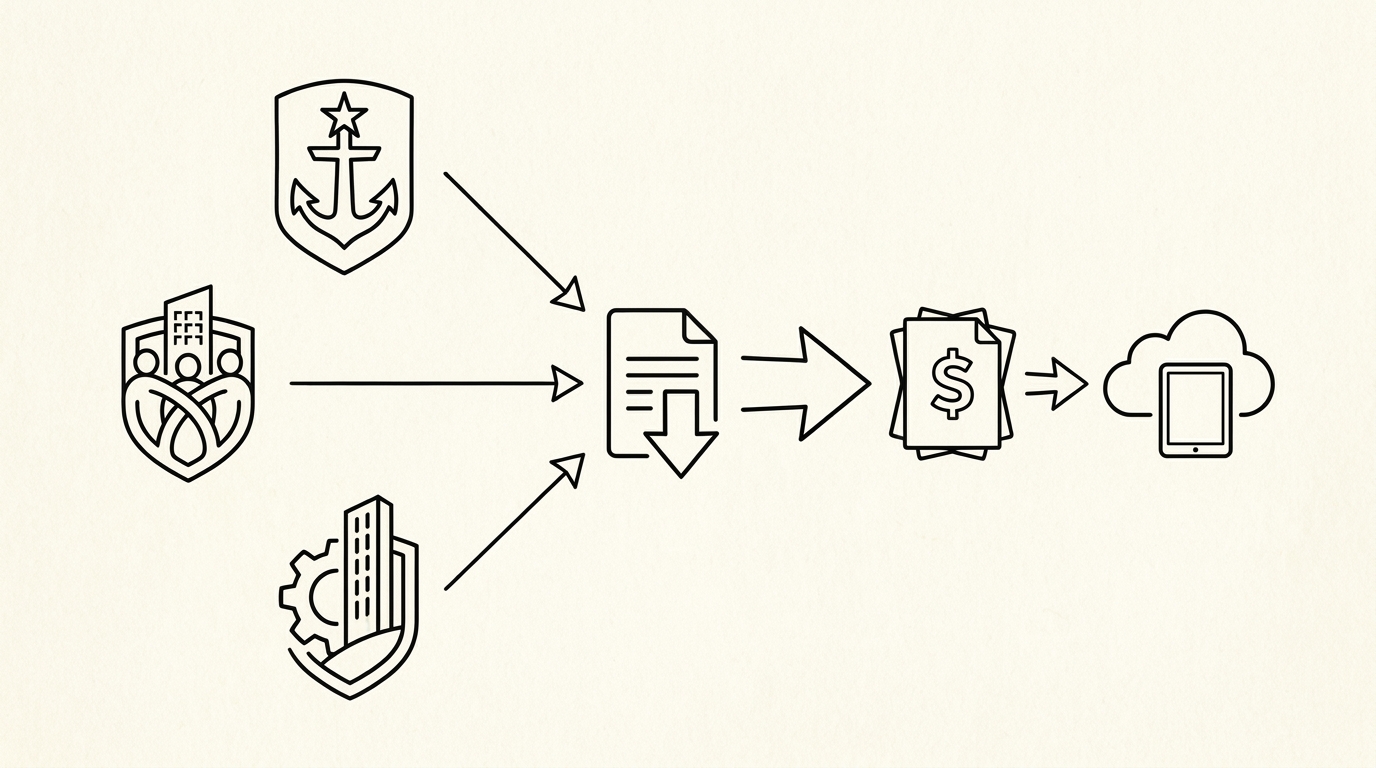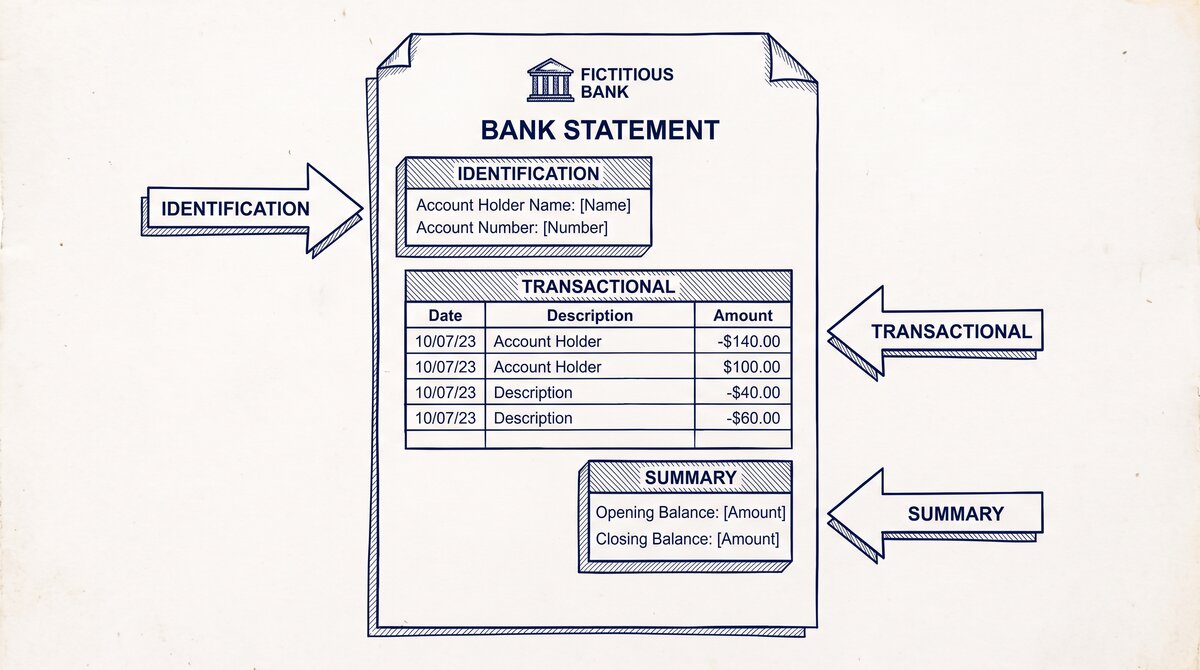

A bank statement is a monthly document from your bank showing all transactions. A bank statement loan is a mortgage product that uses 12-24 months
The short answer: a bank statement is a financial record; a bank statement loan is a loan product. The bank statement is the input to the bank statement loan underwriting. The two are tightly connected: you need good bank statements to qualify for a bank statement loan, but the bank statement itself is just a document, not a loan product.
TL;DR. A bank statement is a document your bank sends monthly. A bank statement loan is a mortgage that uses 12-24 months of those documents to verify your income instead of tax returns. The 5 differences: purpose (record vs loan), source (bank vs lender), format (PDF vs loan product), requirements (none vs 2+ years in business), and interest rate (n/a vs 0.5-1.0% higher than traditional). The 3 cases where the bank statement loan matters: self-employed with high expenses, 1099 contractors, and borrowers without 2 years of tax returns.
What Is a Bank Statement
A bank statement is a formal document issued by the bank at the end of each statement cycle (typically monthly). The statement covers a fixed period (e.g., January 1 to January 31), includes all transactions that posted during that period, and is the official record for the account.
What most guides miss about this workflow is that the quality depends on the mechanism, not on the tool. Two tools that look different on the surface often run the same 4-step process underneath: read, find, parse, verify. The difference is in how well each step handles edge cases (merged cells, missing balances, non-standard date formats, scanned vs digital input). Choosing between tools based on UI alone misses the actual quality lever.
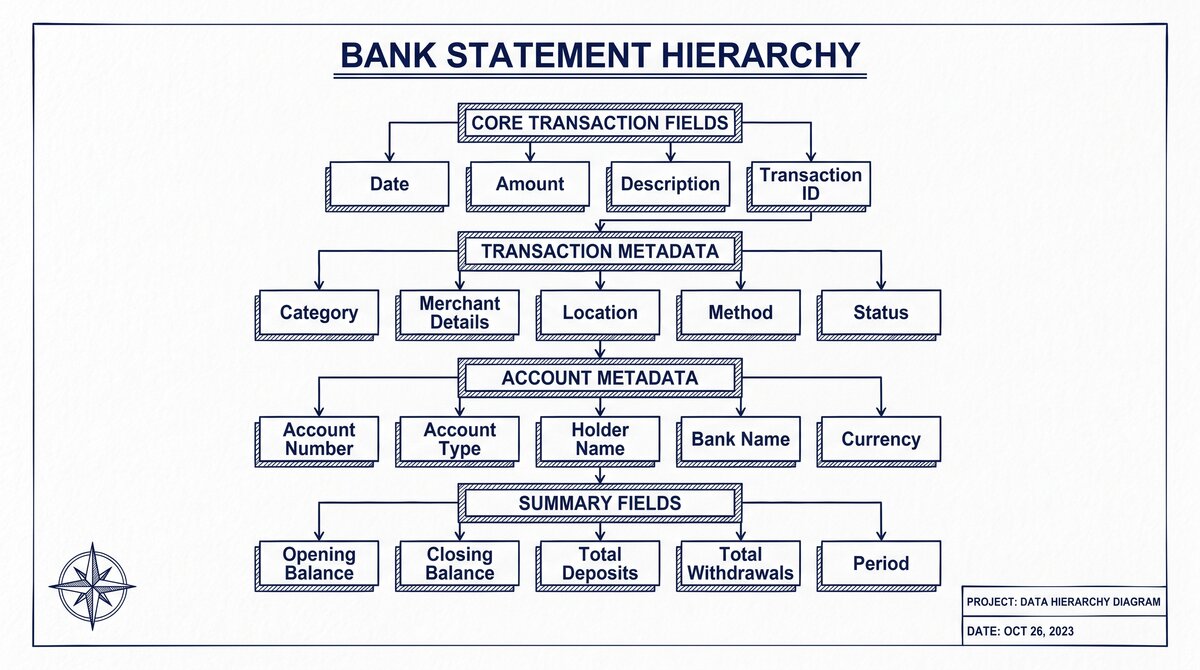
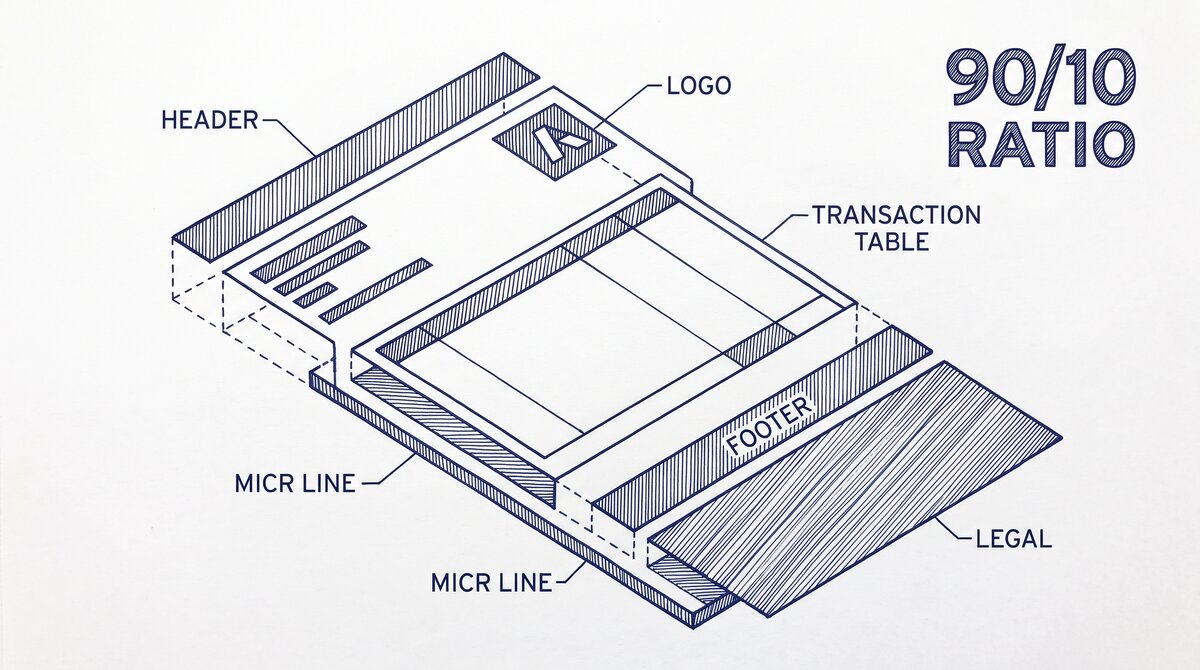
The statement has 4 sections: header (account info, period, opening balance), transaction table (all transactions with date, description, amount, balance), footer (closing balance, totals, fees), and account info (customer service, FDIC notice). The statement is typically 2-5 pages for a personal account and 5-30 pages for a business account.
The statement is provided as a PDF (downloadable from online banking) or as a paper document (mailed). The PDF is the standard for most banks. The statement is the legal record of the account for the period and is accepted by the IRS, courts, lenders, and most other institutions.
For the 4 sections in detail, see the how to read a bank statement guide. For the PDF vs paper comparison, see the bank statement PDF vs paper reference.
What Is a Bank Statement Loan
A bank statement loan is a mortgage product that uses 12-24 months of bank statements to verify the borrower’s income, instead of using tax returns and W-2s. The lender reviews the bank statements, calculates the average monthly deposits, and uses the average as the qualifying income.
The loan is designed for self-employed borrowers (1099 contractors, freelancers, small business owners) who have strong actual income but low taxable income due to business deductions. A traditional mortgage uses the tax return’s net income, which understates the borrower’s true cash flow. The bank statement loan uses the deposits, which reflect the actual cash flow.
Bank statement loans are offered by portfolio lenders, non-QM lenders, and some credit unions. The loans typically have 0.5-1.0% higher rates than traditional mortgages, 10-20% down payment requirements, and 620+ credit score minimum. The loans close in 45-60 days, compared to 30-45 days for traditional mortgages.
For the full comparison, see the bank statement loan vs traditional mortgage guide. For the self-employed mortgage context, see the self-employed mortgage application reference.
Turn That PDF Into a Spreadsheet in Minutes
You've seen how to do it manually — now let the tool handle the heavy lifting. Upload your bank statement and get Excel, CSV, or QBO in a few clicks.
Try It Free5 Differences Between Bank Statement and Bank Statement Loan
5 specific differences that matter for home buyers:
1. Purpose. A bank statement is a financial record. It documents what happened in the account during a period. A bank statement loan is a loan product. It uses bank statements (the documents) to make a lending decision. The bank statement is the input; the loan is the output.
2. Source. A bank statement comes from the bank. The bank issues the statement monthly and provides it to the account holder. A bank statement loan comes from a lender. The lender underwrites the loan based on the bank statements provided by the borrower.
3. Format. A bank statement is a PDF (or paper document). The format is standardized by federal regulation and banking practice. A bank statement loan is a loan product with terms, rate, payment, and amortization. The format is set by the lender and varies by lender and loan program.
4. Requirements. A bank statement has no requirements; the bank issues it to all account holders. A bank statement loan has requirements: 12-24 months of statements, 2+ years in business, 10-20% down payment, 620+ credit score, and 2-3 months of reserves. The lender’s requirements ensure the borrower can repay the loan.
5. Interest rate. A bank statement has no interest rate; it’s a document, not a loan. A bank statement loan has an interest rate that is 0.5-1.0% higher than a traditional mortgage. The higher rate reflects the higher risk of the non-traditional documentation.
3 Cases Where the Bank Statement Loan Matters
3 cases where the bank statement loan is the right choice for the borrower:
1. Self-employed with high business expenses. A borrower who has $300K in business revenue but $200K in business expenses (showing only $100K net income on the tax return) can qualify for a much higher loan with a bank statement loan. The lender uses the $300K revenue, not the $100K net, as the qualifying income.
2. 1099 contractors. A borrower who works as a 1099 contractor (not W-2) has income reported on 1099-NEC forms, not on a W-2. The 1099 income may be inconsistent (some years high, some years low) or underreported (the borrower takes aggressive deductions). The bank statement loan uses the actual deposits, not the 1099 amounts.
3. Borrowers without 2 years of tax returns. A borrower who started the business less than 2 years ago, or who has amended returns in progress, may not have stable tax returns to use for qualification. The bank statement loan uses the bank statements, which don’t depend on tax filing timing.
How They Connect
The bank statement and the bank statement loan are connected in 3 ways:
- Application: The borrower provides 12-24 months of bank statements to the lender as part of the loan application. The statements are the primary documentation for the income verification.
- Underwriting: The lender’s underwriter reviews the statements, calculates the average monthly deposits, and uses the average as the qualifying income. The underwriter may request additional statements if the initial submission is incomplete.
- Closing: The borrower provides the most recent statement (typically within 30 days of closing) to verify the financial situation has not changed since the application.
The bank statements are required at all 3 stages. The borrower should expect to provide 12-24 months of statements at application, 1-2 additional months during underwriting if requested, and the most recent statement at closing.
Preparing the Bank Statements for a Loan Application
The 5-step preparation process:
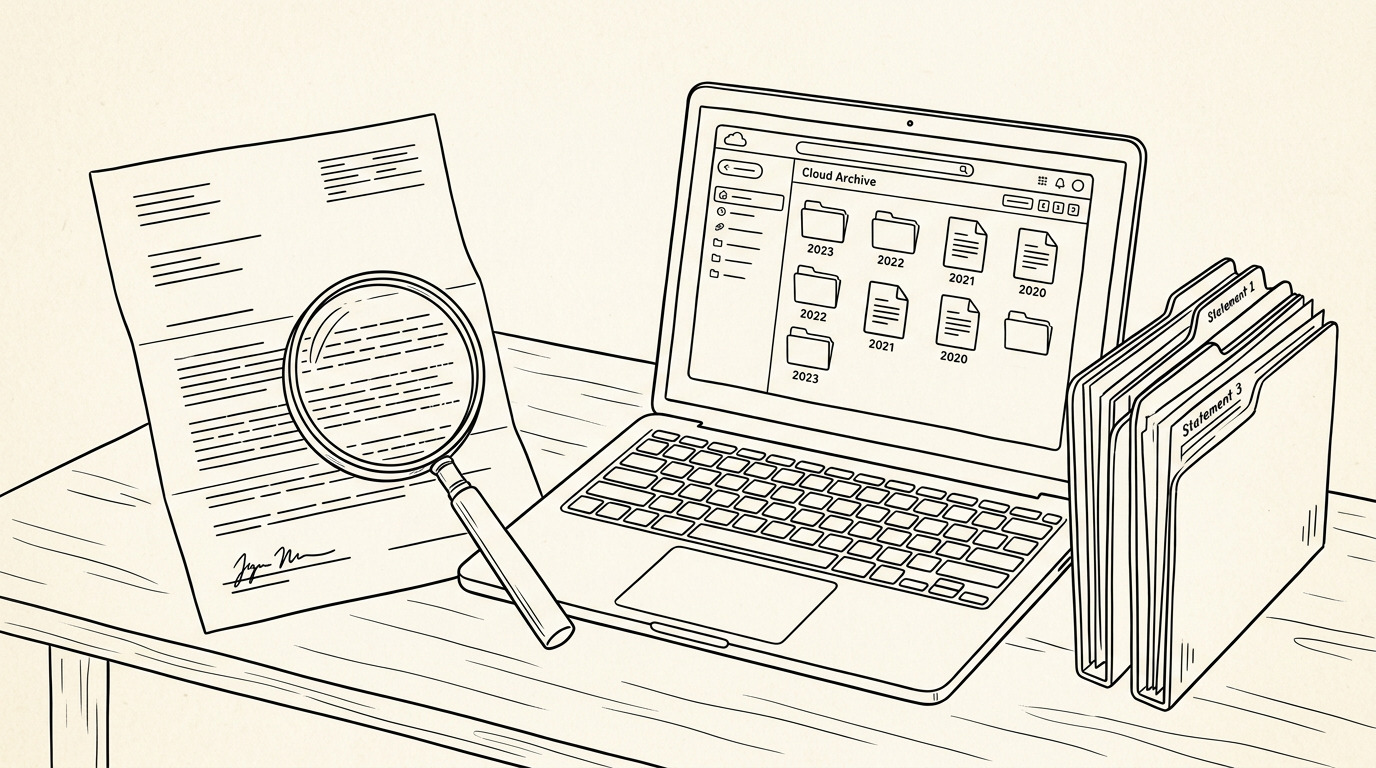
- Download 12-24 months of statements: Log into each bank account, navigate to Statements, and download 12-24 months of PDFs. The statements should be the most recent 12-24 months ending within 30 days of the application date.
- Combine into one PDF: Use a free tool (Smallpdf, ILovePDF) to combine the 12-24 statements into one PDF. Put the most recent statement first.
- Redact account numbers: Redact the middle digits of the account number. Leave the last 4 digits visible.
- Verify all pages are present: Open the combined PDF, verify all pages are present, the text is searchable, the pages are in order.
- Submit with the application: Upload or email the combined PDF with the loan application.
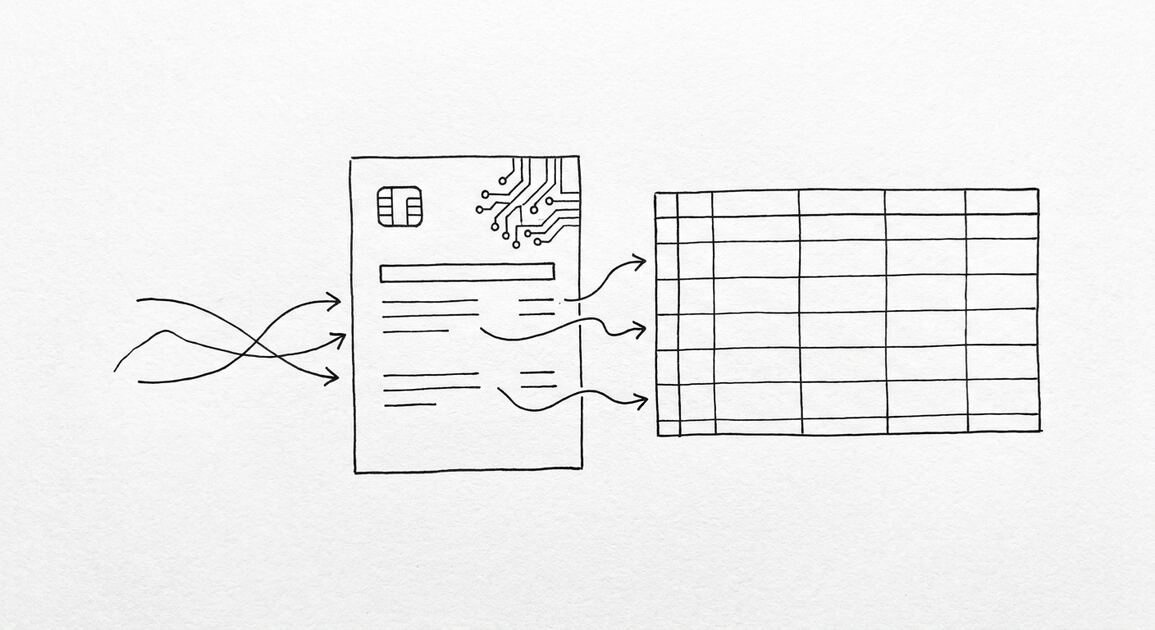
The preparation takes 1-2 hours. For the conversion step (which is helpful for any analysis but not required for the loan application), the bank statement converter handles the PDF-to-Excel step in 2-5 minutes per statement.
3 Common Confusions
3 confusions that borrowers have when navigating the bank statement loan process:
1. The bank issues the statement, the lender underwrites the loan. The borrower may think the bank is involved in the loan. The bank is only the source of the statement; the lender is the source of the loan. The two are separate entities.
2. The bank statement loan uses the deposits, not the balance. A borrower with $500K in the account may think the loan is based on the $500K. The loan is based on the average monthly deposits, not the balance. A borrower with $500K balance but only $10K/month in deposits does not qualify for a high loan amount.
3. The bank statement loan is not the only option. A borrower who qualifies for a traditional mortgage (based on tax returns) should take the traditional mortgage if possible. The bank statement loan is a fallback for borrowers who don’t qualify for the traditional product. The traditional mortgage has a lower rate and lower down payment.
The Right Approach for Most Borrowers
For 90% of home buyers, the right approach is the traditional mortgage: 2 years of tax returns, W-2 or self-employed income, and standard documentation. The bank statement loan is the right approach for the 10% of borrowers who don’t qualify for the traditional product due to high business expenses, 1099 income, or new business.
The decision: try the traditional mortgage first. If the borrower doesn’t qualify, apply for the bank statement loan. The bank statement loan is a fallback, not a default. The fallback has a higher rate, but the alternative (no mortgage) is worse.
A common failure mode bookkeepers report is treating this as a single operation rather than a chain of dependent steps. The temptation is to find a tool that ‘just works’ and stop investigating the mechanism. The result is a wrong-fix cycle: the tool gives partial output, the bookkeeper spends 30+ minutes troubleshooting, the fix is for the wrong step, and the same error recurs on the next statement. The fix: identify which step failed and apply the right intervention to that step.
Related Resources
| Resource | What You Get |
|---|---|
| How To Read A | See-also resource |
| Bank Statement Pdf Vs Paper | See-also resource |
| Bank Statement Loan Vs Traditional Mortgage | See-also resource |
| Self-Employed Mortgage Application | See-also resource |
| Mortgage Application Guide | See-also resource |
| Bank Statement Anatomy | See-also resource |
| Bank Statement Glossary | See-also resource |
For the traditional mortgage context, see the mortgage application bank statement guide. For the bank statement loan details, see the bank statement loan vs traditional mortgage reference. For the underlying statement structure, see the bank statement anatomy page. For the broader bank statement glossary, see the bank statement glossary.
For deeper understanding, see: How Routing Number Mechanism Deep.
From PDF to Excel in one click
Forget retyping line by line. Upload any bank statement, get a spreadsheet you can actually use. Your files are never stored, and you can test the converter with 3 free conversions.
Try it free