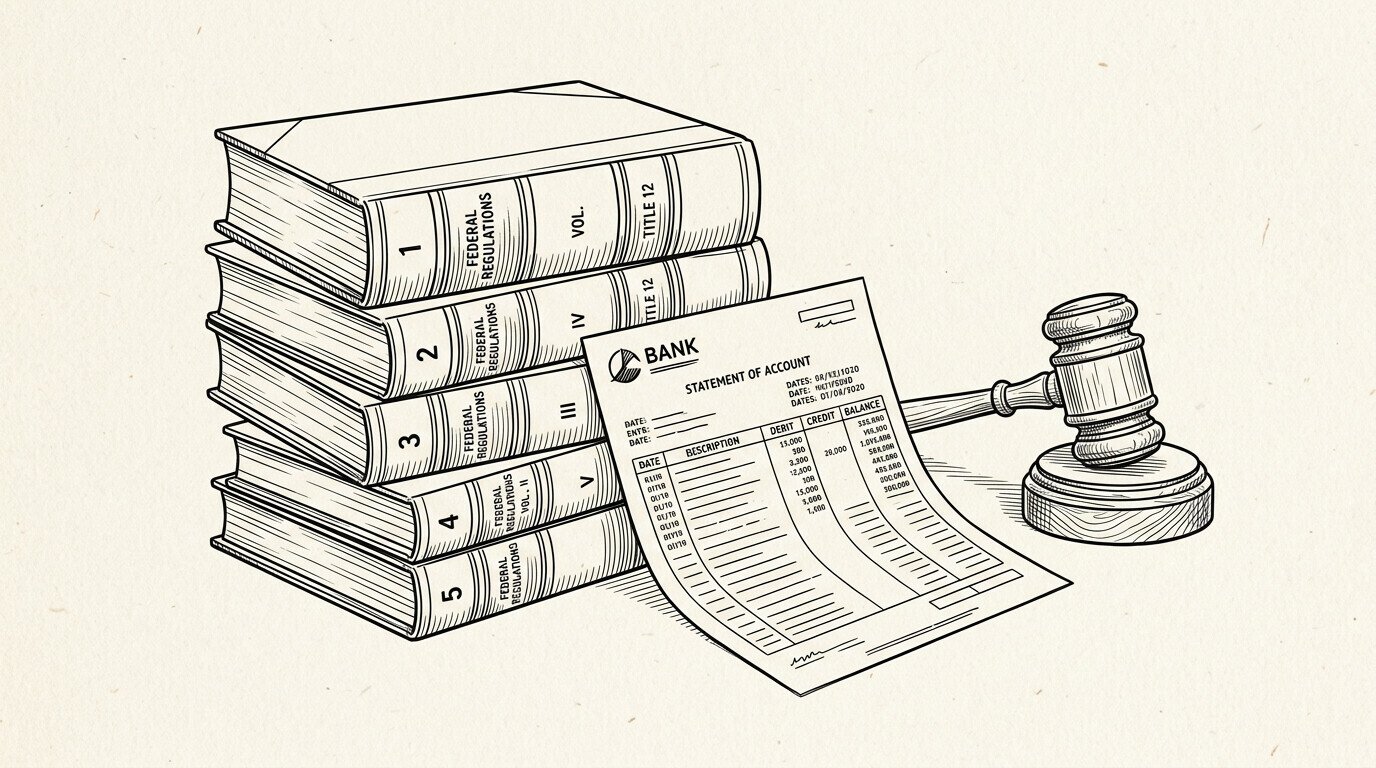

Eviction history screening works by pulling public court records and cross-checking them against the bank statement you submit with your rental application. Landlords look for past eviction filings, money judgments, and garnishment entries that show up as line items in your transaction history. Knowing what they can legally check, how long records last, and where Fair Housing limits apply keeps you from being unfairly denied.
An eviction on your record is not an automatic no. Many landlords weigh the circumstances, the age of the case, and whether you satisfied the judgment. But the screening only works if the criteria are applied the same way to every applicant.
Bank statements add a second layer. A garnishment or a judgment payment visible in your deposits or withdrawals can confirm or contradict what the court record shows, and landlords know to look for it.
Eviction records are public court filings accessible through the county clerk, typically retained for seven years, and landlords may consider them only when criteria are applied consistently and within Fair Housing and state-law limits.
Key facts. Eviction records are public court records accessible via the county clerk, with state-dependent retention of roughly seven years. The Fair Housing Act bars using eviction history to discriminate against protected classes. Landlords may consider eviction history but must apply criteria consistently. Bank statements can reveal eviction-related judgments through garnishment entries. Some states, including California and Oregon, limit the use of eviction records older than seven years.
Seven years is the typical retention window for eviction records, but state statutes can shorten or extend that period.
How landlords find eviction history
Landlords do not rely on a single database. They combine court records, tenant screening reports, and your own bank statement to build a picture of your rental past. Each source has gaps, so most screening companies pull from multiple counties.
County clerk records are the primary source. An eviction filing, a judgment for possession, and a money judgment all create paper trails that are public by default. A screening service aggregates these by name and date of birth, which means common names can produce false matches.
Because of that risk, a careful landlord verifies identity before treating a record as yours. If a screening report flags an eviction, you have the right to dispute it and request the underlying court document. Our guide on bank statements for rental applications covers how to keep your file clean.
Tenant screening reports add credit data, prior addresses, and sometimes prior landlord references. These reports fall under the Fair Credit Reporting Act, which means you must authorize them and receive an adverse action notice if they contribute to a denial.
What bank statements reveal about evictions
A bank statement does not list evictions directly. It lists money movement, and eviction-related money movement has a recognizable shape. Landlords trained in screening know the patterns.
Garnishment entries are the most direct signal. When a landlord wins a money judgment, they can garnish wages or bank accounts. A deposit or withdrawal labeled with a court or collection agency, or a sudden freeze followed by a reduced balance, tells the story.
Large one-time withdrawals around the time of a prior move can also suggest a settlement or a deposit paid under pressure. Late-rent patterns, repeated overdrafts, and sudden drops in balance round out the picture. None of these prove an eviction, but together they raise questions a landlord will ask about.
If you have satisfied a judgment, show the payoff. A bank statement showing the final payment, alongside a satisfaction of judgment from the court, closes the loop. Our guide on fixing a bank statement after denial walks through documentation.
Stat: California caps the use of eviction records older than seven years under state statute, and Oregon applies similar limits. Check your state before assuming a record has aged out.
Turn PDF Bank Statements Into Workable Spreadsheets
Your bank statement is a mess of numbers, but your books shouldn't be. Use our converter to get Excel, CSV, or QBO files — ready for QuickBooks.
Try It Free NowFair Housing limits on eviction screening
The Fair Housing Act does not forbid considering eviction history. It forbids applying that consideration in a way that discriminates against a protected class, or that has a discriminatory effect. The line between the two is where landlords get into trouble.
Disparate impact is the risk. A blanket policy of rejecting anyone with any eviction filing, regardless of outcome or age, can have a disproportionate effect on protected groups. HUD guidance warns against policies that are not narrowly tailored to a legitimate business interest.
The safer approach is a written policy with defined criteria: how old the eviction can be, whether a filing without a judgment counts, whether a satisfied judgment is treated differently, and whether an explanation is allowed. Apply it to every applicant and document the decision.
Consistency is the defense. If two applicants have similar eviction records and receive different outcomes, the difference must be documented and tied to a neutral factor such as income. The landlord screening guide covers building that policy.

State retention and lookback rules
How long an eviction stays visible depends on where you live. Most states follow the seven-year convention for consumer reporting, but several have shorter or longer windows, and some restrict reporting altogether.
California and Oregon limit the use of eviction records older than seven years. Other states seal records after dismissal or after a period of good tenancy. A dismissed eviction should not appear on a screening report at all, though errors happen.
If you believe a record is stale or inaccurate, request your screening report and dispute it with the reporting agency. The FCRA gives you the right to a free copy when an adverse action is taken, and the agency must investigate within thirty days.
Landlords should also know their lookback window. A policy that reaches back ten years may be legal in one state and unlawful in another. When in doubt, narrow the window and document the reason.
Handling an eviction on your record
An eviction record is a hurdle, not a wall. The applicants who get approved are the ones who disclose early, document the resolution, and show stable finances since. Silence invites a denial; a paper trail invites a conversation.
Gather the court documents: the filing, the judgment if any, and the satisfaction if paid. Add a short written explanation of the circumstances and what changed. Pair it with a bank statement showing consistent deposits and a healthy balance.
Offer a cosigner or a higher deposit where state law allows. Some landlords will accept a shorter lease or a larger security deposit in exchange for approving an applicant with a past eviction. Our guide to special cases covers these negotiations.
If you were evicted during a period of hardship that has since resolved, say so plainly and show the recovery in your statements. Landlords respond to evidence of change, not to apologies.
Landlord checklist for eviction screening
A defensible process is short and repeatable. Write it down, train anyone who screens, and keep the file. The goal is not to catch every bad tenant. It is to apply the same standard to every applicant.
- Obtain written authorization before pulling any consumer report.
- Pull court records from every county the applicant has lived in.
- Verify identity to avoid false matches on common names.
- Apply the same lookback window and criteria to every applicant.
- Cross-check the bank statement for garnishment or judgment entries.
- Document the reason for any denial and send an adverse action notice.
- Store and dispose of consumer report data per the FTC Disposal Rule.
For a printable version, see our landlord screening checklist PDF. For scenario-based examples, see rental applicant scenarios.
Frequently asked questions
Can a landlord deny me for an eviction that was dismissed? A dismissed eviction should not be treated as a judgment, but screening errors happen. Dispute the record and provide the dismissal order.
How long does an eviction stay on my record? Roughly seven years in most states, though California and Oregon limit the use of records older than seven years and some states seal dismissed cases.
Will a bank statement show an eviction? Not directly, but garnishment entries, judgment payments, and unusual withdrawals can signal one. Landlords cross-check statements against court records.
Can I redact my bank statement? You may redact account and routing numbers, but a landlord may require the full statement for income verification. See our privacy and redaction rights guide.
Do I have to disclose a past eviction? Disclosure is not always legally required, but disclosing early with documentation usually produces a better outcome than a surprise on the screening report.
Sources: HUD Fair Housing Act overview; CFPB rental housing consumer tools; FCRA (15 U.S.C. 1681); FTC Disposal Rule. This article is informational and not legal advice.
From PDF to Excel in one click
Forget retyping line by line. Upload any bank statement, get a spreadsheet you can actually use. Your files are never stored, and you can test the converter with 3 free conversions.
Try it free