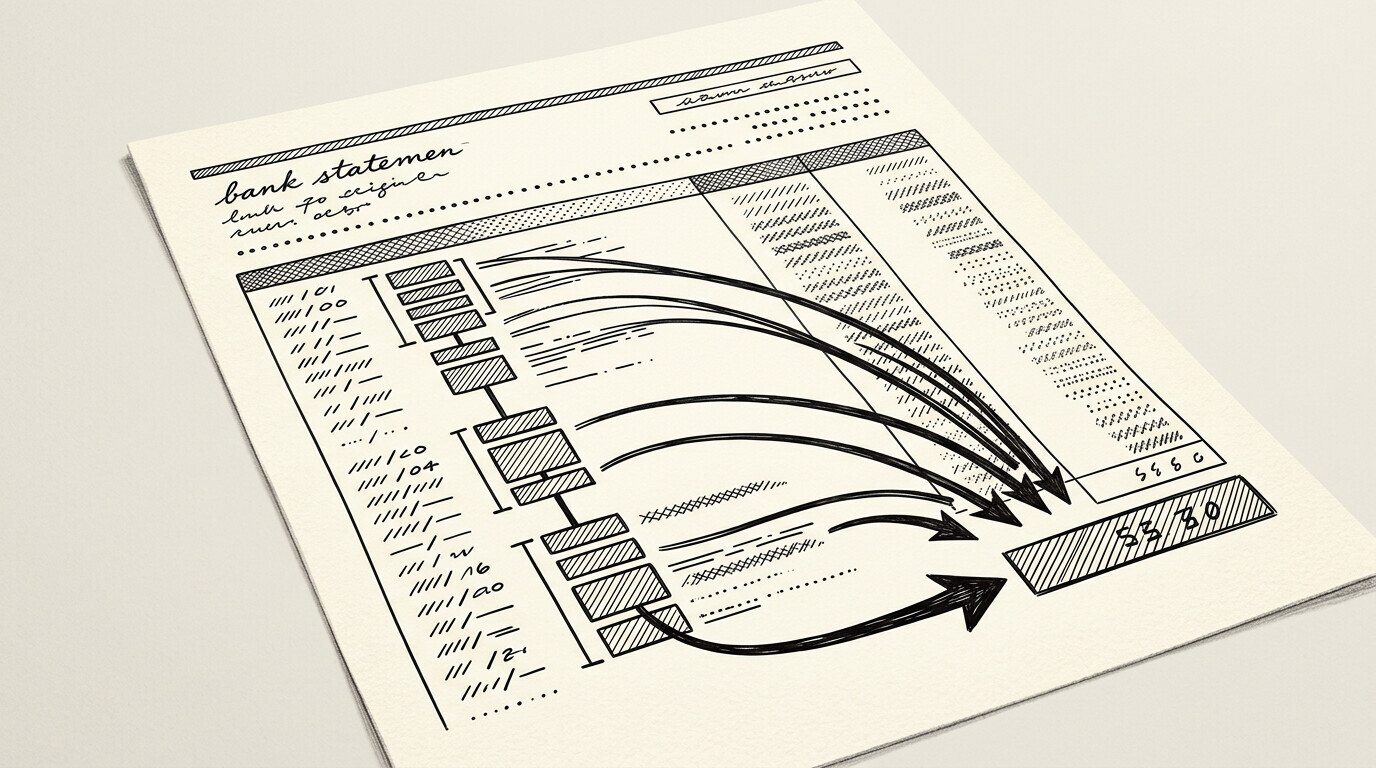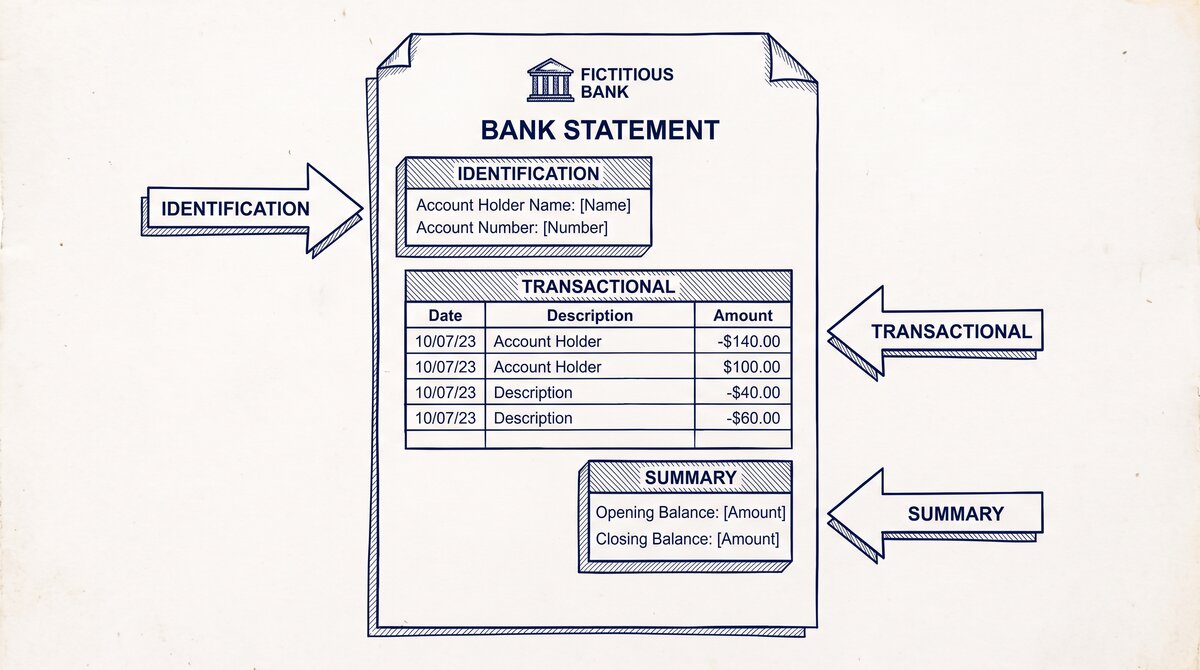

A bank statement charge is any fee your bank deducts from your account and records as a line item on your statement. The charge appears with a date, a description, and an amount, often shown as a negative number or labeled FEE or SVC CHG. Reading it correctly means matching the description to the fee schedule you received when you opened the account.
For a small business owner, these lines are easy to ignore because each one looks small. Ten dollars here and twenty five dollars there add up across a year, and a charge you do not recognize may signal a billing error or a service you no longer need. Understanding the common types keeps your books accurate and your costs under control.
The fee you understand is the fee you can reduce. The fee you ignore is the fee that keeps charging you.
Key facts. Common charges include monthly maintenance, overdraft, ATM, wire, and paper statement fees. Fees are disclosed in the account agreement and fee schedule you receive at opening. Many can be waived by meeting minimum balance or transaction requirements. Overdraft fees apply when a transaction exceeds the available balance. Reviewing statements monthly helps catch unexpected or duplicate charges early.
Monthly review is the cheapest control you have: one short pass through your statement each month catches fees before they repeat.
Common bank statement charges and what they mean
Most fees fall into a handful of categories. The exact names and amounts vary by bank and account type, so use your own fee schedule as the final reference. The table below covers the charges you are most likely to see.
| Charge | Typical trigger | Typical amount | How to reduce |
|---|---|---|---|
| Monthly maintenance fee | Balance below the minimum | $5 to $25 per month | Keep the minimum balance or switch to a no fee account |
| Overdraft fee | Transaction exceeds available balance | $25 to $35 per item | Link savings or opt out of overdraft coverage |
| ATM fee | Use of an out of network ATM | $2 to $5 per withdrawal | Use in network ATMs or choose a bank with rebates |
| Wire transfer fee | Sending or receiving a wire | $15 to $50 | Use ACH or consolidate transfers |
| Paper statement fee | Mailed paper statements | $2 to $5 per month | Switch to electronic statements |
| Foreign transaction fee | Purchase in a foreign currency | 1% to 3% of the transaction | Use a card with no foreign fee |
A bank statement lists each of these as a separate transaction, so the fee does not hide inside another charge. Watch for duplicate lines with the same date and amount, which can indicate a processing error rather than a legitimate fee.
Overdraft coverage and overdraft protection are not the same thing. Coverage lets the bank pay the item and charge a fee. Protection transfers funds from a linked savings account, usually for a smaller transfer fee or no fee at all. Choosing the right one depends on how often your balance runs close to zero.
Why the charges appear
Fees are not arbitrary. They are disclosed in the account agreement and the fee schedule provided when the account is opened. By signing or accepting the terms, you agree to the listed charges. Banks must also give advance notice before changing fees or adding new ones, which is why you sometimes receive a notice in the mail or in your online banking inbox.
Some charges are conditional. A monthly maintenance fee may be waived if you keep a minimum balance, receive direct deposits, or make a set number of transactions. The same account can carry different costs for different customers depending on how they use it. Reading the conditions matters as much as reading the price.
Business accounts often have more fee categories than personal accounts, including cash handling, deposit item limits, and analyzed account charges. If you recently opened a business account, compare the first two statements against the fee schedule so you know which conditions you are meeting.
Federal rules require banks to disclose fees in a standardized format for consumer accounts, and to notify you before changing them. Business accounts are governed more by contract, so read the agreement carefully and ask questions before signing.
Turn That PDF Into a Spreadsheet in Minutes
You've seen how to do it manually — now let the tool handle the heavy lifting. Upload your bank statement and get Excel, CSV, or QBO in a few clicks.
Try It FreeHow to read a charge on your statement
Every charge line has the same basic parts. The date shows when the fee posted, which may differ from when the triggering event happened. The description explains the fee in abbreviated form. The amount shows what was deducted. The running balance updates after the charge. Checking all four parts prevents confusion.
Common abbreviations include SVC CHG for service charge, MAINT FEE for maintenance fee, OD FEE for overdraft fee, ATM FEE for ATM charge, and WIRE FEE for wire transfer. If an abbreviation does not match anything on your fee schedule, call the bank and ask for the full description before assuming it is an error.
The running balance is your verification tool. Each charge should reduce the balance by exactly its amount. If the math does not work, you have either missed a line or found an error. Reconciling the balance after every charge is the fastest way to catch a mistake.
When you export your statement to a spreadsheet, the charge lines become sortable and filterable. You can group by description and total each fee type for the year, which is far easier than scanning pages by hand. Tools that convert a bank statement to Excel or convert a bank statement to CSV make this review routine instead of tedious.
How to reduce or avoid bank charges
Start with the conditions on your account. If a maintenance fee can be waived by a minimum balance, keep a small buffer above that threshold. If direct deposit qualifies, route payroll or client payments through the account. If a transaction count qualifies, spread activity across the month rather than clustering it.
Opt out of overdraft coverage if you prefer a declined transaction over a fee. Link a savings account for overdraft protection, which usually costs less than a standard overdraft fee. For ATM use, choose a bank that refunds out of network fees or plan withdrawals around in network machines.
Review your account annually. Banks change fee schedules, and an account that fit your business two years ago may no longer be the best option. Ask your banker to compare your current account against newer products, and be willing to switch if the math favors it. Even a single waived fee per month is worth the conversation.
Negotiation works more often than people expect. If you have been a customer for years and keep a healthy balance, ask for a fee waiver or a better account tier. The worst answer is no, and the request costs nothing.
What to do about unexpected or duplicate charges
Review your statement monthly and flag anything you do not recognize. Compare the charge against your fee schedule first. If it is not listed, or the amount differs from the schedule, contact the bank promptly and ask for an explanation in writing.
Keep records of the charge, your statement, and all correspondence. For consumer accounts, federal rules generally give you sixty days to report unauthorized electronic transfers. Business account terms vary by agreement, so check your specific terms and move quickly either way.
If the bank does not resolve the issue, you can escalate to a regulator such as the Consumer Financial Protection Bureau. The process is straightforward, and a formal complaint often speeds up a response. For questions about deposit insurance and bank practices, the FDIC is another useful reference.
Do not confuse a fee dispute with an unauthorized transaction claim. A fee you disagree with is a service issue. A charge you did not authorize is a fraud issue. The bank handles them through different channels and timelines, so state clearly which one you are reporting.
If you already know how to get a bank statement from your bank, pull the prior three months as well. A pattern across several statements is stronger evidence than a single charge, and it helps the bank identify a systemic error.
Turning statement charges into clean books
Charges affect both cash flow and expense categorization. A maintenance fee is an operating expense, an overdraft fee is a financing cost, and a wire fee may belong to a specific client or project. Categorizing them correctly keeps your profit and loss statement accurate.
Set up a monthly routine: download the statement, export it, filter for fees, and post them to the right expense accounts. Ten minutes a month prevents a year end surprise and gives you data to negotiate with your bank.
Exporting your statements makes this work fast. A bank statement to Excel converter turns PDF lines into rows you can filter, sum, and reconcile against your general ledger. Once the charges are in a spreadsheet, you can total fees by type and spot trends before they become a problem.
Consistent review, clear categorization, and a quick export routine turn bank statement charges from a mystery into a managed cost. The goal is not zero fees, which is rarely realistic, but fees that are understood, expected, and as low as your account structure allows.
From PDF to Excel in one click
Forget retyping line by line. Upload any bank statement, get a spreadsheet you can actually use. Your files are never stored, and you can test the converter with 3 free conversions.
Try it free