
A 2-month bank statement for a mortgage application is a 4-document package, not a single file. Most applicants walk into the lender with a stack of PDFs and call it done. The underwriter then asks for the same statements in Excel, a written explanation for any $1,000+ deposit, and a source-of-funds letter for the down payment. The 4-document checklist closes that loop in one shot.
The whole prep runs 30-60 minutes per statement once you know the workflow. The longest part is waiting for your bank’s download page to load. The rest is converting, organizing, and explaining. This page covers the 4 documents, the order to build them, and the underwriter rules each one has to satisfy.
What the underwriter is actually checking:
- Source of funds: every dollar in the down payment has to be traceable to a named, documented account
- Income stability: pay cycles match the W-2 or 1099 reported on the application
- Asset seasoning: large deposits over $1,000 need a paper trail older than 60 days
- Recurring debt: auto loans, student loans, and credit card minimums must be visible in the transactions
The Fannie Mae and Freddie Mac selling guide (B3-4.3-01) sets the 2-month minimum for traditional conforming loans. FHA follows the same rule through its handbook 4000.1. Jumbo lenders often extend to 3-6 months on loans over the conforming limit (2026 cap: $832,750 in most counties, $1,249,125 in high-cost areas).
Why 2 Months, Not 3 or 6
Two months is the floor for a conventional mortgage and the most common ask for FHA, VA, and most jumbo lenders. The window is not arbitrary: it covers at least two full pay cycles for a W-2 employee (most pay biweekly, so 2 months = 4 paychecks) plus the end-of-month balance the underwriter needs to verify.
The underwriter needs the most recent 2 months, not any 2 months. Pulling a random June and July when you applied in October is a denial trigger. The statements must be continuous (no gaps), and the closing date on the last statement must fall within 60 days of the application date.
Self-employed borrowers usually need more: 12-24 months of personal and business statements, plus 2 years of tax returns. The 2-month rule is for the asset-reserves portion, not the income-verification portion. If you have any non-W-2 income on the application, expect the lender to ask for the longer window in addition to the 2-month asset pull.
The 4-Document Checklist
Every mortgage bank statement package is built from the same four documents. Miss one and the underwriter sends the file back. Bundle them in this order so the underwriter can read top-down without flipping back.
- The 2-month bank statements themselves – all pages, all accounts, official downloads (not screenshots)
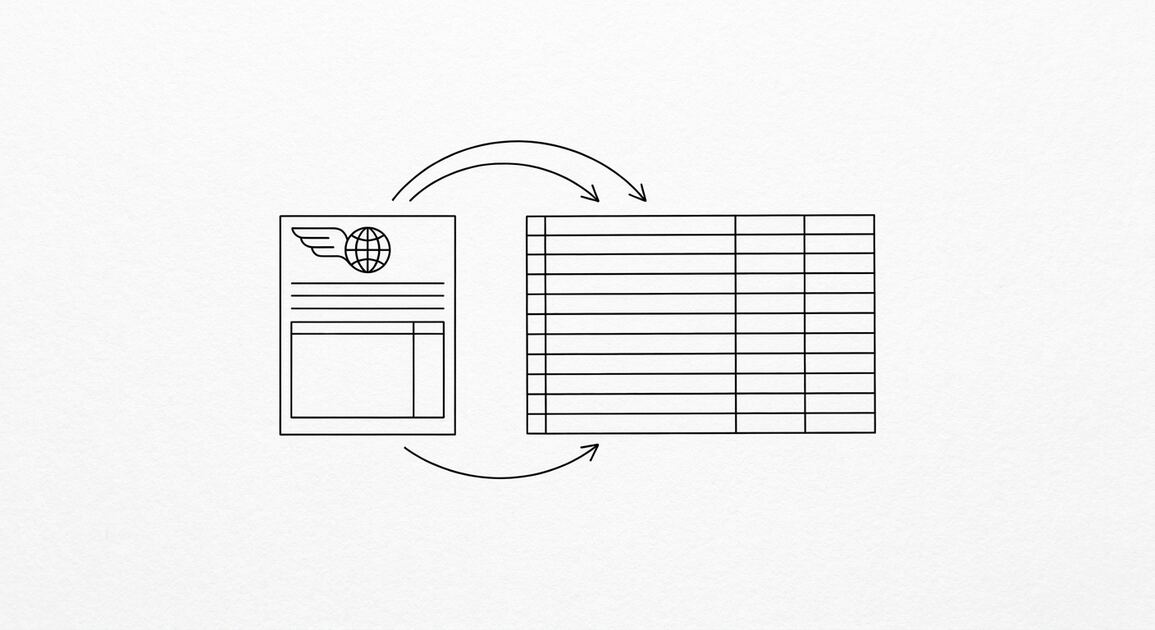
- The same statements converted to Excel, CSV, or QBO – clean, machine-readable, one row per transaction
- Large-deposit explanations – a one-page memo for every deposit over the lender’s threshold (usually $1,000, sometimes $2,500)
- A source-of-funds letter – a signed letter tying the down payment and reserves to the accounts on the statements
The first two are non-negotiable. The third is conditional: if you had no large deposits in the 2-month window, you don’t need it. The fourth is required any time the down payment is more than what the statements can explain on their own. Most borrowers need all four.
Turn PDF Bank Statements Into Workable Spreadsheets
Your bank statement is a mess of numbers, but your books shouldn't be. Use our converter to get Excel, CSV, or QBO files — ready for QuickBooks.
Try It Free NowStep 1: Download the 2 Months of Statements
Log into each account you plan to use for the down payment or reserves. The lender will ask for every account that shows up on the application, even if it isn’t the one funding the loan. Pull a 2-month statement from each, and make sure you grab the official PDF (not a screenshot, not a print-to-PDF of the web view).
- Chase: chase.com > Accounts > Statements & documents > pick the month > download PDF
- Bank of America: bankofamerica.com > Accounts > Statements & documents > pick month > PDF
- Wells Fargo: wellsfargo.com > Accounts > Statements & documents > monthly statement PDF
- Capital One: capitalone.com > Accounts > Statements > download PDF
- Credit unions: most follow the same pattern, but some mail paper statements only
If you are applying jointly, both applicants need the same downloads from every account on the application. Joint accounts count once (one statement, both names), but each person’s individual accounts need their own 2-month download. For the full joint-account workflow, see the joint bank statement to Excel workflow.
Common download mistakes that delay approvals:
- Using a screenshot of the web dashboard instead of the official PDF
- Skipping a page – the transaction table often starts on page 2
- Pulling a partial period (March 1-15 instead of the full March 1-31)
- Forgetting investment or brokerage accounts that show up on the asset list
Step 2: Convert Each Statement to Excel, CSV, or QBO
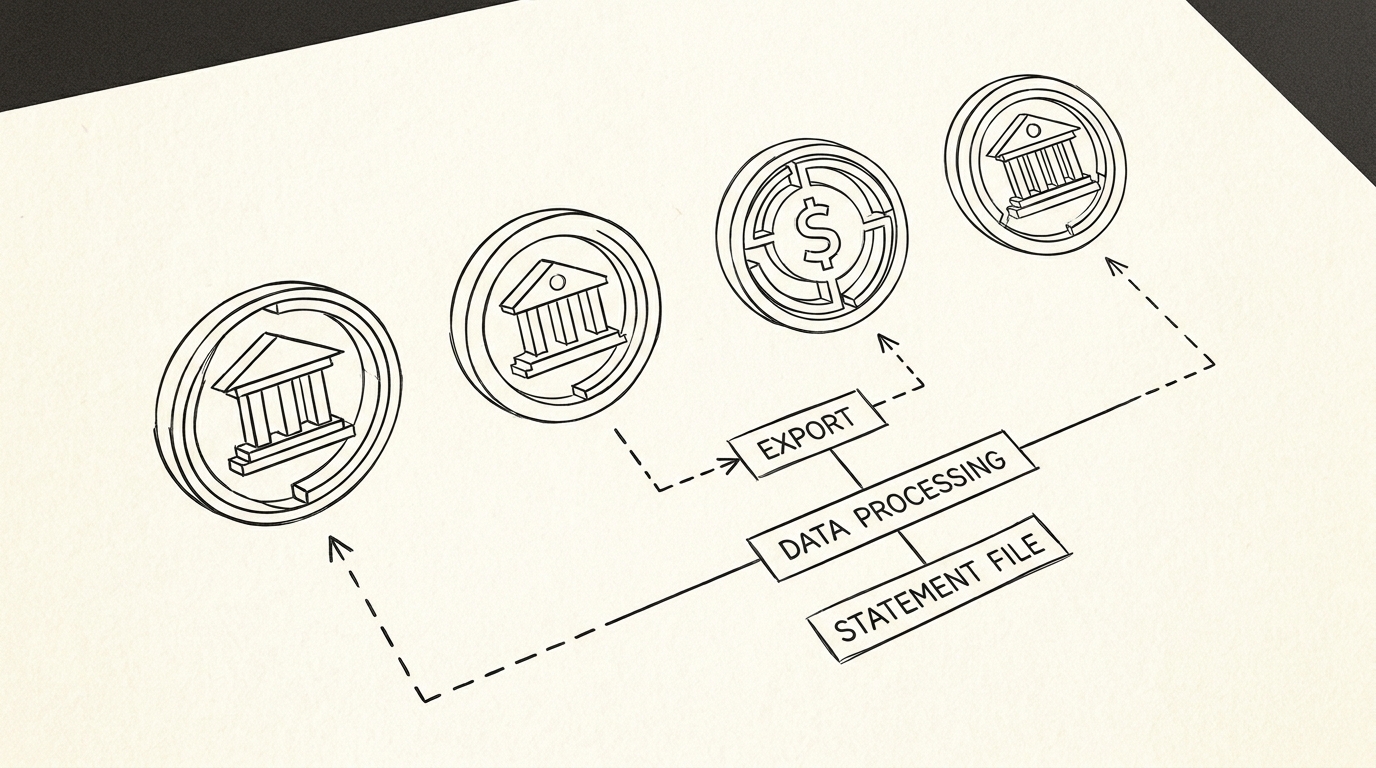
The PDF gets read by the underwriter. The Excel version gets read by the lender’s automated asset verification system (Plaid, Yodlee, or an internal parser) and by the underwriter’s calculator. Both have to show the same closing balance to the penny.
A browser-based PDF-to-Excel converter handles this in 30-60 seconds per statement. Upload the PDF, wait for the extraction, and download the .xlsx file. The output has date, description, amount, and balance columns. Some converters also output CSV or QBO for QuickBooks-compatible lenders.
- Open the .xlsx and check the first and last transaction match the PDF exactly
- Confirm the closing balance in the spreadsheet equals the balance printed on the last page of the PDF
- Spot-check 3-5 random transactions by date and amount
- Make sure no rows were dropped or duplicated (compare transaction count to the PDF)
If anything is off, re-run the conversion with a different tool or fix the spreadsheet by hand. Lenders reject submissions where the converted file does not match the PDF. For a deeper walkthrough of the download-convert-verify flow, the mortgage application bank statement guide covers the full 5-phase process.
Step 3: Explain Anything Unusual
Underwriters flag deposits that look out of place. The most common flag is any single deposit over $1,000 that does not match a regular pay cycle, transfer, or known source. The fix is a one-page memo per flagged deposit.
- Date and exact amount of the deposit
- Source of the funds (gift, bonus, reimbursement, transfer from another account)
- Supporting document (gift letter, employer bonus statement, screenshot of the originating transfer)
- Your signature and the date of the letter
Gift funds get a separate letter called a gift letter, signed by both the donor and the recipient. The gift letter has to state the funds are not a loan and the donor has no ownership interest in the property. Lenders also want a paper trail showing the money in the donor’s account for at least 60 days before the transfer.
Reimbursements and expense repayments are usually one line in the memo. Example: “On April 12, my employer reimbursed $3,200 for travel expenses from a March client engagement.” Attach the reimbursement approval email or the expense report.
Skip the memo only if the deposit is from a recurring source that already appears on the statement, like a regular ACH from your employer or a transfer between your own accounts.
Step 4: Bundle the 4 Documents for Submission
Package the four documents in a single PDF or zip file in this order: PDF statements first, converted files second, large-deposit memos third, source-of-funds letter last. Label each file with the account name and the statement period (for example: “Chase Checking – Sept 2026.pdf”).
The source-of-funds letter has a standard shape:
To the underwriter: The $87,500 down payment and $14,200 in reserves referenced on this mortgage application are sourced from Chase Premier Checking (ending 4421) and the Fidelity brokerage (ending 8810). Both accounts are held in the name of the applicant.
These funds have been on deposit for more than 60 days and are not borrowed. Supporting bank statements and brokerage statements for the most recent 2 months are attached.
Signed: [applicant name], [date].
Sign and date the letter. The lender will return the whole package if the letter is missing a signature, the date, or the account reference. Some lenders have their own source-of-funds form – use theirs if they sent one, and skip the custom letter.
Total bundle is 4-8 pages per account (2-3 pages of PDF statement, 1-2 pages of converted spreadsheet, 1 page per large-deposit memo, 1 source-of-funds letter). The file is ready to upload to the lender portal or email to the loan officer.
Lenders want 2 months of statements in a clean format. Try the converter on your own bank statement first to see the layout.
Reading rail and MCC labels on a mortgage packet
Mortgage underwriting commonly scrutinizes cash advances and large deposits on bank statements. The transaction codes that signal these flows are ACH debits for cash-equivalents, and Zelle payments for transfer rails. See the complete US bank payment rails guide for what each label means.
For credit-card statement sections that may accompany a mortgage packet, see the complete MCC guide for what each merchant code signals, especially categories like restaurants, cash advances, and crypto.
Beyond the 4-document checklist
A 2-month bank statement packet for a mortgage application typically requires more than just four documents once underwriter scrutiny begins. The applicant should be ready to explain any large deposit over $500-$1,000, any cash-equivalent or transfer line that does not match payroll frequency, and any fluctuation in ending balance that exceeds 10 percent of the average balance.
Underwriters pull both credit-card and bank statements when evaluating a self-employed borrower. Credit-card statements show discretionary spending and debt service. Bank-account statements show cash flow. The combined view determines debt-to-income and reserve liquidity.
For the consolidated reading, see the complete MCC guide for what merchant category codes surface on credit-card statements, and the complete US bank payment rails guide for what ACH and wire codes on bank statements mean.
Easy Statement Sheet converts both credit-card and bank-account statements to a clean four-column output that includes the merchant category code label inline within the description (on credit-card statements) or the running balance column (on bank-account statements). The conversion is free for the first three statements of any kind.
What underwriters actually look for
Beyond the four standard documents, an underwriter pulls credit reports and sometimes alternative-data sources. The bank-statement portion is corroborated against those sources. If the application shows monthly income of $12,000 but the bank statements show irregular income around $9,000, the discrepancy is a flag.
Most underwriter focus areas on a bank statement: cash flow consistency (does income match the stated compensation?), reserve liquidity (does the borrower hold 2-3 months expenses in liquid accounts?), and unusual activity (large deposits, ATM cash advances, recurring subscriptions).
The full payment rail layer matters because lender logic differentiates ACH from wire. An inbound wire from a customer looks different from an inbound ACH. Self-employed applicants usually have higher ACH mix because their customers are more likely to pay by ACH than wire.
For the consolidated reading, see the complete MCC guide for what merchant category codes surface on credit-card statements, and the complete US bank payment rails guide for what ACH and wire codes on bank statements mean.
Working with self-employed applicants
Self-employed applicants usually show a different income pattern than W-2 applicants on a 2-month bank statement. The cash flow varies month to month instead of arriving in two predictable semi-monthly payroll deposits.
Lenders underwriting self-employed applicants usually ask for a 2-year tax return alongside the bank statements. The bank statement provides point-in-time validation; the tax return provides annualized validation. Both must align.
Common lender questions for self-employed applicants: Are you paying yourself consistently? Are business expenses separate from personal expenses? Are there large deposits that may be income from unreported sources? Each question has a corresponding line on the statement that needs explanation.
Easy Statement Sheet converts the bank statement to four columns. The underwriter can then sort by Date, Description, Amount, or Balance to find every questionable line. The conversion is free for the first three statements, no card required.
Turn That PDF Into a Spreadsheet in Minutes
You've seen how to do it manually — now let the tool handle the heavy lifting. Upload your bank statement and get Excel, CSV, or QBO in a few clicks.
Try It Free